Argentina Insurance Telematics Market Size & Growth Rate (2026-2032)
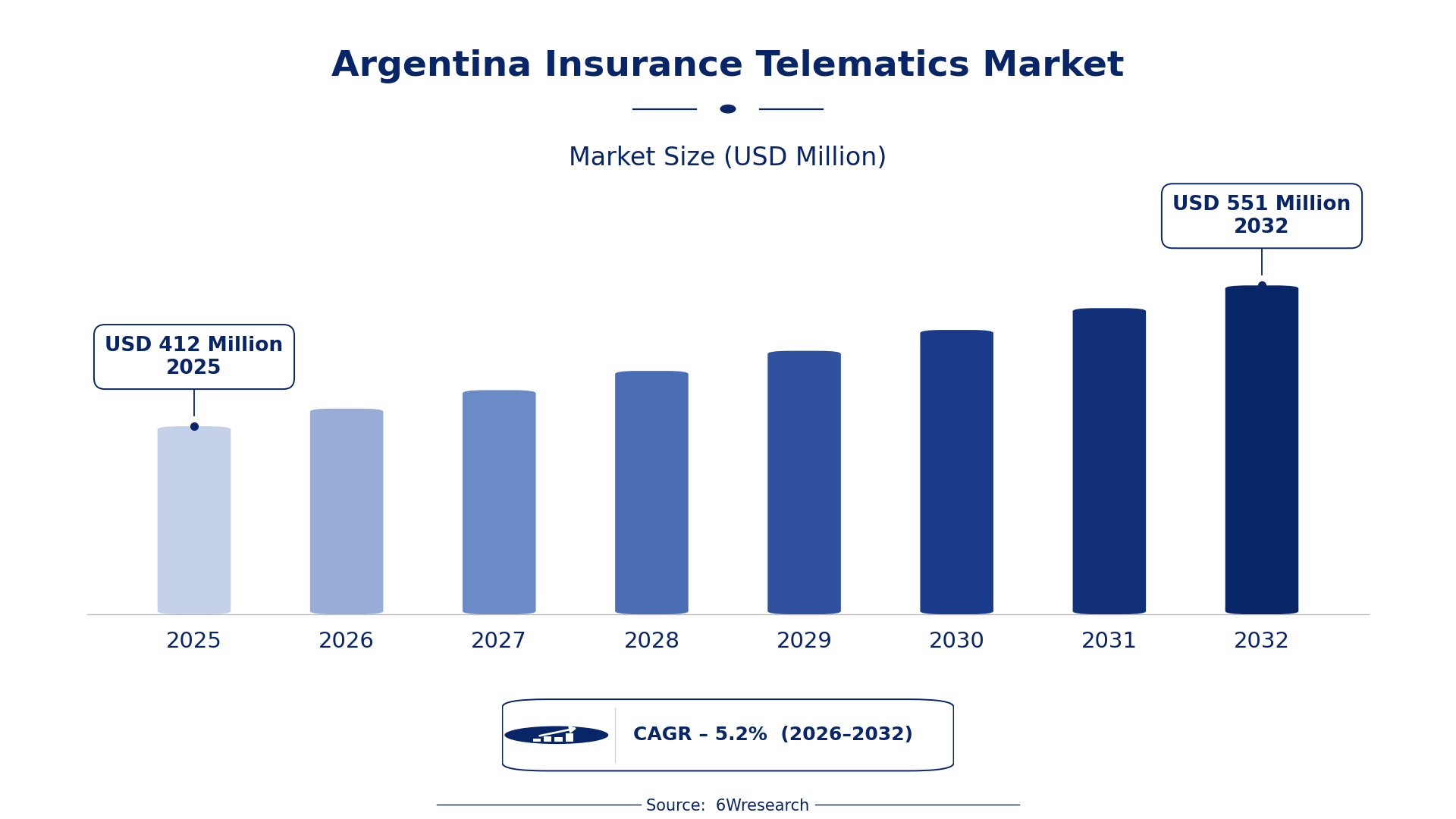
The Argentina Insurance Telematics Market was estimated at USD 412 Million in 2025 and is projected to reach USD 551 Million by 2032, growing at a CAGR of 5.2% from 2026 to 2032.
Argentina Insurance Telematics Market Synopsis
The Argentina Insurance Telematics Market is witnessing significant momentum, driven by advancements in connected vehicle technologies and an increasing demand for personalized insurance solutions. Insurers are increasingly utilizing telematics data to refine their risk assessment processes, creating a more tailored approach to policy pricing.
As the automotive sector embraces connected and autonomous vehicle technologies, the scope for telematics-based insurance offerings continues to expand. Consumers are gravitating toward transparency and flexibility, making usage-based insurance (UBI) a compelling choice for many drivers.
Argentina Insurance Telematics Market Year-wise Growth Rate and Key Drivers
This graph illustrates the annual growth rates of the Argentina Insurance Telematics Market from 2021 to 2032, highlighting a steady upward trajectory and projected expansion over the forecast period.
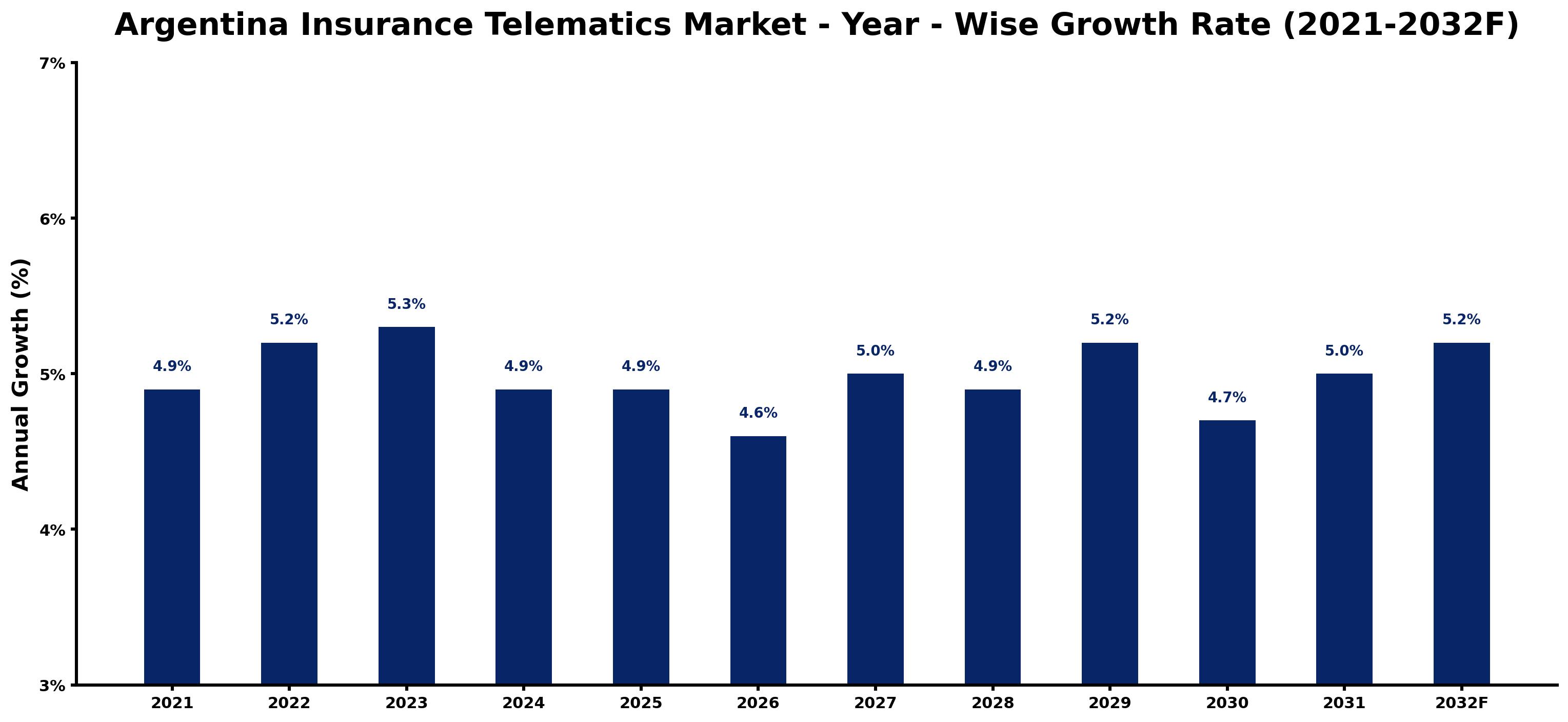
The table below presents the year‑wise growth rates along with the key drivers influencing the market
| Year | Growth Rate | Major Drivers |
| 2021 | 4.9% | Adoption of driving behavior analytics by insurers. |
| 2022 | 5.2% | Regulatory support for usage-based insurance models. |
| 2023 | 5.3% | Increased smartphone penetration driving telematics usage. |
| 2024 | 4.9% | Rising consumer demand for personalized insurance solutions. |
| 2025 | 4.9% | Government initiatives promoting road safety technologies. |
| 2026 | 4.6% | Partnerships between insurers and tech startups growing. |
| 2027 | 5.0% | Increased awareness of telematics benefits among drivers. |
| 2028 | 4.9% | Telematics data integration with traditional insurance processes. |
| 2029 | 5.2% | Local startups enhancing telematics software capabilities. |
| 2030 | 4.7% | Growth in vehicle connectivity boosting telematics adoption. |
| 2031 | 5.0% | Consumer preference shifting towards data-driven pricing models. |
| 2032 | 5.2% | Availability of fleet telematics optimizing commercial insurance. |
Note: Market size estimations and growth projections presented in this report are based on 6Wresearch's proprietary forecasting methodology, utilizing the latest available industry data, government publications, and primary research inputs.
Argentina Insurance Telematics Market Key Takeaways
Below are some of the specific key takeaways from the market, including:
- The growing adoption of telematics technology is enhancing risk assessment and pricing accuracy for insurers.
- Regulatory frameworks are evolving to support the safe use of telematics data while protecting consumer privacy.
- Consumers are increasingly favoring telematics-based insurance solutions for their transparency and adaptability.
- Technological advancements in data analytics are driving innovation in insurance telematics offerings.
- Market growth is further fueled by the rising prevalence of connected cars and their integration into everyday life.
Evaluation of Restraints in Argentina Insurance Telematics Market
Privacy concerns remain a significant barrier for the Argentina Insurance Telematics Market. With telematics devices gathering sensitive information about driving behavior, there is an ongoing apprehension regarding data security. Insurers face the challenge of balancing the benefits of personalized insurance solutions with the need for consumer trust.
Regulatory hurdles add another layer of complexity, as companies must navigate strict data protection laws. Efforts to enhance consumer education about the advantages of telematics are crucial for overcoming these barriers and increasing adoption rates.
Argentina Insurance Telematics Market Trends
The shift toward connected vehicles is reshaping the insurance telematics market. Insurers are increasingly leveraging data analytics to provide real-time feedback to drivers, encouraging safer driving habits and reducing claims. Additionally, the demand for customizable insurance products is prompting insurers to refine their offerings, making UBI more appealing.
on top of that, advancements in mobile technology are enabling more consumers to engage with telematics solutions directly, enhancing the user experience. As the automotive industry accelerates toward automation, the intersection between telematics and insurance will only deepen.
Argentina Insurance Telematics Market Opportunities
There are substantial growth opportunities within the Argentina Insurance Telematics Market, particularly in developing tailored insurance products that cater to specific consumer needs. As the market matures, insurers can explore partnerships with automotive technology firms to enhance their offerings.
The expansion of smart city initiatives presents a further avenue for growth, as integrated urban mobility solutions can be linked to telematics-based insurance models. By embracing innovation and consumer engagement, insurers can position themselves favorably in this evolving market.
Government Initiatives in the Argentina Insurance Telematics Market
Government policy plays a crucial role in shaping the Argentina Insurance Telematics Market. Regulatory frameworks are designed to ensure consumer protection while fostering innovation in telematics solutions. The focus on data privacy and security is paramount, as these policies are developed to protect sensitive information while promoting the growth of telematics-based insurance programs.
- A regulatory framework implemented in 2025 emphasizes consumer transparency regarding telematics data collection and usage.
- Ongoing initiatives include collaborations between government agencies and insurance companies to educate consumers about the benefits of telematics.
- A planned public-private partnership aims to enhance the infrastructure supporting connected vehicle technologies by 2028.
- Recent legislation mandates stricter compliance with data protection laws, affecting how insurers handle telematics data.
- Upcoming initiatives are expected to focus on promoting innovation in telematics solutions while ensuring consumer rights are upheld.
Future Insights of the Argentina Insurance Telematics Market
Looking ahead to 2026-2032, the Argentina Insurance Telematics Market is expected to thrive, driven by continued technological advancements and shifting consumer expectations. Insurers will likely invest in sophisticated data analytics tools to refine their risk assessment processes further.
The integration of telematics with other automotive technologies will create new opportunities for product development, enhancing the overall consumer experience. As safety and personalization become paramount, the market will adapt to meet these evolving demands.
Argentina Insurance Telematics Market Latest Developments
Recent activity in the Argentina Insurance Telematics Market indicates a period of dynamic growth and innovation. Insurers are focusing on enhancing their telematics offerings to attract a broader consumer base while addressing privacy concerns more effectively.
- A major technology vendor launched a new telematics platform in Q1 2025, enabling insurers to offer more personalized products.
- An initiative began in mid-2025 to integrate telematics data into existing insurance frameworks, enhancing risk assessment capabilities.
- By late 2025, a pilot program was completed that tested the effectiveness of telematics in promoting safer driving habits among policyholders.
- Ongoing collaborations between insurers and automotive manufacturers are focused on improving connectivity features in vehicles.
- A rollout of a consumer awareness campaign is planned for early 2026 to educate drivers about the benefits of telematics-based insurance.
Argentina Insurance Telematics Market - Key Attractiveness of the Report
- 10 Years of Market Numbers
- Historical Data Starting from 2022 to 2025
- Base Year: 2025
- Forecast Data until 2032
- Key Performance Indicators Impacting the Market
- Major Upcoming Developments and Projects
Key Highlights of the Report:
- Argentina Insurance Telematics Market Outlook
- Market Size of Argentina Insurance Telematics Market, 2025
- Forecast of Argentina Insurance Telematics Market, 2032
- Historical Data and Forecast of Argentina Insurance Telematics Revenues & Volume for the Period 2022-2032F
- Argentina Insurance Telematics Market Trend Evolution
- Argentina Insurance Telematics Market Drivers and Challenges
- Argentina Insurance Telematics Price Trends
- Argentina Insurance Telematics Porter's Five Forces
- Argentina Insurance Telematics Industry Life Cycle
- Historical Data and Forecast of Argentina Insurance Telematics Market Revenues & Volume By End User for the Period 2022-2032F
- Historical Data and Forecast of Argentina Insurance Telematics Market Revenues & Volume By Small for the Period 2022-2032F
- Historical Data and Forecast of Argentina Insurance Telematics Market Revenues & Volume By Medium Enterprises for the Period 2022-2032F
- Historical Data and Forecast of Argentina Insurance Telematics Market Revenues & Volume By Large Enterprises for the Period 2022-2032F
- Historical Data and Forecast of Argentina Insurance Telematics Market Revenues & Volume By Deployment Type for the Period 2022-2032F
- Historical Data and Forecast of Argentina Insurance Telematics Market Revenues & Volume By Cloud for the Period 2022-2032F
- Historical Data and Forecast of Argentina Insurance Telematics Market Revenues & Volume By On-Premises for the Period 2022-2032F
- Historical Data and Forecast of Argentina Insurance Telematics Market Revenues & Volume By Organization Size for the Period 2022-2032F
- Historical Data and Forecast of Argentina Insurance Telematics Market Revenues & Volume By Small and Medium Enterprises (SMEs) for the Period 2022-2032F
- Historical Data and Forecast of Argentina Insurance Telematics Market Revenues & Volume By Large Enterprises for the Period 2022-2032F
- Argentina Insurance Telematics Import Export Trade Statistics
- Market Opportunity Assessment By End User
- Market Opportunity Assessment By Deployment Type
- Market Opportunity Assessment By Organization Size
- Argentina Insurance Telematics Top Companies Market Share
- Argentina Insurance Telematics Competitive Benchmarking By Technical and Operational Parameters
- Argentina Insurance Telematics Company Profiles
- Argentina Insurance Telematics Key Strategic Recommendations






































