Argentina Microlearning Market Size & Growth Rate (2026-2032)
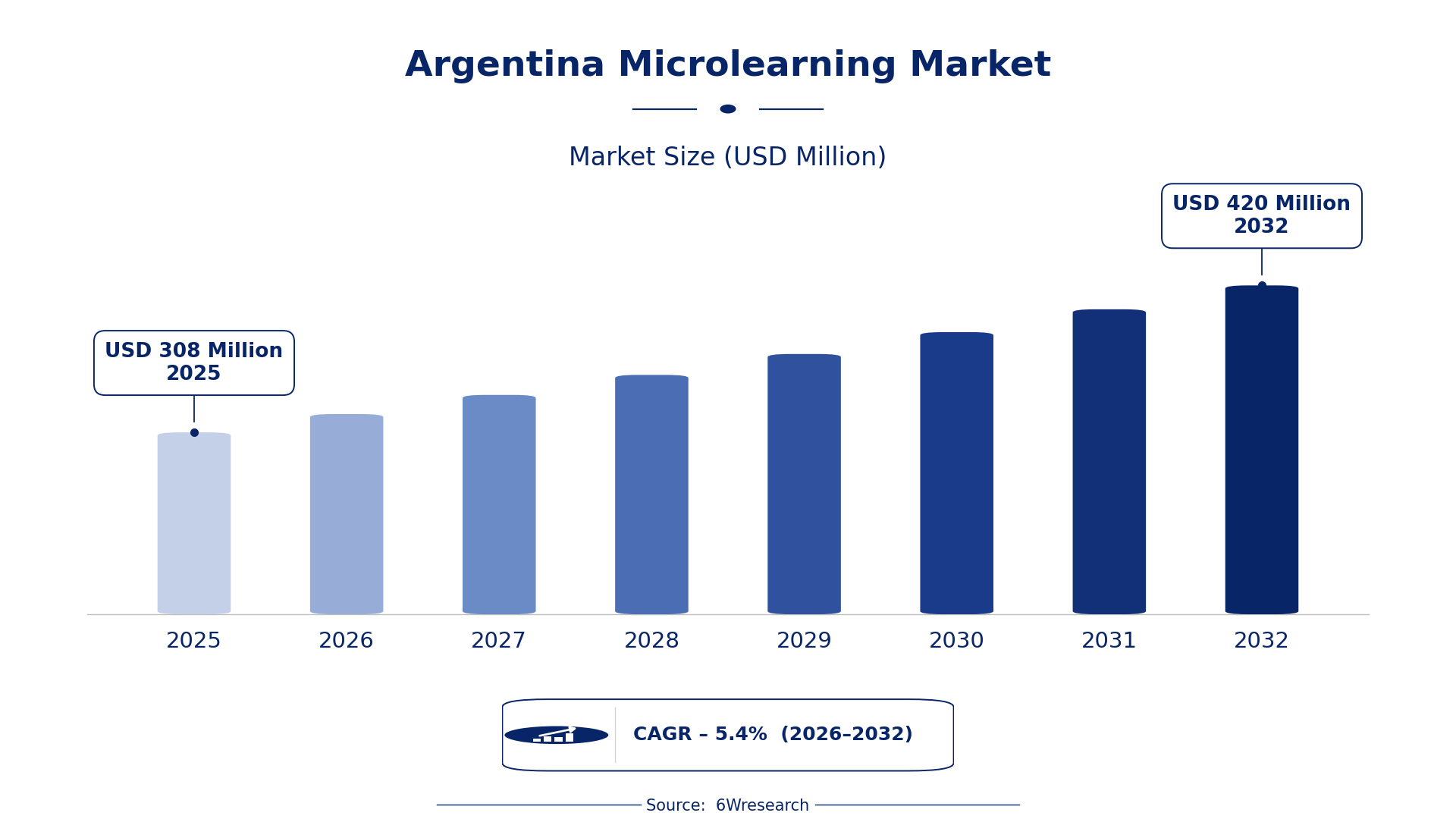
The Argentina Microlearning Market was estimated at USD 308 Million in 2025 and is projected to reach USD 420 Million by 2032, growing at a CAGR of 5.4% from 2026 to 2032.
Argentina Microlearning Market Synopsis
The Argentina microlearning market has recently gained momentum, driven by the increasing integration of digital technologies in both education and corporate training. As organizations seek to enhance learning experiences, the shift towards personalized, on-demand training is rapidly shaping the market's future.
With a diverse range of applications, microlearning is becoming integral to upskilling initiatives across various sectors. As companies prioritize flexibility and engagement in learning, the demand for concise educational content delivered via mobile and online platforms is expected to escalate.
Argentina Microlearning Market Year-wise Growth Rate and Key Drivers
This graph illustrates the annual growth rates of the Argentina Microlearning Market from 2021 to 2032, highlighting a steady upward trajectory and projected expansion over the forecast period.
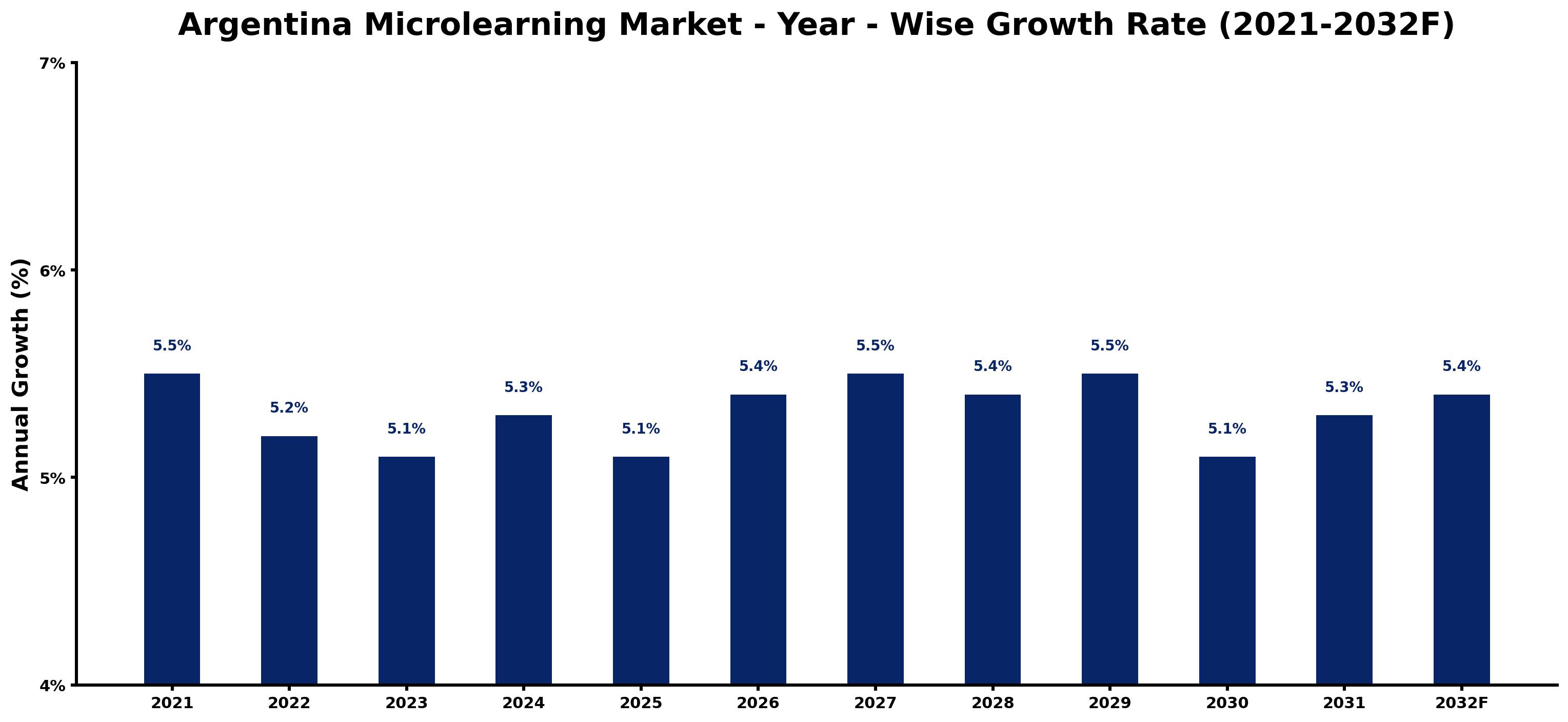
The table below presents the year‑wise growth rates along with the key drivers influencing the market
| Year | Growth Rate | Major Drivers |
| 2021 | 5.5% | Government-supported digital education initiatives boosting access. |
| 2022 | 5.2% | Rising smartphone penetration enhancing microlearning adoption. |
| 2023 | 5.1% | Increased demand for remote training solutions post-pandemic. |
| 2024 | 5.3% | E-learning regulations by the Ministry of Education fostering growth. |
| 2025 | 5.1% | Corporate training investments growing in tech startups sector. |
| 2026 | 5.4% | Youth population driving demand for flexible learning solutions. |
| 2027 | 5.5% | Local tech firms developing innovative microlearning platforms. |
| 2028 | 5.4% | Collaboration between universities and companies enhancing microlearning options. |
| 2029 | 5.5% | Focus on upskilling workers for digital economy jobs. |
| 2030 | 5.1% | Increase in government funding for educational technology. |
| 2031 | 5.3% | Rising interest in personalized learning experiences among students. |
| 2032 | 5.4% | Partnerships with NGOs promoting access to digital education. |
Note: Market size estimations and growth projections presented in this report are based on 6Wresearch's proprietary forecasting methodology, utilizing the latest available industry data, government publications, and primary research inputs.
Argentina Microlearning Market Key Takeaways
Below are some of the specific key takeaways from the market, including:
- Increasing adoption of mobile technologies is driving demand for microlearning solutions.
- Personalization and flexibility are key factors influencing learner engagement.
- Continuous workforce development initiatives are fueling market growth.
- Learning analytics and AI are enhancing the effectiveness of microlearning platforms.
- Awareness and understanding of microlearning remain critical challenges for market expansion.
Evaluation of Restraints in Argentina Microlearning Market
Despite the promising growth trajectory, the Argentina microlearning market faces notable constraints. A significant barrier is the limited awareness among decision-makers about the potential benefits of microlearning methodologies. This lack of understanding slows adoption rates across various sectors.
on top of that, insufficient investment in digital infrastructure hampers the development of quality microlearning content. These issues are compounded by concerns over data privacy and security, which create hesitancy for new market entrants. Addressing these challenges is essential for unlocking the market's full potential.
Argentina Microlearning Market Trends
Several trends are shaping the Argentina microlearning market. The rise of mobile learning platforms is revolutionizing how content is consumed, allowing learners to access materials anytime, anywhere. on top of that, the integration of gamification into microlearning is enhancing engagement levels, making learning more enjoyable and effective.
As organizations seek to respond to skills gaps, there is a growing emphasis on tailored learning experiences that adapt to individual learner needs. The use of analytics to track learner progress and adjust content accordingly is becoming increasingly prevalent, further driving the demand for microlearning solutions.
Argentina Microlearning Market Opportunities
The Argentina microlearning market presents numerous growth opportunities. Companies looking to enhance workforce productivity can invest in tailored microlearning solutions that address specific skill gaps. Additionally, as the demand for continuous learning rises, opportunities for developing industry-specific content are expanding.
Partnerships with educational institutions and technology providers can further bolster content development and delivery mechanisms. on top of that, as organizations increasingly prioritize employee well-being and satisfaction, integrating microlearning into employee training programs can yield significant benefits.
Government Initiatives in the Argentina Microlearning Market
Government policies are playing a crucial role in advancing the Argentina microlearning market. Recognizing the importance of continuous education and skills development, authorities are actively investing in digital infrastructure and innovative learning solutions. These initiatives are aimed at fostering a culture of lifelong learning in the workforce.
- A national digital infrastructure upgrade programme is currently underway, aimed at enhancing internet access for educational institutions.
- The government recently launched a skills development initiative focusing on integrating microlearning into vocational training programs.
- Upcoming legislation is expected to promote partnerships between private tech companies and public educational institutions to expand microlearning access.
- Current efforts include a curriculum reform aimed at incorporating modern learning methodologies, including microlearning strategies.
- Regional pilot programs are being implemented to assess the effectiveness of microlearning in various educational settings.
Future Insights of the Argentina Microlearning Market
Looking ahead to 2026-2032, the Argentina microlearning market is expected to continue its upward trajectory. As organizations increasingly recognize the value of agile learning methodologies, investment in microlearning solutions will likely surge. This growth will be driven by the ongoing push for digital transformation across educational and corporate sectors.
on top of that, advancements in technology will enhance the delivery and effectiveness of microlearning content. As analytics and AI become more integrated into learning platforms, the ability to personalize content will improve, catering to diverse learner needs and preferences.
Argentina Microlearning Market Latest Developments
In the past year, the Argentina microlearning market has witnessed notable developments. These changes reflect a growing commitment to digital education and a recognition of the importance of flexible learning solutions. As the market evolves, several key initiatives have emerged that underscore this trend.
- A major technology vendor launched a new microlearning platform in early 2025, designed to enhance corporate training initiatives.
- In mid-2025, a leading regional operator introduced a mobile app aimed at delivering bite-sized learning content to educational institutions.
- An initiative that began in Q2 2025 focuses on developing localized microlearning content tailored to specific industry needs.
- A partnership between universities and tech companies is currently underway, aimed at creating an integrated microlearning curriculum to be implemented by late 2025.
- Planned for the upcoming year, a national awareness campaign will seek to educate organizations on the benefits of microlearning methodologies.
Argentina Microlearning Market - Key Attractiveness of the Report
- 10 Years of Market Numbers
- Historical Data Starting from 2022 to 2025
- Base Year: 2025
- Forecast Data until 2032
- Key Performance Indicators Impacting the Market
- Major Upcoming Developments and Projects
Key Highlights of the Report:
- Argentina Microlearning Market Outlook
- Market Size of Argentina Microlearning Market, 2025
- Forecast of Argentina Microlearning Market, 2032
- Historical Data and Forecast of Argentina Microlearning Revenues & Volume for the Period 2022-2032F
- Argentina Microlearning Market Trend Evolution
- Argentina Microlearning Market Drivers and Challenges
- Argentina Microlearning Price Trends
- Argentina Microlearning Porter's Five Forces
- Argentina Microlearning Industry Life Cycle
- Historical Data and Forecast of Argentina Microlearning Market Revenues & Volume By Component for the Period 2022-2032F
- Historical Data and Forecast of Argentina Microlearning Market Revenues & Volume By Solution for the Period 2022-2032F
- Historical Data and Forecast of Argentina Microlearning Market Revenues & Volume By Services for the Period 2022-2032F
- Historical Data and Forecast of Argentina Microlearning Market Revenues & Volume By Industry for the Period 2022-2032F
- Historical Data and Forecast of Argentina Microlearning Market Revenues & Volume By Retail for the Period 2022-2032F
- Historical Data and Forecast of Argentina Microlearning Market Revenues & Volume By Manufacturing for the Period 2022-2032F
- Historical Data and Forecast of Argentina Microlearning Market Revenues & Volume By Logistics for the Period 2022-2032F
- Historical Data and Forecast of Argentina Microlearning Market Revenues & Volume By BFSI for the Period 2022-2032F
- Historical Data and Forecast of Argentina Microlearning Market Revenues & Volume By Telecom for the Period 2022-2032F
- Historical Data and Forecast of Argentina Microlearning Market Revenues & Volume By IT for the Period 2022-2032F
- Historical Data and Forecast of Argentina Microlearning Market Revenues & Volume By Healthcare for the Period 2022-2032F
- Historical Data and Forecast of Argentina Microlearning Market Revenues & Volume By Life Sciences for the Period 2022-2032F
- Historical Data and Forecast of Argentina Microlearning Market Revenues & Volume By Deployment Type for the Period 2022-2032F
- Historical Data and Forecast of Argentina Microlearning Market Revenues & Volume By On-Premises for the Period 2022-2032F
- Historical Data and Forecast of Argentina Microlearning Market Revenues & Volume By Cloud for the Period 2022-2032F
- Historical Data and Forecast of Argentina Microlearning Market Revenues & Volume By Organization Size for the Period 2022-2032F
- Historical Data and Forecast of Argentina Microlearning Market Revenues & Volume By SMEs for the Period 2022-2032F
- Historical Data and Forecast of Argentina Microlearning Market Revenues & Volume By Large Enterprises for the Period 2022-2032F
- Argentina Microlearning Import Export Trade Statistics
- Market Opportunity Assessment By Component
- Market Opportunity Assessment By Industry
- Market Opportunity Assessment By Deployment Type
- Market Opportunity Assessment By Organization Size
- Argentina Microlearning Top Companies Market Share
- Argentina Microlearning Competitive Benchmarking By Technical and Operational Parameters
- Argentina Microlearning Company Profiles
- Argentina Microlearning Key Strategic Recommendations






































