China Microlearning Market Size & Growth Rate (2026-2032)
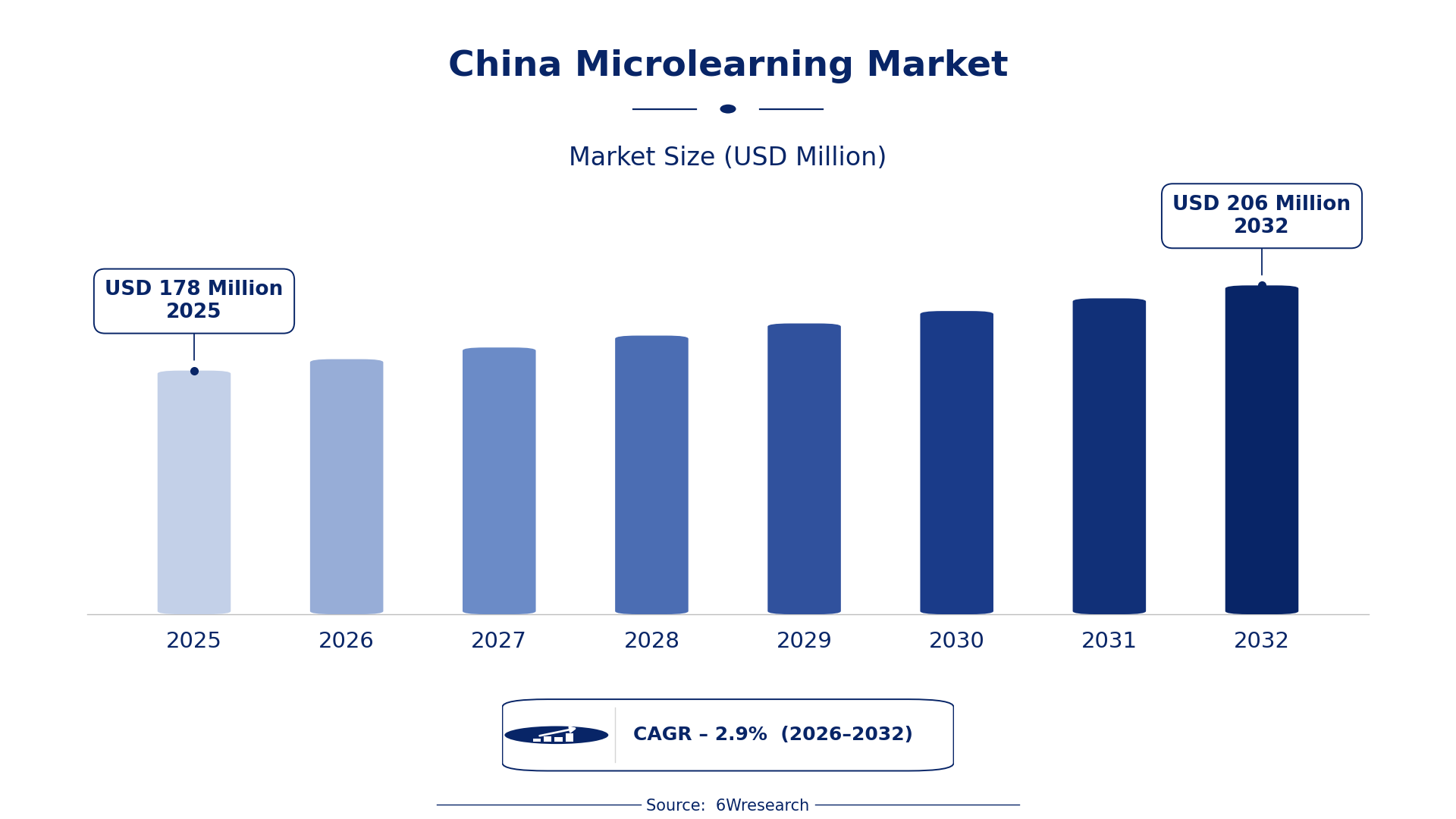
The China Microlearning Market was estimated at USD 178 Million in 2025 and is projected to reach USD 206 Million by 2032, growing at a CAGR of 2.9% from 2026 to 2032.
China Microlearning Market Synopsis
The microlearning trend in China is gaining traction, particularly among younger demographics who prefer concise, engaging content. This shift is largely fueled by the rapid adoption of smartphones and mobile learning platforms, enabling users to access educational material anytime, anywhere.
Corporate training programs are increasingly incorporating microlearning modules to enhance employee engagement and knowledge retention. This strategy not only meets the demand for personalized learning experiences but also aligns with the growing emphasis on continuous skill development in the workplace.
China Microlearning Market Year-wise Growth Rate and Key Drivers
This graph illustrates the annual growth rates of the China Microlearning Market from 2021 to 2032, highlighting a steady upward trajectory and projected expansion over the forecast period.
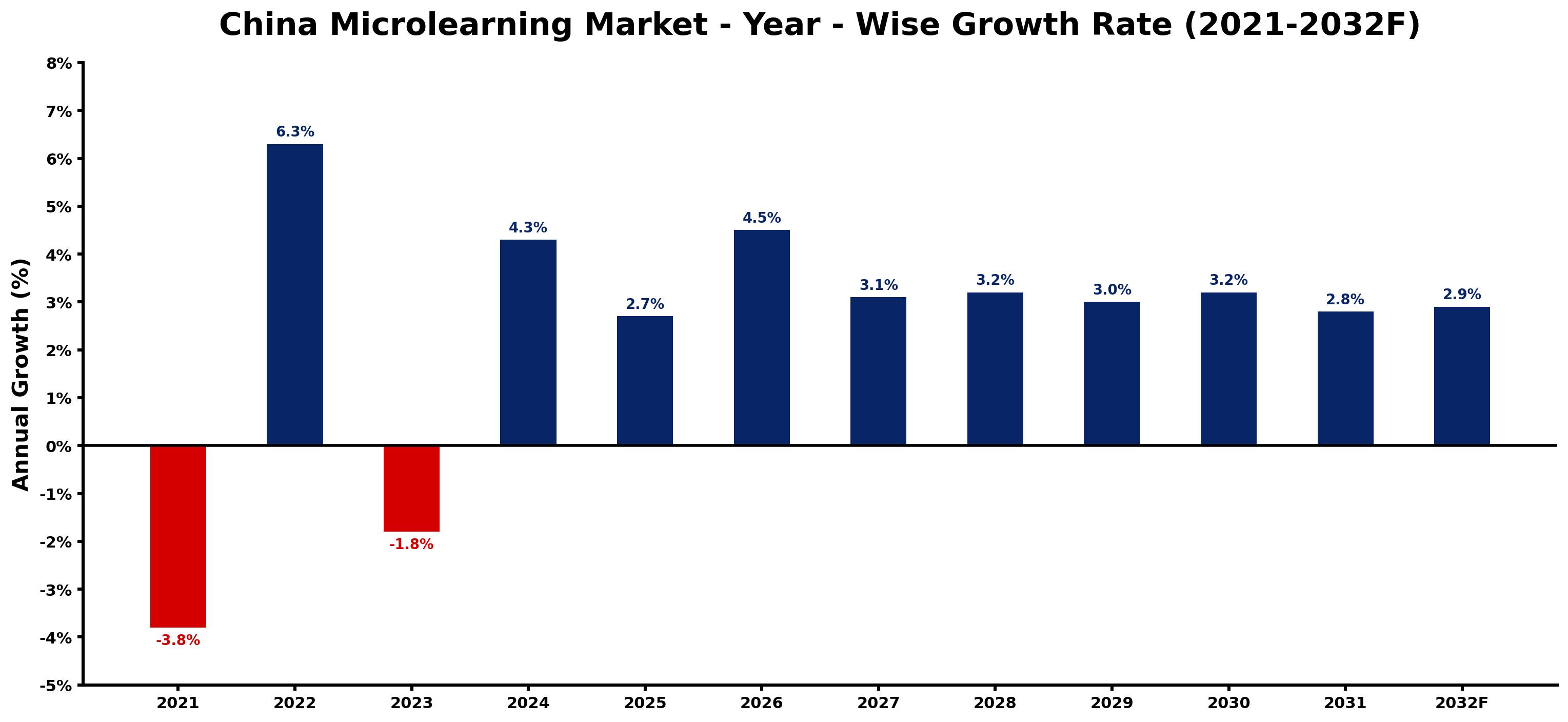
The table below presents the year‑wise growth rates along with the key drivers influencing the market
| Year | Growth Rate | Major Drivers |
| 2021 | -3.8% | Government regulations restricting foreign educational content access. |
| 2022 | 6.3% | Government policies promoting lifelong learning initiatives. |
| 2023 | -1.8% | Rising competition from domestic mobile learning applications. |
| 2024 | 4.3% | Increase in mobile app adoption for learning enhancements. |
| 2025 | 2.7% | Corporate training budgets shifting towards flexible learning formats. |
| 2026 | 4.5% | Rising popularity of gamified learning experiences among youths. |
| 2027 | 3.1% | Local companies prioritizing employee upskilling in digital realms. |
| 2028 | 3.2% | Increased university collaborations developing microlearning modules. |
| 2029 | 3.0% | Growth of urban populations seeking quick learning solutions. |
| 2030 | 3.2% | Interest in micro-credentials from educational institutions expanding. |
| 2031 | 2.8% | Development of localized content for workforce training needs. |
| 2032 | 2.9% | Focus on accommodating diverse learning styles in companies. |
Note: Market size estimations and growth projections presented in this report are based on 6Wresearch's proprietary forecasting methodology, utilizing the latest available industry data, government publications, and primary research inputs.
China Microlearning Market Key Takeaways
Below are some of the specific key takeaways from the market, including:
- The market is driven by a surge in demand for mobile-accessible learning solutions.
- Corporate training initiatives are increasingly adopting microlearning to improve employee outcomes.
- Content localization remains a challenge for providers in diverse regions of China.
- Government policies are fostering the integration of microlearning within educational systems.
- Advancements in e-learning technologies continue to redefine user engagement and retention metrics.
Evaluation of Restraints in China Microlearning Market
Despite its growth, the China microlearning market faces notable restraints. Chief among these is the necessity for content localization, which poses challenges as educational needs can vary significantly across different regions. Maintaining high user engagement also remains critical; without innovative content delivery methods, retention rates may falter, undermining the very premise of microlearning. As competition intensifies, companies must balance quality with the rapid pace of content creation to keep users invested.
China Microlearning Market Trends
The demand for bite-sized learning is reshaping educational paradigms across China. Gamification elements are increasingly being incorporated into microlearning modules, enhancing user interaction and making learning enjoyable. Additionally, artificial intelligence is being utilized to personalize learning experiences, tailoring content to individual user preferences and learning speeds. As educational institutions and corporate entities recognize the efficacy of these methods, adoption rates are expected to rise sharply.
China Microlearning Market Opportunities
Opportunities abound in the China microlearning market, particularly for companies that can deliver localized content effectively. With the corporate sector emphasizing ongoing employee training, businesses that innovate in content delivery can gain significant market share. on top of that, there is potential for partnerships with educational institutions to create curriculum-integrated microlearning solutions, paving the way for broader acceptance and utilization in traditional learning environments.
Government Initiatives in the China Microlearning Market
Government policies are crucial in shaping the China microlearning market, as they set the standards and frameworks necessary for educational technology's growth. Recent initiatives highlight a commitment to improving digital education across the country, ensuring that microlearning platforms meet educational quality requirements. These policies not only foster innovation but also address equity in digital access, promoting educational outcomes for all.
- A national digital infrastructure upgrade programme launched in early 2023 aims to enhance accessibility to educational resources across rural areas.
- Currently, a regulatory framework is being developed to standardize the quality of microlearning content, expected to roll out by late 2025.
- Planned public-private partnerships aim to fund research and development in microlearning technologies, expected to begin in 2026.
- Ongoing initiatives focus on integrating microlearning into existing educational systems to better prepare students for the demands of the modern workforce.
- Recently completed pilot programs have demonstrated the effectiveness of microlearning in corporate training, garnering government support for wider implementation.
Future Insights of the China Microlearning Market
Looking ahead to 2026-2032, the microlearning market in China is set for steady growth. As organizations increasingly recognize the value of just-in-time learning, microlearning will become a staple in training programs. The focus will shift towards creating immersive learning experiences that blend technology with traditional educational methods. Companies that can adapt and innovate in this space will be well-positioned to capitalize on emerging trends and consumer demands.
China Microlearning Market Latest Developments
Over the past year, the China microlearning market has experienced a flurry of activity, characterized by technological advancements and strategic partnerships. Organizations are prioritizing the enhancement of their digital platforms to provide more engaging and effective learning experiences. This momentum is set to reshape the competitive dynamics within the industry.
- A major technology vendor launched a new microlearning platform in Q1 2023, aimed at improving corporate training efficiency.
- In mid-2023, a leading regional operator initiated a project to integrate AI capabilities into their microlearning modules, enhancing personalization.
- Upcoming in late 2024, a consortium of educational institutions plans to introduce a series of microlearning workshops designed to develop digital literacy among students.
- Currently, an initiative that began in early 2023 is exploring the effectiveness of gamified microlearning content in various educational settings.
- In late 2023, a pilot program was completed, demonstrating significant improvements in employee performance through microlearning strategies.
China Microlearning Market - Key Attractiveness of the Report
- 10 Years of Market Numbers
- Historical Data Starting from 2022 to 2025
- Base Year: 2025
- Forecast Data until 2032
- Key Performance Indicators Impacting the Market
- Major Upcoming Developments and Projects
Key Highlights of the Report:
- China Microlearning Market Outlook
- Market Size of China Microlearning Market, 2025
- Forecast of China Microlearning Market, 2032
- Historical Data and Forecast of China Microlearning Revenues & Volume for the Period 2022-2032F
- China Microlearning Market Trend Evolution
- China Microlearning Market Drivers and Challenges
- China Microlearning Price Trends
- China Microlearning Porter's Five Forces
- China Microlearning Industry Life Cycle
- Historical Data and Forecast of China Microlearning Market Revenues & Volume By Component for the Period 2022-2032F
- Historical Data and Forecast of China Microlearning Market Revenues & Volume By Solution for the Period 2022-2032F
- Historical Data and Forecast of China Microlearning Market Revenues & Volume By Services for the Period 2022-2032F
- Historical Data and Forecast of China Microlearning Market Revenues & Volume By Industry for the Period 2022-2032F
- Historical Data and Forecast of China Microlearning Market Revenues & Volume By Retail for the Period 2022-2032F
- Historical Data and Forecast of China Microlearning Market Revenues & Volume By Manufacturing for the Period 2022-2032F
- Historical Data and Forecast of China Microlearning Market Revenues & Volume By Logistics for the Period 2022-2032F
- Historical Data and Forecast of China Microlearning Market Revenues & Volume By BFSI for the Period 2022-2032F
- Historical Data and Forecast of China Microlearning Market Revenues & Volume By Telecom for the Period 2022-2032F
- Historical Data and Forecast of China Microlearning Market Revenues & Volume By IT for the Period 2022-2032F
- Historical Data and Forecast of China Microlearning Market Revenues & Volume By Healthcare for the Period 2022-2032F
- Historical Data and Forecast of China Microlearning Market Revenues & Volume By Life Sciences for the Period 2022-2032F
- Historical Data and Forecast of China Microlearning Market Revenues & Volume By Deployment Type for the Period 2022-2032F
- Historical Data and Forecast of China Microlearning Market Revenues & Volume By On-Premises for the Period 2022-2032F
- Historical Data and Forecast of China Microlearning Market Revenues & Volume By Cloud for the Period 2022-2032F
- Historical Data and Forecast of China Microlearning Market Revenues & Volume By Organization Size for the Period 2022-2032F
- Historical Data and Forecast of China Microlearning Market Revenues & Volume By SMEs for the Period 2022-2032F
- Historical Data and Forecast of China Microlearning Market Revenues & Volume By Large Enterprises for the Period 2022-2032F
- China Microlearning Import Export Trade Statistics
- Market Opportunity Assessment By Component
- Market Opportunity Assessment By Industry
- Market Opportunity Assessment By Deployment Type
- Market Opportunity Assessment By Organization Size
- China Microlearning Top Companies Market Share
- China Microlearning Competitive Benchmarking By Technical and Operational Parameters
- China Microlearning Company Profiles
- China Microlearning Key Strategic Recommendations






































