Argentina Military Radar Market Size, Share & Growth Rate
The Argentina Military Radar Market was estimated at USD 212 Million in 2025 and is projected to reach USD 284 Million by 2032, growing at a CAGR of 4.3% from 2026 to 2032. This growth trajectory is largely propelled by Argentina's urgent need for enhanced surveillance and defense capabilities amid rising regional security concerns. As the country prioritizes airspace and border integrity, the demand for sophisticated radar systems is expected to see significant momentum, reflecting advancements in technology and operational requirements.
Argentina Military Radar Market Year-wise Growth Rate and Key Drivers
This graph highlights how the Argentina Military Radar Market has steadily grown over the years, supported by major growth factors.
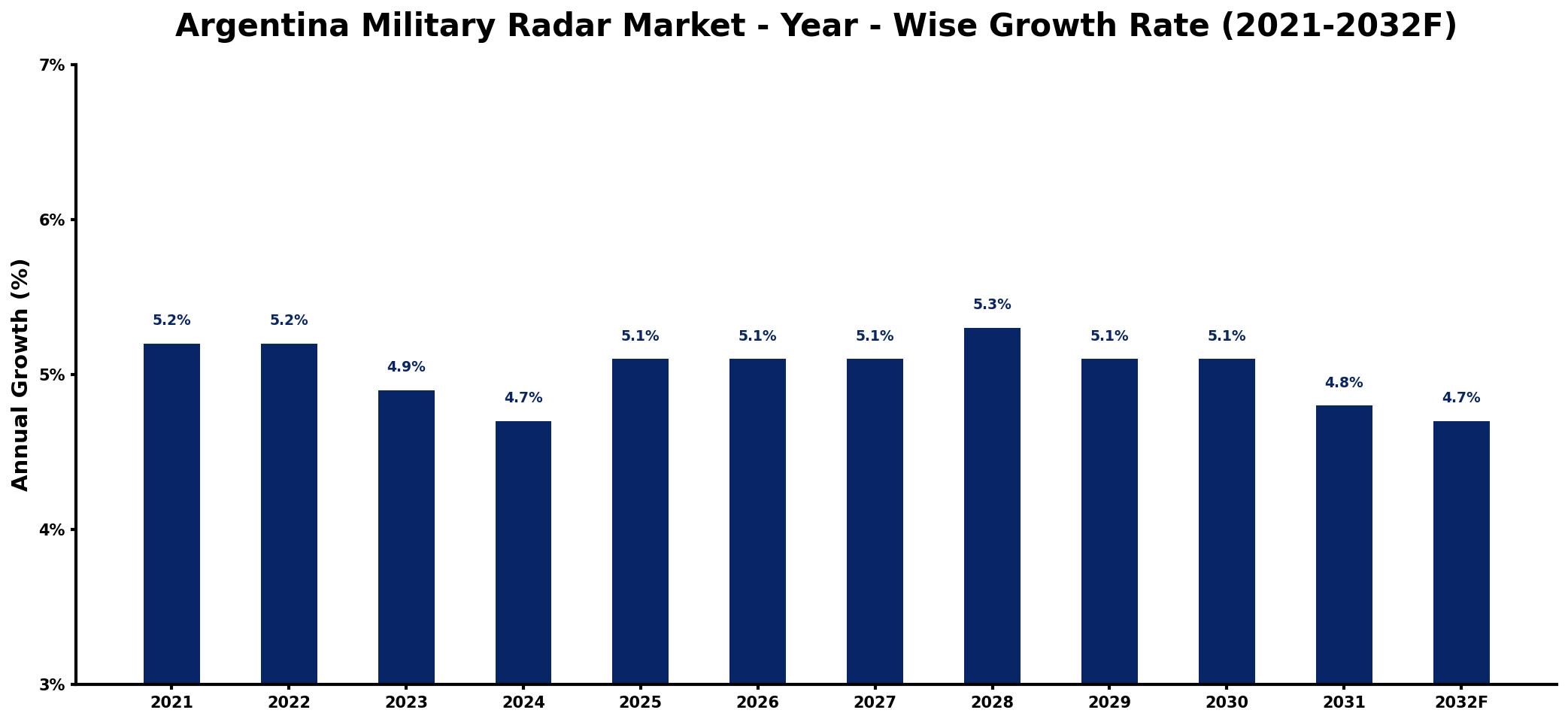
The table below presents the year‑wise growth rates along with the key drivers influencing the market
| Year | Growth Rate | Major Drivers |
| 2021 | 5.2% | growing downstream application demand |
| 2022 | 5.2% | Growing demand for surveillance technologies |
| 2023 | 4.9% | Expansion of national security initiatives |
| 2024 | 4.7% | Rising geopolitical tensions in region |
| 2025 | 5.1% | Investment in advanced detection systems |
| 2026 | 5.1% | strengthening international trade flows |
| 2027 | 5.1% | Focus on modernization of forces |
| 2028 | 5.3% | Enhanced collaboration with technology firms |
| 2029 | 5.1% | Development of integrated defense solutions |
| 2030 | 5.1% | Strengthening of border security measures |
| 2031 | 4.8% | Increased focus on cybersecurity integration |
| 2032 | 4.7% | Growing importance of data analytics |
Note: Market size estimations and growth projections presented in this report are based on 6Wresearch's proprietary forecasting methodology, utilizing the latest available industry data, government publications, and primary research inputs.
Argentina Military Radar Market Synopsis
In Argentina, military radar systems are increasingly recognized as essential assets for comprehensive surveillance, reconnaissance, and target identification. The burgeoning demand is notably fueled by a focus on detecting unmanned aerial vehicles (UAVs) and other asymmetric threats that challenge traditional defense strategies.
Furthermore, the Argentine government is investing in modernizing its military capabilities, which includes upgrading existing radar systems and acquiring advanced technologies. This investment aims to bolster national defense mechanisms against emerging threats while ensuring effective maritime and airspace security.
Argentina Military Radar Market Key Takeaways
- The market is projected to grow steadily as the government prioritizes modernization efforts in military surveillance technologies.
- Increased threats from unconventional warfare tactics are compelling Argentina to adopt advanced radar systems.
- Investment in R&D for radar technologies remains limited, resulting in reliance on foreign systems.
- Emerging technologies in signal processing are opening avenues for more efficient military radar solutions.
- Government policies are aimed at enhancing situational awareness and operational readiness across military branches.
Evaluation of Restraints in Argentina Military Radar Market
Despite the significant growth potential, the Argentina military radar market faces notable challenges. One of the primary restraints is the high complexity and associated costs of developing and deploying state-of-the-art radar technologies. This complexity often leads to a lack of investment in local R&D, which can inhibit the domestic production of radar systems and increase dependency on imported solutions. Furthermore, concerns related to radar performance, particularly regarding interference and reliability, pose additional hurdles for new market entrants and can restrict overall market expansion.
Argentina Military Radar Market Trends
Several key trends are currently shaping the Argentina military radar landscape. There is a pronounced shift towards integrating multi-functional radar platforms that provide comprehensive situational awareness across air, land, and sea domains. Additionally, advancements in AI and machine learning are facilitating improved target detection and tracking capabilities, thereby enhancing operational efficiency. The integration of these technologies into existing systems is seen as a significant competitive advantage for future military operations.
Argentina Military Radar Market Opportunities
The Argentine military radar market presents numerous opportunities for growth and investment. With the government's commitment to modernizing its defense capabilities, foreign companies and local firms are likely to benefit from public-private partnerships aimed at developing indigenous radar solutions. Furthermore, the increasing focus on collaborative defense initiatives in South America could create avenues for joint ventures that leverage technological expertise and shared resources in radar development.
Government Initiatives in the Argentina Military Radar Market
The Argentine government is actively pursuing initiatives to bolster its military radar capabilities. These include policies focused on technology modernization, spectrum management, and strategic procurement processes that ensure the military is equipped with cutting-edge radar technologies. Public spending is directed toward enhancing radar capabilities that support air defense and border surveillance. Moreover, collaborative efforts with international defense organizations are being encouraged to improve overall situational awareness and operational readiness.
Future Insights of the Argentina Military Radar Market
Looking ahead to 2026-2032, the Argentina military radar market is expected to evolve significantly as advancements in radar technology continue to reshape defense strategies. Enhanced capabilities in target detection and tracking will likely underpin future investments, with a growing emphasis on integrating AI and advanced signal processing techniques. The government's sustained focus on enhancing national security will drive further growth, positioning Argentina as a key player in regional defense capabilities.
Argentina Military Radar Market Latest Developments (2025 - 2026)
In recent months, there has been a noticeable shift towards deploying next-generation radar systems within Argentina's military framework. The government has initiated various programs aimed at upgrading existing radar infrastructures, focusing on improving interoperability among defense forces. Additionally, partnerships with foreign defense technology firms are being sought to expedite the transfer of advanced radar technologies, enhancing Argentinas military operational capabilities.
Argentina Military Radar Market - Key Attractiveness of the Report
- 10 Years of Market Numbers
- Historical Data Starting from 2022 to 2025
- Base Year: 2025
- Forecast Data until 2032
- Key Performance Indicators Impacting the Market
- Major Upcoming Developments and Projects
Key Highlights of the Report:
- Argentina Military Radar Market Outlook
- Market Size of Argentina Military Radar Market, 2025
- Forecast of Argentina Military Radar Market, 2032
- Historical Data and Forecast of Argentina Military Radar Revenues & Volume for the Period 2022-2032F
- Argentina Military Radar Market Trend Evolution
- Argentina Military Radar Market Drivers and Challenges
- Argentina Military Radar Price Trends
- Argentina Military Radar Porter's Five Forces
- Argentina Military Radar Industry Life Cycle
- Historical Data and Forecast of Argentina Military Radar Market Revenues & Volume By Platform for the Period 2022-2032F
- Historical Data and Forecast of Argentina Military Radar Market Revenues & Volume By Airborne Radar for the Period 2022-2032F
- Historical Data and Forecast of Argentina Military Radar Market Revenues & Volume By Land Radar for the Period 2022-2032F
- Historical Data and Forecast of Argentina Military Radar Market Revenues & Volume By Naval Radar for the Period 2022-2032F
- Historical Data and Forecast of Argentina Military Radar Market Revenues & Volume By Range for the Period 2022-2032F
- Historical Data and Forecast of Argentina Military Radar Market Revenues & Volume By Long for the Period 2022-2032F
- Historical Data and Forecast of Argentina Military Radar Market Revenues & Volume By Medium for the Period 2022-2032F
- Historical Data and Forecast of Argentina Military Radar Market Revenues & Volume By Short for the Period 2022-2032F
- Historical Data and Forecast of Argentina Military Radar Market Revenues & Volume By Very Short for the Period 2022-2032F
- Historical Data and Forecast of Argentina Military Radar Market Revenues & Volume By Application for the Period 2022-2032F
- Historical Data and Forecast of Argentina Military Radar Market Revenues & Volume By Weapon Guidance for the Period 2022-2032F
- Historical Data and Forecast of Argentina Military Radar Market Revenues & Volume By Airspace Monitoring & Traffic Management for the Period 2022-2032F
- Historical Data and Forecast of Argentina Military Radar Market Revenues & Volume By Airborne Mapping for the Period 2022-2032F
- Historical Data and Forecast of Argentina Military Radar Market Revenues & Volume By Ground Surveillance & Intruder Detection for the Period 2022-2032F
- Historical Data and Forecast of Argentina Military Radar Market Revenues & Volume By Navigation for the Period 2022-2032F
- Historical Data and Forecast of Argentina Military Radar Market Revenues & Volume By Others for the Period 2022-2032F
- Historical Data and Forecast of Argentina Military Radar Market Revenues & Volume By Frequency for the Period 2022-2032F
- Historical Data and Forecast of Argentina Military Radar Market Revenues & Volume By C-Band for the Period 2022-2032F
- Historical Data and Forecast of Argentina Military Radar Market Revenues & Volume By S-Band for the Period 2022-2032F
- Historical Data and Forecast of Argentina Military Radar Market Revenues & Volume By X-Band for the Period 2022-2032F
- Historical Data and Forecast of Argentina Military Radar Market Revenues & Volume By L-Band for the Period 2022-2032F
- Historical Data and Forecast of Argentina Military Radar Market Revenues & Volume By UHF/VHF for the Period 2022-2032F
- Historical Data and Forecast of Argentina Military Radar Market Revenues & Volume By Ku/K/Ka-Band for the Period 2022-2032F
- Historical Data and Forecast of Argentina Military Radar Market Revenues & Volume By Component for the Period 2022-2032F
- Historical Data and Forecast of Argentina Military Radar Market Revenues & Volume By Transmitter for the Period 2022-2032F
- Historical Data and Forecast of Argentina Military Radar Market Revenues & Volume By Antenna for the Period 2022-2032F
- Historical Data and Forecast of Argentina Military Radar Market Revenues & Volume By Receiver for the Period 2022-2032F
- Historical Data and Forecast of Argentina Military Radar Market Revenues & Volume By Duplexer for the Period 2022-2032F
- Historical Data and Forecast of Argentina Military Radar Market Revenues & Volume By Others for the Period 2022-2032F
- Argentina Military Radar Import Export Trade Statistics
- Market Opportunity Assessment By Platform
- Market Opportunity Assessment By Range
- Market Opportunity Assessment By Application
- Market Opportunity Assessment By Frequency
- Market Opportunity Assessment By Component
- Argentina Military Radar Top Companies Market Share
- Argentina Military Radar Competitive Benchmarking By Technical and Operational Parameters
- Argentina Military Radar Company Profiles
- Argentina Military Radar Key Strategic Recommendations






































