Argentina Mobile Money Market Size & Growth Rate (2026-2032)
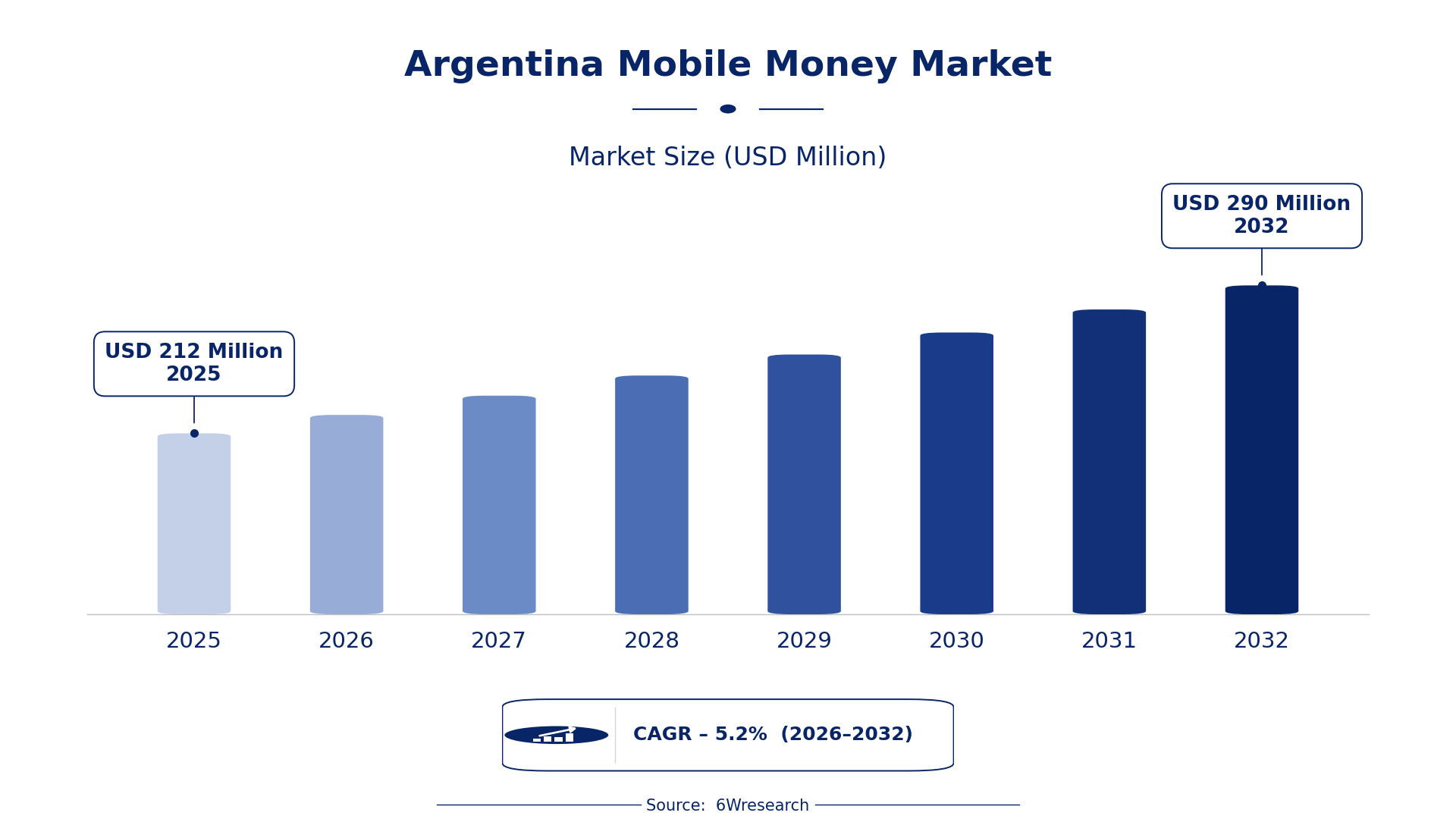
The Argentina Mobile Money Market was estimated at USD 212 Million in 2025 and is projected to reach USD 290 Million by 2032, growing at a CAGR of 5.2% from 2026 to 2032.
Argentina Mobile Money Market Synopsis
The Argentina mobile money market is undergoing a notable transformation, driven by the surge in mobile payment solutions and digital financial services. As users increasingly turn to their smartphones for financial transactions, a wave of convenience and accessibility is sweeping across the nation, setting the stage for broader financial inclusion.
Looking ahead, the market is expected to see steady growth fueled by a burgeoning fintech sector and supportive government policies. Enhanced smartphone penetration, coupled with initiatives aimed at expanding digital payments, will further entrench mobile money services in the daily financial activities of consumers and businesses alike.
Argentina Mobile Money Market Year-wise Growth Rate and Key Drivers
This graph illustrates the annual growth rates of the Argentina Mobile Money Market from 2021 to 2032, highlighting a steady upward trajectory and projected expansion over the forecast period.
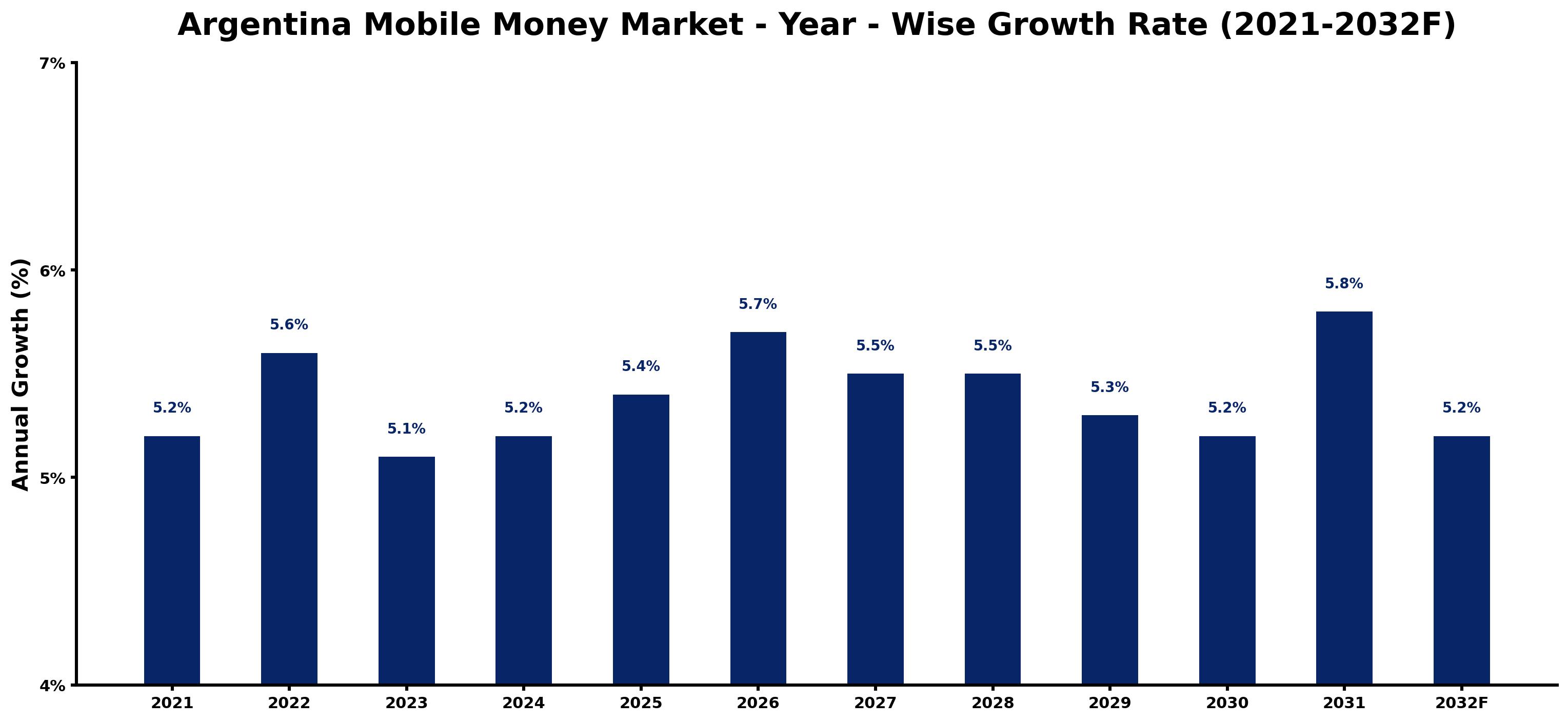
The table below presents the year‑wise growth rates along with the key drivers influencing the market
| Year | Growth Rate | Major Drivers |
| 2021 | 5.2% | Increased smartphone penetration among Argentine population. |
| 2022 | 5.6% | Regulatory support for fintech innovations by CNV. |
| 2023 | 5.1% | Growing adoption of QR payments among retailers. |
| 2024 | 5.2% | Government incentives for digital financial services adoption. |
| 2025 | 5.4% | Rising online shopping trends among urban consumers. |
| 2026 | 5.7% | Increased digital literacy initiatives fostering mobile payments. |
| 2027 | 5.5% | Partnerships between banks and tech firms boosting services. |
| 2028 | 5.5% | Youth demographic favoring cashless transaction solutions. |
| 2029 | 5.3% | Inflation-driven need for secure digital payment alternatives. |
| 2030 | 5.2% | Supportive policies from BCRA promoting financial inclusion. |
| 2031 | 5.8% | Growing acceptance of mobile wallets in rural areas. |
| 2032 | 5.2% | Integration of mobile money into local e-commerce platforms. |
Note: Market size estimations and growth projections presented in this report are based on 6Wresearch's proprietary forecasting methodology, utilizing the latest available industry data, government publications, and primary research inputs.
Argentina Mobile Money Market Key Takeaways
Below are some of the specific key takeaways from the market, including:
- The rise of fintech startups is accelerating the adoption of mobile money solutions.
- Increasing smartphone access and mobile internet connectivity are essential growth drivers.
- Government policies are enhancing financial inclusion through support for digital payments.
- Consumer education remains crucial for overcoming adoption barriers, particularly among the unbanked.
- Data security and regulatory compliance are ongoing challenges affecting market dynamics.
Evaluation of Restraints in Argentina Mobile Money Market
Despite its promising trajectory, the Argentina mobile money market is held back by several key constraints. Chief among these are the regulatory hurdles and compliance requirements that vary by region, which complicate the operational landscape for providers. Navigating these complexities can be resource-intensive, particularly for smaller players.
Concerns about data privacy and cybersecurity further hinder consumer trust in mobile money solutions. As digital fraud becomes increasingly sophisticated, building confidence in these platforms is paramount for sustained growth. The need for interoperability among diverse mobile money systems adds another layer of difficulty, preventing users from enjoying a seamless financial experience.
Argentina Mobile Money Market Trends
Several trends are emerging that will shape the future of the Argentina mobile money market. Notably, the integration of blockchain technology in payment solutions is gaining traction, offering enhanced security and transparency. Additionally, artificial intelligence is being adopted to streamline customer service and improve fraud detection.
Social media platforms are also evolving into channels for mobile money transactions, reflecting changing consumer behaviors. The increasing collaboration between traditional banks and fintech firms is fostering innovation, allowing for the development of tailored financial products that meet the diverse needs of consumers.
Argentina Mobile Money Market Opportunities
Opportunities abound in the Argentina mobile money market, particularly as the government intensifies its efforts toward financial inclusion. With a significant portion of the population still unbanked, there is tremendous potential for mobile money providers to cater to underserved demographics.
Investment in infrastructure aimed at enhancing mobile internet access can also open new avenues for service delivery. The emerging trend of 'super apps'—integrated platforms that offer various financial services—presents a substantial opportunity to capture consumer attention and facilitate widespread adoption.
Government Initiatives in the Argentina Mobile Money Market
The Argentine government is actively supporting the development of the mobile money sector through regulatory frameworks designed to promote financial inclusion. Public policy focuses on fostering digital payment solutions to enhance economic growth and improve access to financial services for all citizens. As these initiatives unfold, their implications for market expansion are profound.
- A national digital infrastructure upgrade programme recently launched aims to improve internet connectivity across rural and underserved areas.
- A regulatory framework introduced in early 2025 mandates greater transparency in mobile payment transactions to enhance consumer trust.
- Current initiatives are underway to streamline licensing processes for mobile money providers, making it easier for new entrants to participate in the market.
- Upcoming incentives for fintech partnerships are expected to stimulate innovation and enhance service offerings in the mobile money landscape by 2027.
Future Insights of the Argentina Mobile Money Market
From 2026 to 2032, the Argentina mobile money market is likely to witness steady advancements fueled by increasing smartphone penetration and a growing reliance on digital transactions. As consumers become more accustomed to mobile financial services, adoption rates will climb, leading to a more significant shift in traditional banking paradigms.
Furthermore, as regulatory measures evolve, the market will mature, ultimately fostering a safer and more accessible environment for users. The collaboration between government entities and private-sector players will be critical in facilitating innovation and expanding service offerings that truly cater to the financial needs of a diverse population.
Argentina Mobile Money Market Latest Developments
In the past year, the Argentina mobile money market has seen a flurry of activity as companies seek to capitalize on the growing demand for digital financial solutions. This trend is marked by significant investments in technology and partnerships aimed at enhancing service delivery and user experience.
- A major technology vendor launched a new digital wallet service in early 2025, providing users with seamless payment options and enhancing user engagement.
- An initiative that began in late 2025 aims to educate consumers about the benefits of mobile money, targeting urban and rural populations alike.
- By mid-2026, a public-private partnership is expected to roll out infrastructure upgrades intended to enhance mobile internet access in isolated regions.
- In Q3 2025, several fintech companies began piloting peer-to-peer payment solutions that have generated positive user feedback.
Argentina Mobile Money Market - Key Attractiveness of the Report
- 10 Years of Market Numbers
- Historical Data Starting from 2022 to 2025
- Base Year: 2025
- Forecast Data until 2032
- Key Performance Indicators Impacting the Market
- Major Upcoming Developments and Projects
Key Highlights of the Report:
- Argentina Mobile Money Market Outlook
- Market Size of Argentina Mobile Money Market, 2025
- Forecast of Argentina Mobile Money Market, 2032
- Historical Data and Forecast of Argentina Mobile Money Revenues & Volume for the Period 2022-2032F
- Argentina Mobile Money Market Trend Evolution
- Argentina Mobile Money Market Drivers and Challenges
- Argentina Mobile Money Price Trends
- Argentina Mobile Money Porter's Five Forces
- Argentina Mobile Money Industry Life Cycle
- Historical Data and Forecast of Argentina Mobile Money Market Revenues & Volume By Transaction mode for the Period 2022-2032F
- Historical Data and Forecast of Argentina Mobile Money Market Revenues & Volume By Point of Sale (PoS) for the Period 2022-2032F
- Historical Data and Forecast of Argentina Mobile Money Market Revenues & Volume By Mobile Apps for the Period 2022-2032F
- Historical Data and Forecast of Argentina Mobile Money Market Revenues & Volume By QR codes for the Period 2022-2032F
- Historical Data and Forecast of Argentina Mobile Money Market Revenues & Volume By Nature of Payment for the Period 2022-2032F
- Historical Data and Forecast of Argentina Mobile Money Market Revenues & Volume By Person to Person (P2P) for the Period 2022-2032F
- Historical Data and Forecast of Argentina Mobile Money Market Revenues & Volume By Person to Business (P2B) for the Period 2022-2032F
- Historical Data and Forecast of Argentina Mobile Money Market Revenues & Volume By Business to Person (B2P) for the Period 2022-2032F
- Historical Data and Forecast of Argentina Mobile Money Market Revenues & Volume By Business to Business (B2B) for the Period 2022-2032F
- Historical Data and Forecast of Argentina Mobile Money Market Revenues & Volume By Application for the Period 2022-2032F
- Historical Data and Forecast of Argentina Mobile Money Market Revenues & Volume By Money transfers for the Period 2022-2032F
- Historical Data and Forecast of Argentina Mobile Money Market Revenues & Volume By Bill Payments for the Period 2022-2032F
- Historical Data and Forecast of Argentina Mobile Money Market Revenues & Volume By Airtime Transfer and Top-Ups for the Period 2022-2032F
- Historical Data and Forecast of Argentina Mobile Money Market Revenues & Volume By Travel and Ticketing for the Period 2022-2032F
- Historical Data and Forecast of Argentina Mobile Money Market Revenues & Volume By Merchandise and Coupons for the Period 2022-2032F
- Historical Data and Forecast of Argentina Mobile Money Market Revenues & Volume By Type of Payments for the Period 2022-2032F
- Historical Data and Forecast of Argentina Mobile Money Market Revenues & Volume By Remote Payments for the Period 2022-2032F
- Historical Data and Forecast of Argentina Mobile Money Market Revenues & Volume By Proximity Payments for the Period 2022-2032F
- Argentina Mobile Money Import Export Trade Statistics
- Market Opportunity Assessment By Transaction mode
- Market Opportunity Assessment By Nature of Payment
- Market Opportunity Assessment By Application
- Market Opportunity Assessment By Type of Payments
- Argentina Mobile Money Top Companies Market Share
- Argentina Mobile Money Competitive Benchmarking By Technical and Operational Parameters
- Argentina Mobile Money Company Profiles
- Argentina Mobile Money Key Strategic Recommendations






































