Argentina Mold Release Agents Market: Import Trend Analysis
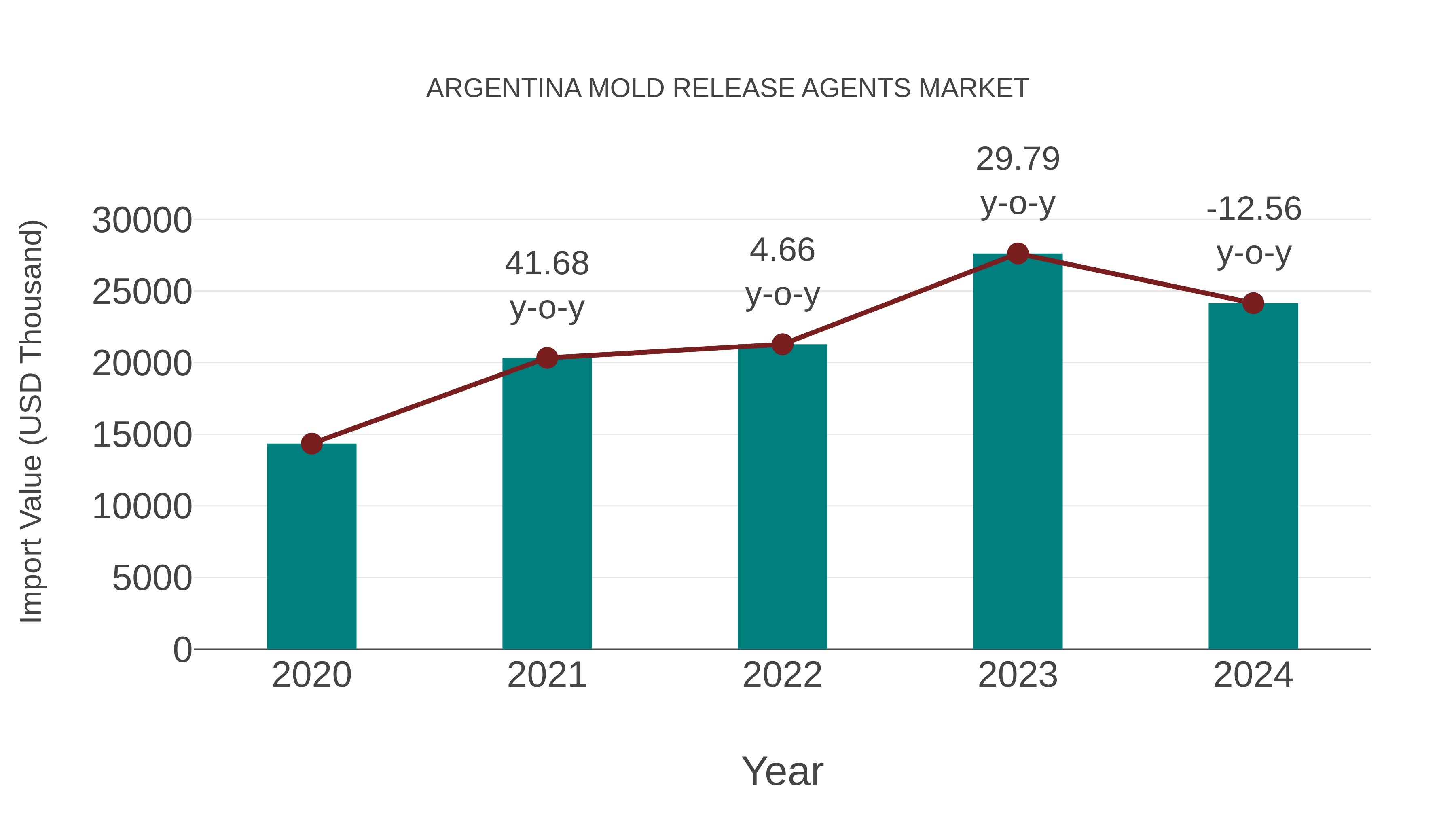
The import trend of mold release agents in Argentina from 2020 to 2024 saw a Compound Annual Growth Rate (CAGR) of 13.90%. However, in 2023-2024, there was a year-on-year growth rate of -12.56%. Despite the decline in the final year, the overall trend showed a significant increase in imports during the period.
Argentina Mold Release Agents Market Synopsis
The Argentina mold release agents market is expanding, supported by the demand for efficient and high-performance lubricants and coatings in molding and casting processes. Mold release agents facilitate the release of molded parts from molds and dies, reducing friction, preventing sticking, and improving surface finish and mold productivity in various manufacturing industries.
Drivers of the market
The Argentina Mold Release Agents market is experiencing growth driven by several key factors. Firstly, the increasing demand for efficient, cost-effective, and environmentally friendly mold release solutions is driving the adoption of mold release agents in Argentina. Mold release agents are chemical compounds or coatings applied to molds or tooling surfaces to facilitate the release of molded parts, preventing adhesion and improving production efficiency in various industries such as plastics, rubber, composites, and die casting. Moreover, the growing emphasis on sustainability, worker safety, and regulatory compliance is fueling the development and adoption of bio-based, solvent-free, and non-toxic mold release formulations in Argentina. Additionally, advancements in formulation chemistry, application methods, and surface treatment technologies are further driving market growth by enhancing the performance, durability, and compatibility of mold release agents with different molding processes and materials in the country.
Challenges of the market
The Argentina mold release agents market faces several challenges impacting its growth and adoption across various manufacturing sectors. One significant challenge is the increasing demand for environmentally friendly and sustainable mold release agents that comply with stringent regulations and consumer preferences for eco-friendly products. Developing effective bio-based or water-based mold release agents while maintaining performance standards poses technical challenges for manufacturers. Moreover, concerns about product effectiveness, compatibility with different molding materials, and ease of application raise challenges for ensuring optimal performance and user satisfaction. Additionally, challenges related to cost competitiveness and market differentiation may arise due to the presence of numerous competitors offering similar mold release products, requiring innovative formulations and value-added services to stand out in the market. Furthermore, the variability in molding processes, equipment, and materials used across different industries may introduce challenges for customization and compatibility of mold release agents, necessitating tailored solutions for specific applications and end-user requirements.
Government Policy of the market
Government regulations in Argentina govern the composition, labeling, and usage of mold release agents in manufacturing processes such as plastics molding and casting. Policies may include product safety standards, environmental impact assessments, and workplace safety regulations to ensure proper handling and disposal of mold release agents.
Key Highlights of the Report:
- Argentina Mold Release Agents Market Outlook
- Market Size of Argentina Mold Release Agents Market, 2025
- Forecast of Argentina Mold Release Agents Market, 2032
- Historical Data and Forecast of Argentina Mold Release Agents Revenues & Volume for the Period 2022-2032F
- Argentina Mold Release Agents Market Trend Evolution
- Argentina Mold Release Agents Market Drivers and Challenges
- Argentina Mold Release Agents Price Trends
- Argentina Mold Release Agents Porter's Five Forces
- Argentina Mold Release Agents Industry Life Cycle
- Historical Data and Forecast of Argentina Mold Release Agents Market Revenues & Volume By Product Type for the Period 2022-2032F
- Historical Data and Forecast of Argentina Mold Release Agents Market Revenues & Volume By Water-based for the Period 2022-2032F
- Historical Data and Forecast of Argentina Mold Release Agents Market Revenues & Volume By Solvent-based for the Period 2022-2032F
- Historical Data and Forecast of Argentina Mold Release Agents Market Revenues & Volume By Application for the Period 2022-2032F
- Historical Data and Forecast of Argentina Mold Release Agents Market Revenues & Volume By Die-casting for the Period 2022-2032F
- Historical Data and Forecast of Argentina Mold Release Agents Market Revenues & Volume By Rubber Molding for the Period 2022-2032F
- Historical Data and Forecast of Argentina Mold Release Agents Market Revenues & Volume By Plastic Molding for the Period 2022-2032F
- Historical Data and Forecast of Argentina Mold Release Agents Market Revenues & Volume By PU Molding for the Period 2022-2032F
- Historical Data and Forecast of Argentina Mold Release Agents Market Revenues & Volume By Concrete for the Period 2022-2032F
- Historical Data and Forecast of Argentina Mold Release Agents Market Revenues & Volume By Wood Composite & Panel Pressing for the Period 2022-2032F
- Historical Data and Forecast of Argentina Mold Release Agents Market Revenues & Volume By Composite Molding for the Period 2022-2032F
- Argentina Mold Release Agents Import Export Trade Statistics
- Market Opportunity Assessment By Product Type
- Market Opportunity Assessment By Application
- Argentina Mold Release Agents Top Companies Market Share
- Argentina Mold Release Agents Competitive Benchmarking By Technical and Operational Parameters
- Argentina Mold Release Agents Company Profiles
- Argentina Mold Release Agents Key Strategic Recommendations






































