Argentina MVNO Market Size & Growth Rate (2026-2032)
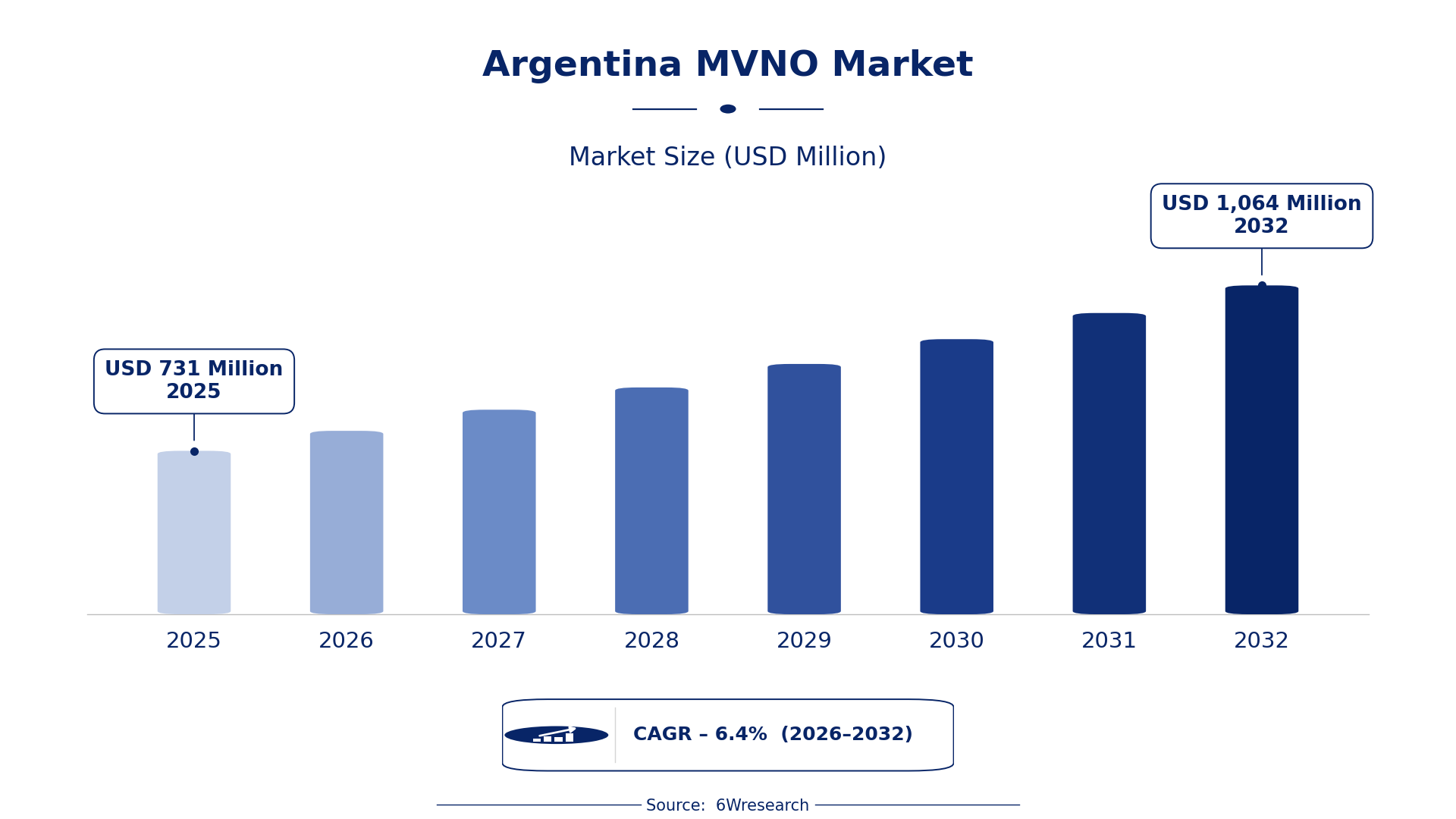
The Argentina MVNO Market was estimated at USD 731 Million in 2025 and is projected to reach USD 1064 Million by 2032, growing at a CAGR of 6.4% from 2026 to 2032.
Argentina MVNO Market Synopsis
The Argentina MVNO market is witnessing an influx of new entrants, each vying for a share in a competitive mobile service environment. With major carriers like Claro, Movistar, and Personal as backbone providers, these virtual operators are tailoring offerings to meet diverse consumer needs.
As mobile penetration rates rise, MVNOs are increasingly positioned to provide affordable and varied mobile services. This dynamic is fostering innovation in pricing strategies, service packages, and customer engagement, leading to a market ripe for further expansion.
Argentina MVNO Market Year-wise Growth Rate and Key Drivers
This graph illustrates the annual growth rates of the Argentina MVNO Market from 2021 to 2032, highlighting a steady upward trajectory and projected expansion over the forecast period.
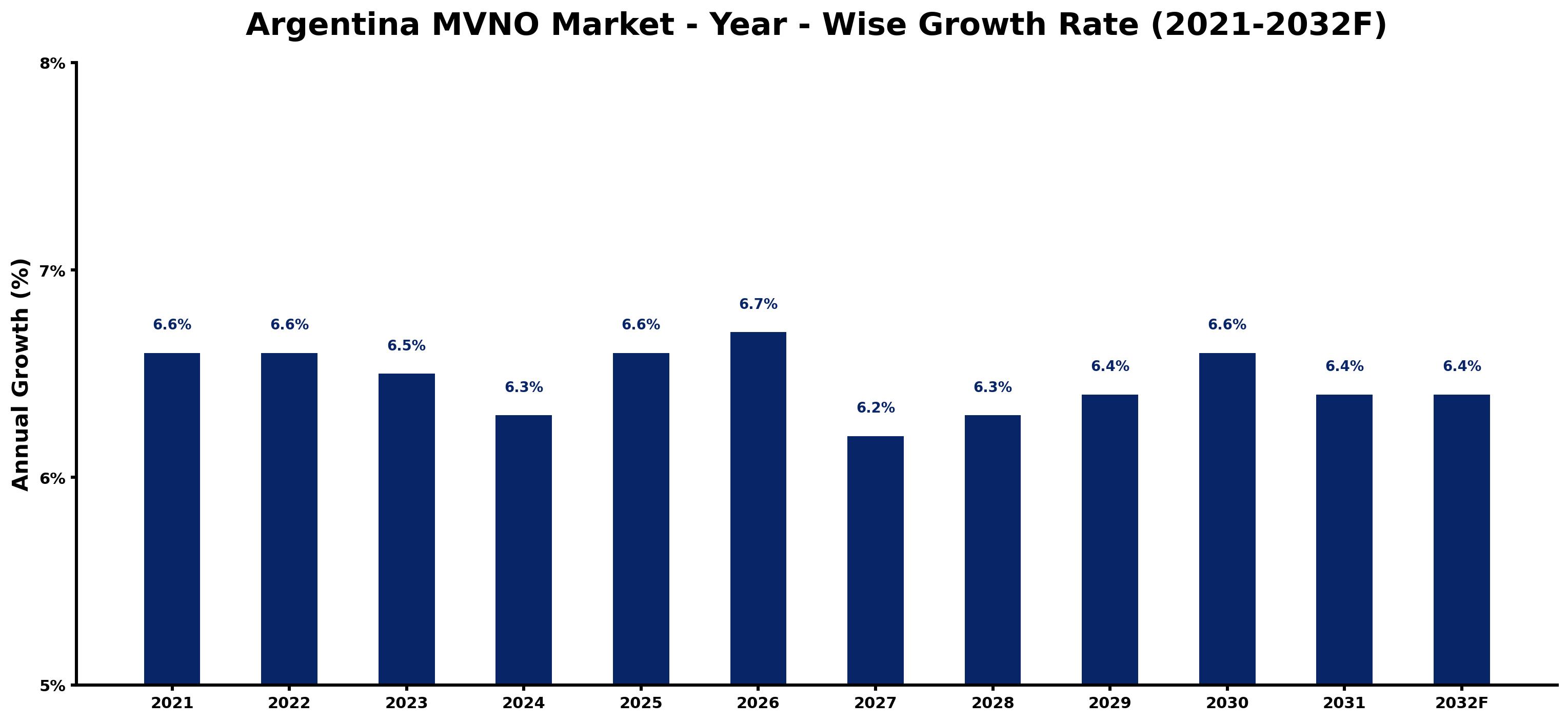
The table below presents the year‑wise growth rates along with the key drivers influencing the market
| Year | Growth Rate | Major Drivers |
| 2021 | 6.6% | Increase in cellular data consumption among consumers. |
| 2022 | 6.6% | Regulatory support for new MVNO licenses by ENACOM. |
| 2023 | 6.5% | Rising smartphone penetration boosting mobile subscriber base. |
| 2024 | 6.3% | Demand for affordable mobile services amidst economic challenges. |
| 2025 | 6.6% | Growing popularity of prepaid mobile plans in urban areas. |
| 2026 | 6.7% | Enhanced 4G infrastructure attracting new MVNO entrants. |
| 2027 | 6.2% | Consumer preference shift towards customizable mobile offerings. |
| 2028 | 6.3% | Increased competition driving service innovation and pricing. |
| 2029 | 6.4% | Government initiatives promoting digital inclusion across demographics. |
| 2030 | 6.6% | Expanding youth market driving demand for mobile connectivity. |
| 2031 | 6.4% | Rising bilingualism prompting niche targeting by MVNOs. |
| 2032 | 6.4% | Improved network coverage in rural areas encouraging adoption. |
Note: Market size estimations and growth projections presented in this report are based on 6Wresearch's proprietary forecasting methodology, utilizing the latest available industry data, government publications, and primary research inputs.
Argentina MVNO Market Key Takeaways
Below are some of the specific key takeaways from the market, including:
- Increasing demand for affordable mobile services is a key driver for MVNO growth.
- Regulatory initiatives are simplifying the entry process for new MVNOs.
- Partnerships with established telecom operators are becoming more common.
- The rise of niche markets, such as youth and expatriates, is shaping service offerings.
- Emerging technologies like 5G are set to enhance MVNO capabilities and offerings.
Evaluation of Restraints in Argentina MVNO Market
Despite the promising outlook, several constraints hinder the growth of the Argentina MVNO market. Chief among these are regulatory barriers that complicate market entry and operational flexibility. The complex licensing process can delay new entrants, stifling innovation and competition.
Additionally, the dominance of established mobile network operators limits MVNOs' negotiating power for favorable wholesale agreements. This environment can restrict their ability to differentiate their offerings, ultimately affecting customer acquisition and retention.
Argentina MVNO Market Trends
Current trends indicate a shift towards flexible and customizable mobile plans, catering to the needs of price-sensitive consumers. Many MVNOs are focusing on unique value propositions, such as no-contract plans and specialized services for niche demographics.
There’s also a significant emphasis on enhancing customer experience through digital channels. MVNOs are increasingly investing in digital marketing and customer service platforms to capture and retain users effectively.
Argentina MVNO Market Opportunities
Growth opportunities in the Argentina MVNO market are abundant. The ongoing expansion of 4G networks and the impending rollout of 5G technology provide a solid foundation for MVNOs to offer high-speed data services.
on top of that, the rise of IoT devices presents a unique avenue for MVNOs to develop specialized connectivity solutions, opening up new revenue streams. This technological advancement, paired with an increasing consumer shift towards digital services, will likely drive further innovation in the sector.
Government Initiatives in the Argentina MVNO Market
The Argentine government is actively working to enhance competition within the MVNO sector through supportive policies and regulatory frameworks. The National Communications Agency (ENACOM) plays a critical role in ensuring equitable access to network infrastructure and promoting new entrants.
- A recently completed initiative involved simplifying the registration process for new MVNOs, thereby reducing entry barriers.
- Currently, there is an ongoing effort to promote transparency in billing practices across all telecom operators, including MVNOs.
- A planned public-private partnership aims to expand telecom infrastructure access by 2028, creating more opportunities for MVNO growth.
- Additionally, the government is expected to introduce new regulations in 2026 to further enhance service quality and consumer protection.
Future Insights of the Argentina MVNO Market
Looking ahead to 2026-2032, the Argentina MVNO market is set for steady growth. Increasing smartphone penetration and a demand for cost-effective mobile solutions will likely drive further market expansion. Collaboration with established MNOs will enable MVNOs to access vital infrastructure, enhancing their service offerings.
As digitalization continues to permeate daily life, MVNOs that can adapt quickly to emerging trends and consumer preferences will find ample opportunities to innovate and capture market share.
Argentina MVNO Market Latest Developments
Recent activity in the Argentina MVNO market indicates a strategic shift towards innovative offerings and enhanced customer engagement. Over the past year, several key developments have emerged, signaling a competitive and responsive environment.
- A leading MVNO launched a new flexible pricing model in Q1 2025, aiming to attract budget-conscious consumers.
- In early 2025, a regional operator expanded its service coverage, enhancing accessibility for rural areas.
- A collaboration between multiple MVNOs to share infrastructure is currently underway, expected to improve service quality across the board.
- There are plans for a major technology vendor to roll out advanced analytics tools to MVNOs in mid-2026, enhancing their customer insights capabilities.
Argentina MVNO Market - Key Attractiveness of the Report
- 10 Years of Market Numbers
- Historical Data Starting from 2022 to 2025
- Base Year: 2025
- Forecast Data until 2032
- Key Performance Indicators Impacting the Market
- Major Upcoming Developments and Projects
Key Highlights of the Report:
- Argentina MVNO Market Outlook
- Market Size of Argentina MVNO Market, 2025
- Forecast of Argentina MVNO Market, 2032
- Historical Data and Forecast of Argentina MVNO Revenues & Volume for the Period 2022-2032F
- Argentina MVNO Market Trend Evolution
- Argentina MVNO Market Drivers and Challenges
- Argentina MVNO Price Trends
- Argentina MVNO Porter's Five Forces
- Argentina MVNO Industry Life Cycle
- Historical Data and Forecast of Argentina MVNO Market Revenues & Volume By Operational Model for the Period 2022-2032F
- Historical Data and Forecast of Argentina MVNO Market Revenues & Volume By Reseller for the Period 2022-2032F
- Historical Data and Forecast of Argentina MVNO Market Revenues & Volume By Service Operator for the Period 2022-2032F
- Historical Data and Forecast of Argentina MVNO Market Revenues & Volume By Full MVNO for the Period 2022-2032F
- Historical Data and Forecast of Argentina MVNO Market Revenues & Volume By Organization Size for the Period 2022-2032F
- Historical Data and Forecast of Argentina MVNO Market Revenues & Volume By SMES for the Period 2022-2032F
- Historical Data and Forecast of Argentina MVNO Market Revenues & Volume By Large Enterprise for the Period 2022-2032F
- Historical Data and Forecast of Argentina MVNO Market Revenues & Volume By Subscriber for the Period 2022-2032F
- Historical Data and Forecast of Argentina MVNO Market Revenues & Volume By Consumer for the Period 2022-2032F
- Historical Data and Forecast of Argentina MVNO Market Revenues & Volume By Enterprise for the Period 2022-2032F
- Argentina MVNO Import Export Trade Statistics
- Market Opportunity Assessment By Operational Model
- Market Opportunity Assessment By Organization Size
- Market Opportunity Assessment By Subscriber
- Argentina MVNO Top Companies Market Share
- Argentina MVNO Competitive Benchmarking By Technical and Operational Parameters
- Argentina MVNO Company Profiles
- Argentina MVNO Key Strategic Recommendations






































