Argentina Personal Computers Market Size, Share & Growth Rate
The Argentina Personal Computers Market was estimated at USD 434 Million in 2025 and is projected to reach USD 592 Million by 2032, growing at a CAGR of 4.5% from 2026 to 2032. This upward trajectory is fueled by a surge in digital literacy, the proliferation of remote work, and the ongoing trend of online learning. As consumers increasingly seek advanced features and reliable devices, the market is adapting to meet these evolving demands.
Argentina Personal Computers Market Year-wise Growth Rate and Key Drivers
This graph highlights how the Argentina Personal Computers Market has steadily grown over the years, supported by major growth factors.
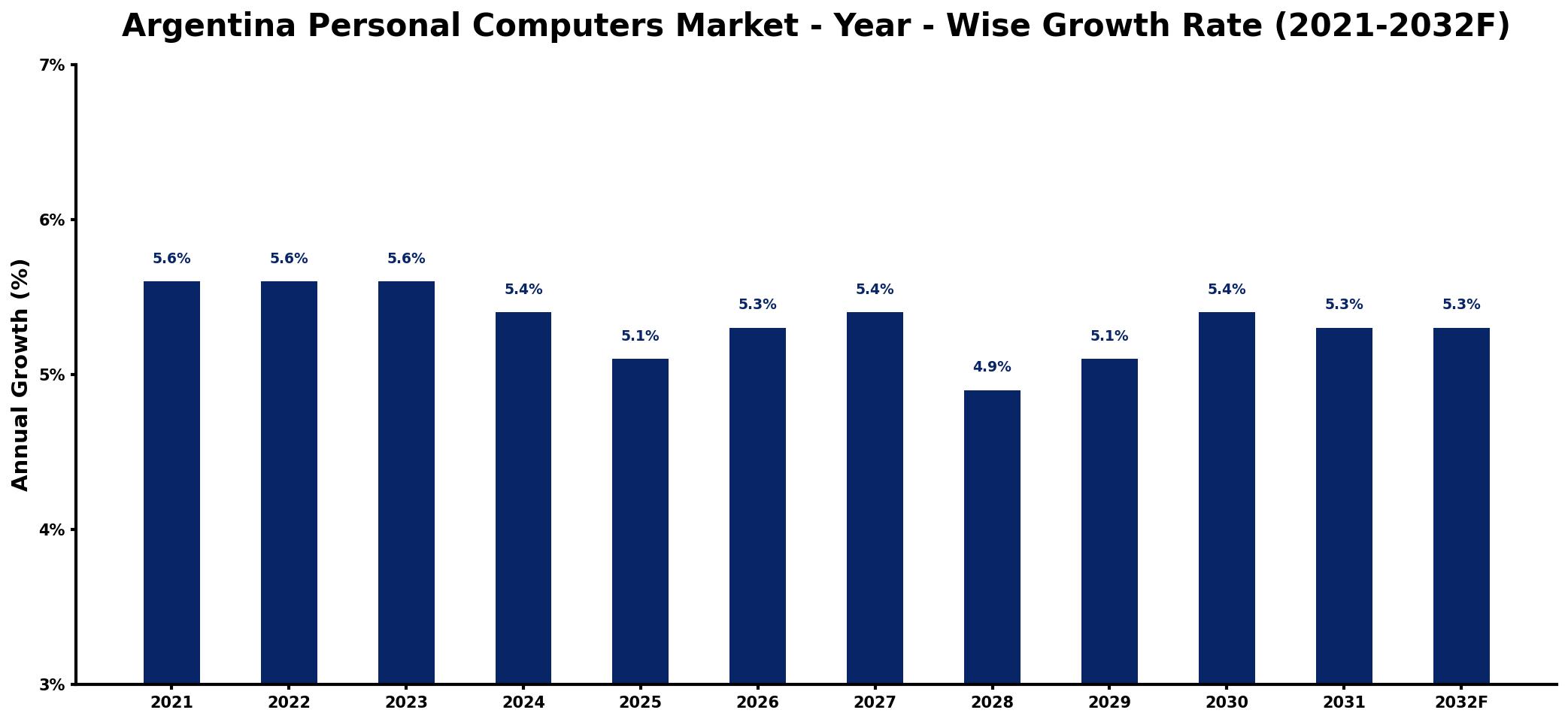
The table below presents the year‑wise growth rates along with the key drivers influencing the market
| Year | Growth Rate | Major Drivers |
| 2021 | 5.6% | increased consumer technology adoption |
| 2022 | 5.6% | growing remote work opportunities |
| 2023 | 5.6% | expansion of digital education initiatives |
| 2024 | 5.4% | rise in cloud computing services |
| 2025 | 5.1% | increased investment in IT infrastructure |
| 2026 | 5.3% | growing demand for gaming applications |
| 2027 | 5.4% | rising procurement volume requirements |
| 2028 | 4.9% | increased focus on cybersecurity solutions |
| 2029 | 5.1% | growth in software development projects |
| 2030 | 5.4% | rising infrastructure development spending |
| 2031 | 5.3% | increased reliance on online services |
| 2032 | 5.3% | improved processing technologies adoption |
Note: Market size estimations and growth projections presented in this report are based on 6Wresearch's proprietary forecasting methodology, utilizing the latest available industry data, government publications, and primary research inputs.
Argentina Personal Computers Market Synopsis
The Argentina Personal Computers Market is currently experiencing a significant transformation driven by changing consumer behaviors and technological advancements. With digital literacy on the rise, the demand for personal computing devices, particularly laptops and desktops, is expanding at an impressive rate.
Major players, including both international and local brands, are innovating to capture market share in this competitive landscape. Consumers are gravitating towards higher-end devices equipped with advanced features, catering to the needs of both personal and professional users.
Argentina Personal Computers Market Key Takeaways
- Digital literacy and remote work trends are primary growth drivers in the market.
- The demand for high-performance laptops and gaming computers is on the rise.
- Economic instability and currency fluctuations pose challenges to consumer purchasing power.
- Government policies are supporting local manufacturing and digital initiatives.
- Opportunities for investment exist in tailored products that meet local market needs.
Evaluation of Restraints in Argentina Personal Computers Market
Despite the promising growth trajectory, the Argentina Personal Computers Market faces several real restraints. Economic instability remains a significant concern, influencing consumer confidence and spending habits. Fluctuating currency exchange rates contribute to higher import costs, which can price many consumers out of the market. Furthermore, high import tariffs on electronics further exacerbate these challenges, leading to elevated retail prices that can deter purchases. Access to affordable financing options is limited, restricting consumer ability to invest in new devices, complicating the purchasing landscape even further.
Argentina Personal Computers Market Trends
Several key trends are shaping the Argentina Personal Computers Market. The demand for laptops and portable devices continues to grow, spurred by the shift to remote work and the increased prevalence of online education. Additionally, consumers are showing a pronounced preference for gaming laptops and high-performance computers that deliver enhanced user experiences. As sustainability becomes a priority, the market is also witnessing a shift toward eco-friendly practices, with consumers increasingly favoring energy-efficient devices and those made from recyclable materials.
Argentina Personal Computers Market Opportunities
The Argentina Personal Computers Market is ripe with investment opportunities. As digital adoption accelerates across both consumer and commercial sectors, there is significant potential for increased sales of personal computing devices. Developing affordable, high-quality products tailored to local preferences can unlock lucrative market segments. Moreover, the ongoing trend of remote work and online learning necessitates reliable computing solutions, presenting a prime opportunity for businesses. Collaborating with local distributors and leveraging e-commerce platforms can further enhance market reach, creating pathways for innovative growth.
Government Initiatives in the Argentina Personal Computers Market
Government policies in Argentina are increasingly aimed at fostering growth in the Personal Computers Market. Initiatives such as tax incentives for domestic manufacturing and assembly of electronic components are designed to promote local production. Moreover, the government is implementing regulations to ensure consumer protection and safety standards for electronic products. Programs to increase access to technology in schools and communities further emphasize the commitment to enhancing digital literacy and bridging the technology gap among the population.
Future Insights of the Argentina Personal Computers Market
Looking ahead to 2026-2032, the Argentina Personal Computers Market is expected to experience moderate growth. Factors contributing to this include an ongoing demand for laptops and desktops driven by remote work and online education. Furthermore, as various industries continue adopting technology, the market stands to benefit from rising consumer expectations for advanced computing solutions. While challenges such as economic conditions and competition from alternative devices like tablets and smartphones may impact growth, the emphasis on digital transformation suggests a steady upward trend in the market.
Argentina Personal Computers Market Latest Developments (2025 - 2026)
Recent developments in the Argentina Personal Computers Market indicate a concerted effort among companies to enhance their product offerings in response to emerging consumer preferences. Innovations in technology, particularly around portability and performance, are gaining traction. Moreover, a notable increase in sustainability initiatives is driving companies to adopt eco-friendly materials and practices in their production processes. As the market continues to evolve, various promotional activities and collaborations are expected to further stimulate growth.
Argentina Personal Computers Market - Key Attractiveness of the Report
- 10 Years of Market Numbers
- Historical Data Starting from 2022 to 2025
- Base Year: 2025
- Forecast Data until 2032
- Key Performance Indicators Impacting the Market
- Major Upcoming Developments and Projects
Key Highlights of the Report:
- Argentina Personal Computers Market Outlook
- Market Size of Argentina Personal Computers Market, 2025
- Forecast of Argentina Personal Computers Market, 2032
- Historical Data and Forecast of Argentina Personal Computers Revenues & Volume for the Period 2022-2032F
- Argentina Personal Computers Market Trend Evolution
- Argentina Personal Computers Market Drivers and Challenges
- Argentina Personal Computers Price Trends
- Argentina Personal Computers Porter's Five Forces
- Argentina Personal Computers Industry Life Cycle
- Historical Data and Forecast of Argentina Personal Computers Market Revenues & Volume By Product Type for the Period 2022-2032F
- Historical Data and Forecast of Argentina Personal Computers Market Revenues & Volume By Desktop for the Period 2022-2032F
- Historical Data and Forecast of Argentina Personal Computers Market Revenues & Volume By Notebook for the Period 2022-2032F
- Historical Data and Forecast of Argentina Personal Computers Market Revenues & Volume By Workstation for the Period 2022-2032F
- Historical Data and Forecast of Argentina Personal Computers Market Revenues & Volume By Others for the Period 2022-2032F
- Historical Data and Forecast of Argentina Personal Computers Market Revenues & Volume By Distribution Channel for the Period 2022-2032F
- Historical Data and Forecast of Argentina Personal Computers Market Revenues & Volume By Business-To-Business (B2B) for the Period 2022-2032F
- Historical Data and Forecast of Argentina Personal Computers Market Revenues & Volume By Business-To-Consumer (B2C) for the Period 2022-2032F
- Historical Data and Forecast of Argentina Personal Computers Market Revenues & Volume By Application for the Period 2022-2032F
- Historical Data and Forecast of Argentina Personal Computers Market Revenues & Volume By Consumer for the Period 2022-2032F
- Historical Data and Forecast of Argentina Personal Computers Market Revenues & Volume By Commercial for the Period 2022-2032F
- Historical Data and Forecast of Argentina Personal Computers Market Revenues & Volume By Industrial for the Period 2022-2032F
- Argentina Personal Computers Import Export Trade Statistics
- Market Opportunity Assessment By Product Type
- Market Opportunity Assessment By Distribution Channel
- Market Opportunity Assessment By Application
- Argentina Personal Computers Top Companies Market Share
- Argentina Personal Computers Competitive Benchmarking By Technical and Operational Parameters
- Argentina Personal Computers Company Profiles
- Argentina Personal Computers Key Strategic Recommendations






































