Argentina Polyphenylene Market: Import Trend Analysis
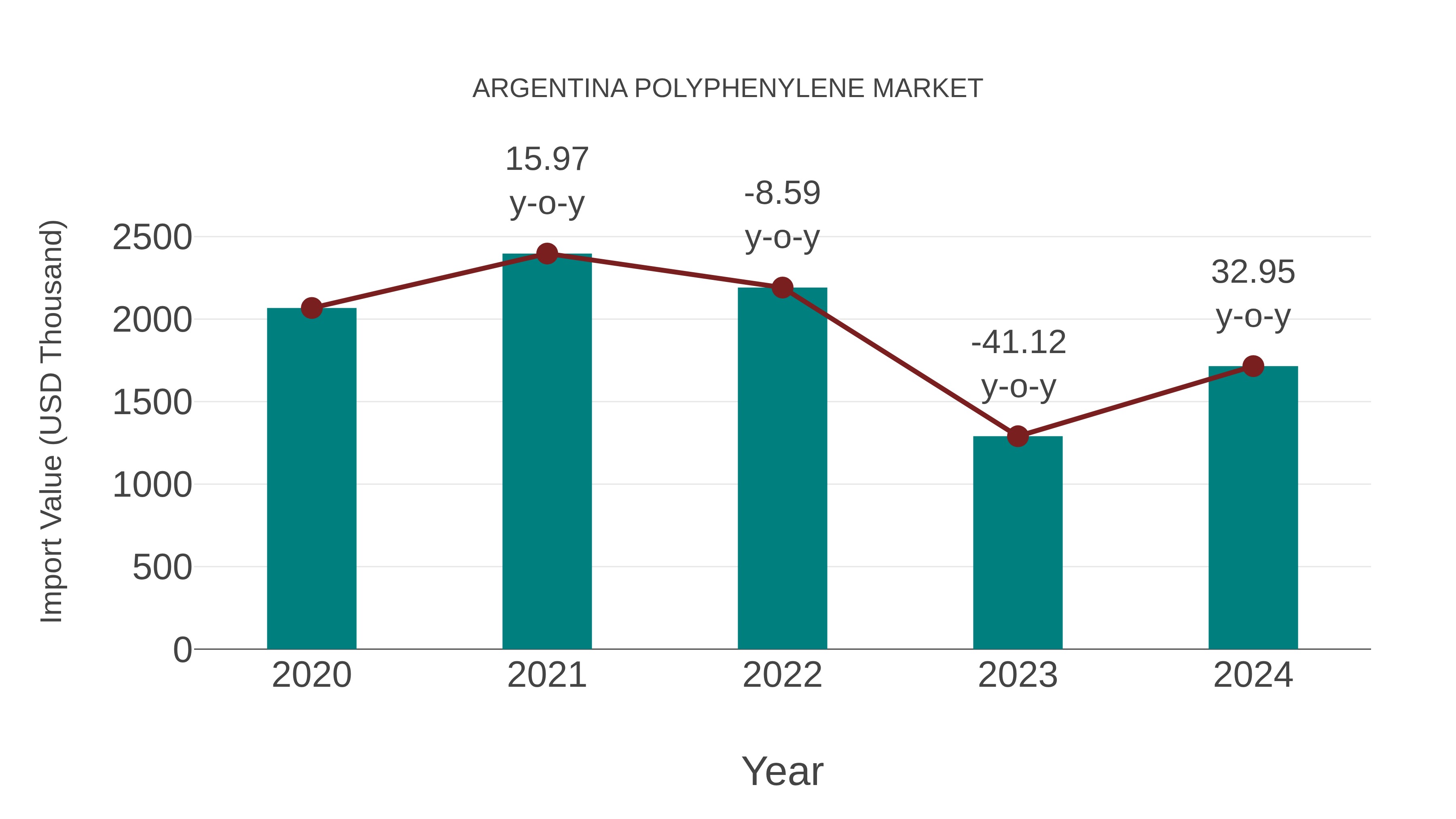
The Argentina polyphenylene market witnessed a negative Compound Annual Growth Rate (CAGR) of -4.56% from 2020 to 2024. However, in 2023-2024, there was a significant year-on-year growth rate of 32.95%. This increase in imports during 2023-2024 can be attributed to various factors influencing market dynamics during that period.
Argentina Polyphenylene Market Overview
The Argentina Polyphenylene market is experiencing steady growth driven by increasing demand from various end-use industries such as automotive, electrical & electronics, and industrial applications. Polyphenylene is favored for its high heat resistance, chemical inertness, and excellent mechanical properties, making it suitable for a wide range of applications. The automotive sector is a key driver of growth, with rising demand for lightweight materials to improve fuel efficiency and reduce emissions. In the electrical & electronics industry, polyphenylene is used in connectors, sockets, and switches due to its high dielectric strength. The market is competitive with key players focusing on innovation and product development to cater to evolving customer needs. However, challenges such as fluctuating raw material prices and regulatory constraints may impact market growth in the near term.
Argentina Polyphenylene Market Trends and Opportunities
The Argentina Polyphenylene Market is experiencing growth driven by increasing demand from the automotive, electrical and electronics, and industrial sectors. The rising focus on lightweight and high-performance materials in the automotive industry, coupled with the expanding electrical and electronics sector, is fueling the demand for polyphenylene in Argentina. Additionally, the growing trend towards sustainable and environmentally friendly materials is creating opportunities for bio-based polyphenylene products in the market. Companies are investing in research and development to innovate and introduce new product variants with enhanced properties to cater to diverse end-user requirements. Overall, the Argentina Polyphenylene Market is poised for further expansion, presenting opportunities for market players to capitalize on the increasing demand and diversification of applications.
Argentina Polyphenylene Market Challenges
In the Argentina Polyphenylene market, one of the key challenges faced is the limited awareness and understanding of the benefits and applications of Polyphenylene among potential customers. This lack of awareness can lead to difficulties in market penetration and adoption of Polyphenylene products. Additionally, the availability of alternative materials at potentially lower costs can pose a challenge in convincing customers of the value proposition of Polyphenylene. Furthermore, economic instability and fluctuations in currency exchange rates in Argentina can impact the pricing and competitiveness of Polyphenylene products in the market. Overcoming these challenges would require targeted marketing efforts, education campaigns, competitive pricing strategies, and a deep understanding of the local economic conditions to effectively position Polyphenylene in the market.
Argentina Polyphenylene Market Drivers
The Argentina Polyphenylene market is primarily driven by the increasing demand for high-performance engineering plastics in industries such as automotive, electronics, and aerospace. Polyphenylene is favored for its excellent thermal stability, mechanical strength, and chemical resistance, making it an ideal material for manufacturing components that require high performance and reliability. Additionally, the growing trend towards lightweight materials to improve fuel efficiency in automotive applications is boosting the demand for polyphenylene composites. Furthermore, the expanding electronics industry in Argentina, coupled with the rising adoption of advanced technologies, is driving the demand for polyphenylene in the production of electronic components. Overall, the increasing focus on advanced materials with superior properties is expected to continue driving the growth of the Argentina Polyphenylene market in the coming years.
Argentina Polyphenylene Market Government Policy
Government policies related to the Argentina Polyphenylene Market focus on promoting domestic production and innovation in the industry. The government provides various incentives and support schemes for local polyphenylene manufacturers to enhance competitiveness and increase export potential. Additionally, there are regulations in place to ensure environmental sustainability and compliance with quality standards in production processes. The government also encourages research and development activities in the polyphenylene sector to foster technological advancements and drive growth in the market. Overall, government policies aim to stimulate the growth of the Argentina Polyphenylene Market by supporting local businesses, promoting innovation, and ensuring sustainability in the industry.
Argentina Polyphenylene Market Future Outlook
The future outlook for the Argentina Polyphenylene Market appears positive, with anticipated growth driven by increasing demand from various end-use industries such as automotive, electronics, and industrial applications. Factors such as the lightweight and high-performance characteristics of polyphenylene, along with its resistance to chemicals and high temperatures, are expected to fuel its adoption in diverse applications. Additionally, the growing focus on sustainable and eco-friendly materials is likely to drive the demand for polyphenylene in the coming years. The market is also projected to benefit from technological advancements and innovations in polyphenylene production processes, leading to enhanced product performance and cost-efficiency. Overall, the Argentina Polyphenylene Market is poised for expansion, supported by favorable market dynamics and growing applications across different sectors.
Key Highlights of the Report:
- Argentina Polyphenylene Market Outlook
- Market Size of Argentina Polyphenylene Market, 2025
- Forecast of Argentina Polyphenylene Market, 2032
- Historical Data and Forecast of Argentina Polyphenylene Revenues & Volume for the Period 2022 - 2032F
- Argentina Polyphenylene Market Trend Evolution
- Argentina Polyphenylene Market Drivers and Challenges
- Argentina Polyphenylene Price Trends
- Argentina Polyphenylene Porter's Five Forces
- Argentina Polyphenylene Industry Life Cycle
- Historical Data and Forecast of Argentina Polyphenylene Market Revenues & Volume By Type for the Period 2022 - 2032F
- Historical Data and Forecast of Argentina Polyphenylene Market Revenues & Volume By PPS for the Period 2022 - 2032F
- Historical Data and Forecast of Argentina Polyphenylene Market Revenues & Volume By PPO/PPE for the Period 2022 - 2032F
- Historical Data and Forecast of Argentina Polyphenylene Market Revenues & Volume By Application for the Period 2022 - 2032F
- Historical Data and Forecast of Argentina Polyphenylene Market Revenues & Volume By Engineering Plastics for the Period 2022 - 2032F
- Historical Data and Forecast of Argentina Polyphenylene Market Revenues & Volume By Filter Bag for the Period 2022 - 2032F
- Historical Data and Forecast of Argentina Polyphenylene Market Revenues & Volume By Composites for the Period 2022 - 2032F
- Historical Data and Forecast of Argentina Polyphenylene Market Revenues & Volume By High Performance Lubricants for the Period 2022 - 2032F
- Historical Data and Forecast of Argentina Polyphenylene Market Revenues & Volume By End Use Industry for the Period 2022 - 2032F
- Historical Data and Forecast of Argentina Polyphenylene Market Revenues & Volume By Automotive for the Period 2022 - 2032F
- Historical Data and Forecast of Argentina Polyphenylene Market Revenues & Volume By Electronics & Electrical for the Period 2022 - 2032F
- Historical Data and Forecast of Argentina Polyphenylene Market Revenues & Volume By Industrial for the Period 2022 - 2032F
- Historical Data and Forecast of Argentina Polyphenylene Market Revenues & Volume By Coatings for the Period 2022 - 2032F
- Argentina Polyphenylene Import Export Trade Statistics
- Market Opportunity Assessment By Type
- Market Opportunity Assessment By Application
- Market Opportunity Assessment By End Use Industry
- Argentina Polyphenylene Top Companies Market Share
- Argentina Polyphenylene Competitive Benchmarking By Technical and Operational Parameters
- Argentina Polyphenylene Company Profiles
- Argentina Polyphenylene Key Strategic Recommendations






































