Argentina Processed Fruit Market Growth Rate Analysis (2025 - 2031)
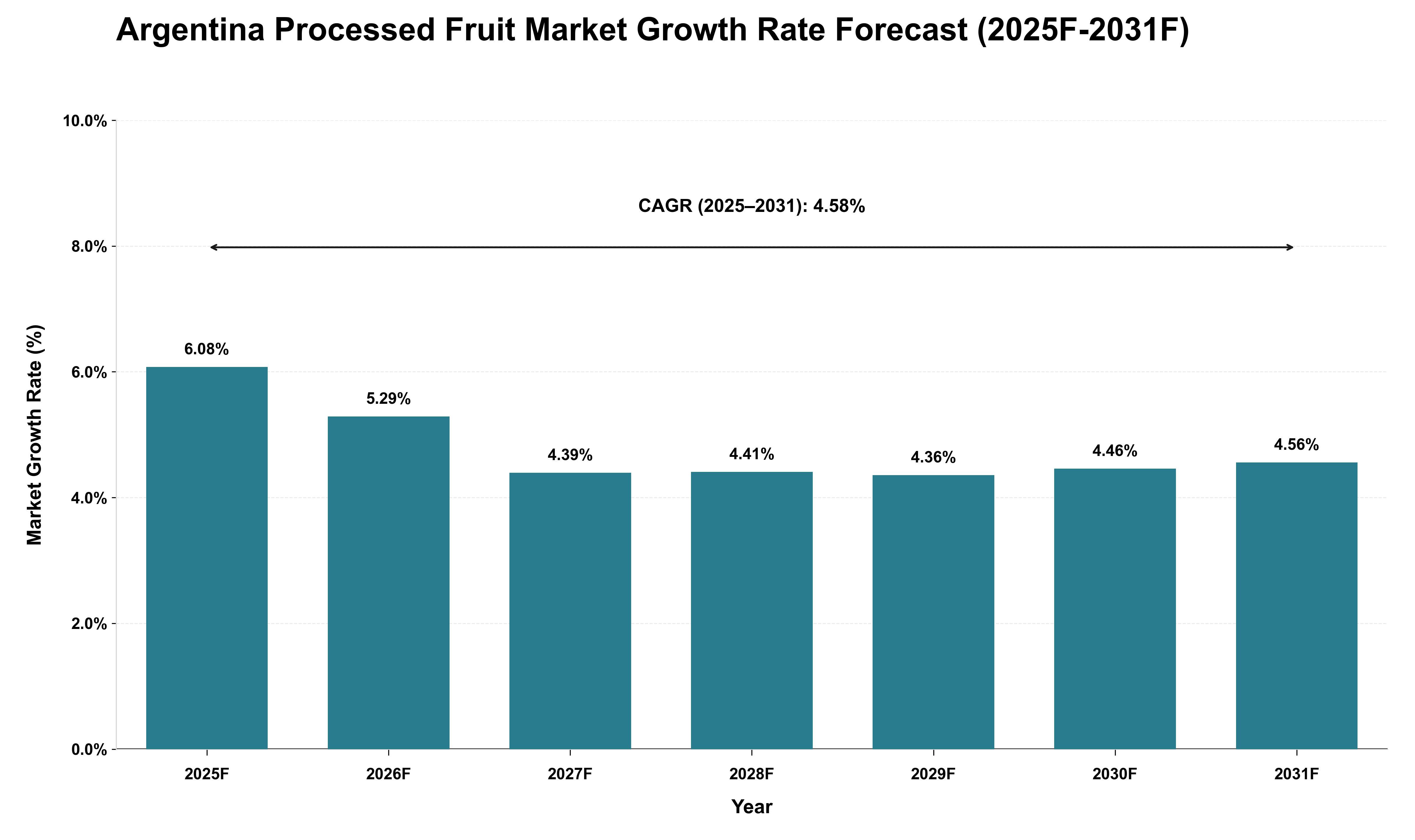
The Argentina processed fruit market will experience a notable shift in export and import dynamics from 2025 to 2031, driven by increasing global demand for healthy food options and the country's agricultural capabilities. The forecasted CAGR of 4.58% reflects a robust growth trajectory, with annual growth rates peaking at 6.08% in 2025 before gradually stabilizing around the mid-4% range. This trend indicates that Argentina will likely enhance its position as a key exporter of processed fruits, capitalizing on favorable trade agreements and improving logistics infrastructure. Concurrently, import dependencies may evolve as domestic consumption patterns shift towards higher-quality processed products, necessitating imports to meet consumer preferences. As global markets increasingly prioritize sustainability and traceability, Argentina's ability to adapt its production practices will be crucial in maintaining competitive export flows throughout this period.
Key Highlights of the Report:
- Argentina Processed Fruit Market Outlook
- Market Size of Argentina Processed Fruit Market, 2025
- Forecast of Argentina Processed Fruit Market, 2032
- Historical Data and Forecast of Argentina Processed Fruit Revenues & Volume for the Period 2022-2032F
- Argentina Processed Fruit Market Trend Evolution
- Argentina Processed Fruit Market Drivers and Challenges
- Argentina Processed Fruit Price Trends
- Argentina Processed Fruit Porter's Five Forces
- Argentina Processed Fruit Industry Life Cycle
- Historical Data and Forecast of Argentina Processed Fruit Market Revenues & Volume By Product for the Period 2022-2032F
- Historical Data and Forecast of Argentina Processed Fruit Market Revenues & Volume By Fresh for the Period 2022-2032F
- Historical Data and Forecast of Argentina Processed Fruit Market Revenues & Volume By Fresh- Cut for the Period 2022-2032F
- Historical Data and Forecast of Argentina Processed Fruit Market Revenues & Volume By Canned for the Period 2022-2032F
- Historical Data and Forecast of Argentina Processed Fruit Market Revenues & Volume By Frozen for the Period 2022-2032F
- Historical Data and Forecast of Argentina Processed Fruit Market Revenues & Volume By Drying &Dehydration for the Period 2022-2032F
- Historical Data and Forecast of Argentina Processed Fruit Market Revenues & Volume By Processing Equipment for the Period 2022-2032F
- Historical Data and Forecast of Argentina Processed Fruit Market Revenues & Volume By Pre-processing for the Period 2022-2032F
- Historical Data and Forecast of Argentina Processed Fruit Market Revenues & Volume By Processing for the Period 2022-2032F
- Historical Data and Forecast of Argentina Processed Fruit Market Revenues & Volume By Washing for the Period 2022-2032F
- Historical Data and Forecast of Argentina Processed Fruit Market Revenues & Volume By Filling for the Period 2022-2032F
- Historical Data and Forecast of Argentina Processed Fruit Market Revenues & Volume By Seasoning for the Period 2022-2032F
- Historical Data and Forecast of Argentina Processed Fruit Market Revenues & Volume By Packaging for the Period 2022-2032F
- Argentina Processed Fruit Import Export Trade Statistics
- Market Opportunity Assessment By Product
- Market Opportunity Assessment By Processing Equipment
- Argentina Processed Fruit Top Companies Market Share
- Argentina Processed Fruit Competitive Benchmarking By Technical and Operational Parameters
- Argentina Processed Fruit Company Profiles
- Argentina Processed Fruit Key Strategic Recommendations






































