Argentina Unified Monitoring Market Size & Growth Rate (2026-2032)
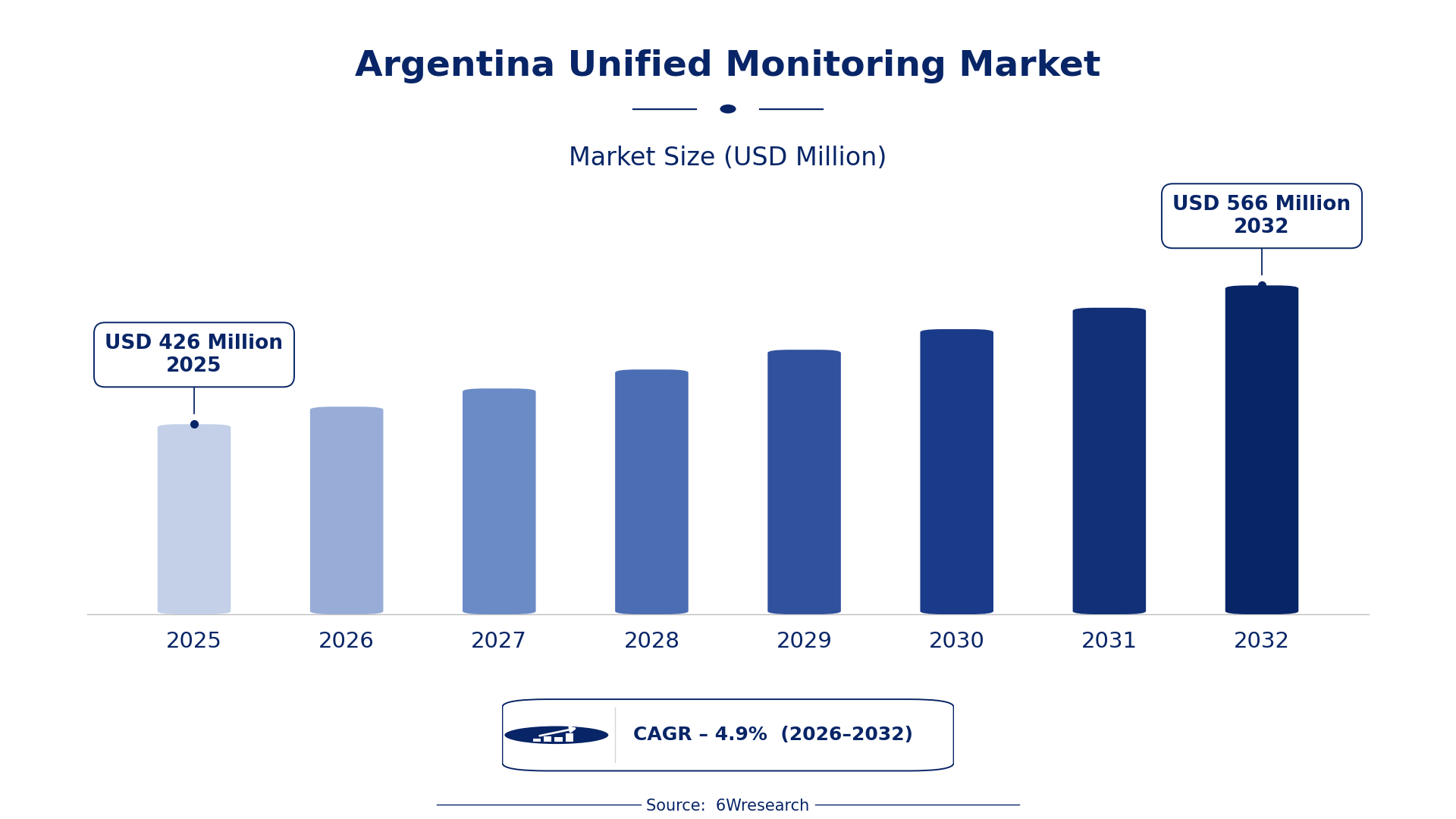
The Argentina Unified Monitoring Market was estimated at USD 426 Million in 2025 and is projected to reach USD 566 Million by 2032, growing at a CAGR of 4.9% from 2026 to 2032.
Argentina Unified Monitoring Market Synopsis
The complexity of IT infrastructures in Argentina is the primary force propelling the unified monitoring market. Businesses are increasingly reliant on integrated solutions that provide a comprehensive view of their operations, particularly as digital transformation accelerates.
Unified monitoring solutions are evolving to meet the demands for real-time insights into performance management, allowing organizations to troubleshoot issues before they impact services. As reliance on digital technologies grows, the need for effective monitoring becomes non-negotiable for maintaining competitive edge.
Argentina Unified Monitoring Market Year-wise Growth Rate and Key Drivers
This graph illustrates the annual growth rates of the Argentina Unified Monitoring Market from 2021 to 2032, highlighting a steady upward trajectory and projected expansion over the forecast period.
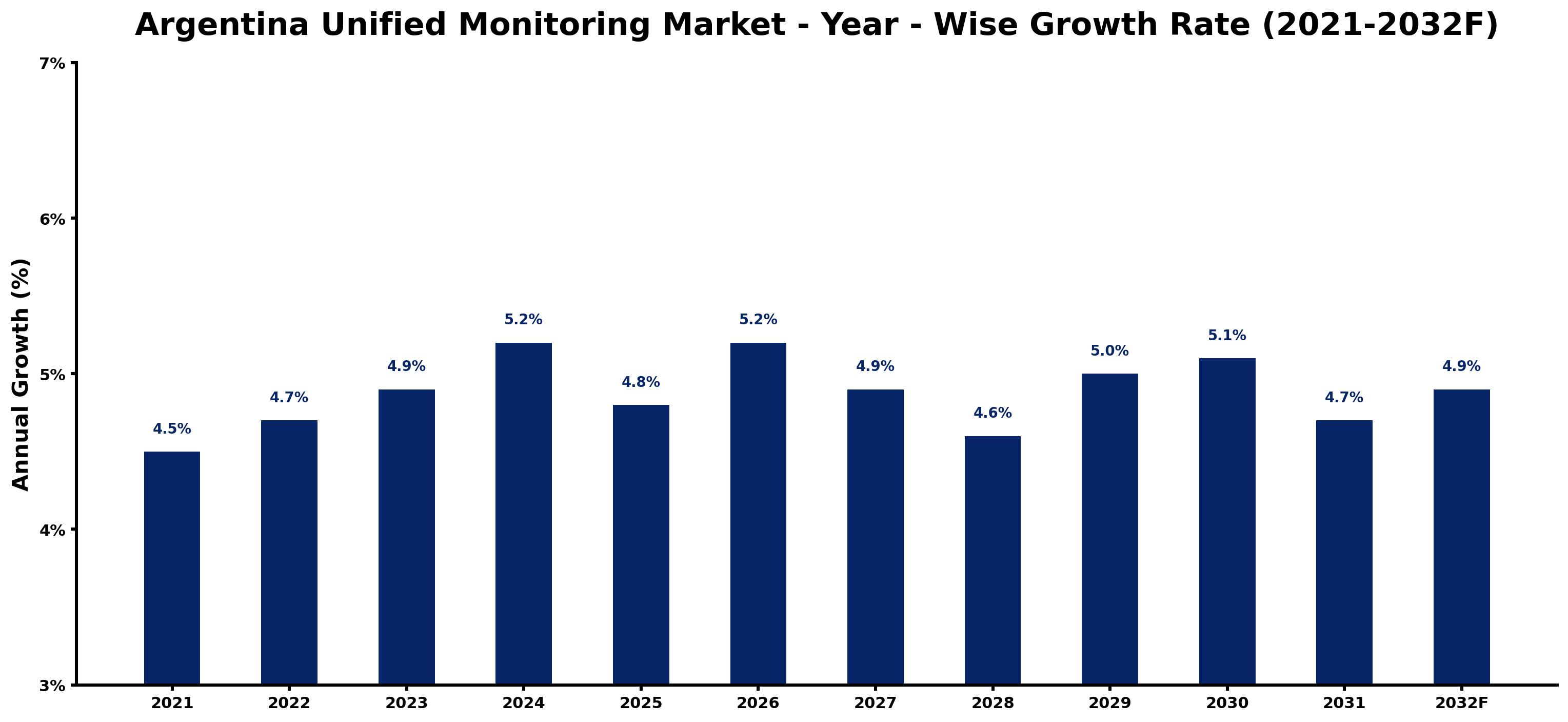
The table below presents the year‑wise growth rates along with the key drivers influencing the market
| Year | Growth Rate | Major Drivers |
| 2021 | 4.5% | Government initiative for enhanced environmental regulation monitoring. |
| 2022 | 4.7% | Increased urbanization driving demand for real-time data. |
| 2023 | 4.9% | Adoption of smart technology in agriculture sector. |
| 2024 | 5.2% | Growth of renewable projects requiring stringent monitoring solutions. |
| 2025 | 4.8% | Strengthening of local cybersecurity regulations enhancing data safety. |
| 2026 | 5.2% | Emergence of new startups in IoT monitoring technologies. |
| 2027 | 4.9% | Growing need for compliance in resource extraction industries. |
| 2028 | 4.6% | Government investment in disaster management technology enhancements. |
| 2029 | 5.0% | Rising public health concerns necessitating improved environmental oversight. |
| 2030 | 5.1% | Increased availability of funding for tech-driven monitoring solutions. |
| 2031 | 4.7% | Boost in local manufacturing capabilities supporting monitoring devices. |
| 2032 | 4.9% | Focus on sustainable urban development prompting monitoring innovations. |
Note: Market size estimations and growth projections presented in this report are based on 6Wresearch's proprietary forecasting methodology, utilizing the latest available industry data, government publications, and primary research inputs.
Argentina Unified Monitoring Market Key Takeaways
Below are some of the specific key takeaways from the market, including:
- The increasing complexity of IT environments drives the adoption of unified monitoring solutions.
- Digitalization initiatives across sectors bolster the demand for comprehensive monitoring platforms.
- Real-time insights and proactive performance management are essential for maintaining service availability.
- Challenges related to data volume and variety present significant hurdles for providers.
- Government policies aimed at enhancing digital infrastructure play a crucial role in market growth.
Evaluation of Restraints in Argentina Unified Monitoring Market
Despite its growth potential, the Argentina Unified Monitoring Market faces notable restraints. The sheer volume and variety of data can hinder effective monitoring and analysis, complicating the integration of insights across diverse platforms. Additionally, meeting scalability requirements while ensuring real-time data processing is a significant challenge. The issue of minimizing false positives remains a major concern for solution providers, impacting the perceived reliability of monitoring tools.
Argentina Unified Monitoring Market Trends
Several trends are shaping the Argentina Unified Monitoring Market. The rise of artificial intelligence and machine learning in monitoring solutions is allowing for more accurate and predictive analytics. As organizations aim for digital transformation, there’s a marked shift toward cloud-based monitoring tools that offer flexibility and scalability. on top of that, an increasing emphasis on cybersecurity is driving businesses to adopt comprehensive monitoring systems that ensure data integrity and security.
Argentina Unified Monitoring Market Opportunities
The market holds considerable opportunities for investment and growth. The ongoing digitalization of traditional sectors presents a fertile ground for unified monitoring solutions. Additionally, as companies increasingly prioritize customer experience, there is a growing need for tools that provide actionable insights into service performance. The integration of IoT devices within monitoring frameworks is another area ripe for expansion, enabling businesses to harness data from various sources.
Government Initiatives in the Argentina Unified Monitoring Market
Government initiatives in Argentina are shaping the unified monitoring market by promoting digital infrastructure and enhancing service quality. Policies geared towards standardizing network monitoring and improving the reliability of telecommunications have created an environment conducive to market growth. These initiatives not only address current challenges but also lay the groundwork for future advancements.
- A recently completed national digital infrastructure upgrade aimed at enhancing broadband access and reliability across urban and rural areas.
- A current initiative focusing on establishing network monitoring standards to ensure compliance with service level agreements.
- Plans for a public-private partnership that seeks to expand IT infrastructure capabilities, with an emphasis on application performance monitoring by 2028.
- A recently launched regulatory framework intended to improve the quality of service metrics applicable to unified monitoring solutions.
Future Insights of the Argentina Unified Monitoring Market
Looking forward, the Argentina Unified Monitoring Market is on track for sustained growth. The ongoing integration of advanced technologies such as AI and machine learning will enhance monitoring capabilities, enabling organizations to respond swiftly to issues. on top of that, as digital transformation continues to penetrate various sectors, the demand for unified solutions that offer a singular view of IT performance will only increase. Businesses that adapt to these changes and embrace innovation will likely find themselves at a significant advantage.
Argentina Unified Monitoring Market Latest Developments
In the past year, activity in the Argentina Unified Monitoring Market has accelerated, with several key developments reflecting the growing focus on integrated solutions. Companies are increasingly investing in technologies that enable real-time monitoring and analytics, demonstrating a commitment to enhancing IT performance and operational efficiency.
- A major technology vendor launched a new cloud-based monitoring solution in early 2025, designed to cater specifically to SMEs in Argentina.
- A leading regional operator is currently upgrading its monitoring capabilities, focusing on AI-driven analytics to improve service performance, with deployment expected by mid-2026.
- A partnership between a software provider and a telecommunications company is ongoing, aimed at developing integrated monitoring tools tailored for specific industry needs.
- Upcoming in late 2026 is a rollout of a training program intended to educate IT professionals on best practices for utilizing unified monitoring solutions.
Argentina Unified Monitoring Market - Key Attractiveness of the Report
- 10 Years of Market Numbers
- Historical Data Starting from 2022 to 2025
- Base Year: 2025
- Forecast Data until 2032
- Key Performance Indicators Impacting the Market
- Major Upcoming Developments and Projects
Key Highlights of the Report:
- Argentina Unified Monitoring Market Outlook
- Market Size of Argentina Unified Monitoring Market, 2025
- Forecast of Argentina Unified Monitoring Market, 2032
- Historical Data and Forecast of Argentina Unified Monitoring Revenues & Volume for the Period 2022-2032F
- Argentina Unified Monitoring Market Trend Evolution
- Argentina Unified Monitoring Market Drivers and Challenges
- Argentina Unified Monitoring Price Trends
- Argentina Unified Monitoring Porter's Five Forces
- Argentina Unified Monitoring Industry Life Cycle
- Historical Data and Forecast of Argentina Unified Monitoring Market Revenues & Volume By Component for the Period 2022-2032F
- Historical Data and Forecast of Argentina Unified Monitoring Market Revenues & Volume By Solutions for the Period 2022-2032F
- Historical Data and Forecast of Argentina Unified Monitoring Market Revenues & Volume By Services for the Period 2022-2032F
- Historical Data and Forecast of Argentina Unified Monitoring Market Revenues & Volume By Deployment Type for the Period 2022-2032F
- Historical Data and Forecast of Argentina Unified Monitoring Market Revenues & Volume By On-Premises for the Period 2022-2032F
- Historical Data and Forecast of Argentina Unified Monitoring Market Revenues & Volume By Cloud for the Period 2022-2032F
- Historical Data and Forecast of Argentina Unified Monitoring Market Revenues & Volume By Vertical for the Period 2022-2032F
- Historical Data and Forecast of Argentina Unified Monitoring Market Revenues & Volume By BFSI for the Period 2022-2032F
- Historical Data and Forecast of Argentina Unified Monitoring Market Revenues & Volume By Healthcare & Life Sciences for the Period 2022-2032F
- Historical Data and Forecast of Argentina Unified Monitoring Market Revenues & Volume By Telecommunications & ITES for the Period 2022-2032F
- Historical Data and Forecast of Argentina Unified Monitoring Market Revenues & Volume By Manufacturing for the Period 2022-2032F
- Historical Data and Forecast of Argentina Unified Monitoring Market Revenues & Volume By Organization Size for the Period 2022-2032F
- Historical Data and Forecast of Argentina Unified Monitoring Market Revenues & Volume By Small and Medium-sized Enterprises (SMEs) for the Period 2022-2032F
- Historical Data and Forecast of Argentina Unified Monitoring Market Revenues & Volume By Large enterprises for the Period 2022-2032F
- Argentina Unified Monitoring Import Export Trade Statistics
- Market Opportunity Assessment By Component
- Market Opportunity Assessment By Deployment Type
- Market Opportunity Assessment By Vertical
- Market Opportunity Assessment By Organization Size
- Argentina Unified Monitoring Top Companies Market Share
- Argentina Unified Monitoring Competitive Benchmarking By Technical and Operational Parameters
- Argentina Unified Monitoring Company Profiles
- Argentina Unified Monitoring Key Strategic Recommendations






































