Argentina Workspace as a Service Market Size & Growth Rate (2026-2032)
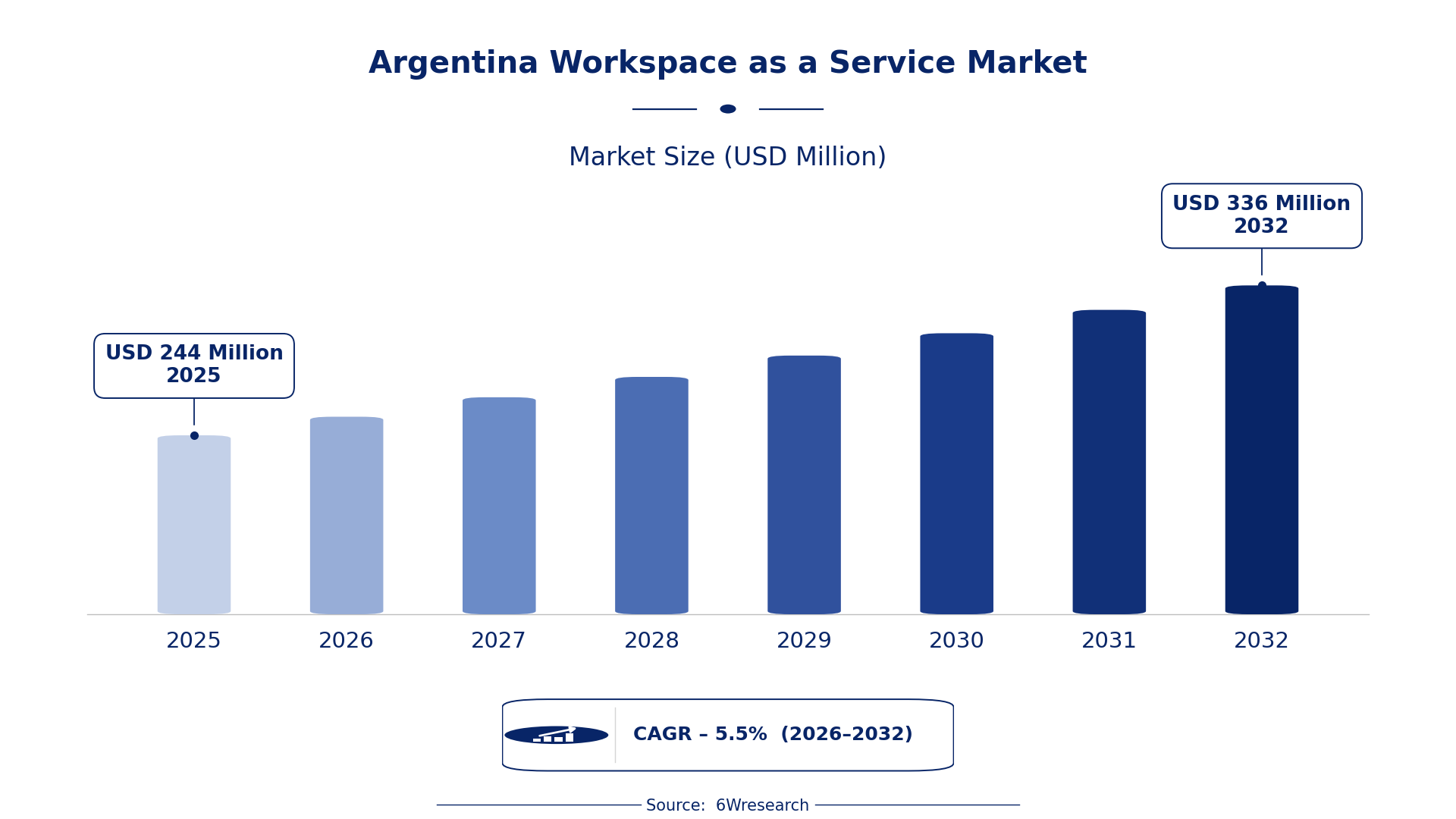
The Argentina Workspace as a Service Market was estimated at USD 244 Million in 2025 and is projected to reach USD 336 Million by 2032, growing at a CAGR of 5.5% from 2026 to 2032.
Argentina Workspace as a Service Market Synopsis
The Argentina Workspace as a Service market is witnessing a surge in demand fueled by the increasing reliance on remote work solutions and digital collaboration tools. With more businesses adopting flexible work arrangements, WaaS solutions are becoming indispensable, providing employees with secure access to applications and data from any device.
Cloud-based services are at the forefront of this transition, offering virtual desktops and applications tailored to the unique needs of organizations. As companies seek cost-effective and scalable options to enhance productivity, WaaS is emerging as a strategic choice in Argentina's business environment.
Argentina Workspace as a Service Market Year-wise Growth Rate and Key Drivers
This graph illustrates the annual growth rates of the Argentina Workspace as a Service Market from 2021 to 2032, highlighting a steady upward trajectory and projected expansion over the forecast period.
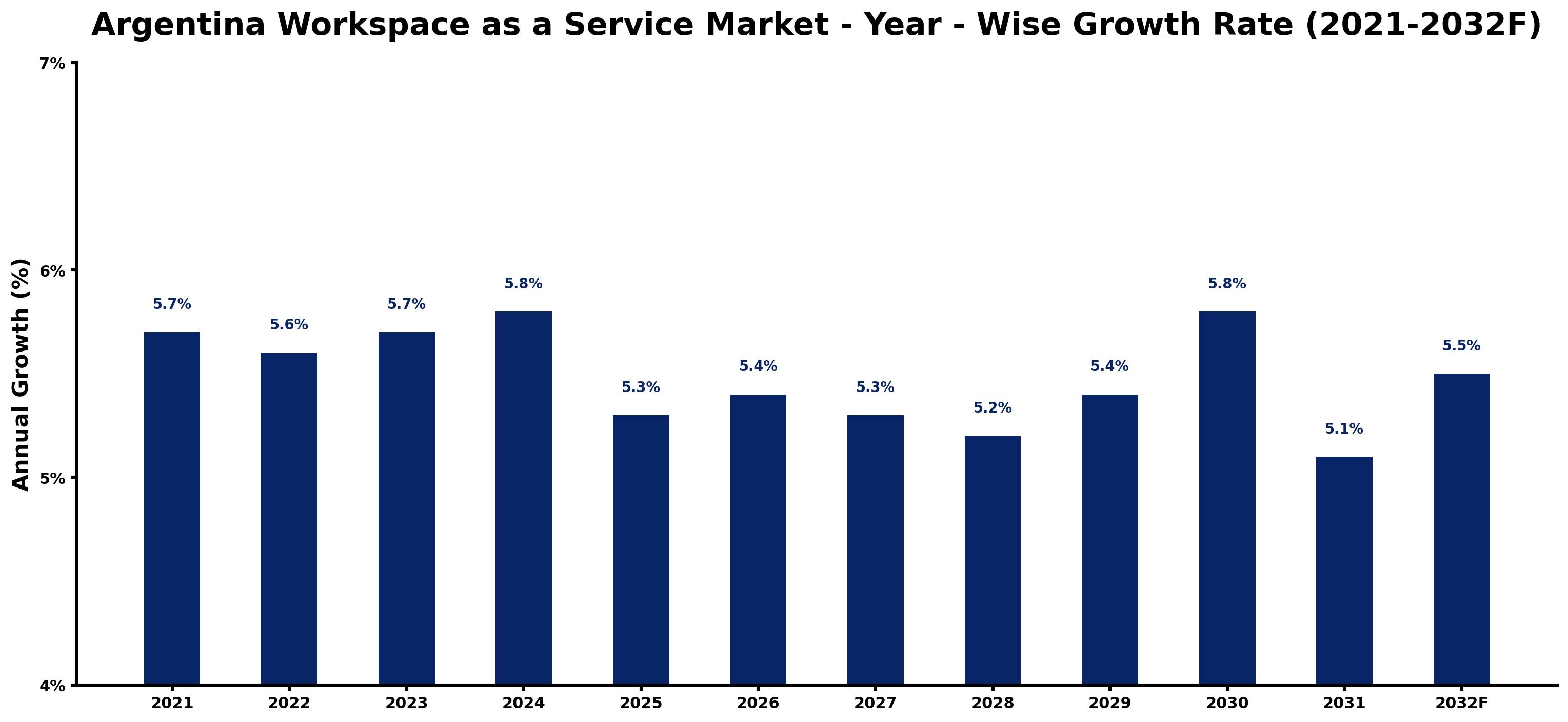
The table below presents the year‑wise growth rates along with the key drivers influencing the market
| Year | Growth Rate | Major Drivers |
| 2021 | 5.7% | Remote work legislation encourages flexible workspace solutions. |
| 2022 | 5.6% | Increased digital nomadism among young professionals boosts demand. |
| 2023 | 5.7% | Government programs support startups adopting workspace technologies. |
| 2024 | 5.8% | Rise in telecommuting drives interest in WaaS offerings. |
| 2025 | 5.3% | E-commerce growth stimulates remote collaboration tools. |
| 2026 | 5.4% | Local startups investing in innovative workspace technologies. |
| 2027 | 5.3% | Remote workforce expansion increases demand for virtual offices. |
| 2028 | 5.2% | Regulatory incentives for tech adoption in businesses. |
| 2029 | 5.4% | Shift towards hybrid work models sustains WaaS market. |
| 2030 | 5.8% | Growing interest in sustainability prompts green workspace solutions. |
| 2031 | 5.1% | Economic recovery leads to increased market competitiveness. |
| 2032 | 5.5% | Cultural acceptance of remote work enhances WaaS adoption. |
Note: Market size estimations and growth projections presented in this report are based on 6Wresearch's proprietary forecasting methodology, utilizing the latest available industry data, government publications, and primary research inputs.
Argentina Workspace as a Service Market Key Takeaways
Below are some of the specific key takeaways from the market, including:
- The demand for flexible, scalable workspace solutions continues to rise as organizations adapt to hybrid work models.
- Cost savings and operational efficiency are primary drivers pushing businesses towards adopting WaaS solutions.
- Data security regulations present challenges but also motivate investment in compliant WaaS infrastructures.
- Increased investment in cloud technologies is reshaping how businesses operate in Argentina.
- Remote access and collaboration tools are critical for maintaining business continuity in the face of disruptions.
Evaluation of Restraints in Argentina Workspace as a Service Market
While the Argentina Workspace as a Service market is expanding, several real barriers hinder its growth. Data security regulations create a complex landscape that companies must navigate, often requiring significant investment to meet compliance standards. Additionally, challenges related to remote access infrastructure can complicate service delivery, impacting user experience and performance. Service providers face the dual pressure of ensuring high performance while managing the scalability of virtual desktop solutions, which can be a delicate balance.
Argentina Workspace as a Service Market Trends
Current trends in the Argentina Workspace as a Service market highlight a shift towards integrated collaboration platforms that enhance remote team productivity. As organizations increasingly rely on cloud technologies, there is a growing emphasis on user experience and customization of workspace solutions. on top of that, the adoption of AI-driven analytics tools is on the rise, enabling businesses to optimize their workflows and gain insights into employee engagement and performance.
Argentina Workspace as a Service Market Opportunities
The Argentina Workspace as a Service market presents numerous opportunities for growth and investment. Companies that focus on developing tailored solutions that cater to specific industries can carve out a niche. Additionally, as data privacy concerns escalate, businesses that provide compliant and secure WaaS offerings are likely to see increased demand. Investing in local partnerships can also enhance service delivery, helping to overcome infrastructure challenges while improving accessibility.
Government Initiatives in the Argentina Workspace as a Service Market
The Argentine government is actively shaping the Workspace as a Service market through various regulatory frameworks and initiatives aimed at promoting digital transformation. These policies focus on enhancing cloud computing infrastructure and ensuring data privacy, which is essential for fostering a secure environment for WaaS solutions. As such, compliance with these regulations is vital for businesses looking to thrive in this sector.
- A national digital infrastructure upgrade programme is currently in its rollout phase, aimed at enhancing broadband access across urban and rural areas.
- Recent policy changes in 2025 mandated stricter compliance with data localization laws, compelling businesses to invest in local data centers.
- Ongoing discussions around a regulatory framework to promote cloud computing adoption are expected to be finalized by late 2026.
- A planned public-private partnership is anticipated to launch in 2027, focusing on enhancing cybersecurity measures for cloud-based services.
Future Insights of the Argentina Workspace as a Service Market
Looking ahead to 2026-2032, the Argentina Workspace as a Service market is set for notable advancements. The demand for WaaS solutions will likely be propelled by an increasing number of organizations adopting hybrid work environments. As technology continues to evolve, the integration of AI and machine learning into WaaS offerings will enhance operational efficiency and user experience. The market will also see a stronger emphasis on compliance and security, as businesses prioritize protecting sensitive data in a rapidly changing regulatory environment.
Argentina Workspace as a Service Market Latest Developments
In the past year, the Argentina Workspace as a Service market has witnessed significant developments, reflecting a growing interest in cloud-based solutions. Companies are focusing on enhancing their offerings to meet the rising demand for remote work solutions. As organizations adapt, innovations in service delivery and technology integration are becoming more prevalent.
- A leading regional operator launched a new cloud-based collaboration platform in early 2025, providing enhanced features for remote teamwork.
- An initiative that began in mid-2025 is underway to improve data center capabilities, ensuring compliance with emerging regulatory standards.
- A major technology vendor announced plans for an upcoming service upgrade expected to begin in Q3 2026, focusing on enhanced security features.
- A partnership between local tech startups and established firms was formed in late 2025, aimed at fostering innovation in WaaS solutions.
Argentina Workspace as a Service Market - Key Attractiveness of the Report
- 10 Years of Market Numbers
- Historical Data Starting from 2022 to 2025
- Base Year: 2025
- Forecast Data until 2032
- Key Performance Indicators Impacting the Market
- Major Upcoming Developments and Projects
Key Highlights of the Report:
- Argentina Workspace as a Service Market Outlook
- Market Size of Argentina Workspace as a Service Market, 2025
- Forecast of Argentina Workspace as a Service Market, 2032
- Historical Data and Forecast of Argentina Workspace as a Service Revenues & Volume for the Period 2022-2032F
- Argentina Workspace as a Service Market Trend Evolution
- Argentina Workspace as a Service Market Drivers and Challenges
- Argentina Workspace as a Service Price Trends
- Argentina Workspace as a Service Porter's Five Forces
- Argentina Workspace as a Service Industry Life Cycle
- Historical Data and Forecast of Argentina Workspace as a Service Market Revenues & Volume By Solutions for the Period 2022-2032F
- Historical Data and Forecast of Argentina Workspace as a Service Market Revenues & Volume By VDI and Applications for the Period 2022-2032F
- Historical Data and Forecast of Argentina Workspace as a Service Market Revenues & Volume By Desktop as a Service for the Period 2022-2032F
- Historical Data and Forecast of Argentina Workspace as a Service Market Revenues & Volume By Hosted Applications (Unified Communication Applications) for the Period 2022-2032F
- Historical Data and Forecast of Argentina Workspace as a Service Market Revenues & Volume By Security Solutions for the Period 2022-2032F
- Historical Data and Forecast of Argentina Workspace as a Service Market Revenues & Volume By Others (Browser-based WaaS solutions) for the Period 2022-2032F
- Historical Data and Forecast of Argentina Workspace as a Service Market Revenues & Volume By Services for the Period 2022-2032F
- Historical Data and Forecast of Argentina Workspace as a Service Market Revenues & Volume By System Integration for the Period 2022-2032F
- Historical Data and Forecast of Argentina Workspace as a Service Market Revenues & Volume By Consulting services for the Period 2022-2032F
- Historical Data and Forecast of Argentina Workspace as a Service Market Revenues & Volume By Managed services for the Period 2022-2032F
- Historical Data and Forecast of Argentina Workspace as a Service Market Revenues & Volume By Deployment Type for the Period 2022-2032F
- Historical Data and Forecast of Argentina Workspace as a Service Market Revenues & Volume By Public for the Period 2022-2032F
- Historical Data and Forecast of Argentina Workspace as a Service Market Revenues & Volume By Private for the Period 2022-2032F
- Historical Data and Forecast of Argentina Workspace as a Service Market Revenues & Volume By Hybrid for the Period 2022-2032F
- Historical Data and Forecast of Argentina Workspace as a Service Market Revenues & Volume By End-Users for the Period 2022-2032F
- Historical Data and Forecast of Argentina Workspace as a Service Market Revenues & Volume By Enterprises for the Period 2022-2032F
- Historical Data and Forecast of Argentina Workspace as a Service Market Revenues & Volume By Small and medium businesses(SMB) for the Period 2022-2032F
- Historical Data and Forecast of Argentina Workspace as a Service Market Revenues & Volume By Verticals for the Period 2022-2032F
- Historical Data and Forecast of Argentina Workspace as a Service Market Revenues & Volume By Banking, Financial Services and Insurance (BFSI) for the Period 2022-2032F
- Historical Data and Forecast of Argentina Workspace as a Service Market Revenues & Volume By Retail for the Period 2022-2032F
- Historical Data and Forecast of Argentina Workspace as a Service Market Revenues & Volume By Government for the Period 2022-2032F
- Historical Data and Forecast of Argentina Workspace as a Service Market Revenues & Volume By Healthcare for the Period 2022-2032F
- Historical Data and Forecast of Argentina Workspace as a Service Market Revenues & Volume By Manufacturing for the Period 2022-2032F
- Historical Data and Forecast of Argentina Workspace as a Service Market Revenues & Volume By Telecom and IT for the Period 2022-2032F
- Historical Data and Forecast of Argentina Workspace as a Service Market Revenues & Volume By Utilities for the Period 2022-2032F
- Historical Data and Forecast of Argentina Workspace as a Service Market Revenues & Volume By Travel and Hospitality for the Period 2022-2032F
- Argentina Workspace as a Service Import Export Trade Statistics
- Market Opportunity Assessment By Solutions
- Market Opportunity Assessment By Services
- Market Opportunity Assessment By Deployment Type
- Market Opportunity Assessment By End-Users
- Market Opportunity Assessment By Verticals
- Argentina Workspace as a Service Top Companies Market Share
- Argentina Workspace as a Service Competitive Benchmarking By Technical and Operational Parameters
- Argentina Workspace as a Service Company Profiles
- Argentina Workspace as a Service Key Strategic Recommendations






































