Armenia Pipe Market Year-wise Growth Rate (2021-2031F)
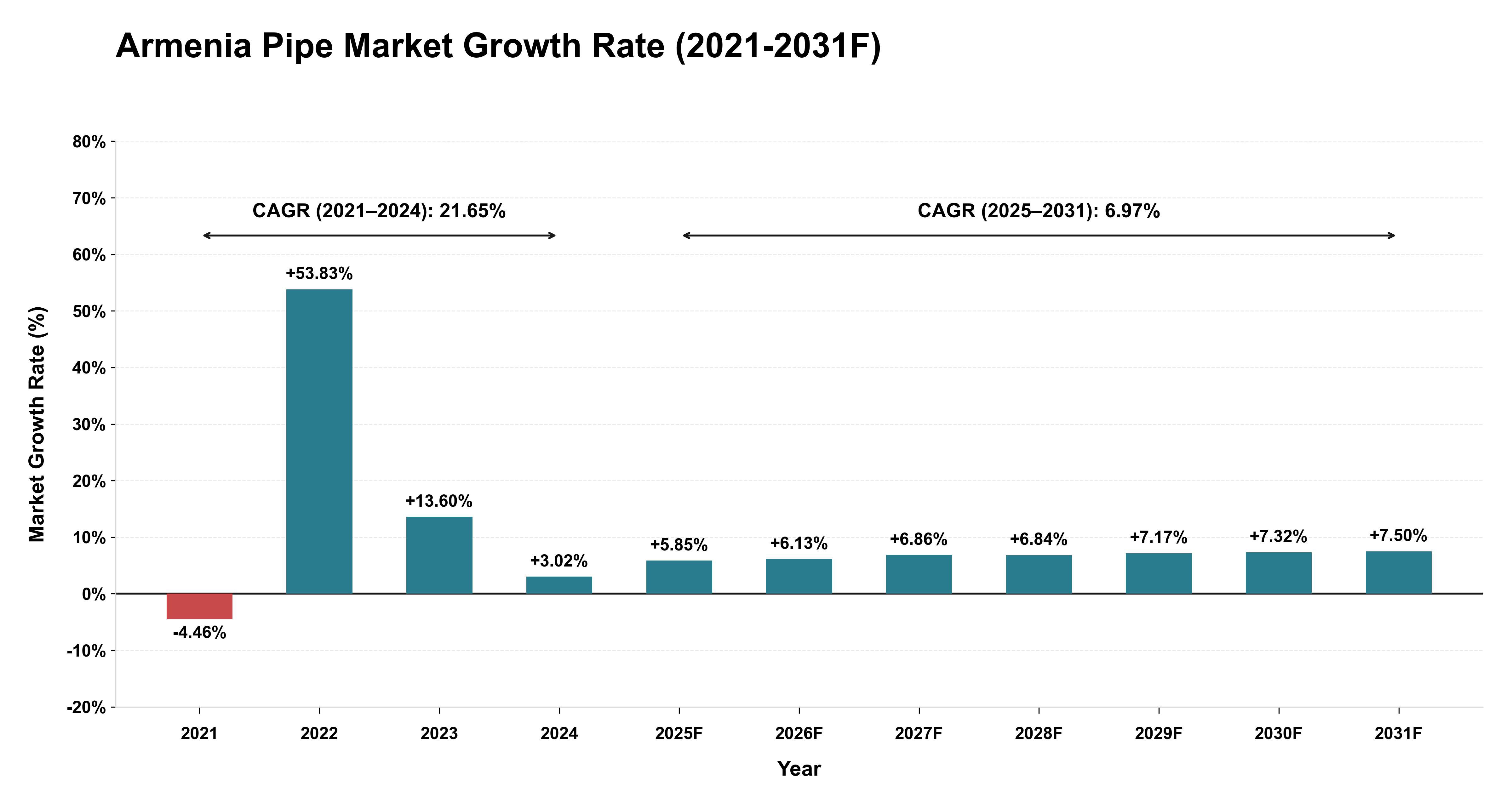
The Armenia Pipe Market experienced a tumultuous period from 2021 to 2024, marked by a significant contraction of -4.46% in 2021, followed by a remarkable rebound with 53.83% growth in 2022 driven by infrastructure projects. Subsequent years saw more stable growth rates of 13.60% in 2023 and 3.02% in 2024 as demand stabilized post-recovery phase. Looking ahead to 2025-2031, the market is poised for a more sustainable growth trajectory with an expected CAGR of 6.97%. This forecast indicates a shift towards steady expansion driven by ongoing construction activities, urbanization trends, and infrastructure development projects in Armenia. The deceleration in growth rates post-2024 reflects a maturing market adapting to new demand dynamics and regulatory changes, signaling a more balanced and resilient pipe market moving forward.
Key Highlights of the Report:
- Armenia Pipe Market Outlook
- Market Size of Armenia Pipe Market, 2025
- Forecast of Armenia Pipe Market, 2032
- Historical Data and Forecast of Armenia Pipe Revenues & Volume for the Period 2022-2032F
- Armenia Pipe Market Trend Evolution
- Armenia Pipe Market Drivers and Challenges
- Armenia Pipe Price Trends
- Armenia Pipe Porter's Five Forces
- Armenia Pipe Industry Life Cycle
- Historical Data and Forecast of Armenia Pipe Market Revenues & Volume By Material for the Period 2022-2032F
- Historical Data and Forecast of Armenia Pipe Market Revenues & Volume By Concrete for the Period 2022-2032F
- Historical Data and Forecast of Armenia Pipe Market Revenues & Volume By Thermoset and composite for the Period 2022-2032F
- Historical Data and Forecast of Armenia Pipe Market Revenues & Volume By Metal for the Period 2022-2032F
- Historical Data and Forecast of Armenia Pipe Market Revenues & Volume By Thermoplastic for the Period 2022-2032F
- Historical Data and Forecast of Armenia Pipe Market Revenues & Volume By Diameter for the Period 2022-2032F
- Historical Data and Forecast of Armenia Pipe Market Revenues & Volume By DN upto 50 mm for the Period 2022-2032F
- Historical Data and Forecast of Armenia Pipe Market Revenues & Volume By DN 51 to 150 mm for the Period 2022-2032F
- Historical Data and Forecast of Armenia Pipe Market Revenues & Volume By DN 151 to 300 mm for the Period 2022-2032F
- Historical Data and Forecast of Armenia Pipe Market Revenues & Volume By DN 301 to 500 mm for the Period 2022-2032F
- Historical Data and Forecast of Armenia Pipe Market Revenues & Volume By DN above 501 mm for the Period 2022-2032F
- Historical Data and Forecast of Armenia Pipe Market Revenues & Volume By Application for the Period 2022-2032F
- Historical Data and Forecast of Armenia Pipe Market Revenues & Volume By Water and wastewater for the Period 2022-2032F
- Historical Data and Forecast of Armenia Pipe Market Revenues & Volume By Industrial for the Period 2022-2032F
- Historical Data and Forecast of Armenia Pipe Market Revenues & Volume By Oil and gas for the Period 2022-2032F
- Historical Data and Forecast of Armenia Pipe Market Revenues & Volume By Other for the Period 2022-2032F
- Armenia Pipe Import Export Trade Statistics
- Market Opportunity Assessment By Material
- Market Opportunity Assessment By Diameter
- Market Opportunity Assessment By Application
- Armenia Pipe Top Companies Market Share
- Armenia Pipe Competitive Benchmarking By Technical and Operational Parameters
- Armenia Pipe Company Profiles
- Armenia Pipe Key Strategic Recommendations






































