Armenia Truck Market Growth Rate Analysis (2025 - 2031)
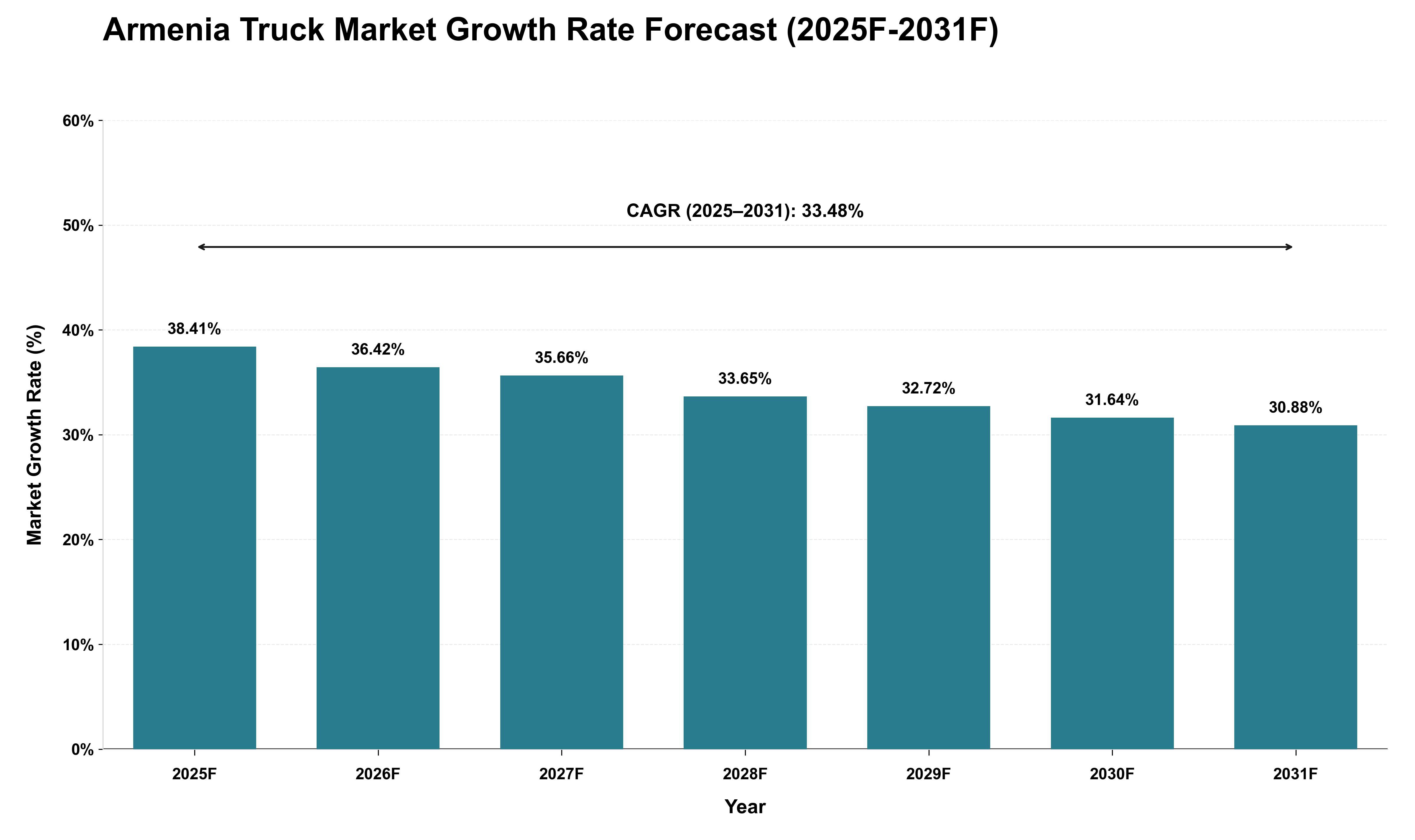
The forecasted growth of the Armenian truck market, projected at a CAGR of 33.48% from 2025 to 2031, will be significantly influenced by evolving regulatory frameworks and trade policies that prioritize infrastructure development and logistics efficiency. As Armenia seeks to enhance its connectivity with regional markets, anticipated government initiatives aimed at modernizing transportation networks will likely drive demand for trucks. The annual growth rates, peaking at 38.41% in 2025 and gradually tapering to 30.88% by 2031, reflect an initial surge in import dependencies as local manufacturers ramp up production capabilities to meet rising domestic needs. Additionally, cyclical trends in global supply chains may further stimulate truck sales as businesses adapt to fluctuating economic conditions and seek reliable transport solutions. Overall, these macroeconomic factors will create a robust environment for sustained growth in the truck market throughout the forecast period.
Key Highlights of the Report:
- Armenia Truck Market Outlook
- Market Size of Armenia Truck Market, 2024
- Forecast of Armenia Truck Market, 2031
- Historical Data and Forecast of Armenia Truck Revenues & Volume for the Period 2021-2031
- Armenia Truck Market Trend Evolution
- Armenia Truck Market Drivers and Challenges
- Armenia Truck Price Trends
- Armenia Truck Porter`s Five Forces
- Armenia Truck Industry Life Cycle
- Historical Data and Forecast of Armenia Truck Market Revenues & Volume By Vehicle Type for the Period 2021-2031
- Historical Data and Forecast of Armenia Truck Market Revenues & Volume By Heavy Duty Truck for the Period 2021-2031
- Historical Data and Forecast of Armenia Truck Market Revenues & Volume By Medium Duty Truck for the Period 2021-2031
- Historical Data and Forecast of Armenia Truck Market Revenues & Volume By Light Duty Truck for the Period 2021-2031
- Historical Data and Forecast of Armenia Truck Market Revenues & Volume By Tonnage Capacity for the Period 2021-2031
- Historical Data and Forecast of Armenia Truck Market Revenues & Volume By 3.5 7.5 Tons for the Period 2021-2031
- Historical Data and Forecast of Armenia Truck Market Revenues & Volume By 7.5 16 Tons for the Period 2021-2031
- Historical Data and Forecast of Armenia Truck Market Revenues & Volume By 16 30 Tons for the Period 2021-2031
- Historical Data and Forecast of Armenia Truck Market Revenues & Volume By Above 30 Tons for the Period 2021-2031
- Historical Data and Forecast of Armenia Truck Market Revenues & Volume By Fuel Type for the Period 2021-2031
- Historical Data and Forecast of Armenia Truck Market Revenues & Volume By Diesel for the Period 2021-2031
- Historical Data and Forecast of Armenia Truck Market Revenues & Volume By Petrol for the Period 2021-2031
- Historical Data and Forecast of Armenia Truck Market Revenues & Volume By CNG & LNG for the Period 2021-2031
- Historical Data and Forecast of Armenia Truck Market Revenues & Volume By Application for the Period 2021-2031
- Historical Data and Forecast of Armenia Truck Market Revenues & Volume By Construction for the Period 2021-2031
- Historical Data and Forecast of Armenia Truck Market Revenues & Volume By Logistics for the Period 2021-2031
- Historical Data and Forecast of Armenia Truck Market Revenues & Volume By Others for the Period 2021-2031
- Armenia Truck Import Export Trade Statistics
- Market Opportunity Assessment By Vehicle Type
- Market Opportunity Assessment By Tonnage Capacity
- Market Opportunity Assessment By Fuel Type
- Market Opportunity Assessment By Application
- Armenia Truck Top Companies Market Share
- Armenia Truck Competitive Benchmarking By Technical and Operational Parameters
- Armenia Truck Company Profiles
- Armenia Truck Key Strategic Recommendations






































