Australia Aerospace & Defense C-class Parts Market Size, Share & Growth Rate
The Australia Aerospace & Defense C-class Parts Market was estimated at USD 145 Million in 2025 and is projected to reach USD 171 Million by 2032, growing at a CAGR of 2.4% from 2026 to 2032. This growth trajectory is significantly fueled by the Australian government's increasing defense spending, which reflects a strategic prioritization of national security. Additionally, the rising demand for advanced military aircraft and a focus on enhancing supply chain resilience are pivotal factors driving this market.
Australia Aerospace & Defense C-class Parts Market Year-wise Growth Rate and Key Drivers
This graph highlights how the Australia Aerospace & Defense C-class Parts Market has steadily grown over the years, supported by major growth factors.
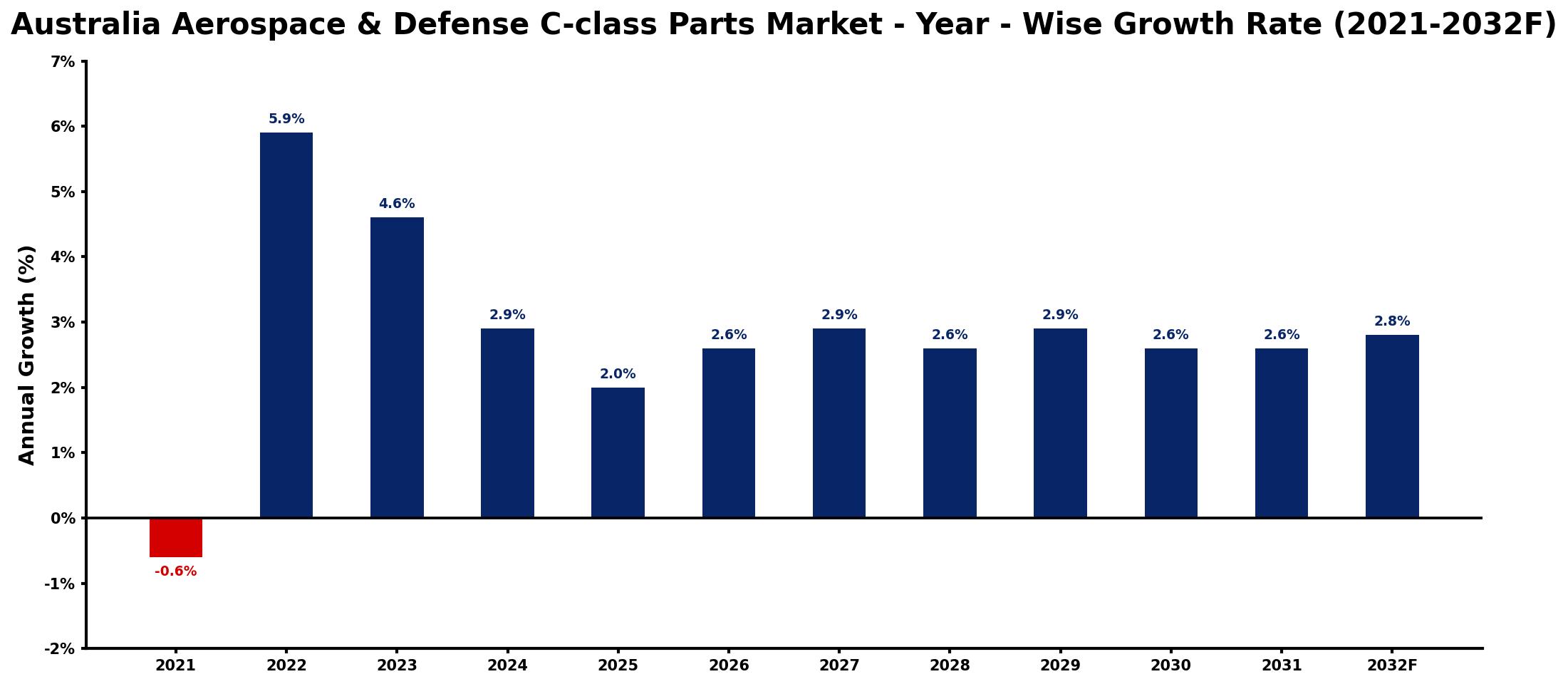
The table below presents the year‑wise growth rates along with the key drivers influencing the market
| Year | Growth Rate | Major Drivers |
| 2021 | -0.6% | decreased government spending initiatives |
| 2022 | 5.9% | increased military modernization programs |
| 2023 | 4.6% | growing demand for innovation |
| 2024 | 2.9% | expansion of commercial aviation sector |
| 2025 | 2.0% | rising investments in technology |
| 2026 | 2.6% | enhanced international cooperation efforts |
| 2027 | 2.9% | surge in private sector contracts |
| 2028 | 2.6% | advancements in manufacturing capabilities |
| 2029 | 2.9% | increased focus on sustainability |
| 2030 | 2.6% | growing regional consumption patterns |
| 2031 | 2.6% | rising global security concerns |
| 2032 | 2.8% | rising end-use demand growth |
Note: Market size estimations and growth projections presented in this report are based on 6Wresearch's proprietary forecasting methodology, utilizing the latest available industry data, government publications, and primary research inputs.
Australia Aerospace & Defense C-class Parts Market Synopsis
In recent years, the Australia Aerospace & Defense C-class Parts Market has witnessed remarkable growth as the defense sector continues to modernize. Fasteners, fittings, and other hardware components have become critical to ensuring the reliability and safety of aerospace systems amidst evolving operational challenges.
This market is characterized by its stringent quality requirements, with suppliers striving to meet the regulatory standards that govern aerospace and defense manufacturing. The importance of these C-class parts cannot be understated; they form the backbone of operational efficiency across military and aerospace applications.
- The market is set to expand significantly due to rising defense budgets and modernization efforts.
- Key drivers include demand for high-quality fasteners and seals essential for mission-critical applications.
- Strategic partnerships are being formed to enhance production capabilities and supply chain resilience.
- Regulatory compliance poses ongoing challenges for suppliers in terms of traceability and authenticity.
- The market is bolstered by government initiatives aimed at increasing domestic manufacturing capabilities.
Despite the positive growth outlook, the Australia Aerospace & Defense C-class Parts Market faces notable restraints that could temper its expansion. Supply chain disruptions remain a pressing concern, often exacerbated by geopolitical uncertainties and global logistics challenges. Additionally, the rise of counterfeit components poses a significant threat to quality assurance and operational integrity. Compliance with evolving defense procurement regulations further complicates the procurement landscape, as suppliers must ensure their products meet rigorous standards while also navigating the complexities of certification processes. These factors underscore the importance of robust quality control measures and strategic risk management for all stakeholders in the market.
The Australia Aerospace & Defense C-class Parts Market is witnessing several trends that are shaping its future. An increasing focus on sustainability is prompting manufacturers to explore eco-friendly materials and production methods. Additionally, technological advancements are leading to the adoption of smart manufacturing practices, enhancing efficiency and reducing lead times. There is also a growing emphasis on digitalization within the supply chain, facilitating better inventory management and traceability of components.
Significant growth opportunities exist within the Australia Aerospace & Defense C-class Parts Market, particularly in the realm of domestic manufacturing. As the government champions local production, suppliers have the chance to establish themselves as vital partners in the defense supply chain. Furthermore, the ongoing need for aftermarket support and maintenance services presents avenues for sustained engagement with defense agencies and contractors, driving recurrent revenue streams. Investment in R&D to develop next-generation materials and technologies will also be crucial for market participants seeking to differentiate themselves.
The Australian government has implemented several initiatives aimed at bolstering the defense manufacturing sector. Policies designed to enhance supplier diversity and support small to medium-sized enterprises are encouraging innovation and competition. Additionally, public spending on defense procurement has been strategically directed toward projects that emphasize domestic capability development, thereby ensuring a resilient supply chain. These initiatives not only benefit manufacturers but also help in securing long-term contracts with defense agencies.
Looking ahead to 2026-2032, the Australia Aerospace & Defense C-class Parts Market is poised for continuous growth, driven by persistent demands for modernization and technological integration. The increasing prioritization of national security is expected to stimulate consistent government investment in defense capabilities. Moreover, as the industry adapts to emerging technologies, including AI and automation, C-class parts will likely evolve in terms of functionality and complexity, further reinforcing their critical role in the aerospace and defense sectors.
In recent months, the Australia Aerospace & Defense C-class Parts Market has seen a growing emphasis on collaboration between government agencies and local manufacturers. Initiatives aimed at enhancing supply chain transparency are gaining traction, alongside heightened scrutiny of component authenticity. Furthermore, defense contracts increasingly incorporate clauses that prioritize the use of domestically sourced materials and components, reflecting a commitment to bolster the local economy while ensuring operational readiness.
- 10 Years of Market Numbers
- Historical Data Starting from 2022 to 2025
- Base Year: 2025
- Forecast Data until 2032
- Key Performance Indicators Impacting the Market
- Major Upcoming Developments and Projects
Key Highlights of the Report:
- Australia Aerospace & Defense C-class Parts Market Outlook
- Market Size of Australia Aerospace & Defense C-class Parts Market, 2025
- Forecast of Australia Aerospace & Defense C-class Parts Market, 2032
- Historical Data and Forecast of Australia Aerospace & Defense C-class Parts Revenues & Volume for the Period 2022-2032F
- Australia Aerospace & Defense C-class Parts Market Trend Evolution
- Australia Aerospace & Defense C-class Parts Market Drivers and Challenges
- Australia Aerospace & Defense C-class Parts Price Trends
- Australia Aerospace & Defense C-class Parts Porter's Five Forces
- Australia Aerospace & Defense C-class Parts Industry Life Cycle
- Historical Data and Forecast of Australia Aerospace & Defense C-class Parts Market Revenues & Volume By Product for the Period 2022-2032F
- Historical Data and Forecast of Australia Aerospace & Defense C-class Parts Market Revenues & Volume By Fasteners for the Period 2022-2032F
- Historical Data and Forecast of Australia Aerospace & Defense C-class Parts Market Revenues & Volume By Bearings for the Period 2022-2032F
- Historical Data and Forecast of Australia Aerospace & Defense C-class Parts Market Revenues & Volume By Electrical Parts for the Period 2022-2032F
- Historical Data and Forecast of Australia Aerospace & Defense C-class Parts Market Revenues & Volume By Machined Parts for the Period 2022-2032F
- Historical Data and Forecast of Australia Aerospace & Defense C-class Parts Market Revenues & Volume By Application for the Period 2022-2032F
- Historical Data and Forecast of Australia Aerospace & Defense C-class Parts Market Revenues & Volume By Engine for the Period 2022-2032F
- Historical Data and Forecast of Australia Aerospace & Defense C-class Parts Market Revenues & Volume By Aerostructure for the Period 2022-2032F
- Historical Data and Forecast of Australia Aerospace & Defense C-class Parts Market Revenues & Volume By Interiors for the Period 2022-2032F
- Historical Data and Forecast of Australia Aerospace & Defense C-class Parts Market Revenues & Volume By Equipment for the Period 2022-2032F
- Historical Data and Forecast of Australia Aerospace & Defense C-class Parts Market Revenues & Volume By Safety for the Period 2022-2032F
- Historical Data and Forecast of Australia Aerospace & Defense C-class Parts Market Revenues & Volume By Support for the Period 2022-2032F
- Historical Data and Forecast of Australia Aerospace & Defense C-class Parts Market Revenues & Volume By Avionics for the Period 2022-2032F
- Historical Data and Forecast of Australia Aerospace & Defense C-class Parts Market Revenues & Volume By End-use for the Period 2022-2032F
- Historical Data and Forecast of Australia Aerospace & Defense C-class Parts Market Revenues & Volume By Commercial for the Period 2022-2032F
- Historical Data and Forecast of Australia Aerospace & Defense C-class Parts Market Revenues & Volume By Military for the Period 2022-2032F
- Historical Data and Forecast of Australia Aerospace & Defense C-class Parts Market Revenues & Volume By Business & General Aviation for the Period 2022-2032F
- Historical Data and Forecast of Australia Aerospace & Defense C-class Parts Market Revenues & Volume By Others for the Period 2022-2032F
- Australia Aerospace & Defense C-class Parts Import Export Trade Statistics
- Market Opportunity Assessment By Product
- Market Opportunity Assessment By Application
- Market Opportunity Assessment By End-use
- Australia Aerospace & Defense C-class Parts Top Companies Market Share
- Australia Aerospace & Defense C-class Parts Competitive Benchmarking By Technical and Operational Parameters
- Australia Aerospace & Defense C-class Parts Company Profiles
- Australia Aerospace & Defense C-class Parts Key Strategic Recommendations






































