Australia Air Traffic Control (ATC) Equipment Market Size, Share & Growth Rate
The Australia Air Traffic Control (ATC) Equipment Market was estimated at USD 441 Million in 2025 and is projected to reach USD 602 Million by 2032, growing at a CAGR of 4.5% from 2026 to 2032. This robust growth is driven by an escalating need for modernization within the air traffic management infrastructure, ensuring the system can handle increased air traffic volumes. Additionally, the rapid advancements in technology—ranging from automation to the deployment of remote tower solutions—are enhancing operational efficiency and safety, thereby further propelling the market's trajectory.
Australia Air Traffic Control (ATC) Equipment Market Year-wise Growth Rate and Key Drivers
This graph highlights how the Australia Air Traffic Control (ATC) Equipment Market has steadily grown over the years, supported by major growth factors.
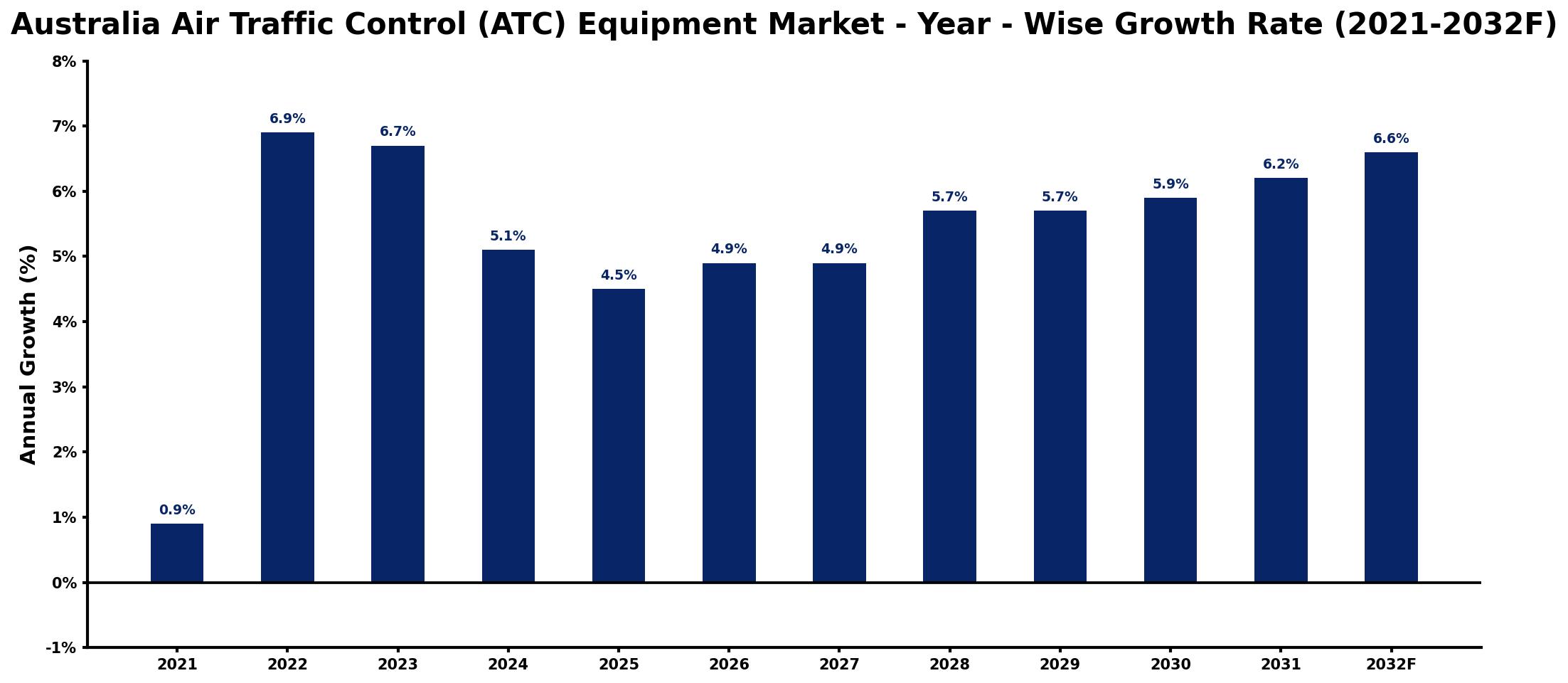
The table below presents the year‑wise growth rates along with the key drivers influencing the market
| Year | Growth Rate | Major Drivers |
| 2021 | 0.9% | Increased investment in aviation infrastructure |
| 2022 | 6.9% | Growing demand for flight safety |
| 2023 | 6.7% | Expansion of commercial flight operations |
| 2024 | 5.1% | growing emerging market penetration |
| 2025 | 4.5% | growing automotive sector requirements |
| 2026 | 4.9% | Technological advancements in navigation |
| 2027 | 4.9% | Increased emphasis on sustainability initiatives |
| 2028 | 5.7% | rising infrastructure development spending |
| 2029 | 5.7% | Rising passenger travel expectations |
| 2030 | 5.9% | Development of smart aviation technologies |
| 2031 | 6.2% | Increased collaboration among stakeholders |
| 2032 | 6.6% | expanding manufacturing base activity |
Note: Market size estimations and growth projections presented in this report are based on 6Wresearch's proprietary forecasting methodology, utilizing the latest available industry data, government publications, and primary research inputs.
Australia Air Traffic Control (ATC) Equipment Market Synopsis
In Australia, the demand for sophisticated air traffic control equipment is on the rise as airports and air navigation service providers seek to enhance their operational capabilities. With the growing air traffic volumes, the emphasis on advanced radar systems and communication technologies has never been more critical to ensuring the safety and efficiency of air travel.
Moreover, the market reflects a significant push towards integrating digital solutions that streamline air traffic management processes. As the aviation sector undergoes transformative changes, investments in surveillance technologies are expected to intensify, bolstering the market further and meeting the evolving demands of the aviation industry.
Australia Air Traffic Control (ATC) Equipment Market Key Takeaways
- The Australian ATC equipment market is witnessing robust growth due to modernization initiatives.
- Technological advancements are central to enhancing operational safety and efficiency.
- Air traffic demand is increasing, necessitating upgraded systems and solutions.
- Government regulations play a pivotal role in shaping market dynamics and equipment standards.
- Investment in surveillance and communication technologies is crucial for future readiness.
Evaluation of Restraints in Australia Air Traffic Control (ATC) Equipment Market
While the Australia ATC equipment market is poised for growth, it faces constraints primarily linked to technological complexity and stringent regulatory compliance. Stakeholders are required to navigate a landscape marked by rigorous safety standards and interoperability mandates. These factors can complicate the procurement and implementation of advanced technologies, potentially leading to delays in infrastructure upgrades. Moreover, the high costs associated with state-of-the-art systems can limit investment from smaller service providers, affecting overall market accessibility and expansion.
Australia Air Traffic Control (ATC) Equipment Market Trends
Current trends in the Australia ATC equipment market reveal a shift towards automation and remote air traffic management solutions. The adoption of digital technologies is reshaping traditional practices, fostering a more agile and responsive air traffic system. As airspace congestion continues to be a challenge, there is an increasing focus on integrated communication systems and enhanced surveillance technologies that support real-time data sharing and operational transparency.
Additionally, sustainability initiatives are influencing purchasing decisions, as authorities and service providers look to implement greener solutions that reduce environmental impact. This trend is creating opportunities for innovative technologies that not only enhance efficiency but also align with global environmental standards.
Australia Air Traffic Control (ATC) Equipment Market Opportunities
The market presents numerous growth and investment opportunities, particularly in the realm of smart technologies. The integration of artificial intelligence and machine learning into air traffic systems can streamline operations and enhance safety. Furthermore, there is a notable potential in developing hybrid systems that combine traditional equipment with modern digital solutions, catering to both new and existing infrastructure.
Moreover, collaborations with technology providers and startups focused on innovation can lead to transformative solutions that meet the challenges of the future. As aviation authorities prioritize safety and efficiency, those who invest in cutting-edge ATC equipment are likely to emerge as leaders in a competitive marketplace.
Government Initiatives in the Australia Air Traffic Control (ATC) Equipment Market
Government policies and regulations significantly influence the Australia ATC equipment market, primarily through initiatives aimed at enhancing aviation safety and airspace management. The Civil Aviation Safety Authority (CASA) sets stringent regulations that govern equipment operation and certification. Furthermore, the government is committed to modernizing air traffic management systems and infrastructure, which includes funding and support for advanced surveillance technologies. These initiatives not only boost market demand but also stimulate innovation within the sector.
Future Insights of the Australia Air Traffic Control (ATC) Equipment Market
Looking ahead to 2026-2032, the Australia ATC equipment market is expected to evolve significantly, fueled by ongoing technological advancements and an increasing focus on safety and efficiency. The continued integration of automated solutions is likely to redefine air traffic management, enabling more efficient handling of rising air traffic volumes. Furthermore, as regulatory frameworks adapt to new technologies, opportunities for investment in innovative systems will broaden. The emphasis on sustainable practices will also encourage the adoption of greener technologies, positioning the market for substantial growth in the coming years.
Australia Air Traffic Control (ATC) Equipment Market Latest Developments (2025 - 2026)
Recent developments in the Australia ATC equipment market indicate a marked shift towards the implementation of next-generation technologies. With growing collaboration between governmental bodies and technology providers, there has been an increased focus on enhancing system interoperability and data sharing capabilities. Moreover, significant strides have been made in deploying remote tower technologies across selected airports, showcasing the evolving landscape of air traffic management.
Australia Air Traffic Control (ATC) Equipment Market - Key Attractiveness of the Report
- 10 Years of Market Numbers
- Historical Data Starting from 2022 to 2025
- Base Year: 2025
- Forecast Data until 2032
- Key Performance Indicators Impacting the Market
- Major Upcoming Developments and Projects
Key Highlights of the Report:
- Australia Air Traffic Control (ATC) Equipment Market Outlook
- Market Size of Australia Air Traffic Control (ATC) Equipment Market, 2025
- Forecast of Australia Air Traffic Control (ATC) Equipment Market, 2032
- Historical Data and Forecast of Australia Air Traffic Control (ATC) Equipment Revenues & Volume for the Period 2022-2032F
- Australia Air Traffic Control (ATC) Equipment Market Trend Evolution
- Australia Air Traffic Control (ATC) Equipment Market Drivers and Challenges
- Australia Air Traffic Control (ATC) Equipment Price Trends
- Australia Air Traffic Control (ATC) Equipment Porter's Five Forces
- Australia Air Traffic Control (ATC) Equipment Industry Life Cycle
- Historical Data and Forecast of Australia Air Traffic Control (ATC) Equipment Market Revenues & Volume By Product for the Period 2022-2032F
- Historical Data and Forecast of Australia Air Traffic Control (ATC) Equipment Market Revenues & Volume By Communications Equipment for the Period 2022-2032F
- Historical Data and Forecast of Australia Air Traffic Control (ATC) Equipment Market Revenues & Volume By Navigation Equipment for the Period 2022-2032F
- Historical Data and Forecast of Australia Air Traffic Control (ATC) Equipment Market Revenues & Volume By Surveillance Equipment for the Period 2022-2032F
- Historical Data and Forecast of Australia Air Traffic Control (ATC) Equipment Market Revenues & Volume By Air Traffic Control Equipment Application Outlook (USD Million, 2023-2032) for the Period 2022-2032F
- Historical Data and Forecast of Australia Air Traffic Control (ATC) Equipment Market Revenues & Volume By Commercial Aircraft for the Period 2022-2032F
- Historical Data and Forecast of Australia Air Traffic Control (ATC) Equipment Market Revenues & Volume By Private Aircraft for the Period 2022-2032F
- Historical Data and Forecast of Australia Air Traffic Control (ATC) Equipment Market Revenues & Volume By Military Aircraft for the Period 2022-2032F
- Australia Air Traffic Control (ATC) Equipment Import Export Trade Statistics
- Market Opportunity Assessment By Product
- Australia Air Traffic Control (ATC) Equipment Top Companies Market Share
- Australia Air Traffic Control (ATC) Equipment Competitive Benchmarking By Technical and Operational Parameters
- Australia Air Traffic Control (ATC) Equipment Company Profiles
- Australia Air Traffic Control (ATC) Equipment Key Strategic Recommendations






































