Australia Ammonia Market: Import Trend Analysis
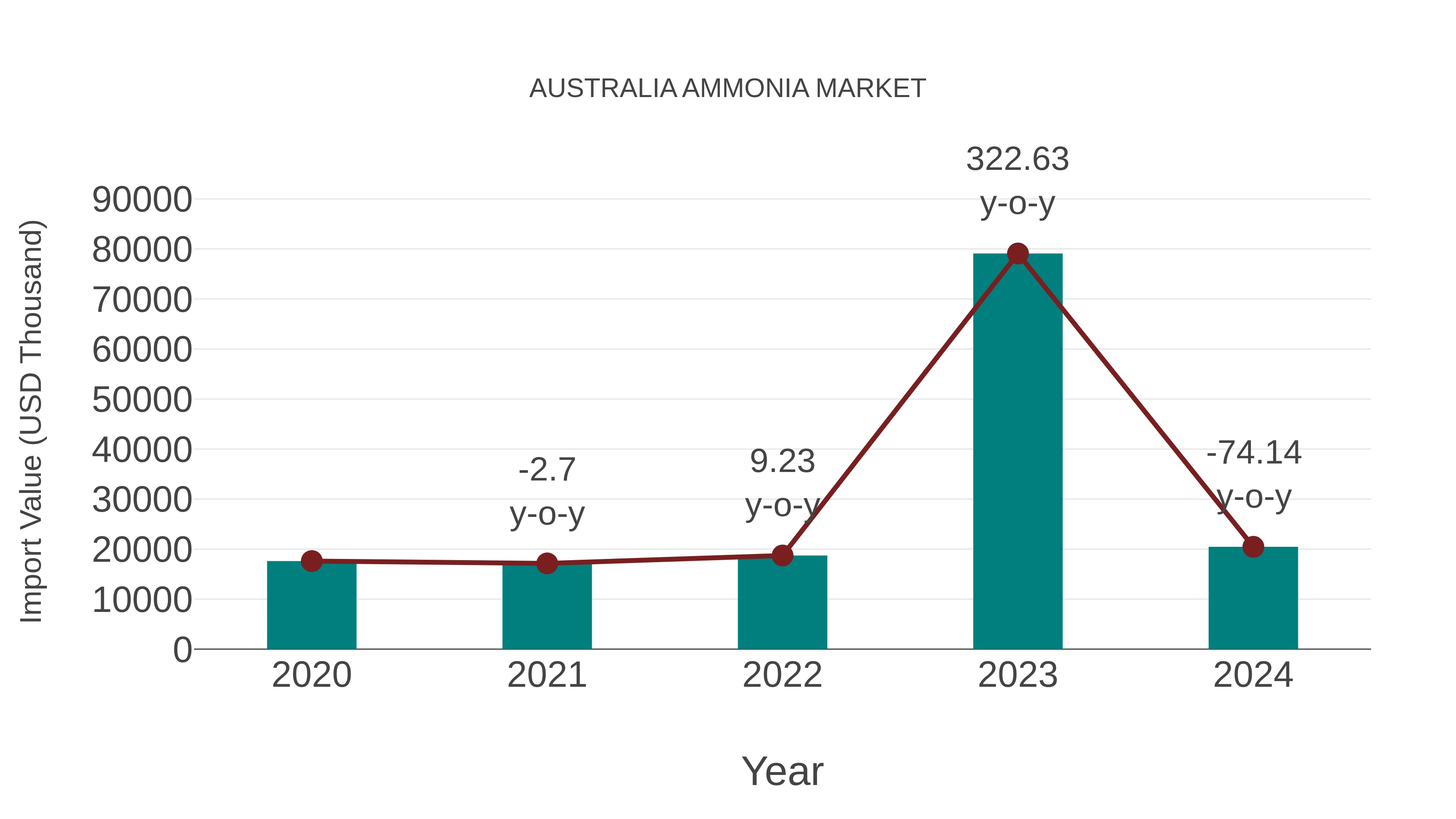
Australia`s ammonia import trend for the Australia market experienced a significant decline from 2023 to 2024, with a growth rate of -74.14%. However, the compound annual growth rate (CAGR) from 2020 to 2024 stood at 3.81%. This substantial drop in import momentum could be attributed to shifting demand patterns or changes in trade policies impacting market stability.
Australia Ammonia Market Overview
The ammonia market in Australia is witnessing steady growth owing to its diverse applications in agriculture, chemical manufacturing, and refrigeration. Ammonia is one of the most widely produced chemicals globally and is primarily used as a nitrogen fertilizer in agriculture. Additionally, it serves as a crucial raw material in the production of various chemicals such as urea, ammonium nitrate, and nitric acid. The growing demand for food products and the increasing use of ammonia in industrial processes are driving market growth. However, environmental concerns regarding ammonia emissions and the need for sustainable production practices pose challenges to market expansion.
Drivers of the market
The Australia ammonia market is primarily driven by its applications in agriculture, chemical manufacturing, and refrigeration. Ammonia, a compound of nitrogen and hydrogen, is one of the most widely produced chemicals globally. In agriculture, ammonia is used as a nitrogen fertilizer to enhance crop yields and soil fertility. Similarly, in chemical manufacturing, it serves as a precursor for producing various nitrogen-containing compounds, including fertilizers, explosives, and polymers. Moreover, in refrigeration, ammonia is utilized as a refrigerant in industrial cooling systems and heat pumps due to its thermodynamic properties and environmental friendliness. The market growth is fueled by the demand for agricultural inputs, industrial chemicals, and refrigeration solutions in Australia agricultural and manufacturing sectors.
Challenges of the market
The Australia ammonia market faces challenges related to production sustainability and environmental impact. Ammonia is a critical chemical used in fertilizers, refrigerants, and industrial processes, but its production is energy-intensive and emits greenhouse gases. As environmental regulations tighten and sustainability concerns escalate, ammonia producers must invest in cleaner production technologies and emission reduction strategies. Moreover, market volatility and global supply chain disruptions add complexity to supply and demand dynamics, impacting pricing and profitability.
Government Policy of the market
Government regulations in the Australia ammonia market aim to ensure product quality, safety, and environmental sustainability. Standards may cover ammonia purity, concentration levels, and manufacturing processes to meet industry requirements and customer specifications. Additionally, regulations may address issues such as chemical storage, handling procedures, and emissions control to minimize environmental impact and protect public health. Government agencies provide guidance, monitoring services, and regulatory oversight to support compliance with ammonia standards and promote responsible practices in the industry.
Key Highlights of the Report:
- Australia Ammonia Market Outlook
- Market Size of Australia Ammonia Market, 2024
- Forecast of Australia Ammonia Market, 2031
- Historical Data and Forecast of Australia Ammonia Revenues & Volume for the Period 2018 - 2031
- Australia Ammonia Market Trend Evolution
- Australia Ammonia Market Drivers and Challenges
- Australia Ammonia Price Trends
- Australia Ammonia Porter's Five Forces
- Australia Ammonia Industry Life Cycle
- Historical Data and Forecast of Australia Ammonia Market Revenues & Volume By Type for the Period 2018 - 2031
- Historical Data and Forecast of Australia Ammonia Market Revenues & Volume By Liquid for the Period 2018 - 2031
- Historical Data and Forecast of Australia Ammonia Market Revenues & Volume By Gas for the Period 2018 - 2031
- Historical Data and Forecast of Australia Ammonia Market Revenues & Volume By End-user Industry for the Period 2018 - 2031
- Historical Data and Forecast of Australia Ammonia Market Revenues & Volume By Agriculture for the Period 2018 - 2031
- Historical Data and Forecast of Australia Ammonia Market Revenues & Volume By Textiles for the Period 2018 - 2031
- Historical Data and Forecast of Australia Ammonia Market Revenues & Volume By Mining for the Period 2018 - 2031
- Historical Data and Forecast of Australia Ammonia Market Revenues & Volume By Pharmaceutical for the Period 2018 - 2031
- Historical Data and Forecast of Australia Ammonia Market Revenues & Volume By Refrigeration for the Period 2018 - 2031
- Historical Data and Forecast of Australia Ammonia Market Revenues & Volume By Others for the Period 2018 - 2031
- Australia Ammonia Import Export Trade Statistics
- Market Opportunity Assessment By Type
- Market Opportunity Assessment By End-user Industry
- Australia Ammonia Top Companies Market Share
- Australia Ammonia Competitive Benchmarking By Technical and Operational Parameters
- Australia Ammonia Company Profiles
- Australia Ammonia Key Strategic Recommendations






































