Australia Angledozer & Bulldozer Market Size, Share & Growth Rate
The Australia Angledozer & Bulldozer Market was estimated at USD 141 Million in 2025 and is projected to reach USD 166 Million by 2032, growing at a CAGR of 2.4% from 2026 to 2032. This growth trajectory is primarily fueled by robust infrastructure investments across the nation, coupled with a burgeoning demand for advanced machinery in construction and mining applications. The increasing emphasis on efficient land development and urbanization in major cities further propels the adoption of angle dozer bulldozers, which offer unparalleled versatility in material handling.
Australia Angledozer & Bulldozer Market Year-wise Growth Rate and Key Drivers
This graph highlights how the Australia Angledozer & Bulldozer Market has steadily grown over the years, supported by major growth factors.
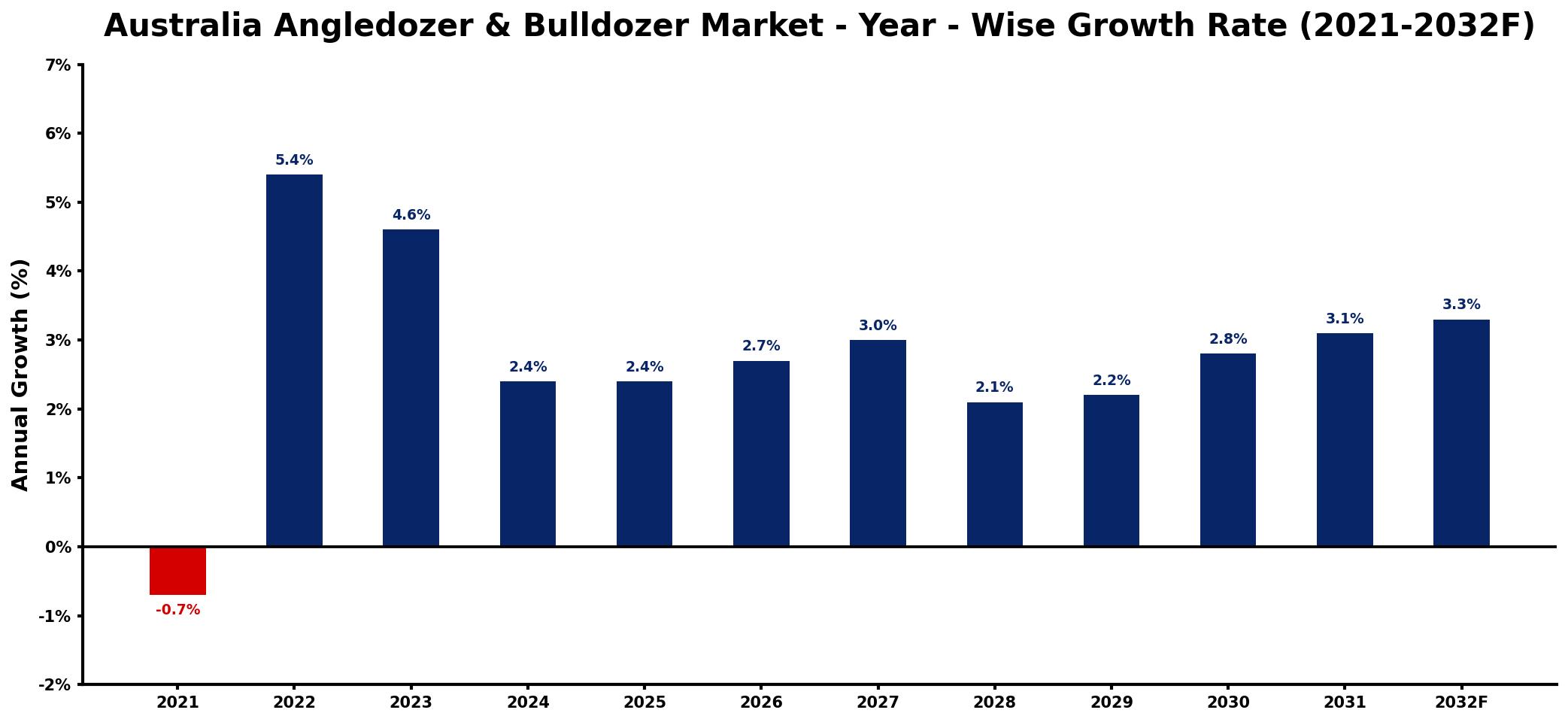
The table below presents the year‑wise growth rates along with the key drivers influencing the market
| Year | Growth Rate | Major Drivers |
| 2021 | -0.7% | construction project delays impact demand |
| 2022 | 5.4% | increased infrastructure spending initiatives |
| 2023 | 4.6% | rising demand for construction machinery |
| 2024 | 2.4% | expansion of mining operations planned |
| 2025 | 2.4% | growing residential development projects |
| 2026 | 2.7% | renewable energy projects boost investments |
| 2027 | 3.0% | strong economic recovery drives demand |
| 2028 | 2.1% | urbanization trends increase equipment needs |
| 2029 | 2.2% | government projects enhance market opportunities |
| 2030 | 2.8% | technological advancements attract investments |
| 2031 | 3.1% | increased focus on sustainability initiatives |
| 2032 | 3.3% | expanding global trade stimulates demand |
Note: Market size estimations and growth projections presented in this report are based on 6Wresearch's proprietary forecasting methodology, utilizing the latest available industry data, government publications, and primary research inputs.
Australia Angledozer & Bulldozer Market Synopsis
Australia's angle dozer bulldozers are uniquely suited for a variety of tasks, including slope grading and land clearing, making them indispensable in contemporary construction projects. Their ability to function in tight spaces and push material to either side enhances operational flexibility, appealing to contractors facing diverse site conditions.
As technology continues to advance, the integration of features such as GPS guidance and telematics systems is becoming standard in new models, significantly enhancing productivity and operational efficiency. This trend reflects an ongoing commitment to innovation within the industry, responding to the evolving needs of Australia's construction landscape.
- The market is witnessing steady growth driven by infrastructure development and urbanization trends.
- Technological advancements are enhancing the efficiency and capabilities of angle dozer bulldozers.
- Government investments in infrastructure are contributing significantly to market expansion.
- Product differentiation and aftermarket support are key strategies for market participants.
- Environmental regulations are shaping the design and operational features of bulldozers.
Despite the positive growth outlook, several factors may restrain the market. Equipment durability remains a critical concern, as operators seek machines that can withstand the demanding conditions typically encountered in construction and mining operations. Furthermore, ensuring safety standards for operators is paramount, prompting manufacturers to innovate responsibly. Additionally, intense competition within the market necessitates continuous product improvement and differentiation to capture and retain market share. As businesses seek to navigate these challenges, a focus on operational efficiency and safety compliance will be essential.
The trend towards automation is reshaping the Australia angle dozer bulldozer market significantly. Innovations in automation technology, such as automated blade controls, are streamlining operations and reducing the reliance on skilled labor. In tandem, there is a growing shift towards sustainable practices, with eco-friendly machinery gaining traction in response to regulatory pressures and consumer preferences. Additionally, the incorporation of telematics not only enhances machine performance but also allows for real-time monitoring, thereby improving fleet management and operational efficiencies.
The Australia angle dozer bulldozer market presents lucrative opportunities, especially in sectors heavily influenced by government funding and initiatives. The ongoing urban development projects across major Australian cities signal a robust pipeline for angle dozer utilization. Furthermore, as mining activities rebound and infrastructure projects gain momentum, there is a heightened need for efficient, technologically advanced equipment. Companies that can offer tailored solutions, such as rental services or specialized aftermarket support, stand to gain a competitive advantage in this evolving landscape.
Government regulations in Australia play a crucial role in shaping the angle dozer bulldozer market. These regulations focus on equipment safety, environmental impact, and compliance with construction standards. Policies are increasingly emphasizing the need for machinery to meet stringent emission controls and noise level guidelines, reflecting a broader commitment to sustainable development. In addition, initiatives aimed at enhancing workforce safety ensure that manufacturers prioritize operator protection, fostering an environment conducive to innovation while promoting responsible practices.
Looking ahead to the period from 2026 to 2032, the Australia angle dozer bulldozer market is poised for steady growth driven by sustained infrastructure investments. The integration of advanced technologies such as automation and data analytics is expected to redefine operational efficiencies within the industry. As the demand for environmentally sustainable machinery increases, manufacturers who innovate in this space will likely capture significant market share. Overall, the confluence of urbanization, technological advancements, and governmental support will provide a fertile ground for growth in this sector.
Recent developments in the Australia angle dozer bulldozer market indicate a trend toward enhanced connectivity and smart technology adoption. Manufacturers are increasingly incorporating telematics into new models, allowing for real-time tracking and performance monitoring. Additionally, the focus on operator safety has prompted several initiatives aimed at improving safety features and compliance with current regulations. As industry players respond to market needs, the introduction of rental services and flexible financing options is gaining traction, catering to contractors seeking cost-effective solutions.
- 10 Years of Market Numbers
- Historical Data Starting from 2022 to 2025
- Base Year: 2025
- Forecast Data until 2032
- Key Performance Indicators Impacting the Market
- Major Upcoming Developments and Projects
Key Highlights of the Report:
- Australia Angledozer & Bulldozer Market Outlook
- Market Size of Australia Angledozer & Bulldozer Market, 2025
- Forecast of Australia Angledozer & Bulldozer Market, 2032
- Historical Data and Forecast of Australia Angledozer & Bulldozer Revenues & Volume for the Period 2022-2032F
- Australia Angledozer & Bulldozer Market Trend Evolution
- Australia Angledozer & Bulldozer Market Drivers and Challenges
- Australia Angledozer & Bulldozer Price Trends
- Australia Angledozer & Bulldozer Porter's Five Forces
- Australia Angledozer & Bulldozer Industry Life Cycle
- Historical Data and Forecast of Australia Angledozer & Bulldozer Market Revenues & Volume By Product Type for the Period 2022-2032F
- Historical Data and Forecast of Australia Angledozer & Bulldozer Market Revenues & Volume By Crawler Type for the Period 2022-2032F
- Historical Data and Forecast of Australia Angledozer & Bulldozer Market Revenues & Volume By Wheeled for the Period 2022-2032F
- Historical Data and Forecast of Australia Angledozer & Bulldozer Market Revenues & Volume By Angledozer and bulldozer blades for the Period 2022-2032F
- Australia Angledozer & Bulldozer Import Export Trade Statistics
- Market Opportunity Assessment By Product Type
- Australia Angledozer & Bulldozer Top Companies Market Share
- Australia Angledozer & Bulldozer Competitive Benchmarking By Technical and Operational Parameters
- Australia Angledozer & Bulldozer Company Profiles
- Australia Angledozer & Bulldozer Key Strategic Recommendations






































