Australia Anti-money Laundering Market Size & Growth Rate (2026-2032)
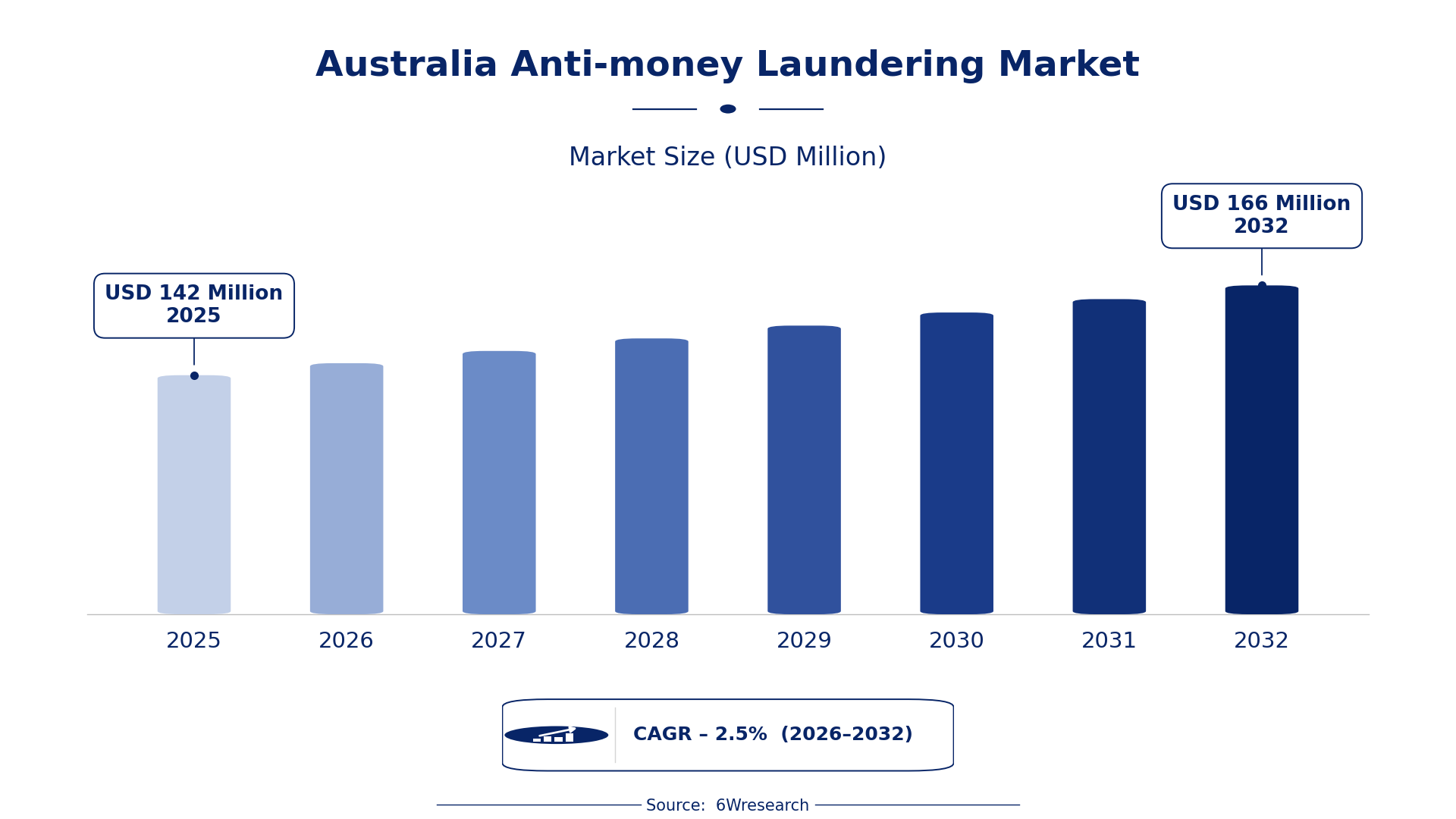
The Australia Anti-money Laundering Market was estimated at USD 142 Million in 2025 and is projected to reach USD 166 Million by 2032, growing at a CAGR of 2.5% from 2026 to 2032.
Australia Anti-money Laundering Market Synopsis
The anti-money laundering (AML) market in Australia is witnessing substantial growth driven by a surge in regulatory demands and the increasing complexity of financial crimes. Financial institutions, regulators, and law enforcement are now under immense pressure to implement effective AML measures, raising the stakes for compliance and technology investments.
In this context, AML solutions are evolving rapidly, with a focus on advanced data analytics and transaction monitoring systems. The need to safeguard reputations and ensure financial integrity has made investment in AML technologies critical across sectors, particularly in banking and finance.
Australia Anti-money Laundering Market Year-wise Growth Rate and Key Drivers
This graph illustrates the annual growth rates of the Australia Anti-money Laundering Market from 2021 to 2032, highlighting a steady upward trajectory and projected expansion over the forecast period.
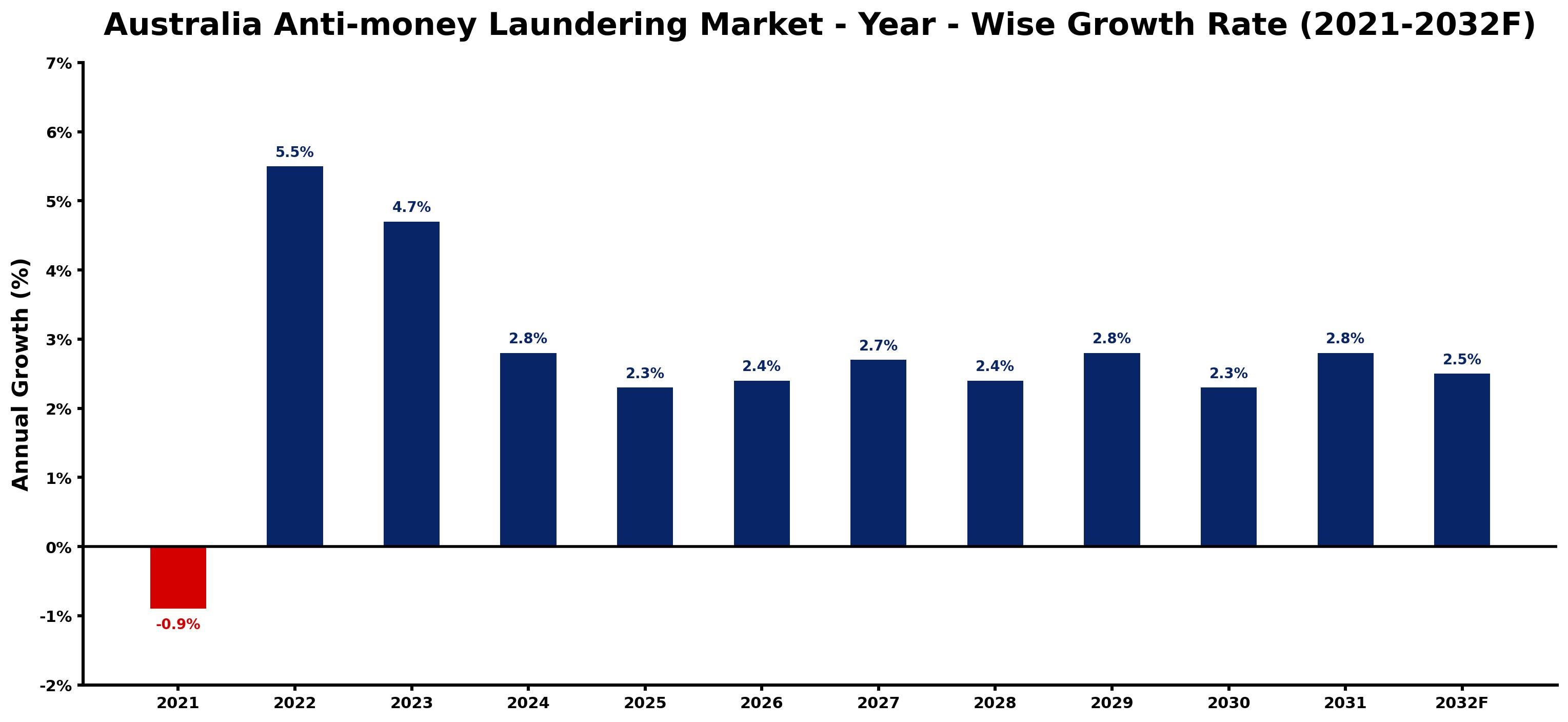
The table below presents the year‑wise growth rates along with the key drivers influencing the market
| Year | Growth Rate | Major Drivers |
| 2021 | -0.9% | APRA's regulatory changes delayed compliance for institutions. |
| 2022 | 5.5% | ACCC's crackdown on digital financial fraud intensified AML measures. |
| 2023 | 4.7% | Increase in regulatory scrutiny under AUSTRAC's new guidelines. |
| 2024 | 2.8% | Heightened concerns about cryptocurrency usage in money laundering. |
| 2025 | 2.3% | Banks adopting AI-driven analytics for compliance enhancements. |
| 2026 | 2.4% | Rise in international trade boosting AML compliance requirements. |
| 2027 | 2.7% | Government funding for AML education in financial sectors. |
| 2028 | 2.4% | Consumer demand for enhanced security in online transactions. |
| 2029 | 2.8% | Increased collaboration between banks and law enforcement agencies. |
| 2030 | 2.3% | Emergence of new technologies to combat financial crime. |
| 2031 | 2.8% | Implementation of stricter AML policies in real estate sector. |
| 2032 | 2.5% | Ongoing efforts to integrate AML standards in gaming industry. |
Note: Market size estimations and growth projections presented in this report are based on 6Wresearch's proprietary forecasting methodology, utilizing the latest available industry data, government publications, and primary research inputs.
Australia Anti-money Laundering Market Key Takeaways
Below are some of the specific key takeaways from the market, including:
- The market is growing due to heightened regulatory scrutiny and technological advancements.
- Increased collaboration between financial institutions and government bodies is essential for effective AML strategies.
- Complex and evolving financial crime techniques necessitate ongoing investments in AML technologies.
- The focus on customer due diligence and transaction monitoring continues to expand.
- Regulatory compliance remains a significant driver for market growth and technology adoption.
Evaluation of Restraints in Australia Anti-money Laundering Market
Several factors are hindering the growth of the Australia anti-money laundering market. The stringent nature of compliance regulations creates a challenge for organizations, especially smaller institutions with limited resources. Additionally, balancing the need for robust data privacy measures while implementing AML protocols complicates the operational landscape. Detecting sophisticated money laundering schemes demands continuous adaptation of technologies and processes, which can strain both financial institutions and regulatory authorities.
Australia Anti-money Laundering Market Trends
Several trends are shaping the Australia anti-money laundering market. The integration of AI and machine learning in AML solutions is gaining momentum, enabling more effective detection of suspicious activities. There is also a notable shift towards collaborative efforts between various financial institutions and governmental bodies to share data and best practices. Furthermore, increasing investment in blockchain technology aims to enhance transparency and traceability in financial transactions, presenting an innovative approach to combat financial crimes.
Australia Anti-money Laundering Market Opportunities
The opportunities within the Australia anti-money laundering market are significant. There is potential for growth in fintech solutions that offer specialized AML services tailored to niche markets. Additionally, companies can capitalize on the rising demand for integrated AML solutions that combine compliance with advanced analytics. As the regulatory environment becomes increasingly complex, specialized consultancy services focusing on AML compliance will also find a receptive market. The expansion of e-commerce and digital transactions further opens avenues for enhanced AML monitoring technologies.
Government Initiatives in the Australia Anti-money Laundering Market
Government policy plays a crucial role in shaping the Australia anti-money laundering market. Regulatory frameworks are becoming stricter as authorities intensify their efforts to ensure financial integrity and transparency. In this environment, effective policies not only help mitigate risks associated with money laundering but also support international collaboration against financial crimes.
- A national AML strategy launched in early 2025 focused on enhancing regulatory compliance and financial system integrity.
- Current initiatives include enhanced training programs for law enforcement agencies to improve their capabilities in financial crime detection.
- A regulatory framework is underway to strengthen customer due diligence requirements across various sectors.
- Upcoming initiatives aim to promote the use of technology in monitoring transactions, set to be introduced by mid-2026.
- Plans for an inter-agency task force to facilitate data sharing between public and private entities are expected to roll out in 2028.
Future Insights of the Australia Anti-money Laundering Market
As we look ahead to 2026-2032, the Australia anti-money laundering market is expected to evolve significantly. Increasing regulatory requirements will drive ongoing investments in advanced AML technologies and solutions. The landscape will also likely feature more collaboration between financial institutions and regulatory bodies, as the fight against money laundering becomes a collective effort. The integration of emerging technologies such as AI will further redefine how institutions approach compliance and risk management, setting the stage for a more resilient financial system.
Australia Anti-money Laundering Market Latest Developments
Over the past 12-14 months, the Australia anti-money laundering market has seen a flurry of activity as companies strive to enhance their compliance frameworks amid escalating regulatory scrutiny. Innovative technological solutions are being prioritized, and partnerships are forming to address the challenges presented by sophisticated financial crimes.
- A partnership announced in Q3 2025 between a major financial institution and a technology vendor to develop advanced transaction monitoring software is currently ongoing.
- A new customer due diligence tool launched in early 2025 aims to streamline compliance processes for smaller banks.
- An industry conference held in late 2025 focused on collaboration between regulators and financial institutions to share best practices in AML.
- Research and development initiatives that began in mid-2025 are exploring the application of blockchain technology for AML compliance solutions.
- A planned upgrade of regulatory reporting requirements is set to commence in early 2026, emphasizing real-time data sharing.
Australia Anti-money Laundering Market - Key Attractiveness of the Report
- 10 Years of Market Numbers
- Historical Data Starting from 2022 to 2025
- Base Year: 2025
- Forecast Data until 2032
- Key Performance Indicators Impacting the Market
- Major Upcoming Developments and Projects
Key Highlights of the Report:
- Australia Anti-money Laundering Market Outlook
- Market Size of Australia Anti-money Laundering Market, 2025
- Forecast of Australia Anti-money Laundering Market, 2032
- Historical Data and Forecast of Australia Anti-money Laundering Revenues & Volume for the Period 2022-2032F
- Australia Anti-money Laundering Market Trend Evolution
- Australia Anti-money Laundering Market Drivers and Challenges
- Australia Anti-money Laundering Price Trends
- Australia Anti-money Laundering Porter's Five Forces
- Australia Anti-money Laundering Industry Life Cycle
- Historical Data and Forecast of Australia Anti-money Laundering Market Revenues & Volume By Component for the Period 2022-2032F
- Historical Data and Forecast of Australia Anti-money Laundering Market Revenues & Volume By Services for the Period 2022-2032F
- Historical Data and Forecast of Australia Anti-money Laundering Market Revenues & Volume By Solutions for the Period 2022-2032F
- Historical Data and Forecast of Australia Anti-money Laundering Market Revenues & Volume By Deployment Mode for the Period 2022-2032F
- Historical Data and Forecast of Australia Anti-money Laundering Market Revenues & Volume By On-Premises for the Period 2022-2032F
- Historical Data and Forecast of Australia Anti-money Laundering Market Revenues & Volume By Cloud for the Period 2022-2032F
- Historical Data and Forecast of Australia Anti-money Laundering Market Revenues & Volume By End User for the Period 2022-2032F
- Historical Data and Forecast of Australia Anti-money Laundering Market Revenues & Volume By Banking & Financial Institutes for the Period 2022-2032F
- Historical Data and Forecast of Australia Anti-money Laundering Market Revenues & Volume By Insurance for the Period 2022-2032F
- Historical Data and Forecast of Australia Anti-money Laundering Market Revenues & Volume By Gaming & Gambling for the Period 2022-2032F
- Historical Data and Forecast of Australia Anti-money Laundering Market Revenues & Volume By Organization Size for the Period 2022-2032F
- Historical Data and Forecast of Australia Anti-money Laundering Market Revenues & Volume By Large Enterprises for the Period 2022-2032F
- Historical Data and Forecast of Australia Anti-money Laundering Market Revenues & Volume By SMEs for the Period 2022-2032F
- Australia Anti-money Laundering Import Export Trade Statistics
- Market Opportunity Assessment By Component
- Market Opportunity Assessment By Deployment Mode
- Market Opportunity Assessment By End User
- Market Opportunity Assessment By Organization Size
- Australia Anti-money Laundering Top Companies Market Share
- Australia Anti-money Laundering Competitive Benchmarking By Technical and Operational Parameters
- Australia Anti-money Laundering Company Profiles
- Australia Anti-money Laundering Key Strategic Recommendations






































