Australia Application Security Market Size & Growth Rate (2026-2032)
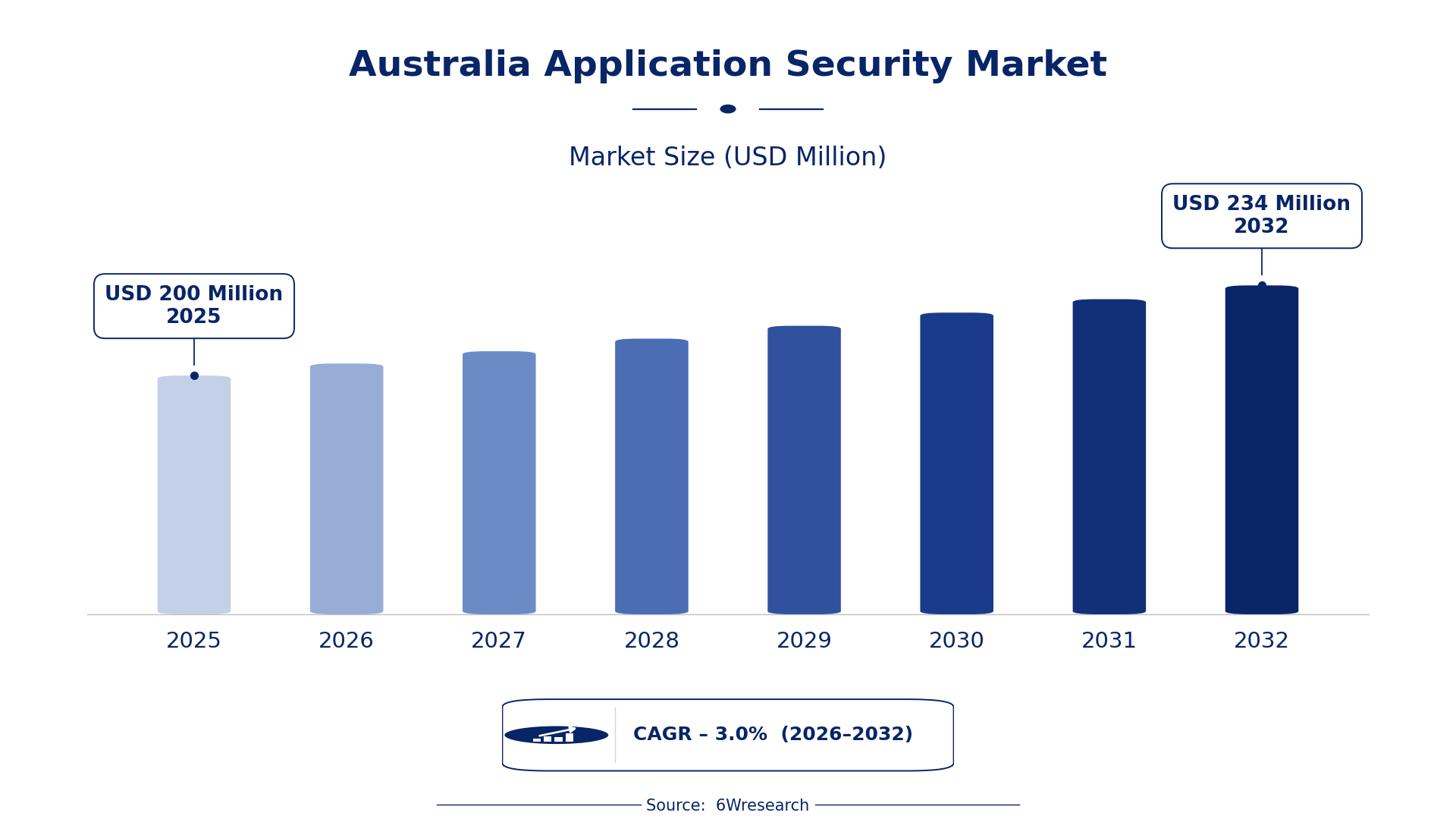
The Australia Application Security Market was estimated at USD 200 Million in 2025 and is projected to reach USD 234 Million by 2032, growing at a CAGR of 3.0% from 2026 to 2032.
Australia Application Security Market Synopsis
In Australia, application security has shifted from being a technical concern to a core business priority, reflecting the growing urgency to protect sensitive data against persistent cyber threats. Organizations are increasingly investing in comprehensive application security solutions, emphasizing the need for proactive measures that span the software development lifecycle.
A surge in the deployment of web and mobile applications has brought forward new security challenges. Companies across various sectors are seeking advanced tools to identify vulnerabilities early in development and maintain compliance with evolving regulations related to data protection and privacy. This shift highlights the critical nature of application security in safeguarding organizational integrity.
Australia Application Security Market Year-wise Growth Rate and Key Drivers
This graph illustrates the annual growth rates of the Australia Application Security Market from 2021 to 2032, highlighting a steady upward trajectory and projected expansion over the forecast period.
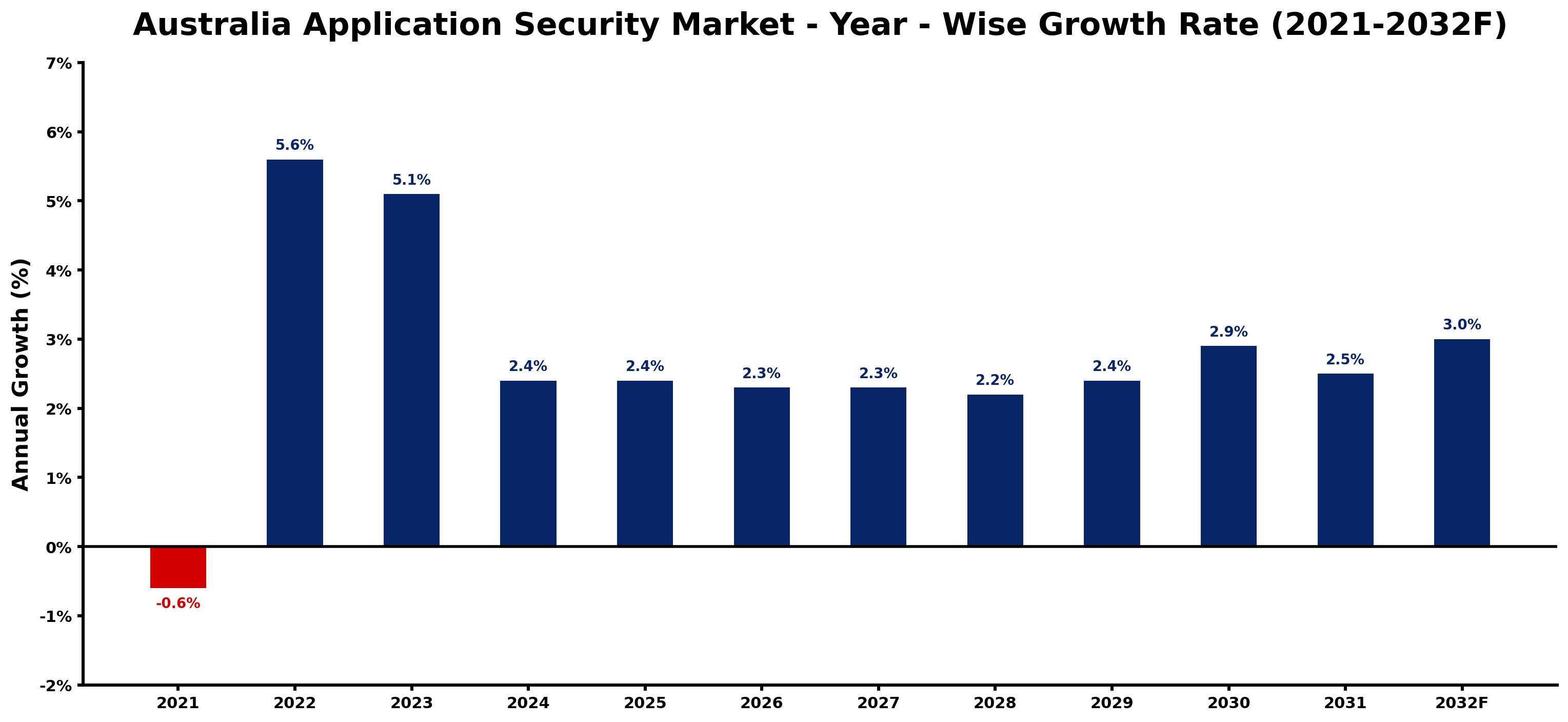
The table below presents the year‑wise growth rates along with the key drivers influencing the market
| Year | Growth Rate | Major Drivers |
| 2021 | -0.6% | Increased focus on regulatory compliance by ASCS. |
| 2022 | 5.6% | Australian Cyber Security Strategy enhancing application protections. |
| 2023 | 5.1% | Growing GDPR-like regulations increasing data protection requirements. |
| 2024 | 2.4% | Rise in cyber threats boosting security software investments. |
| 2025 | 2.4% | Increased mobile app usage necessitating robust security measures. |
| 2026 | 2.3% | Local enterprises shifting to cloud applications for security. |
| 2027 | 2.3% | Collaboration between tech firms and government on cybersecurity. |
| 2028 | 2.2% | Emergence of fintech driving secure application development. |
| 2029 | 2.4% | Increased focus on KYC regulations among local businesses. |
| 2030 | 2.9% | Demand for secure e-commerce platforms rising in Australia. |
| 2031 | 2.5% | Support for app security certifications by regional authorities. |
| 2032 | 3.0% | Increased public awareness of data breaches prompts investments. |
Note: Market size estimations and growth projections presented in this report are based on 6Wresearch's proprietary forecasting methodology, utilizing the latest available industry data, government publications, and primary research inputs.
Australia Application Security Market Key Takeaways
Below are some of the specific key takeaways from the market, including:
- Increasing investment in application security technologies driven by rising cyber threats.
- Compliance with data protection regulations is a key factor influencing security investments.
- Integration of application security measures in DevOps practices is gaining traction.
- Organizations are focusing on training and skill development to address the cybersecurity talent gap.
- Emerging technologies such as AI and machine learning are enhancing threat detection capabilities.
Evaluation of Restraints in Australia Application Security Market
Despite the vibrant growth, the application security market in Australia faces significant restraints. The rapidly evolving nature of cyber threats makes it challenging for organizations to stay ahead of potential vulnerabilities. Regulatory compliance adds layers of complexity, requiring continuous adaptation to new laws and standards.
on top of that, the shortage of skilled cybersecurity professionals hampers effective implementation and management of application security solutions. Businesses must compete for limited talent while striving to establish a strong security culture, which is vital for safeguarding applications effectively.
Australia Application Security Market Trends
In Australia, there are notable trends shaping the application security market. The shift towards cloud computing is prompting organizations to prioritize security measures tailored for cloud-native applications. Companies are increasingly adopting a 'shift-left' approach, integrating security practices early in the development process to identify vulnerabilities before deployment.
Additionally, the use of automated security testing tools is on the rise, enabling businesses to maintain agility without sacrificing security. The increasing awareness of the cybersecurity talent gap has led to greater emphasis on employee training and development programs, fostering a culture of security within organizations.
Australia Application Security Market Opportunities
The application security market in Australia presents various growth opportunities as businesses continue to prioritize digital transformation. The ongoing shift to cloud services opens up avenues for innovative security solutions that cater to the unique needs of cloud-based applications.
Additionally, the increasing integration of artificial intelligence and machine learning into security tools offers prospects for enhanced threat detection and response capabilities. Organizations focusing on DevSecOps practices can capitalize on streamlined security processes, positioning themselves as leaders in the application security arena.
Government Initiatives in the Australia Application Security Market
The Australian government is playing a crucial role in shaping the application security market through robust regulations and initiatives aimed at enhancing data protection and application integrity. Prioritizing cybersecurity has become essential, particularly as cyber threats continue to escalate in sophistication. By establishing clear guidelines and frameworks, government agencies are helping organizations meet compliance requirements and bolster their security postures.
- A national cybersecurity strategy launched in early 2025 emphasizes improving resilience against cyber threats across all sectors.
- A currently ongoing program promotes the adoption of secure coding practices among developers in both public and private sectors.
- A planned initiative to introduce comprehensive application security certifications is expected to roll out by late 2026, targeting skill enhancement.
- New legislation focused on data breach notification requirements was recently enacted, aiming to hold organizations accountable for data protection.
- A government-backed funding scheme supporting cybersecurity innovation in small to medium enterprises is currently in development.
Future Insights of the Australia Application Security Market
Looking ahead to 2026-2032, the Australia application security market is likely to experience continued growth driven by both market demands and regulatory pressures. Companies will increasingly seek integrated security solutions that accommodate the complexities of hybrid and multi-cloud environments. As the cybersecurity landscape continues to evolve, organizations that invest in proactive application security measures will be better equipped to manage risks associated with cyber threats.
on top of that, the focus on fostering a culture of security within organizations through comprehensive training and awareness programs will become paramount. By emphasizing both technology and people, the market will see innovations that further bolster security and compliance in application development.
Australia Application Security Market Latest Developments
In the past 12-14 months, the Australia application security market has seen a surge of activity as organizations respond to the increasing pressure of cyber threats. Many firms are advancing their application security measures, prioritizing investments in tools that enable continuous monitoring and vulnerability management. The urgency for robust security practices is palpable across industries as data breaches remain a significant concern.
- A major technology vendor launched a next-generation application security testing platform in Q2 2025, enhancing static and dynamic analysis capabilities.
- An initiative began in late 2025 to integrate threat intelligence feeds with existing security tools, aimed at improving real-time detection of vulnerabilities.
- A public-private partnership focused on developing industry standards for application security is currently underway, with participation from key stakeholders.
- By early 2026, an upcoming upgrade of a widely used application security framework is expected to enhance support for cloud-based services.
- A collaborative project with local universities to foster research on application security methodologies is planned for late 2026.
Australia Application Security Market - Key Attractiveness of the Report
- 10 Years of Market Numbers
- Historical Data Starting from 2022 to 2025
- Base Year: 2025
- Forecast Data until 2032
- Key Performance Indicators Impacting the Market
- Major Upcoming Developments and Projects
Key Highlights of the Report:
- Australia Application Security Market Outlook
- Market Size of Australia Application Security Market, 2025
- Forecast of Australia Application Security Market, 2032
- Historical Data and Forecast of Australia Application Security Revenues & Volume for the Period 2022-2032F
- Australia Application Security Market Trend Evolution
- Australia Application Security Market Drivers and Challenges
- Australia Application Security Price Trends
- Australia Application Security Porter's Five Forces
- Australia Application Security Industry Life Cycle
- Historical Data and Forecast of Australia Application Security Market Revenues & Volume By Component for the Period 2022-2032F
- Historical Data and Forecast of Australia Application Security Market Revenues & Volume By Software Tools (SAST and DAST) for the Period 2022-2032F
- Historical Data and Forecast of Australia Application Security Market Revenues & Volume By Services for the Period 2022-2032F
- Historical Data and Forecast of Australia Application Security Market Revenues & Volume By Type for the Period 2022-2032F
- Historical Data and Forecast of Australia Application Security Market Revenues & Volume By Web Application Security for the Period 2022-2032F
- Historical Data and Forecast of Australia Application Security Market Revenues & Volume By Mobile Application Security for the Period 2022-2032F
- Historical Data and Forecast of Australia Application Security Market Revenues & Volume By Deployment Mode for the Period 2022-2032F
- Historical Data and Forecast of Australia Application Security Market Revenues & Volume By On-premises for the Period 2022-2032F
- Historical Data and Forecast of Australia Application Security Market Revenues & Volume By Cloud for the Period 2022-2032F
- Historical Data and Forecast of Australia Application Security Market Revenues & Volume By Organization Size for the Period 2022-2032F
- Historical Data and Forecast of Australia Application Security Market Revenues & Volume By Large Enterprises for the Period 2022-2032F
- Historical Data and Forecast of Australia Application Security Market Revenues & Volume By SMEs for the Period 2022-2032F
- Historical Data and Forecast of Australia Application Security Market Revenues & Volume By Vertical Healthcare for the Period 2022-2032F
- Historical Data and Forecast of Australia Application Security Market Revenues & Volume By Healthcare for the Period 2022-2032F
- Historical Data and Forecast of Australia Application Security Market Revenues & Volume By BFSI for the Period 2022-2032F
- Australia Application Security Import Export Trade Statistics
- Market Opportunity Assessment By Component
- Market Opportunity Assessment By Type
- Market Opportunity Assessment By Deployment Mode
- Market Opportunity Assessment By Organization Size
- Market Opportunity Assessment By Vertical Healthcare
- Australia Application Security Top Companies Market Share
- Australia Application Security Competitive Benchmarking By Technical and Operational Parameters
- Australia Application Security Company Profiles
- Australia Application Security Key Strategic Recommendations






































