Australia Artificial Intelligence in Accounting Market Size & Growth Rate (2026-2032)
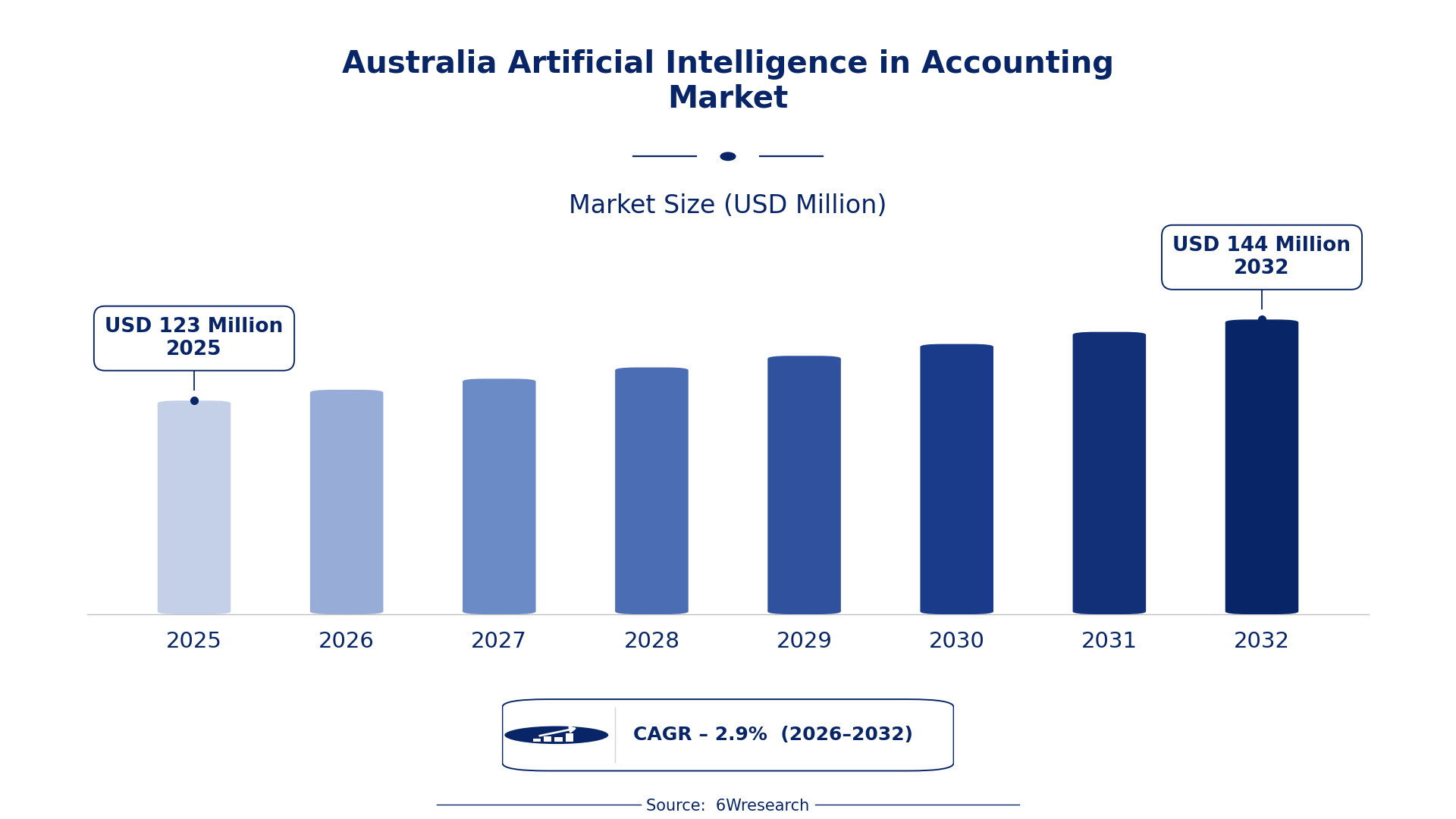
The Australia Artificial Intelligence in Accounting Market was estimated at USD 123 Million in 2025 and is projected to reach USD 144 Million by 2032, growing at a CAGR of 2.9% from 2026 to 2032.
Australia Artificial Intelligence in Accounting Market Synopsis
The most influential force driving the Australia Artificial Intelligence in Accounting Market is the increasing demand for automation in accounting processes. This trend is reshaping how firms operate, allowing for greater efficiency and accuracy while freeing professionals from mundane tasks.
Firms are increasingly adopting AI solutions to enhance decision-making and compliance with regulatory standards. The convergence of digitalization initiatives and the need for real-time financial insights are compelling enterprises to invest in AI-driven accounting software, marking a pivotal shift in traditional accounting practices.
Australia Artificial Intelligence in Accounting Market Year-wise Growth Rate and Key Drivers
This graph illustrates the annual growth rates of the Australia Artificial Intelligence in Accounting Market from 2021 to 2032, highlighting a steady upward trajectory and projected expansion over the forecast period.
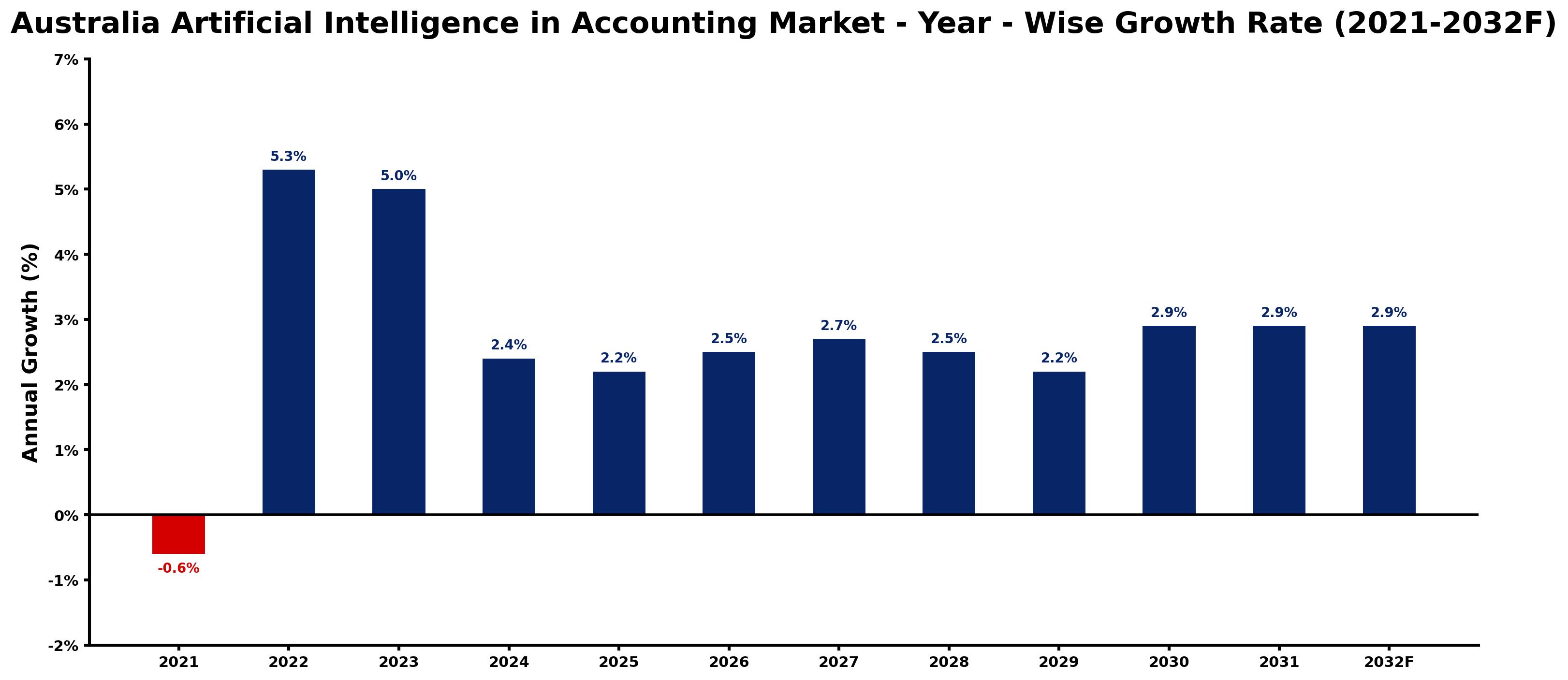
The table below presents the year‑wise growth rates along with the key drivers influencing the market
| Year | Growth Rate | Major Drivers |
| 2021 | -0.6% | CPA Australia criticized AI for job displacements. |
| 2022 | 5.3% | Australian Taxation Office encourages AI adoption for compliance. |
| 2023 | 5.0% | Increased investment in AI startups by Australian venture capital. |
| 2024 | 2.4% | Growth in remote work driving demand for accounting automation. |
| 2025 | 2.2% | Tax reforms prompting firms to integrate AI technologies. |
| 2026 | 2.5% | Rise of fintech partnerships enhancing AI accounting tools. |
| 2027 | 2.7% | Government grants supporting AI integration in small businesses. |
| 2028 | 2.5% | Advancements in machine learning enhancing audit processes. |
| 2029 | 2.2% | Increased focus on data security driving AI solutions. |
| 2030 | 2.9% | More firms adopting AI for financial forecasting accuracy. |
| 2031 | 2.9% | Growing reliance on data analytics in strategic planning. |
| 2032 | 2.9% | Transition to digital currency fostering AI-driven accounting needs. |
Note: Market size estimations and growth projections presented in this report are based on 6Wresearch's proprietary forecasting methodology, utilizing the latest available industry data, government publications, and primary research inputs.
Australia Artificial Intelligence in Accounting Market Key Takeaways
Below are some of the specific key takeaways from the market, including:
- Growing reliance on AI for automating repetitive tasks is streamlining workflows across the industry.
- The demand for real-time financial insights is pushing accounting firms to adopt advanced AI technologies.
- Regulatory compliance is a major driver influencing investment in AI applications within the sector.
- Cloud-based accounting solutions are becoming increasingly popular among businesses seeking flexibility and efficiency.
- AI innovations are reshaping the financial analysis landscape, enabling more accurate predictions and assessments.
Evaluation of Restraints in Australia Artificial Intelligence in Accounting Market
Despite its promising growth, the Australia Artificial Intelligence in Accounting Market faces notable restraints. Ensuring the accuracy and reliability of AI-driven analyses remains a challenge, as firms grapple with the complexities of integrating AI into existing workflows. on top of that, regulatory compliance poses hurdles, particularly as standards continue to evolve. Resistance to change among accounting professionals can hinder the pace of adoption. Trust in AI systems must be built, supported by training and demonstrable value, to realize its full potential in transforming accounting practices.
Australia Artificial Intelligence in Accounting Market Trends
The market is witnessing several trends that are influencing demand and technological development. First, the shift towards remote work has accelerated the adoption of cloud-based AI accounting solutions, enabling teams to collaborate efficiently from various locations. Second, there is an increasing focus on enhancing data analytics capabilities to provide deeper insights into financial performance. Lastly, the trend towards personalized financial advisory services is pushing firms to leverage AI for tailored client interactions.
Australia Artificial Intelligence in Accounting Market Opportunities
Several opportunities lie ahead for stakeholders in this market. The ongoing digital transformation across industries is creating a fertile ground for AI-driven solutions in accounting. Investment in training programs for accounting professionals can facilitate smoother transitions to AI technologies. Additionally, partnerships between software providers and accounting firms may foster innovation and enhance service offerings, enabling firms to differentiate themselves in a competitive landscape.
Government Initiatives in the Australia Artificial Intelligence in Accounting Market
The Australian government is actively promoting initiatives to foster the integration of AI in the accounting sector. By focusing on workforce upskilling and encouraging the adoption of AI technologies, the government aims to enhance productivity and compliance within the industry. Addressing data privacy and accountability challenges is also a priority, as these factors are critical to gaining trust in AI systems.
- A national workforce upskilling program launched in early 2025 aims to equip accounting professionals with AI competencies.
- An ongoing initiative to streamline regulatory processes is intended to simplify compliance for firms utilizing AI-driven accounting solutions.
- A planned public-private partnership is expected to focus on developing frameworks for data privacy in AI applications by 2028.
- Recent legislation promoting transparency in AI algorithms was introduced in late 2024 to enhance accountability in AI-driven financial practices.
- A pilot program initiated in mid-2025 seeks to assess the impact of AI on financial forecasting accuracy among small businesses.
Future Insights of the Australia Artificial Intelligence in Accounting Market
Looking ahead, the Australia Artificial Intelligence in Accounting Market is expected to continue evolving as firms increasingly embrace AI technologies. By 2032, we anticipate more integrated solutions that combine AI with traditional accounting practices, leading to improved accuracy and efficiency. As regulatory frameworks stabilize, firms will be better positioned to leverage AI for strategic decision-making, enhancing their competitive edge in the marketplace.
Australia Artificial Intelligence in Accounting Market Latest Developments
Over the past year, the Australia Artificial Intelligence in Accounting Market has seen several noteworthy developments. Companies are actively refining their AI offerings to enhance user experience and address emerging client needs. As the market matures, stakeholders are focusing on creating innovative solutions that align with regulatory expectations while delivering superior financial insights.
- A leading technology vendor launched a new AI-driven financial analytics platform in early 2025, designed to improve forecasting capabilities for accounting firms.
- An ongoing collaboration between an AI startup and a major accounting firm aims to integrate machine learning algorithms into auditing processes, enhancing accuracy.
- A rollout of enhanced cloud-based accounting solutions is expected to begin in Q3 2025, focusing on providing real-time data access for remote teams.
- In late 2024, a comprehensive training program for accountants on AI applications was initiated, with a focus on enhancing technological fluency.
- A planned upgrade to AI-driven compliance tools is set to be implemented by mid-2026, aimed at streamlining regulatory reporting for firms.
Australia Artificial Intelligence in Accounting Market - Key Attractiveness of the Report
- 10 Years of Market Numbers
- Historical Data Starting from 2022 to 2025
- Base Year: 2025
- Forecast Data until 2032
- Key Performance Indicators Impacting the Market
- Major Upcoming Developments and Projects
Key Highlights of the Report:
- Australia Artificial Intelligence in Accounting Market Outlook
- Market Size of Australia Artificial Intelligence in Accounting Market, 2025
- Forecast of Australia Artificial Intelligence in Accounting Market, 2032
- Historical Data and Forecast of Australia Artificial Intelligence in Accounting Revenues & Volume for the Period 2022-2032F
- Australia Artificial Intelligence in Accounting Market Trend Evolution
- Australia Artificial Intelligence in Accounting Market Drivers and Challenges
- Australia Artificial Intelligence in Accounting Price Trends
- Australia Artificial Intelligence in Accounting Porter's Five Forces
- Australia Artificial Intelligence in Accounting Industry Life Cycle
- Historical Data and Forecast of Australia Artificial Intelligence in Accounting Market Revenues & Volume By Application for the Period 2022-2032F
- Historical Data and Forecast of Australia Artificial Intelligence in Accounting Market Revenues & Volume By Automated Bookkeeping for the Period 2022-2032F
- Historical Data and Forecast of Australia Artificial Intelligence in Accounting Market Revenues & Volume By Invoice Classification and Approvals for the Period 2022-2032F
- Historical Data and Forecast of Australia Artificial Intelligence in Accounting Market Revenues & Volume By Fraud and Risk Management for the Period 2022-2032F
- Historical Data and Forecast of Australia Artificial Intelligence in Accounting Market Revenues & Volume By Reporting for the Period 2022-2032F
- Historical Data and Forecast of Australia Artificial Intelligence in Accounting Market Revenues & Volume By Others for the Period 2022-2032F
- Historical Data and Forecast of Australia Artificial Intelligence in Accounting Market Revenues & Volume By Component for the Period 2022-2032F
- Historical Data and Forecast of Australia Artificial Intelligence in Accounting Market Revenues & Volume By Solutions for the Period 2022-2032F
- Historical Data and Forecast of Australia Artificial Intelligence in Accounting Market Revenues & Volume By Services for the Period 2022-2032F
- Historical Data and Forecast of Australia Artificial Intelligence in Accounting Market Revenues & Volume By Technology for the Period 2022-2032F
- Historical Data and Forecast of Australia Artificial Intelligence in Accounting Market Revenues & Volume By Machine Learning (ML) and Deep Learning for the Period 2022-2032F
- Historical Data and Forecast of Australia Artificial Intelligence in Accounting Market Revenues & Volume By NLP for the Period 2022-2032F
- Historical Data and Forecast of Australia Artificial Intelligence in Accounting Market Revenues & Volume By Deployment Mode for the Period 2022-2032F
- Historical Data and Forecast of Australia Artificial Intelligence in Accounting Market Revenues & Volume By On-premises for the Period 2022-2032F
- Historical Data and Forecast of Australia Artificial Intelligence in Accounting Market Revenues & Volume By Cloud for the Period 2022-2032F
- Historical Data and Forecast of Australia Artificial Intelligence in Accounting Market Revenues & Volume By Enterprise Size for the Period 2022-2032F
- Historical Data and Forecast of Australia Artificial Intelligence in Accounting Market Revenues & Volume By Large Enterprises for the Period 2022-2032F
- Historical Data and Forecast of Australia Artificial Intelligence in Accounting Market Revenues & Volume By Small and Medium-Sized Enterprises (SMEs) for the Period 2022-2032F
- Australia Artificial Intelligence in Accounting Import Export Trade Statistics
- Market Opportunity Assessment By Application
- Market Opportunity Assessment By Component
- Market Opportunity Assessment By Technology
- Market Opportunity Assessment By Deployment Mode
- Market Opportunity Assessment By Enterprise Size
- Australia Artificial Intelligence in Accounting Top Companies Market Share
- Australia Artificial Intelligence in Accounting Competitive Benchmarking By Technical and Operational Parameters
- Australia Artificial Intelligence in Accounting Company Profiles
- Australia Artificial Intelligence in Accounting Key Strategic Recommendations






































