Australia Automotive Aftermarket Market Size, Share & Growth Rate
The Australia Automotive Aftermarket Market was estimated at USD 87 Million in 2025 and is projected to reach USD 102 Million by 2032, growing at a CAGR of 2.3% from 2026 to 2032. This growth trajectory is underpinned by an aging vehicle fleet, as older vehicles require more frequent maintenance and parts replacements. Moreover, Australian consumers are increasingly seeking customization options and performance upgrades, driven by both personal preferences and advancements in aftermarket technologies.
Australia Automotive Aftermarket Market Year-wise Growth Rate and Key Drivers
This graph highlights how the Australia Automotive Aftermarket Market has steadily grown over the years, supported by major growth factors.
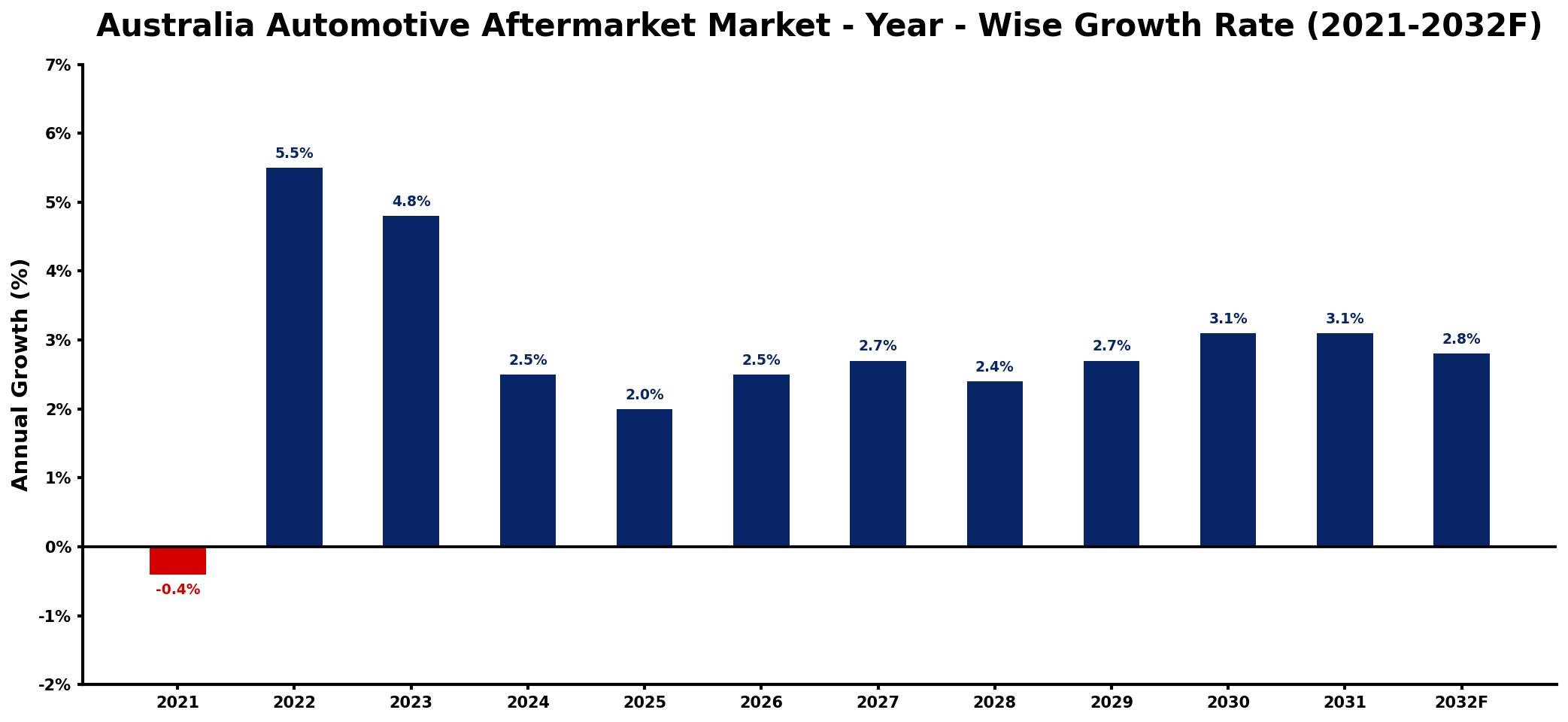
The table below presents the year‑wise growth rates along with the key drivers influencing the market
| Year | Growth Rate | Major Drivers |
| 2021 | -0.4% | shifts in consumer spending patterns |
| 2022 | 5.5% | increased vehicle ownership rates |
| 2023 | 4.8% | growth in online retail platforms |
| 2024 | 2.5% | rising demand for electric vehicles |
| 2025 | 2.0% | expansion of service networks |
| 2026 | 2.5% | increased disposable income levels |
| 2027 | 2.7% | growing interest in vehicle customization |
| 2028 | 2.4% | enhancements in supply chain efficiency |
| 2029 | 2.7% | increased focus on sustainability initiatives |
| 2030 | 3.1% | stronger distribution network expansion |
| 2031 | 3.1% | expanding industrial usage applications |
| 2032 | 2.8% | increased collaboration among stakeholders |
Note: Market size estimations and growth projections presented in this report are based on 6Wresearch's proprietary forecasting methodology, utilizing the latest available industry data, government publications, and primary research inputs.
Australia Automotive Aftermarket Market Synopsis
The Australian automotive aftermarket is experiencing dynamic changes, reflecting broader consumer trends and technological advances. As vehicle owners become more engaged in maintenance and enhancements, the demand for high-quality replacement parts and accessories continues to rise.
The sector is characterized by a robust DIY culture, where enthusiasts and regular consumers alike pursue personal modifications and repairs. This not only fuels the market but also encourages innovation among suppliers, who strive to meet the ever-evolving preferences of Australian motorists.
Australia Automotive Aftermarket Market Key Takeaways
- Increasing vehicle age is propelling demand for aftermarket parts and services.
- Consumer interest in vehicle customization and performance upgrades is on the rise.
- Technological advancements are reshaping product offerings and customer engagement.
- Government policies promote safety and consumer rights within the aftermarket sector.
- Online purchasing habits are influencing how consumers acquire aftermarket products.
Evaluation of Restraints in Australia Automotive Aftermarket Market
While the Australia automotive aftermarket market shows promising growth potential, it faces several significant restraints. The increasing complexity of vehicle electronics and software presents challenges for both consumers and service providers, often requiring specialized knowledge for repairs and upgrades. Additionally, inventory management and distribution channel efficiency remain critical hurdles, especially as more consumers shift toward online purchasing. This evolving landscape demands agility from aftermarket suppliers to adapt to changing consumer behaviors and preferences.
Australia Automotive Aftermarket Market Trends
Several trends are shaping the Australia automotive aftermarket landscape. Firstly, the integration of digital platforms into the purchasing process is enhancing customer convenience and access to information. Secondly, an increasing emphasis on eco-friendly parts and services reflects a growing consumer awareness of sustainability issues. This trend is pushing suppliers to innovate with environmentally friendly products that do not compromise on quality. Finally, the adoption of advanced diagnostics and repair technologies is further revolutionizing service offerings, streamlining maintenance processes for both professionals and DIY enthusiasts.
Australia Automotive Aftermarket Market Opportunities
There are several key growth opportunities within the Australian automotive aftermarket. The ongoing transition to electric vehicles (EVs) presents new avenues for aftermarket services and products tailored to this evolving market segment. Additionally, suppliers focusing on enhancing online engagement and e-commerce capabilities can tap into a broader customer base. Investment in research and development for innovative products that cater to advanced vehicle technologies will also position companies favorably as consumer expectations continue to rise.
Government Initiatives in the Australia Automotive Aftermarket Market
The Australian government actively supports the automotive aftermarket through various policies that focus on consumer protection, competition, and safety standards. Recent initiatives aim to enhance consumer education about aftermarket products, ensuring better informed purchasing decisions. Regulatory frameworks address concerns regarding counterfeit parts, vehicle recalls, and emissions compliance, all in an effort to safeguard public safety and consumer interests. Furthermore, ongoing support for small and medium-sized enterprises underscores the government's commitment to fostering a competitive environment in the aftermarket sector.
Future Insights of the Australia Automotive Aftermarket Market
Looking ahead to the years 2026-2032, the Australian automotive aftermarket market is set to witness transformative changes. The accelerated adoption of electric vehicles is expected to shape product development and service offerings significantly. As consumer awareness around sustainability grows, there will be a marked shift towards eco-friendly aftermarket solutions. Furthermore, advancements in technology, particularly in the realms of connectivity and digital interfaces, will redefine customer interactions and expectations, paving the way for a more dynamic and responsive aftermarket ecosystem.
Australia Automotive Aftermarket Market Latest Developments (2025 - 2026)
Recent developments in the Australian automotive aftermarket indicate a shift towards more integrated service offerings, with an emphasis on digital solutions. Companies are increasingly leveraging online platforms for product distribution and customer engagement, enhancing the convenience for consumers. Additionally, there is a growing collaboration between traditional aftermarket businesses and tech firms, aiming to innovate around diagnostics and repair services, ensuring they stay relevant in a rapidly evolving marketplace.
Australia Automotive Aftermarket Market - Key Attractiveness of the Report
- 10 Years of Market Numbers
- Historical Data Starting from 2022 to 2025
- Base Year: 2025
- Forecast Data until 2032
- Key Performance Indicators Impacting the Market
- Major Upcoming Developments and Projects
Key Highlights of the Report:
- Australia Automotive Aftermarket Market Outlook
- Market Size of Australia Automotive Aftermarket Market, 2025
- Forecast of Australia Automotive Aftermarket Market, 2032
- Historical Data and Forecast of Australia Automotive Aftermarket Revenues & Volume for the Period 2022-2032F
- Australia Automotive Aftermarket Market Trend Evolution
- Australia Automotive Aftermarket Market Drivers and Challenges
- Australia Automotive Aftermarket Price Trends
- Australia Automotive Aftermarket Porter's Five Forces
- Australia Automotive Aftermarket Industry Life Cycle
- Historical Data and Forecast of Australia Automotive Aftermarket Market Revenues & Volume By Replacement Parts for the Period 2022-2032F
- Historical Data and Forecast of Australia Automotive Aftermarket Market Revenues & Volume By Tire for the Period 2022-2032F
- Historical Data and Forecast of Australia Automotive Aftermarket Market Revenues & Volume By Battery for the Period 2022-2032F
- Historical Data and Forecast of Australia Automotive Aftermarket Market Revenues & Volume By Brake Parts for the Period 2022-2032F
- Historical Data and Forecast of Australia Automotive Aftermarket Market Revenues & Volume By Filters for the Period 2022-2032F
- Historical Data and Forecast of Australia Automotive Aftermarket Market Revenues & Volume By Body parts for the Period 2022-2032F
- Historical Data and Forecast of Australia Automotive Aftermarket Market Revenues & Volume By Lighting & Electronic Components for the Period 2022-2032F
- Historical Data and Forecast of Australia Automotive Aftermarket Market Revenues & Volume By Wheels for the Period 2022-2032F
- Historical Data and Forecast of Australia Tire Automotive Aftermarket Market Revenues & Volume By Exhaust components for the Period 2022-2032F
- Historical Data and Forecast of Australia Automotive Aftermarket Market Revenues & Volume By Distribution Channel for the Period 2022-2032F
- Historical Data and Forecast of Australia Automotive Aftermarket Market Revenues & Volume By Retailers for the Period 2022-2032F
- Historical Data and Forecast of Australia Automotive Aftermarket Market Revenues & Volume By Wholesalers & Distributors for the Period 2022-2032F
- Historical Data and Forecast of Australia Automotive Aftermarket Market Revenues & Volume By Service Channel for the Period 2022-2032F
- Historical Data and Forecast of Australia Automotive Aftermarket Market Revenues & Volume By DIY (Do it Yourself) for the Period 2022-2032F
- Historical Data and Forecast of Australia Automotive Aftermarket Market Revenues & Volume By DIFM (Do it for Me) for the Period 2022-2032F
- Historical Data and Forecast of Australia Automotive Aftermarket Market Revenues & Volume By OE (Delegating to OEM??s) for the Period 2022-2032F
- Historical Data and Forecast of Australia Automotive Aftermarket Market Revenues & Volume By Certification for the Period 2022-2032F
- Historical Data and Forecast of Australia Automotive Aftermarket Market Revenues & Volume By Genuine Parts for the Period 2022-2032F
- Historical Data and Forecast of Australia Automotive Aftermarket Market Revenues & Volume By Certified Parts for the Period 2022-2032F
- Historical Data and Forecast of Australia Automotive Aftermarket Market Revenues & Volume By Uncertified Parts for the Period 2022-2032F
- Australia Automotive Aftermarket Import Export Trade Statistics
- Market Opportunity Assessment By Replacement Parts
- Market Opportunity Assessment By Distribution Channel
- Market Opportunity Assessment By Service Channel
- Market Opportunity Assessment By Certification
- Australia Automotive Aftermarket Top Companies Market Share
- Australia Automotive Aftermarket Competitive Benchmarking By Technical and Operational Parameters
- Australia Automotive Aftermarket Company Profiles
- Australia Automotive Aftermarket Key Strategic Recommendations






































