Australia Automotive Reversing Radar Market Size, Share & Growth Rate
The Australia Automotive Reversing Radar Market was estimated at USD 214 Million in 2025 and is projected to reach USD 286 Million by 2032, growing at a CAGR of 4.2% from 2026 to 2032. This growth trajectory is primarily driven by heightened consumer awareness regarding vehicle safety features, alongside an increasing number of vehicles equipped with advanced driver-assistance systems. Additionally, urban congestion and the need for more efficient parking solutions further fuel demand for reversing radar technologies.
Australia Automotive Reversing Radar Market Year-wise Growth Rate and Key Drivers
This graph highlights how the Australia Automotive Reversing Radar Market has steadily grown over the years, supported by major growth factors.
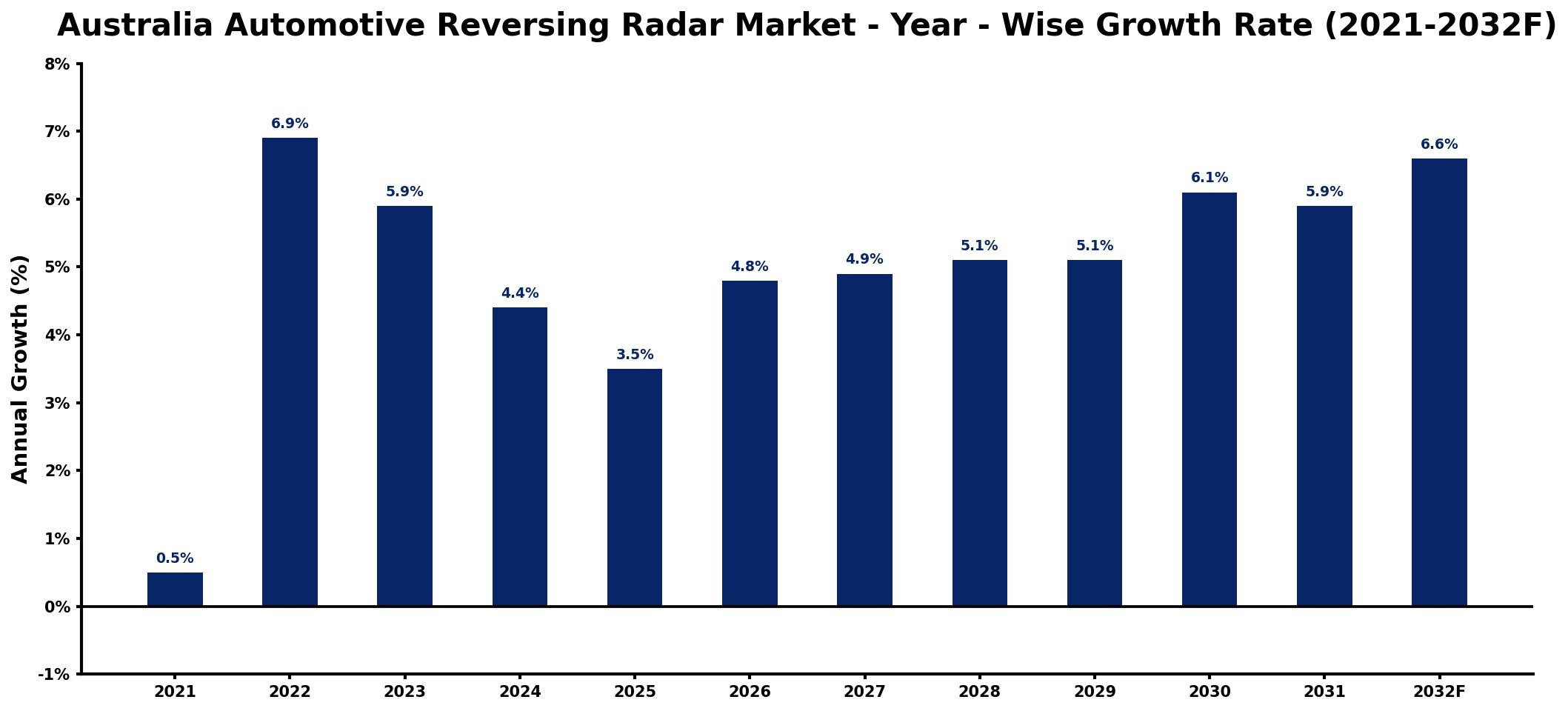
The table below presents the year‑wise growth rates along with the key drivers influencing the market
| Year | Growth Rate | Major Drivers |
| 2021 | 0.5% | Rising consumer safety awareness |
| 2022 | 6.9% | Increased vehicle technology adoption |
| 2023 | 5.9% | Growing demand for smart features |
| 2024 | 4.4% | Expansion of urban infrastructure projects |
| 2025 | 3.5% | expanding manufacturing base activity |
| 2026 | 4.8% | Surge in electric vehicle sales |
| 2027 | 4.9% | Strengthening regulations for safety |
| 2028 | 5.1% | Increase in fleet management solutions |
| 2029 | 5.1% | Development of advanced driver assistance |
| 2030 | 6.1% | Boost in aftermarket service offerings |
| 2031 | 5.9% | Growth in connected vehicle ecosystem |
| 2032 | 6.6% | Enhancement of user experience focus |
Note: Market size estimations and growth projections presented in this report are based on 6Wresearch's proprietary forecasting methodology, utilizing the latest available industry data, government publications, and primary research inputs.
Australia Automotive Reversing Radar Market Synopsis
The Australian automotive landscape is rapidly adapting to the integration of advanced safety technologies, particularly reversing radar systems. These systems are becoming indispensable in enhancing driver awareness and ensuring safety during reversing maneuvers, thus significantly reducing accident rates. As urban environments become more crowded, the necessity for reliable parking aids has never been more pertinent.
Recent technological advancements, such as the incorporation of 360-degree coverage and real-time alerts, have significantly improved the functionality of reversing radars. Consequently, these innovations not only enhance safety but also contribute to a more enjoyable driving experience, appealing to both new car buyers and seasoned drivers alike.
Australia Automotive Reversing Radar Market Key Takeaways
- Increasing focus on vehicle safety and accident prevention is propelling market growth.
- Technological advancements are enhancing radar capabilities, such as object detection and automatic braking.
- Government regulations are promoting the adoption of safety technologies, including reversing radars.
- Urbanization and the rise in vehicle ownership are fueling demand for parking assistance technologies.
- Challenges regarding weather reliability and sensor integration persist but are being addressed through ongoing R&D.
Evaluation of Restraints in Australia Automotive Reversing Radar Market
Despite the robust growth projections for the Australia automotive reversing radar market, several key restraints remain. One primary concern is the design of radar systems that can effectively and accurately detect obstacles under various environmental conditions. The market also faces challenges related to the reliability of detection in adverse weather, which can impact the performance of these systems. Additionally, false alarms continue to be a point of contention, requiring manufacturers to improve sensor integration with existing vehicle technologies to enhance overall effectiveness and driver trust.
Australia Automotive Reversing Radar Market Trends
The market is currently witnessing a surge in trends geared towards smart technology integration. Systems that utilize sensor fusion technology, which combines data from various sensors for improved accuracy, are becoming increasingly popular. Moreover, the trend towards autonomous driving is influencing manufacturers to innovate their reversing radar systems, ensuring they can support more advanced vehicle technologies in the near future. Enhanced visualization features and intuitive user interfaces are also being prioritized as part of a broader effort to improve user experience.
Australia Automotive Reversing Radar Market Opportunities
Opportunities for growth in the Australia automotive reversing radar market are significant, particularly in the realm of research and development. As the demand for integrated safety solutions rises, manufacturers can explore partnerships with technology firms to develop next-generation systems. Additionally, as government regulations increasingly mandate safety technologies in vehicles, early adopters of advanced reversing radar systems may gain a competitive edge. The potential for expansion into electric and autonomous vehicles also presents a promising avenue for investment.
Government Initiatives in the Australia Automotive Reversing Radar Market
Government policy in Australia is progressively steering the automotive industry towards enhanced safety standards. Initiatives aimed at promoting vehicle safety have led to the encouragement of reversing radar technologies that comply with strict safety regulations. This is further complemented by public spending directed towards research and development of innovative technologies that improve detection accuracy and driver assistance capabilities. The regulatory framework surrounding the automotive sector is actively evolving, aiming to reduce collision rates and improve overall vehicle safety.
Future Insights of the Australia Automotive Reversing Radar Market
Looking ahead to the period from 2026 to 2032, the Australia automotive reversing radar market is expected to undergo substantial transformation driven by continuous advancements in technology. As the automotive industry increasingly embraces automation, the integration of reversing radar with more comprehensive safety systems will likely become standard. This evolution will not only enhance vehicle safety but also cater to the growing consumer demand for smarter, more user-friendly driving aids. The market is set to expand rapidly as vehicle safety remains a priority, aligning with the broader goals of the Australian automotive sector.
Australia Automotive Reversing Radar Market Latest Developments (2025 - 2026)
In the recent months leading into mid-2026, the automotive industry has seen notable advancements in reversing radar technology. Developments are focused on enhancing integration with existing driver-assistance systems, ensuring a seamless user experience. Additionally, manufacturers are increasingly emphasizing R&D for improving the robustness and reliability of these systems across varied environmental conditions. The ongoing trend towards vehicle electrification is also encouraging innovations aimed at integrating reversing radars into electric vehicles, thus supporting the transition towards greener transportation options.
Australia Automotive Reversing Radar Market - Key Attractiveness of the Report
- 10 Years of Market Numbers
- Historical Data Starting from 2022 to 2025
- Base Year: 2025
- Forecast Data until 2032
- Key Performance Indicators Impacting the Market
- Major Upcoming Developments and Projects
Key Highlights of the Report:
- Australia Automotive Reversing Radar Market Outlook
- Market Size of Australia Automotive Reversing Radar Market, 2025
- Forecast of Australia Automotive Reversing Radar Market, 2032
- Historical Data and Forecast of Australia Automotive Reversing Radar Revenues & Volume for the Period 2022-2032F
- Australia Automotive Reversing Radar Market Trend Evolution
- Australia Automotive Reversing Radar Market Drivers and Challenges
- Australia Automotive Reversing Radar Price Trends
- Australia Automotive Reversing Radar Porter's Five Forces
- Australia Automotive Reversing Radar Industry Life Cycle
- Historical Data and Forecast of Australia Automotive Reversing Radar Market Revenues & Volume By Type for the Period 2022-2032F
- Historical Data and Forecast of Australia Automotive Reversing Radar Market Revenues & Volume By Ultrasonic for the Period 2022-2032F
- Historical Data and Forecast of Australia Automotive Reversing Radar Market Revenues & Volume By Electromagnetic for the Period 2022-2032F
- Historical Data and Forecast of Australia Automotive Reversing Radar Market Revenues & Volume By Application for the Period 2022-2032F
- Historical Data and Forecast of Australia Automotive Reversing Radar Market Revenues & Volume By Passenger Vehicle for the Period 2022-2032F
- Historical Data and Forecast of Australia Automotive Reversing Radar Market Revenues & Volume By Commercial Vehicle for the Period 2022-2032F
- Australia Automotive Reversing Radar Import Export Trade Statistics
- Market Opportunity Assessment By Type
- Market Opportunity Assessment By Application
- Australia Automotive Reversing Radar Top Companies Market Share
- Australia Automotive Reversing Radar Competitive Benchmarking By Technical and Operational Parameters
- Australia Automotive Reversing Radar Company Profiles
- Australia Automotive Reversing Radar Key Strategic Recommendations






































