Australia Bimetallic Thermometer Market Size, Share & Growth Rate
The Australia Bimetallic Thermometer Market was estimated at USD 211 Million in 2025 and is projected to reach USD 248 Million by 2032, growing at a CAGR of 2.3% from 2026 to 2032. This growth trajectory is largely fueled by the escalating demand for temperature monitoring solutions across key sectors such as industrial manufacturing, HVAC, and healthcare. These industries prioritize reliable and accurate temperature measurement to enhance process control, safety, and compliance with regulatory standards.
Australia Bimetallic Thermometer Market Year-wise Growth Rate and Key Drivers
This graph highlights how the Australia Bimetallic Thermometer Market has steadily grown over the years, supported by major growth factors.
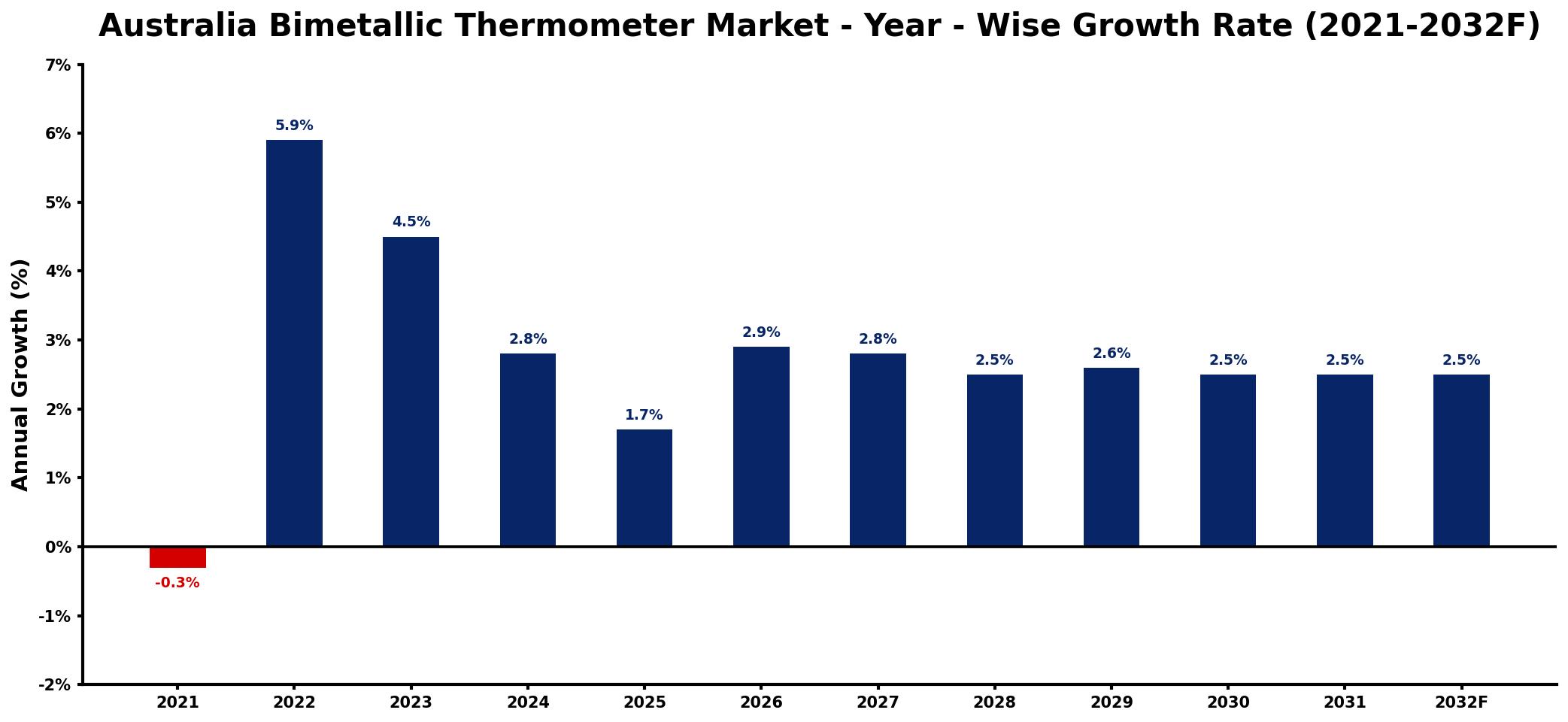
The table below presents the year‑wise growth rates along with the key drivers influencing the market
| Year | Growth Rate | Major Drivers |
| 2021 | -0.3% | decreased industrial equipment investments |
| 2022 | 5.9% | rising demand from manufacturing sector |
| 2023 | 4.5% | increased focus on quality control |
| 2024 | 2.8% | expansion of food processing facilities |
| 2025 | 1.7% | growing adoption in laboratories |
| 2026 | 2.9% | surge in construction activities |
| 2027 | 2.8% | enhanced regulatory compliance requirements |
| 2028 | 2.5% | growth in renewable energy projects |
| 2029 | 2.6% | increased consumer health awareness |
| 2030 | 2.5% | expanding industrial usage applications |
| 2031 | 2.5% | rising popularity in home kitchens |
| 2032 | 2.5% | increased investment in R&D initiatives |
Note: Market size estimations and growth projections presented in this report are based on 6Wresearch's proprietary forecasting methodology, utilizing the latest available industry data, government publications, and primary research inputs.
Australia Bimetallic Thermometer Market Synopsis
Recent momentum in the Australia bimetallic thermometer market underscores a growing reliance on these devices for a variety of applications, from industrial processes to healthcare diagnostics. However, as technology advances, the market is poised for even greater transformation, driven by innovations in sensor technologies and digital integration.
The demand for bimetallic thermometers is not only stable but is also evolving, as industries increasingly seek precision and durability in their temperature measurement tools. This shift is influenced by an overarching focus on quality control and operational efficiency, setting the stage for sustained growth in the upcoming years.
Australia Bimetallic Thermometer Market Key Takeaways
- The market is primarily driven by increasing demand from the industrial, HVAC, and healthcare sectors.
- Technological advancements are enhancing product offerings, particularly in sensor accuracy and connectivity.
- Regulatory standards play a crucial role in shaping compliance and market dynamics.
- Focus on quality control and safety is driving the adoption of bimetallic thermometers across industries.
- The market shows promising growth potential, with a projected CAGR of 2.3% from 2026 to 2032.
Evaluation of Restraints in Australia Bimetallic Thermometer Market
While the Australia bimetallic thermometer market enjoys a favorable growth outlook, it also faces certain restraints. A primary concern is the need for strict compliance with government regulations, which can impose additional costs on manufacturers. The demand for advanced technology often necessitates substantial investment in research and development, which may be prohibitive for smaller firms. Furthermore, fluctuating raw material prices can impact profitability, making it essential for companies to manage supply chain strategies effectively.
Australia Bimetallic Thermometer Market Trends
Currently, there is a marked trend towards digital integration in temperature measurement solutions. Innovations such as wireless connectivity and smart sensors are gaining traction, enabling real-time monitoring and data collection. Additionally, industries are increasingly recognizing the importance of accuracy and durability in thermometers, prompting manufacturers to enhance their product designs.
The healthcare sector, in particular, is witnessing a surge in the use of bimetallic thermometers, especially in settings where precision is critical. There is also a growing emphasis on environmentally sustainable practices, which could influence product development and market dynamics moving forward.
Australia Bimetallic Thermometer Market Opportunities
Significant growth opportunities exist within the Australia bimetallic thermometer market, particularly for manufacturers willing to invest in R&D. The rise of smart technology creates avenues for developing next-generation thermometers with enhanced functionalities. Furthermore, the increasing need for safety compliance and quality control measures across various sectors presents a ripe opportunity for companies offering reliable temperature monitoring solutions.
Government Initiatives in the Australia Bimetallic Thermometer Market
The Australian government plays a pivotal role in ensuring the accuracy and reliability of temperature measurement devices, including bimetallic thermometers. Various regulations and standards are in place to enforce compliance in calibration, response time, and operational capabilities. Government initiatives aimed at promoting workplace safety and environmental monitoring further emphasize the importance of precise temperature measurement, indirectly fostering demand in the market.
Future Insights of the Australia Bimetallic Thermometer Market
Looking ahead to 2026-2032, the Australia bimetallic thermometer market is expected to undergo significant evolution. The integration of smart technologies and digital interfaces will likely redefine user experiences and operational efficiencies. With industries increasingly prioritizing safety, compliance, and efficiency, the demand for innovative, reliable temperature measurement solutions will continue to rise, paving the way for sustained market growth.
Australia Bimetallic Thermometer Market Latest Developments (2025 - 2026)
Recent developments in the Australia bimetallic thermometer market indicate a focused shift toward incorporating advanced technologies, particularly in the realms of digital connectivity and sensor accuracy. Manufacturers are actively exploring collaborations and partnerships to enhance product offerings and expand their market reach. Additionally, ongoing regulatory updates are prompting companies to align their products with evolving compliance standards, positioning themselves strategically for future growth.
Australia Bimetallic Thermometer Market - Key Attractiveness of the Report
- 10 Years of Market Numbers
- Historical Data Starting from 2022 to 2025
- Base Year: 2025
- Forecast Data until 2032
- Key Performance Indicators Impacting the Market
- Major Upcoming Developments and Projects
Key Highlights of the Report:
- Australia Bimetallic Thermometer Market Outlook
- Market Size of Australia Bimetallic Thermometer Market, 2025
- Forecast of Australia Bimetallic Thermometer Market, 2032
- Historical Data and Forecast of Australia Bimetallic Thermometer Revenues & Volume for the Period 2022-2032F
- Australia Bimetallic Thermometer Market Trend Evolution
- Australia Bimetallic Thermometer Market Drivers and Challenges
- Australia Bimetallic Thermometer Price Trends
- Australia Bimetallic Thermometer Porter's Five Forces
- Australia Bimetallic Thermometer Industry Life Cycle
- Historical Data and Forecast of Australia Bimetallic Thermometer Market Revenues & Volume By Design Type for the Period 2022-2032F
- Historical Data and Forecast of Australia Bimetallic Thermometer Market Revenues & Volume By Angle Type for the Period 2022-2032F
- Historical Data and Forecast of Australia Bimetallic Thermometer Market Revenues & Volume By Straight Type for the Period 2022-2032F
- Historical Data and Forecast of Australia Bimetallic Thermometer Market Revenues & Volume By Adjustable Angle Type for the Period 2022-2032F
- Historical Data and Forecast of Australia Bimetallic Thermometer Market Revenues & Volume By End User for the Period 2022-2032F
- Historical Data and Forecast of Australia Bimetallic Thermometer Market Revenues & Volume By Oil & Gas Industry for the Period 2022-2032F
- Historical Data and Forecast of Australia Bimetallic Thermometer Market Revenues & Volume By Energy Industries for the Period 2022-2032F
- Historical Data and Forecast of Australia Bimetallic Thermometer Market Revenues & Volume By Chemical Industries for the Period 2022-2032F
- Historical Data and Forecast of Australia Bimetallic Thermometer Market Revenues & Volume By Iron & Steel Industries for the Period 2022-2032F
- Historical Data and Forecast of Australia Bimetallic Thermometer Market Revenues & Volume By Others for the Period 2022-2032F
- Australia Bimetallic Thermometer Import Export Trade Statistics
- Market Opportunity Assessment By Design Type
- Market Opportunity Assessment By End User
- Australia Bimetallic Thermometer Top Companies Market Share
- Australia Bimetallic Thermometer Competitive Benchmarking By Technical and Operational Parameters
- Australia Bimetallic Thermometer Company Profiles
- Australia Bimetallic Thermometer Key Strategic Recommendations






































