Australia Biosimilars Market Size, Share & Growth Rate
The Australia Biosimilars Market was estimated at USD 200 Million in 2025 and is projected to reach USD 236 Million by 2032, growing at a CAGR of 2.4% from 2026 to 2032. This growth trajectory is predominantly driven by the increasing demand for cost-effective biologic therapies. As original biologics face patent expirations, the influx of biosimilars offers healthcare providers more affordable treatment options, enabling enhanced patient access while also aiding in managing healthcare expenditures.
Australia Biosimilars Market Year-wise Growth Rate and Key Drivers
This graph highlights how the Australia Biosimilars Market has steadily grown over the years, supported by major growth factors.
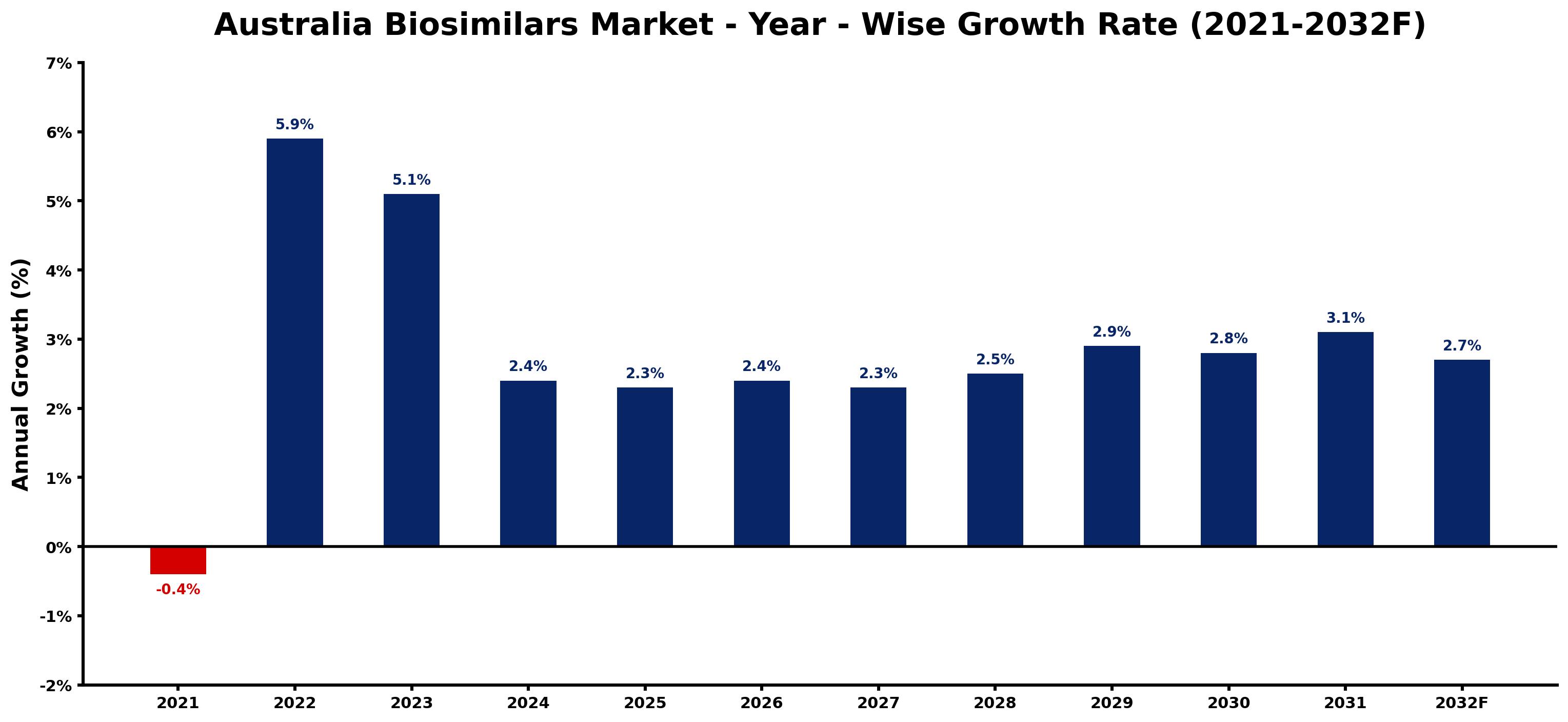
The table below presents the year‑wise growth rates along with the key drivers influencing the market
| Year | Growth Rate | Major Drivers |
| 2021 | -0.4% | Government infrastructure modernization initiatives |
| 2022 | 5.9% | Growing urbanization and commercial development |
| 2023 | 5.1% | Rising electricity demand across industries |
| 2024 | 2.4% | Expansion of manufacturing activities |
| 2025 | 2.3% | Rapid growth in telecom and data center sectors |
| 2026 | 2.4% | Growing renewable energy integration projects |
| 2027 | 2.3% | Rising electricity demand across industries |
| 2028 | 2.5% | Increasing industrial infrastructure investments |
| 2029 | 2.9% | Increasing adoption of advanced technologies |
| 2030 | 2.8% | Increasing industrial automation investments |
| 2031 | 3.1% | Growing urbanization and commercial development |
| 2032 | 2.7% | Rapid growth in telecom and data center sectors |
Note - Market size estimations and growth projections presented in this report are based on 6Wresearch’s advanced forecasting approach, validated with industry datasets as of June 2026.
Australia Biosimilars Market Synopsis
A notable increase in healthcare budget constraints is pushing the adoption of biosimilars in Australia. The demand for biologic therapies continues to rise, and with biosimilars positioned as viable alternatives, there is a unique opportunity for healthcare systems to improve sustainability and affordability.
Furthermore, the successful collaborations among biosimilar developers, regulatory agencies, and healthcare stakeholders are fostering confidence in these products. As the regulatory frameworks for biosimilars become more established, these dynamics pave the way for the market's ongoing expansion.
Australia Biosimilars Market Key Takeaways
- The market is benefitting from patent expirations of original biologics, creating opportunities for biosimilar development.
- Government initiatives are increasingly promoting the use of biosimilars to support healthcare affordability and accessibility.
- Healthcare provider confidence in biosimilars is bolstered by robust regulatory frameworks ensuring their safety and efficacy.
- Collaborative efforts within the healthcare ecosystem are enhancing market penetration and fostering competition.
- Cost-saving potential is a major driver of biosimilar uptake, ultimately benefiting patients and healthcare systems alike.
Evaluation of Restraints in Australia Biosimilars Market
Despite its promising growth, the Australia Biosimilars Market faces notable restraints. Regulatory approval processes can be complex, often causing delays in market entry for new biosimilars. Moreover, there are ongoing concerns regarding the interchangeability and overall efficacy of biosimilars compared to their original biologic counterparts. These challenges can hinder the confidence of healthcare providers and patients, impacting the overall acceptance and utilization of biosimilars in treatment protocols.
Australia Biosimilars Market Trends
The shift towards biosimilars is reflective of broader trends in the healthcare landscape focused on cost reduction and improved patient access. An increasing number of healthcare providers are integrating biosimilars into treatment regimens, supported by growing evidence of their efficacy and safety. Additionally, the rise of digital health initiatives and real-world evidence studies are expected to bolster confidence in biosimilars, paving the way for enhanced market penetration.
Australia Biosimilars Market Opportunities
The current market landscape presents several compelling opportunities for investment in biosimilars. With ongoing government support and a favorable regulatory environment, companies can explore innovative partnerships with healthcare providers. Additionally, as awareness and education around biosimilars increase among both professionals and patients, the potential for market growth becomes more pronounced.
Government Initiatives in the Australia Biosimilars Market
The Australian government has implemented several initiatives aimed at promoting the use of biosimilars. These policies focus on enhancing access to affordable biologic therapies, thus encouraging healthcare providers to consider biosimilars as substitutes for more expensive original biologic products. There are also financial incentives for healthcare professionals and hospitals to increase the adoption of biosimilars, ultimately aimed at sustaining the healthcare system's financial viability.
Future Insights of the Australia Biosimilars Market
Looking ahead to the years 2026 through 2032, the Australia Biosimilars Market is expected to continue its upward trajectory. The convergence of increasing healthcare costs, a shift towards value-based care, and expanding reimbursement frameworks for biosimilars will likely amplify their presence in therapeutic settings. Furthermore, innovation in biosimilar development and heightened regulatory support are poised to invigorate competition, ultimately benefiting patients through greater treatment options.
Australia Biosimilars Market Latest Developments (May 2025 - June 2026)
Recent months have seen a significant focus on regulatory adjustments that streamline the approval processes for biosimilars. As more biosimilars achieve market entry, awareness campaigns targeting healthcare professionals are ramping up, emphasizing the safety and efficacy of these products. Collaborations among pharmaceutical companies and healthcare providers have been increasingly common, aimed at fostering a supportive environment for biosimilars in clinical practice.
Australia Biosimilars Market - Key Attractiveness of the Report
- 10 Years of Market Numbers
- Historical Data Starting from 2022 to 2025
- Base Year: 2025
- Forecast Data until 2032
- Key Performance Indicators Impacting the Market
- Major Upcoming Developments and Projects
Key Highlights of the Report:
- Australia Biosimilars Market Outlook
- Market Size of Australia Biosimilars Market, 2025
- Forecast of Australia Biosimilars Market, 2032
- Historical Data and Forecast of Australia Biosimilars Revenues & Volume for the Period 2022-2032F
- Australia Biosimilars Market Trend Evolution
- Australia Biosimilars Market Drivers and Challenges
- Australia Biosimilars Price Trends
- Australia Biosimilars Porter's Five Forces
- Australia Biosimilars Industry Life Cycle
- Historical Data and Forecast of Australia Biosimilars Market Revenues & Volume By Product for the Period 2022-2032F
- Historical Data and Forecast of Australia Biosimilars Market Revenues & Volume By Insulin for the Period 2022-2032F
- Historical Data and Forecast of Australia Biosimilars Market Revenues & Volume By Follitropin for the Period 2022-2032F
- Historical Data and Forecast of Australia Biosimilars Market Revenues & Volume By Calcitonin for the Period 2022-2032F
- Historical Data and Forecast of Australia Biosimilars Market Revenues & Volume By Glucagon for the Period 2022-2032F
- Historical Data and Forecast of Australia Biosimilars Market Revenues & Volume By Teriparatide for the Period 2022-2032F
- Historical Data and Forecast of Australia Biosimilars Market Revenues & Volume By Others for the Period 2022-2032F
- Historical Data and Forecast of Australia Biosimilars Market Revenues & Volume By Indication for the Period 2022-2032F
- Historical Data and Forecast of Australia Biosimilars Market Revenues & Volume By Oncology for the Period 2022-2032F
- Historical Data and Forecast of Australia Biosimilars Market Revenues & Volume By Offsite Treatment for the Period 2022-2032F
- Historical Data and Forecast of Australia Biosimilars Market Revenues & Volume By Chronic Disorders for the Period 2022-2032F
- Historical Data and Forecast of Australia Biosimilars Market Revenues & Volume By Blood Disorders for the Period 2022-2032F
- Historical Data and Forecast of Australia Biosimilars Market Revenues & Volume By Infectious Diseases for the Period 2022-2032F
- Historical Data and Forecast of Australia Biosimilars Market Revenues & Volume By Others for the Period 2022-2032F
- Historical Data and Forecast of Australia Biosimilars Market Revenues & Volume By Manufacturing for the Period 2022-2032F
- Historical Data and Forecast of Australia Biosimilars Market Revenues & Volume By Outsourced for the Period 2022-2032F
- Historical Data and Forecast of Australia Biosimilars Market Revenues & Volume By In-house for the Period 2022-2032F
- Australia Biosimilars Import Export Trade Statistics
- Market Opportunity Assessment By Product
- Market Opportunity Assessment By Indication
- Market Opportunity Assessment By Manufacturing
- Australia Biosimilars Top Companies Market Share
- Australia Biosimilars Competitive Benchmarking By Technical and Operational Parameters
- Australia Biosimilars Company Profiles
- Australia Biosimilars Key Strategic Recommendations






































