Australia Bottle Filling Machine Market Size, Share & Growth Rate
The Australia Bottle Filling Machine Market was estimated at USD 202 Million in 2025 and is projected to reach USD 237 Million by 2032, growing at a CAGR of 2.3% from 2026 to 2032. This growth trajectory is driven primarily by the increasing demand for automation within the beverage, food, and pharmaceutical sectors, where efficiency and precision in filling operations are paramount. The shift toward high-speed production lines and the rising popularity of bottled beverages further contribute to the market's robust expansion.
Australia Bottle Filling Machine Market Year-wise Growth Rate and Key Drivers
This graph highlights how the Australia Bottle Filling Machine Market has steadily grown over the years, supported by major growth factors.
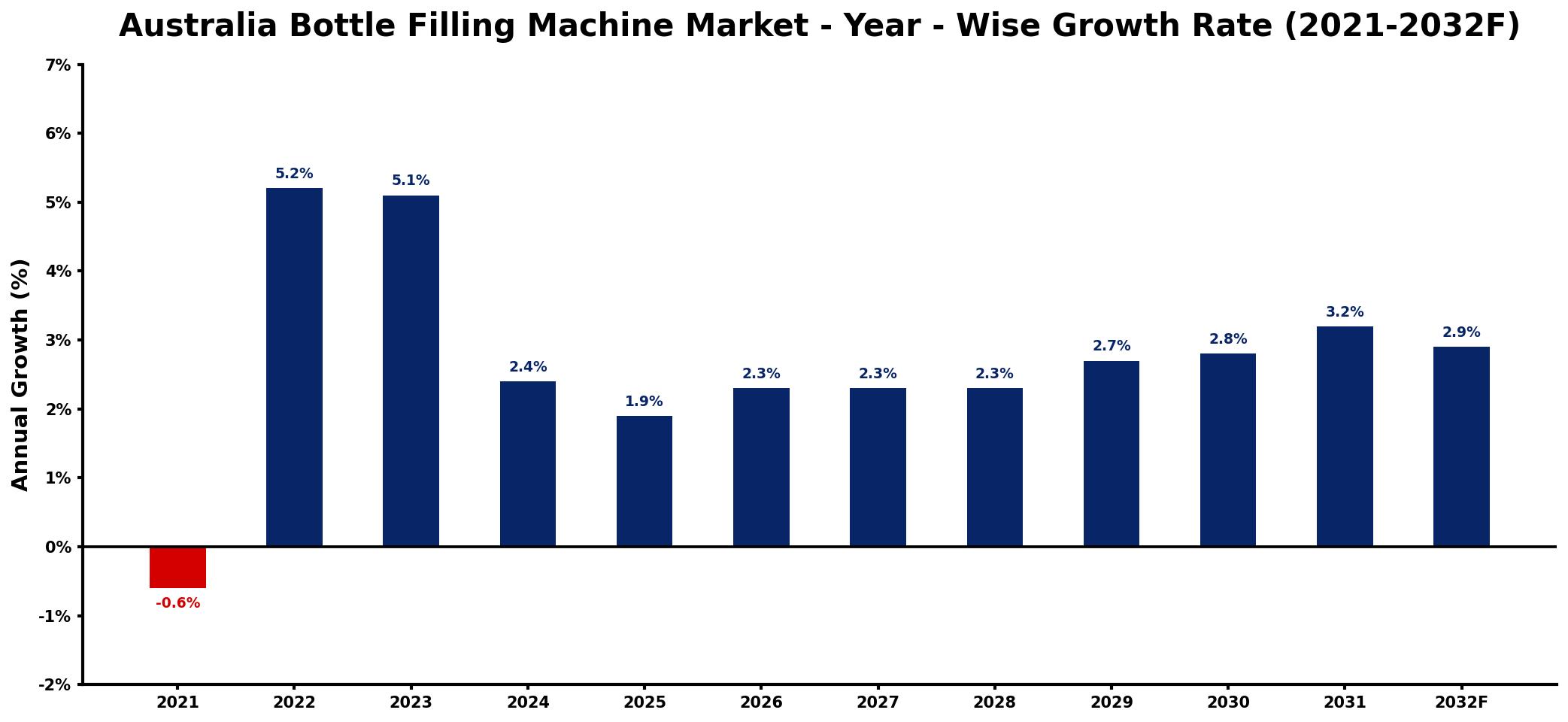
The table below presents the year‑wise growth rates along with the key drivers influencing the market
| Year | Growth Rate | Major Drivers |
| 2021 | -0.6% | decreased investment in manufacturing capacity |
| 2022 | 5.2% | increased beverage industry production demands |
| 2023 | 5.1% | growing environmental sustainability initiatives |
| 2024 | 2.4% | expansion of food service sector |
| 2025 | 1.9% | rising e-commerce distribution needs |
| 2026 | 2.3% | enhanced automation technology adoption |
| 2027 | 2.3% | increased focus on operational efficiency |
| 2028 | 2.3% | growing demand for customization options |
| 2029 | 2.7% | enhanced product quality standards |
| 2030 | 2.8% | rising consumer preference for convenience |
| 2031 | 3.2% | increased investment in R&D |
| 2032 | 2.9% | growing trend of eco-friendly packaging |
Note: Market size estimations and growth projections presented in this report are based on 6Wresearch's proprietary forecasting methodology, utilizing the latest available industry data, government publications, and primary research inputs.
Australia Bottle Filling Machine Market Synopsis
Recently, the Australia bottle filling machine market has witnessed a surge in investments due to heightened demand for quality and consistency across various industries. As we look ahead, the focus is shifting towards technological advancements that enhance filling accuracy and speed, ensuring the market keeps pace with evolving consumer preferences.
While the market has experienced positive momentum, challenges persist in adapting to diverse packaging formats and maintaining compatibility with an array of container types. Nonetheless, ongoing innovation in automation technologies positions the Australia bottle filling machine market for sustained growth and improvement.
Australia Bottle Filling Machine Market Key Takeaways
- Increasing demand for automated packaging solutions drives the growth of bottle filling machines across various industries.
- Technological advancements, including gravimetric and aseptic filling, enhance machine performance and product safety.
- Government regulations on food safety and packaging standards shape market dynamics and demand for quality equipment.
- The market faces challenges with filling speed optimization and adapting to varied container formats.
- Investments in high-speed production lines signify a strong commitment to efficiency and quality in the industry.
Evaluation of Restraints in Australia Bottle Filling Machine Market
The Australia bottle filling machine market grapples with several restraints that could limit its potential. One of the primary challenges is the need for optimization of filling speeds, which varies greatly depending on the product type and packaging requirements. Additionally, as manufacturers adapt to changing consumer preferences, they often face difficulties in ensuring compatibility with a diverse range of container formats. These challenges necessitate ongoing investments in research and development to enhance filling accuracy and maintain operational efficiency. As such, manufacturers must navigate these complexities while striving to meet the rigorous demands of food safety and product quality.
Australia Bottle Filling Machine Market Trends
Emerging trends in the Australia bottle filling machine market point towards a significant shift towards smart automation and data-driven solutions. Manufacturers are increasingly adopting Industry 4.0 technologies, which facilitate real-time monitoring and control of filling processes, ensuring enhanced precision and efficiency. Additionally, there is a notable rise in demand for environmentally friendly packaging solutions, pushing manufacturers to integrate sustainable practices into their operations, thereby shaping the future of the market.
Australia Bottle Filling Machine Market Opportunities
Genuine growth opportunities lie in the exploration of new applications for bottle filling machines, particularly in the health and wellness sector, where demand for nutraceuticals and herbal products is on the rise. Furthermore, as the beverage industry diversifies into non-alcoholic options, there is an increasing need for flexible filling systems that can accommodate varying bottle shapes and sizes. Investing in R&D to develop machines that cater to these evolving demands presents a significant opportunity for market players.
Government Initiatives in the Australia Bottle Filling Machine Market
Government initiatives in Australia focus heavily on regulations that enhance food safety and packaging standards, directly influencing the bottle filling machine market. Policies aimed at improving production efficiency and promoting sustainable practices are also shaping the landscape. The government continues to support advancements in technology and automation through grants and funding programs designed to bolster manufacturing capabilities and innovation across various sectors.
Future Insights of the Australia Bottle Filling Machine Market
Looking ahead to 2026-2032, the Australia bottle filling machine market is poised for a promising trajectory driven by technological innovations and the persistent need for efficiency in production lines. As manufacturers increasingly focus on quality assurance and sustainability, the adoption of smart technologies will likely become more prevalent. Furthermore, the ability to adapt to changing consumer demands and preferences will be critical for market players seeking to maintain competitiveness in this dynamic environment.
Australia Bottle Filling Machine Market Latest Developments (2025 - 2026)
Recent developments in the Australia bottle filling machine market highlight a concerted effort toward automation and efficiency enhancements. Companies are increasingly investing in advanced filling technologies that enable greater accuracy and faster production speeds. Furthermore, collaborations and partnerships within the industry aim to facilitate knowledge sharing and innovation, driving forward the capabilities of filling machines to meet the complexities of modern packaging demands.
Australia Bottle Filling Machine Market - Key Attractiveness of the Report
- 10 Years of Market Numbers
- Historical Data Starting from 2022 to 2025
- Base Year: 2025
- Forecast Data until 2032
- Key Performance Indicators Impacting the Market
- Major Upcoming Developments and Projects
Key Highlights of the Report:
- Australia Bottle Filling Machine Market Outlook
- Market Size of Australia Bottle Filling Machine Market, 2025
- Forecast of Australia Bottle Filling Machine Market, 2032
- Historical Data and Forecast of Australia Bottle Filling Machine Revenues & Volume for the Period 2022-2032F
- Australia Bottle Filling Machine Market Trend Evolution
- Australia Bottle Filling Machine Market Drivers and Challenges
- Australia Bottle Filling Machine Price Trends
- Australia Bottle Filling Machine Porter's Five Forces
- Australia Bottle Filling Machine Industry Life Cycle
- Historical Data and Forecast of Australia Bottle Filling Machine Market Revenues & Volume By Bottle Type for the Period 2022-2032F
- Historical Data and Forecast of Australia Bottle Filling Machine Market Revenues & Volume By PET Bottles for the Period 2022-2032F
- Historical Data and Forecast of Australia Bottle Filling Machine Market Revenues & Volume By Glass Bottles for the Period 2022-2032F
- Historical Data and Forecast of Australia Bottle Filling Machine Market Revenues & Volume By Others for the Period 2022-2032F
- Historical Data and Forecast of Australia Bottle Filling Machine Market Revenues & Volume By Application for the Period 2022-2032F
- Historical Data and Forecast of Australia Bottle Filling Machine Market Revenues & Volume By Food Products for the Period 2022-2032F
- Historical Data and Forecast of Australia Bottle Filling Machine Market Revenues & Volume By Beverages for the Period 2022-2032F
- Historical Data and Forecast of Australia Bottle Filling Machine Market Revenues & Volume By Chemicals & Pharmaceuticals for the Period 2022-2032F
- Historical Data and Forecast of Australia Bottle Filling Machine Market Revenues & Volume By Cosmetics for the Period 2022-2032F
- Australia Bottle Filling Machine Import Export Trade Statistics
- Market Opportunity Assessment By Bottle Type
- Market Opportunity Assessment By Application
- Australia Bottle Filling Machine Top Companies Market Share
- Australia Bottle Filling Machine Competitive Benchmarking By Technical and Operational Parameters
- Australia Bottle Filling Machine Company Profiles
- Australia Bottle Filling Machine Key Strategic Recommendations






































