Australia Business Intelligence Market Size & Growth Rate (2026-2032)
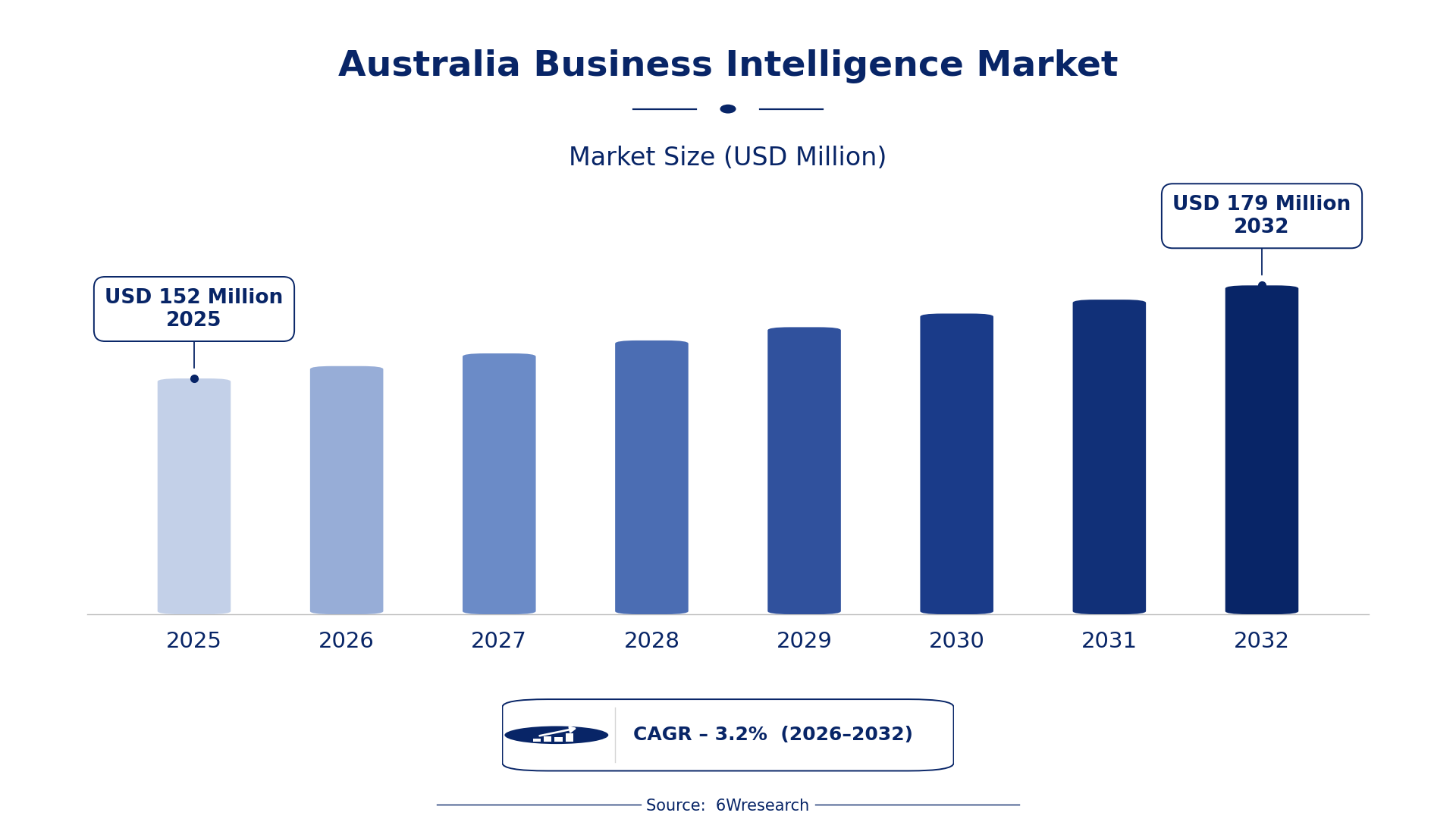
The Australia Business Intelligence Market was estimated at USD 152 Million in 2025 and is projected to reach USD 179 Million by 2032, growing at a CAGR of 3.2% from 2026 to 2032.
Australia Business Intelligence Market Synopsis
The current surge in demand for data-driven decision-making is the most influential force shaping the Australia Business Intelligence Market. Organizations across various sectors are increasingly recognizing the importance of actionable insights, prompting investments in advanced BI tools and solutions that can provide real-time data analysis and comprehensive reporting functionalities.
Technological advancements are further propelling this market, particularly in artificial intelligence and machine learning. These innovations enhance the capabilities of BI platforms, allowing companies to analyze vast amounts of data more effectively and respond to market dynamics with agility.
Australia Business Intelligence Market Year-wise Growth Rate and Key Drivers
This graph illustrates the annual growth rates of the Australia Business Intelligence Market from 2021 to 2032, highlighting a steady upward trajectory and projected expansion over the forecast period.
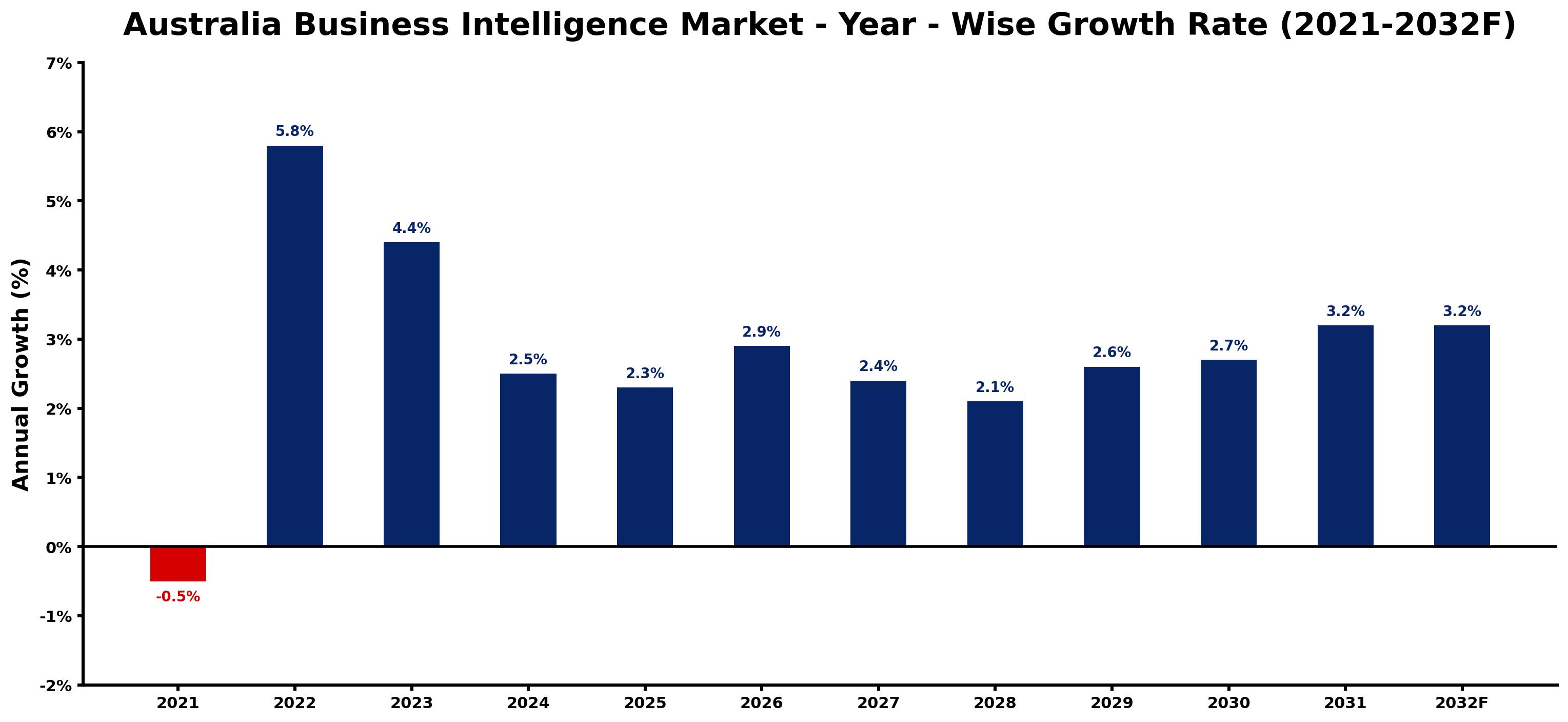
The table below presents the year‑wise growth rates along with the key drivers influencing the market
| Year | Growth Rate | Major Drivers |
| 2021 | -0.5% | COVID-19 lockdowns hindered business analytics investments. |
| 2022 | 5.8% | Increased investment in data-driven decision-making processes. |
| 2023 | 4.4% | Surge in local startups leveraging BI for innovation. |
| 2024 | 2.5% | Focus on compliance with Australian data privacy regulations. |
| 2025 | 2.3% | Growing interest in predictive analytics across retail sector. |
| 2026 | 2.9% | Enhanced cloud adoption driving BI software implementations. |
| 2027 | 2.4% | Emergence of AI-driven insights for competitive edge. |
| 2028 | 2.1% | Boost in regional partnerships for BI software solutions. |
| 2029 | 2.6% | Integration of BI tools within traditional industries. |
| 2030 | 2.7% | Shift towards personalized customer experiences using BI. |
| 2031 | 3.2% | Increase in government spending on digital analytics initiatives. |
| 2032 | 3.2% | Rising focus on sustainability metrics using business intelligence. |
Note: Market size estimations and growth projections presented in this report are based on 6Wresearch's proprietary forecasting methodology, utilizing the latest available industry data, government publications, and primary research inputs.
Australia Business Intelligence Market Key Takeaways
Below are some of the specific key takeaways from the market, including:
- Growing recognition of the value of data analytics in driving strategic business decisions.
- Advancements in AI and machine learning are increasing the effectiveness of BI solutions.
- Real-time analytics and predictive capabilities are becoming standard expectations in BI tools.
- Data quality and management remain pressing concerns for BI solution providers.
- Government policies are increasingly focusing on data privacy and compliance across industries.
Evaluation of Restraints in Australia Business Intelligence Market
Despite the positive momentum, the Australia Business Intelligence Market faces several constraints. Data quality issues can hinder the effectiveness of BI tools, leading to inaccurate insights that affect decision-making. Organizations also experience information overload, where the sheer volume of data complicates the ability to extract actionable insights. on top of that, the complexity of BI systems presents a barrier, as businesses must continually adapt to evolving reporting requirements, which can be a daunting task for many.
Australia Business Intelligence Market Trends
The demand for integrated BI solutions that combine various functionalities is on the rise. Businesses are increasingly looking for platforms that not only provide reporting and analytics but also incorporate predictive modeling and machine learning capabilities. Additionally, the focus on user-friendly interfaces is driving software development, making it easier for non-technical users to engage with BI tools. This trend supports broader adoption across different organizational levels.
Australia Business Intelligence Market Opportunities
The future holds several promising opportunities for the Australia Business Intelligence Market. As companies strive for digital transformation, there is a burgeoning demand for advanced BI tools that can cater to specific industry needs. Additionally, the growing emphasis on data security and compliance presents opportunities for BI solutions that prioritize these elements. Companies that can innovate around data integration and real-time analytics will likely capture significant market share.
Government Initiatives in the Australia Business Intelligence Market
Government initiatives play a crucial role in shaping the trajectory of the Australia Business Intelligence Market. With an increasing focus on data privacy and security, public policy is influencing the development and adoption of BI tools across sectors. The regulatory environment encourages organizations to invest in compliant solutions, thereby promoting growth in the BI market.
- A national digital infrastructure upgrade programme launched in early 2024 aims to enhance data accessibility for businesses.
- Currently underway is a regulatory framework introduced in 2023, focusing on data privacy standards applicable to BI tools.
- A planned public-private initiative expected to expand analytics capabilities in the healthcare sector by 2026.
- Recent policy revisions in 2023 mandate improved transparency for data usage across financial institutions, influencing BI tool requirements.
Future Insights of the Australia Business Intelligence Market
Looking ahead to 2026-2032, the Australia Business Intelligence Market is expected to continue its upward trajectory. The integration of AI and machine learning will deepen, making BI tools not just reactive but predictive. As more businesses acknowledge the necessity of data-driven insights for competitive advantage, investment in BI solutions will become a strategic priority. Organizations that prioritize innovation and adapt to the changing landscape will likely thrive.
Australia Business Intelligence Market Latest Developments
In the past year, the Australia Business Intelligence Market has witnessed a flurry of activity, reflecting a strong focus on enhancing analytical capabilities. Companies are increasingly adopting advanced technologies that facilitate better data management and insights generation.
- A major technology vendor introduced a cutting-edge BI tool in Q1 2025 that integrates AI-driven analytics with traditional reporting capabilities.
- An ongoing initiative that began in mid-2025 aims to upgrade existing BI systems across multiple sectors to ensure compliance with new regulations.
- In early 2025, a leading regional operator partnered with a software company to develop a customized BI solution for the healthcare industry.
- A rollout expected to begin in the second half of 2026 will focus on enhancing real-time data visualization tools for enterprises.
Australia Business Intelligence Market - Key Attractiveness of the Report
- 10 Years of Market Numbers
- Historical Data Starting from 2022 to 2025
- Base Year: 2025
- Forecast Data until 2032
- Key Performance Indicators Impacting the Market
- Major Upcoming Developments and Projects
Key Highlights of the Report:
- Australia Business Intelligence Market Outlook
- Market Size of Australia Business Intelligence Market, 2025
- Forecast of Australia Business Intelligence Market, 2032
- Historical Data and Forecast of Australia Business Intelligence Revenues & Volume for the Period 2022-2032F
- Australia Business Intelligence Market Trend Evolution
- Australia Business Intelligence Market Drivers and Challenges
- Australia Business Intelligence Price Trends
- Australia Business Intelligence Porter's Five Forces
- Australia Business Intelligence Industry Life Cycle
- Historical Data and Forecast of Australia Business Intelligence Market Revenues & Volume By Component for the Period 2022-2032F
- Historical Data and Forecast of Australia Business Intelligence Market Revenues & Volume By Solutions for the Period 2022-2032F
- Historical Data and Forecast of Australia Business Intelligence Market Revenues & Volume By Services for the Period 2022-2032F
- Historical Data and Forecast of Australia Business Intelligence Market Revenues & Volume By Business Function for the Period 2022-2032F
- Historical Data and Forecast of Australia Business Intelligence Market Revenues & Volume By Human Resource for the Period 2022-2032F
- Historical Data and Forecast of Australia Business Intelligence Market Revenues & Volume By Finance for the Period 2022-2032F
- Historical Data and Forecast of Australia Business Intelligence Market Revenues & Volume By Operations for the Period 2022-2032F
- Historical Data and Forecast of Australia Business Intelligence Market Revenues & Volume By Sales and Marketing for the Period 2022-2032F
- Historical Data and Forecast of Australia Business Intelligence Market Revenues & Volume By Deployment Mode for the Period 2022-2032F
- Historical Data and Forecast of Australia Business Intelligence Market Revenues & Volume By On-premises for the Period 2022-2032F
- Historical Data and Forecast of Australia Business Intelligence Market Revenues & Volume By Cloud for the Period 2022-2032F
- Historical Data and Forecast of Australia Business Intelligence Market Revenues & Volume By Organization Size for the Period 2022-2032F
- Historical Data and Forecast of Australia Business Intelligence Market Revenues & Volume By SMEs for the Period 2022-2032F
- Historical Data and Forecast of Australia Business Intelligence Market Revenues & Volume By Large Enterprises for the Period 2022-2032F
- Historical Data and Forecast of Australia Business Intelligence Market Revenues & Volume By Vertical for the Period 2022-2032F
- Historical Data and Forecast of Australia Business Intelligence Market Revenues & Volume By Retail for the Period 2022-2032F
- Historical Data and Forecast of Australia Business Intelligence Market Revenues & Volume By Manufacturing for the Period 2022-2032F
- Historical Data and Forecast of Australia Business Intelligence Market Revenues & Volume By Government and Public Services for the Period 2022-2032F
- Historical Data and Forecast of Australia Business Intelligence Market Revenues & Volume By Media and Entertainment for the Period 2022-2032F
- Historical Data and Forecast of Australia Business Intelligence Market Revenues & Volume By Transportation and Logistics for the Period 2022-2032F
- Historical Data and Forecast of Australia Business Intelligence Market Revenues & Volume By BFSI for the Period 2022-2032F
- Historical Data and Forecast of Australia Business Intelligence Market Revenues & Volume By Telecom and IT for the Period 2022-2032F
- Historical Data and Forecast of Australia Business Intelligence Market Revenues & Volume By Healthcare and Life Sciences for the Period 2022-2032F
- Australia Business Intelligence Import Export Trade Statistics
- Market Opportunity Assessment By Component
- Market Opportunity Assessment By Business Function
- Market Opportunity Assessment By Deployment Mode
- Market Opportunity Assessment By Organization Size
- Market Opportunity Assessment By Vertical
- Australia Business Intelligence Top Companies Market Share
- Australia Business Intelligence Competitive Benchmarking By Technical and Operational Parameters
- Australia Business Intelligence Company Profiles
- Australia Business Intelligence Key Strategic Recommendations






































