Australia Cameras Market Summary
The australia cameras market was estimated at USD 139 Million in 2025 and is projected to reach USD 163 Million by 2032, growing at a CAGR of 2.8% from 2026 to 2032.
Australia Cameras Market Year-wise Growth Rate and Key Drivers
This graph highlights how the Australia Cameras Market has steadily grown over the past five years, supported by major growth factors.
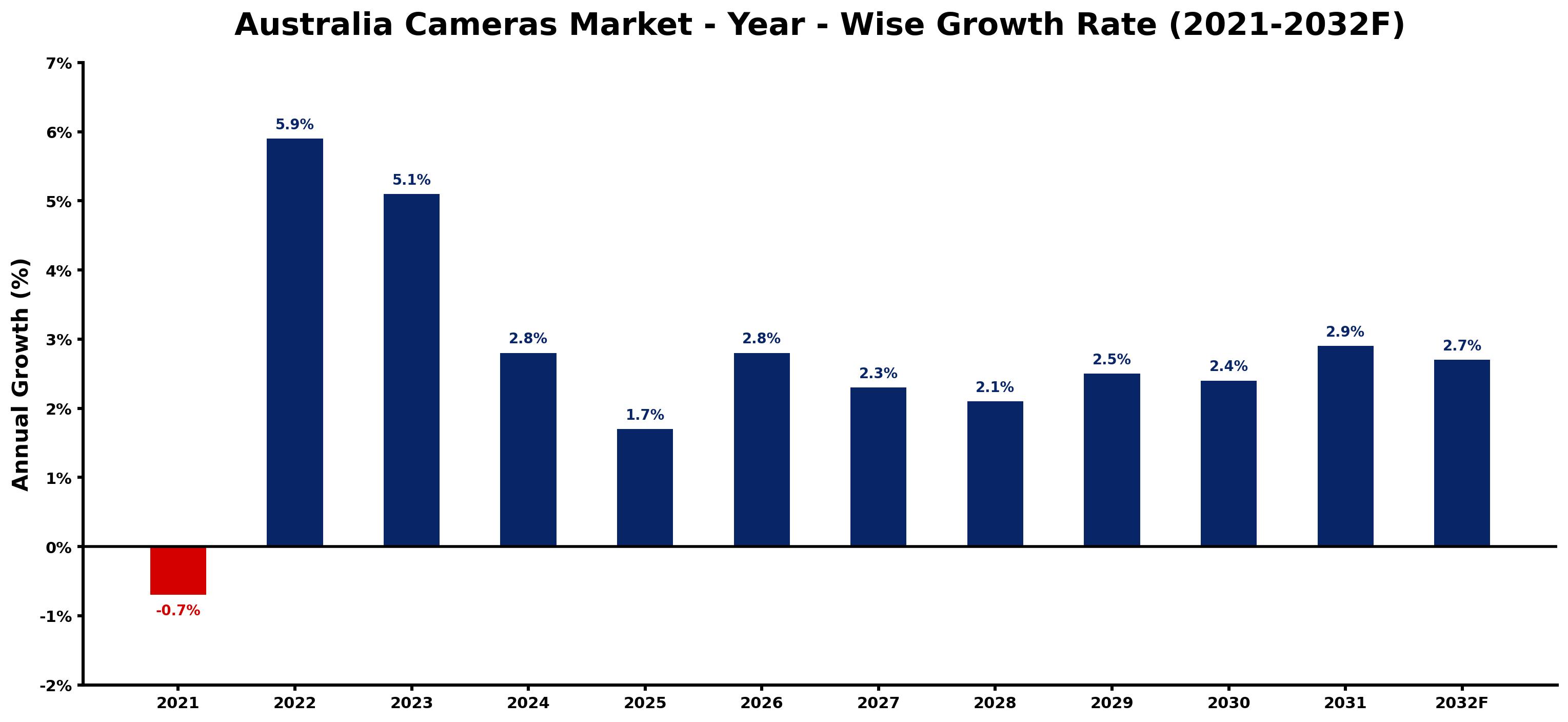
The table below presents the year wise growth rates along with the key drivers influencing the market
| Year | Growth Rate | Major Drivers |
| 2021 | -0.7% | Extended travel restrictions diminished demand for photographic equipment as consumers postponed vacation plans and outdoor activities. |
| 2022 | 5.9% | Innovations in mirrorless camera technology expanded options for both amateurs and professionals. |
| 2023 | 5.1% | Sustainability initiatives prompted brands to develop eco-friendly camera materials and packaging. |
| 2024 | 2.8% | The rise of vlogging and content creation drove demand for compact, high-quality cameras. |
| 2025 | 1.7% | Integration of AI features in cameras attracted tech-savvy users eager for advanced functionalities. |
| 2026 | 2.8% | Retail expansions, including online platforms, improved accessibility to diverse camera brands. |
| 2027 | 2.3% | The growing popularity of travel photography motivated consumers to invest in high-performance gear. |
| 2028 | 2.1% | Enhanced smartphone camera capabilities challenged traditional models, prompting innovation in the sector. |
| 2029 | 2.5% | Professional photography continued its resurgence as businesses sought quality visuals for marketing. |
| 2030 | 2.4% | Virtual reality and augmented reality applications opened new avenues for camera technology development. |
| 2031 | 2.9% | Collaborations between brands and content creators fostered deeper market engagement and loyalty. |
| 2032 | 2.7% | Consumer preference shifted toward multi-functional devices, integrating photography with other media capabilities. |
Note - Market size estimations and growth projections presented in this report are based on 6Wresearch's advanced forecasting approach, validated with industry datasets as of June 2026.
Australia Cameras Market Synopsis
The Australia Cameras Market is projected to reach 2.8% and witness significant growth during the forecast period (2026-2032). This dynamic landscape encompasses various camera types, including digital cameras, DSLRs, mirrorless systems, and action cameras, serving both amateur and professional photographers. The rising demand for quality imaging solutions, coupled with technological advancements such as enhanced image stabilization and 4K video capabilities, is driving the market's expansion.
Australia Cameras Market Growth Drivers
The proliferation of photography and videography as both hobbies and professional endeavors is a primary driver of growth in the Australia Cameras Market. Key factors influencing this trend include:
- Increased accessibility to high-quality cameras has motivated many individuals to pursue photography seriously, whether for personal enjoyment or career opportunities.
- Technological advancements have led to features that enhance the user experience, such as wireless connectivity that allows for seamless sharing of images and videos.
- The demand for professional gear continues to rise, particularly among content creators who require equipment that delivers superior image quality and performance.
- Rising social media presence has made photography and videography essential tools for personal branding and online marketing, driving demand for camera equipment.
- The increasing popularity of outdoor activities and travel photography has also spurred interest in portable, rugged camera options.
Australia Cameras Market Challenges and Restraints
Despite the positive growth outlook, the Australia Cameras Market faces several challenges that impede its progress:
- The surge in smartphone photography has significantly reduced demand for standalone cameras, compelling manufacturers to innovate continuously.
- Consumer expectations are shifting towards multifunctionality and advanced features, necessitating investments in R&D to meet these demands.
- Price sensitivity remains a concern as potential buyers gravitate towards affordable options, impacting the sales of high-end models.
- The rapid pace of technological changes poses a challenge for manufacturers to keep up and adapt their product offerings effectively.
- Concerns over data privacy and digital image rights are becoming more pronounced, placing additional regulatory pressures on the industry.
Australia Cameras Market Trends and Opportunities
Emerging trends within the Australia Cameras Market indicate numerous opportunities for growth and innovation:
- The integration of artificial intelligence in camera systems is enhancing automation and image processing capabilities, appealing to tech-savvy users.
- The rise of vlogging and live streaming has created a new demand for equipment that caters specifically to content creators.
- A growing emphasis on sustainability has led manufacturers to explore eco-friendly materials and production methods, attracting environmentally conscious consumers.
- Collaborations with software developers for editing platforms are increasing, creating a more holistic user experience from capture to post-production.
- Innovative marketing strategies, including educational workshops and community events, are being employed to engage potential customers and build brand loyalty.
Australia Cameras Market Government Investment and Initiatives
Government policies play a critical role in shaping the Australia Cameras Market. Key initiatives include:
- Regulatory frameworks that encourage innovation within the digital imaging sector, focusing on protecting intellectual property and promoting fair competition.
- Investment in public infrastructure and technology initiatives that support the growth of creative industries, fostering environments conducive to content creation.
- Incentives for startups and businesses engaged in developing camera technologies and imaging software, aiming to stimulate local manufacturing and innovation.
- Support for educational programs and workshops aimed at enhancing photography and videography skills among the youth and emerging professionals.
- Awareness campaigns focused on digital rights and data privacy to ensure that consumers feel secure when using sophisticated imaging technologies.
Australia Cameras Market Latest Developments (May 2025 - June 2026)
The Australia Cameras Market has witnessed several noteworthy developments between May 2025 and June 2026, indicating the evolving landscape:
- Numerous manufacturers have enhanced product lines, focusing on compact designs that offer high performance without compromising portability.
- Increased collaboration between tech companies and photography educators has fostered a growth environment, enriching skills and knowledge sharing across the industry.
- Advancements in camera sensor technology have improved low-light performance and autofocus capabilities, making high-quality photography more accessible.
- Marketing strategies have increasingly embraced influencer partnerships, leveraging social media to reach broader audiences and engage potential customers.
- Improved after-sales support services have gained importance, as manufacturers strive to enhance customer satisfaction and brand loyalty.
Australia Cameras Market - Key Attractiveness of the Report
- 10 Years of Market Numbers
- Historical Data Starting from 2022 to 2025
- Base Year: 2025
- Forecast Data until 2032
- Key Performance Indicators Impacting the Market
- Major Upcoming Developments and Projects
Key Highlights of the Report:
- Australia Cameras Market Outlook
- Market Size of Australia Cameras Market, 2025
- Forecast of Australia Cameras Market, 2032
- Historical Data and Forecast of Australia Cameras Revenues & Volume for the Period 2022-2032F
- Australia Cameras Market Trend Evolution
- Australia Cameras Market Drivers and Challenges
- Australia Cameras Price Trends
- Australia Cameras Porter's Five Forces
- Australia Cameras Industry Life Cycle
- Historical Data and Forecast of Australia Cameras Market Revenues & Volume By Product Type for the Period 2022-2032F
- Historical Data and Forecast of Australia Cameras Market Revenues & Volume By Built-in Lens Camera for the Period 2022-2032F
- Historical Data and Forecast of Australia Cameras Market Revenues & Volume By Interchangeable Lens Camera for the Period 2022-2032F
- Historical Data and Forecast of Australia Cameras Market Revenues & Volume By DSLR for the Period 2022-2032F
- Historical Data and Forecast of Australia Cameras Market Revenues & Volume By Non-reflex for the Period 2022-2032F
- Historical Data and Forecast of Australia Cameras Market Revenues & Volume By Application for the Period 2022-2032F
- Historical Data and Forecast of Australia Cameras Market Revenues & Volume By Commercial for the Period 2022-2032F
- Historical Data and Forecast of Australia Cameras Market Revenues & Volume By Residential for the Period 2022-2032F
- Historical Data and Forecast of Australia Cameras Market Revenues & Volume By Distribution Channel for the Period 2022-2032F
- Historical Data and Forecast of Australia Cameras Market Revenues & Volume By Online for the Period 2022-2032F
- Historical Data and Forecast of Australia Cameras Market Revenues & Volume By Offline for the Period 2022-2032F
- Australia Cameras Import Export Trade Statistics
- Market Opportunity Assessment By Product Type
- Market Opportunity Assessment By Application
- Market Opportunity Assessment By Distribution Channel
- Australia Cameras Top Companies Market Share
- Australia Cameras Competitive Benchmarking By Technical and Operational Parameters
- Australia Cameras Company Profiles
- Australia Cameras Key Strategic Recommendations






































