Australia Cellulose Acetate Fiber Market Size, Share & Growth Rate
The Australia Cellulose Acetate Fiber Market was estimated at USD 134 Million in 2025 and is projected to reach USD 158 Million by 2032, growing at a CAGR of 2.4% from 2026 to 2032. This growth is largely driven by an increasing demand for eco-friendly and biodegradable textiles, paired with a rising consumer consciousness around sustainable fashion. As industries transition towards environmentally responsible practices, cellulose acetate fiber's unique properties ensure its relevance across various applications, particularly in textiles and industrial sectors.
Australia Cellulose Acetate Fiber Market Year-wise Growth Rate and Key Drivers
This graph highlights how the Australia Cellulose Acetate Fiber Market has steadily grown over the years, supported by major growth factors.
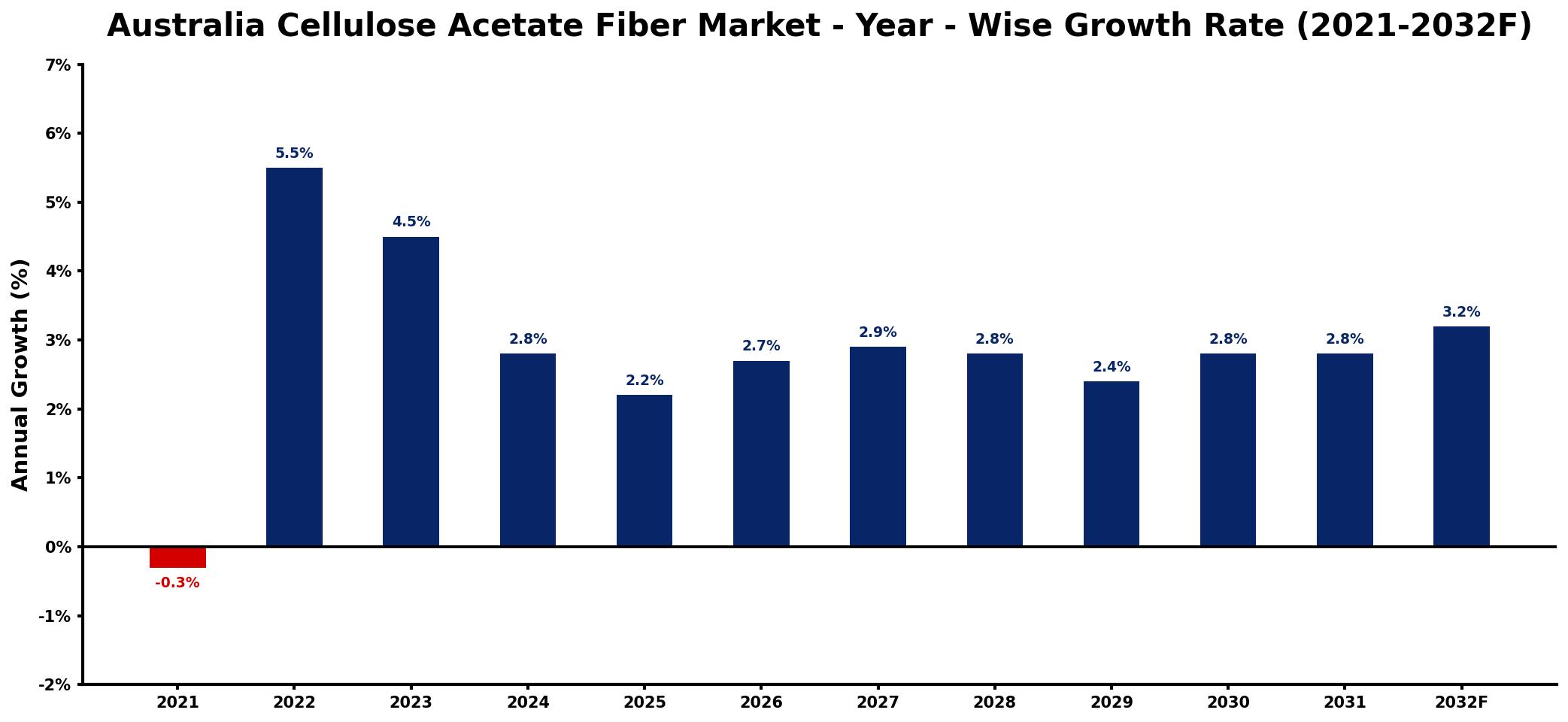
The table below presents the year‑wise growth rates along with the key drivers influencing the market
| Year | Growth Rate | Major Drivers |
| 2021 | -0.3% | Supply chain disruptions impact production |
| 2022 | 5.5% | Rising demand from textile industry |
| 2023 | 4.5% | Increased adoption in fashion sector |
| 2024 | 2.8% | Growth in sustainable materials trend |
| 2025 | 2.2% | Expansion of home textile applications |
| 2026 | 2.7% | Investments in innovative manufacturing technologies |
| 2027 | 2.9% | growing automotive sector requirements |
| 2028 | 2.8% | increased domestic production output |
| 2029 | 2.4% | Diversification into nonwoven applications |
| 2030 | 2.8% | Emerging markets driving new demand |
| 2031 | 2.8% | Increased focus on recycling initiatives |
| 2032 | 3.2% | Technological advancements enhancing production |
Note: Market size estimations and growth projections presented in this report are based on 6Wresearch's proprietary forecasting methodology, utilizing the latest available industry data, government publications, and primary research inputs.
Australia Cellulose Acetate Fiber Market Synopsis
The cellulose acetate fiber market in Australia is gaining traction, propelled by its sustainable attributes and versatility. With applications in textiles, cigarette filters, and industrial uses, the fiber serves as a biodegradable alternative that resonates with environmentally-conscious consumers.
Recent trends indicate a growing preference for cellulose acetate fiber among manufacturers focusing on sustainable production methods. As awareness about the environmental impact of synthetic fibers increases, the demand for cellulose acetate is likely to continue on its upward trajectory, bolstered by its inherent characteristics such as softness, luster, and breathability.
Australia Cellulose Acetate Fiber Market Key Takeaways
- Growing consumer demand for sustainable and biodegradable textiles is significantly impacting market dynamics.
- Cellulose acetate fiber is gaining traction across various applications, including fashion and home furnishings.
- The versatility of this fiber continues to enhance its appeal in multiple sectors, especially textiles.
- Challenges from synthetic alternatives and fluctuating raw material prices may influence market growth.
- Government initiatives promoting sustainable practices can create an enabling environment for market expansion.
Evaluation of Restraints in Australia Cellulose Acetate Fiber Market
Despite its advantages, the Australia cellulose acetate fiber market faces several notable restraints. One primary concern stems from competition with synthetic fibers, which often present cost-effective solutions for manufacturers. Additionally, fluctuations in raw material prices can adversely impact production costs, creating uncertainty within the market. Environmental concerns surrounding the sourcing of cellulose acetate, even though it is biodegradable, present another layer of complexity for producers committed to sustainability. As the market evolves, addressing these challenges will be critical for future growth.
Australia Cellulose Acetate Fiber Market Trends
Current trends in the Australia cellulose acetate fiber market indicate a shift towards sustainable and ethical production practices. Manufacturers are increasingly adopting eco-friendly processes, reflecting broader consumer preferences for green products. Moreover, the rise in collaborations between fashion brands and sustainability-focused suppliers is driving innovation and the development of new product lines using cellulose acetate fiber. This trend signifies not only a demand for functionality but also an alignment with the values of environmentally-conscious consumers.
Australia Cellulose Acetate Fiber Market Opportunities
Growth opportunities in the Australia cellulose acetate fiber market are significant, particularly in the sustainable textiles sector. As companies continue to seek alternatives to conventional synthetic materials, cellulose acetate fiber presents an appealing option. Additionally, emerging technologies related to recycling and repurposing cellulose fibers may pave the way for innovative applications. Investments in research and development focused on improving the properties of cellulose acetate can further enhance its market potential, catering to a growing audience that values environmental responsibility.
Government Initiatives in the Australia Cellulose Acetate Fiber Market
Australian governmental policies increasingly emphasize sustainability, providing a conducive environment for the cellulose acetate fiber market. Initiatives promoting sustainable forestry practices and incentives for eco-friendly fiber production are gaining traction. Furthermore, support for recycling technologies highlights a commitment to reducing waste and enhancing the circular economy. These governmental efforts not only bolster the cellulose acetate fiber industry but also align with broader environmental goals set by Australia.
Future Insights of the Australia Cellulose Acetate Fiber Market
Looking ahead to the period from 2026 to 2032, the Australia cellulose acetate fiber market is poised for continued growth. The increasing adoption of sustainable practices across industries will likely enhance demand, especially as consumers prioritize environmentally-friendly choices. The anticipated technological advancements in production methods and applications will further solidify cellulose acetate's role as a key player in the textile industry. As sustainability remains at the forefront of consumer consciousness, the cellulose acetate fiber market can expect a strong upward trend.
Australia Cellulose Acetate Fiber Market Latest Developments (2025 - 2026)
Recent industry developments indicate a growing focus on innovation in the Australia cellulose acetate fiber market. As manufacturers respond to increasing consumer demand for sustainable options, there has been a marked increase in the launch of eco-friendly product lines. Additionally, partnerships between textile firms and environmental organizations are becoming more common, aimed at enhancing sustainability practices. Such collaborations signal a commitment to responsible sourcing and production, setting the stage for a robust market growth trajectory.
Australia Cellulose Acetate Fiber Market - Key Attractiveness of the Report
- 10 Years of Market Numbers
- Historical Data Starting from 2022 to 2025
- Base Year: 2025
- Forecast Data until 2032
- Key Performance Indicators Impacting the Market
- Major Upcoming Developments and Projects
Key Highlights of the Report:
- Australia Cellulose Acetate Fiber Market Outlook
- Market Size of Australia Cellulose Acetate Fiber Market, 2025
- Forecast of Australia Cellulose Acetate Fiber Market, 2032
- Historical Data and Forecast of Australia Cellulose Acetate Fiber Revenues & Volume for the Period 2022-2032F
- Australia Cellulose Acetate Fiber Market Trend Evolution
- Australia Cellulose Acetate Fiber Market Drivers and Challenges
- Australia Cellulose Acetate Fiber Price Trends
- Australia Cellulose Acetate Fiber Porter's Five Forces
- Australia Cellulose Acetate Fiber Industry Life Cycle
- Historical Data and Forecast of Australia Cellulose Acetate Fiber Market Revenues & Volume By Type for the Period 2022-2032F
- Historical Data and Forecast of Australia Cellulose Acetate Fiber Market Revenues & Volume By Plastic for the Period 2022-2032F
- Historical Data and Forecast of Australia Cellulose Acetate Fiber Market Revenues & Volume By Fiber for the Period 2022-2032F
- Historical Data and Forecast of Australia Cellulose Acetate Fiber Market Revenues & Volume By Application for the Period 2022-2032F
- Historical Data and Forecast of Australia Cellulose Acetate Fiber Market Revenues & Volume By Photographic Films for the Period 2022-2032F
- Historical Data and Forecast of Australia Cellulose Acetate Fiber Market Revenues & Volume By Cigarette Filters for the Period 2022-2032F
- Historical Data and Forecast of Australia Cellulose Acetate Fiber Market Revenues & Volume By Tapes & Labels for the Period 2022-2032F
- Historical Data and Forecast of Australia Cellulose Acetate Fiber Market Revenues & Volume By Textiles & Apparel for the Period 2022-2032F
- Australia Cellulose Acetate Fiber Import Export Trade Statistics
- Market Opportunity Assessment By Type
- Market Opportunity Assessment By Application
- Australia Cellulose Acetate Fiber Top Companies Market Share
- Australia Cellulose Acetate Fiber Competitive Benchmarking By Technical and Operational Parameters
- Australia Cellulose Acetate Fiber Company Profiles
- Australia Cellulose Acetate Fiber Key Strategic Recommendations






































