Australia Ceramic Wall and Floor Tile Market Summary
The australia ceramic wall and floor tile market was estimated at USD 170 Million in 2025 and is projected to reach USD 200 Million by 2032, growing at a CAGR of 2.7% from 2026 to 2032.
Australia Ceramic Wall and Floor Tile Market Year-wise Growth Rate and Key Drivers
This graph highlights how the Australia Ceramic Wall and Floor Tile Market has steadily grown over the past five years, supported by major growth factors.
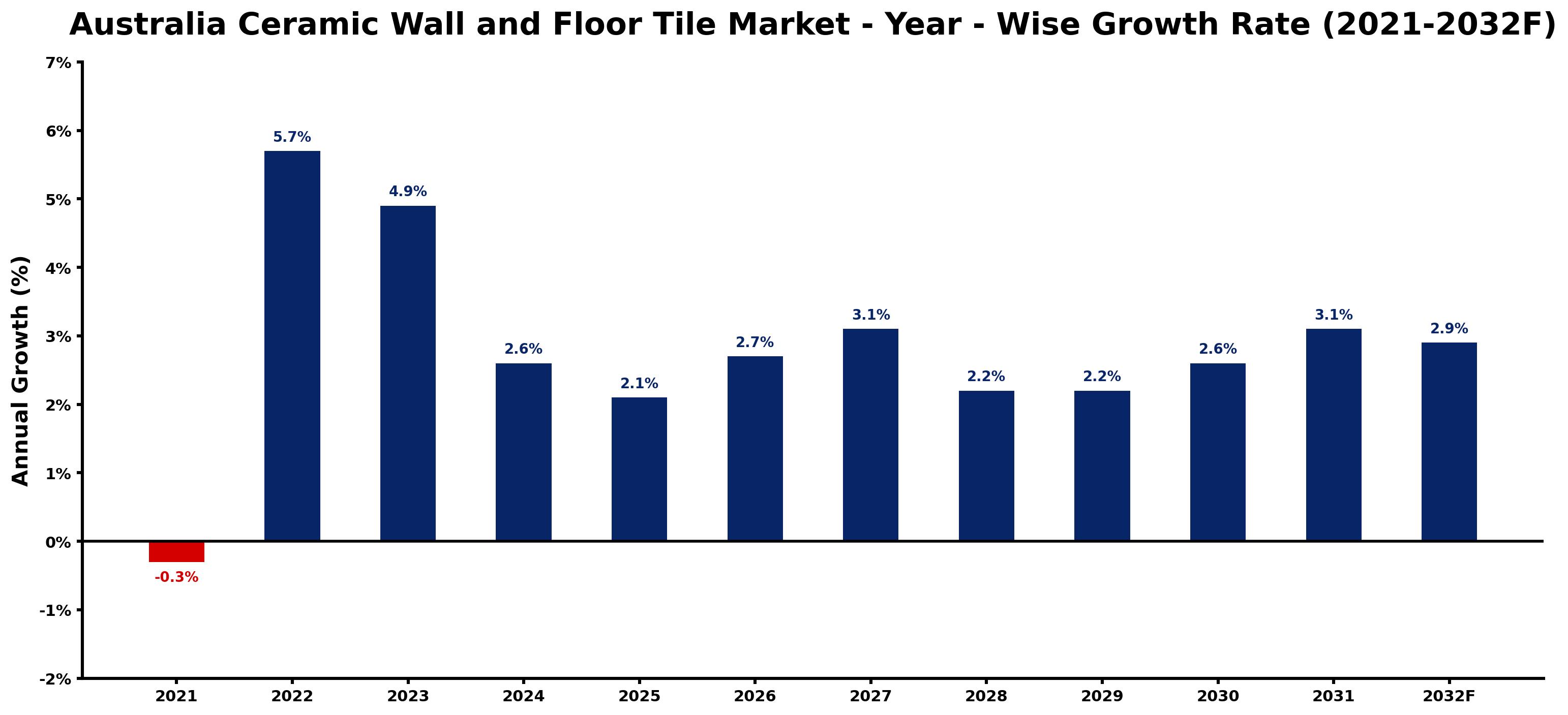
The table below presents the year wise growth rates along with the key drivers influencing the market
| Year | Growth Rate | Major Drivers |
| 2021 | -0.3% | Decreased housing construction activity led to a significant drop in tile installation projects across Australia. |
| 2022 | 5.7% | Sustainable construction practices gained traction, influencing tile material choices across projects. |
| 2023 | 4.9% | Technological innovations in production enhanced efficiency and reduced waste in tile manufacturing. |
| 2024 | 2.6% | Urbanization trends fueled residential developments, increasing tile demand in metropolitan areas. |
| 2025 | 2.1% | Design trends shifted towards larger format tiles, impacting production and inventory strategies. |
| 2026 | 2.7% | A focus on eco-friendly materials attracted environmentally conscious consumers to ceramic tiles. |
| 2027 | 3.1% | Renovation projects in commercial spaces expanded, boosting the demand for durable flooring options. |
| 2028 | 2.2% | Online retail growth offered convenience, leading to increased consumer tile purchases digitally. |
| 2029 | 2.2% | Collaboration between designers and manufacturers introduced unique styles appealing to niche markets. |
| 2030 | 2.6% | Investment in infrastructure projects created new opportunities for ceramic tile usage in public spaces. |
| 2031 | 3.1% | Market competition intensified, prompting innovative designs and improved customer service strategies. |
| 2032 | 2.9% | Evolving lifestyle trends emphasized home aesthetics, pushing ceramic tiles into mainstream preferences. |
Note - Market size estimations and growth projections presented in this report are based on 6Wresearch's advanced forecasting approach, validated with industry datasets as of June 2026.
Australia Ceramic Wall and Floor Tile Market Synopsis
The Australia Ceramic Wall and Floor Tile Market is projected to reach 2.7% and witness significant growth during the forecast period (2026-2032). This expansion is primarily driven by the increasing urbanization, ongoing infrastructure development, and the rising trend of renovation projects across residential, commercial, and institutional sectors. Renowned for their durability and aesthetic value, ceramic tiles offer advantages such as water resistance and ease of maintenance, solidifying their preference in both interior and exterior applications.
Australia Ceramic Wall and Floor Tile Market Growth Drivers
Several key factors contribute to the growth of the Australia Ceramic Wall and Floor Tile Market. First and foremost is the heightened demand for durable and stylish surfacing materials in various construction and renovation undertakings. The versatility of ceramic tiles, enabling their use in a multitude of settings such as bathrooms, kitchens, living areas, and outdoor spaces, also plays a significant role in their popularity. Furthermore, the growing preference for ceramic tiles over traditional materials is evident, largely due to their resilience and design flexibility.
- The rise in urbanization leads to increased construction and renovation projects, which directly impacts the demand for ceramic tiles.
- Renovation projects are particularly influential, as homeowners seek modern and durable materials to upgrade existing spaces.
- The aesthetic appeal of ceramic tiles is enhancing their adoption, especially in high-traffic areas that require a balance of style and function.
- Consumer awareness regarding sustainability and the eco-friendly characteristics of ceramic tiles is driving their preference over alternatives.
- Innovative designs and technological advancements in tile manufacturing are expanding options for consumers, further stimulating market growth.
Australia Ceramic Wall and Floor Tile Market Challenges and Restraints
Despite its growth potential, the Australia Ceramic Wall and Floor Tile Market faces several challenges. The need to cater to diverse aesthetic preferences and evolving design trends necessitates constant innovation and adaptability from manufacturers. Additionally, ensuring the durability and slip resistance of tiles is critical for maintaining customer satisfaction and adhering to safety standards in both residential and commercial applications.
- Competition from alternative flooring materials poses a significant threat to the market, as consumers weigh options based on price and functionality.
- Price volatility in raw materials can disrupt production costs, affecting the pricing strategy of ceramic tiles.
- The installation challenges associated with ceramic tiles require skilled labor, which can be a barrier to widespread adoption in some regions.
- Changing consumer trends may shift preferences away from traditional ceramic tiles toward more modern, innovative surfacing solutions.
- Manufacturers must continuously invest in R&D to keep pace with consumer demands and regulatory standards, which can strain resources.
Australia Ceramic Wall and Floor Tile Market Government Investment and Initiatives
Government policies and initiatives play a vital role in shaping the Australia Ceramic Wall and Floor Tile Market. Public spending on infrastructure development often includes mandates for durable building materials, creating opportunities for ceramic tile adoption. Additionally, the government's emphasis on promoting sustainable building practices encourages the use of ceramic materials, aligning with ecological standards. Support for local tile manufacturing industries through grants and export assistance programs also fosters a conducive environment for market growth.
- Investment in public infrastructure projects often includes the integration of high-quality materials, increasing ceramic tile utilization.
- The government's commitment to sustainability encourages policies that favor eco-friendly products, benefiting the ceramic tile sector.
- Workshops and training programs backed by governmental support help ensure skilled labor availability for tile installation.
- Subsidies for manufacturers that engage in sustainable production practices can enhance competitiveness in the ceramic tile market.
- Collaboration between government bodies and industry stakeholders can spur innovation in tile design and production methodologies.
Australia Ceramic Wall and Floor Tile Market Latest Developments (May 2025 - June 2026)
Recent developments in the Australia Ceramic Wall and Floor Tile Market showcase an industry increasingly focused on sustainability and innovation. Manufacturers are progressively adopting eco-friendly production processes, responding to consumer demand for more sustainable building materials. Additionally, advancements in technology are enabling the creation of tiles that mimic natural materials while providing enhanced durability and ease of maintenance. Market players are also emphasizing design flexibility, introducing a wider range of styles and textures to cater to diverse consumer preferences.
- Emerging trends indicate an increased focus on minimalistic designs with natural finishes, creating a growing market for organic-style ceramic tiles.
- New product launches highlight the integration of smart technologies in tile solutions, enhancing functionality in modern living spaces.
- Collaborative efforts among industry stakeholders are fostering research initiatives aimed at enhancing tile performance and sustainability.
- Participation in major trade exhibitions is also providing manufacturers with platforms to showcase innovative products and engage with customers directly.
- Consumer education campaigns are being initiated to highlight the benefits of ceramic tiles, particularly around longevity and environmental impact.
Australia Ceramic Wall and Floor Tile Market - Key Attractiveness of the Report
- 10 Years of Market Numbers
- Historical Data Starting from 2022 to 2025
- Base Year: 2025
- Forecast Data until 2032
- Key Performance Indicators Impacting the Market
- Major Upcoming Developments and Projects
Key Highlights of the Report:
- Australia Ceramic Wall and Floor Tile Market Outlook
- Market Size of Australia Ceramic Wall and Floor Tile Market, 2025
- Forecast of Australia Ceramic Wall and Floor Tile Market, 2032
- Historical Data and Forecast of Australia Ceramic Wall and Floor Tile Revenues & Volume for the Period 2022-2032F
- Australia Ceramic Wall and Floor Tile Market Trend Evolution
- Australia Ceramic Wall and Floor Tile Market Drivers and Challenges
- Australia Ceramic Wall and Floor Tile Price Trends
- Australia Ceramic Wall and Floor Tile Porter's Five Forces
- Australia Ceramic Wall and Floor Tile Industry Life Cycle
- Historical Data and Forecast of Australia Ceramic Wall and Floor Tile Market Revenues & Volume By Product Type for the Period 2022-2032F
- Historical Data and Forecast of Australia Ceramic Wall and Floor Tile Market Revenues & Volume By Wall Tile for the Period 2022-2032F
- Historical Data and Forecast of Australia Ceramic Wall and Floor Tile Market Revenues & Volume By Floor Tile for the Period 2022-2032F
- Historical Data and Forecast of Australia Ceramic Wall and Floor Tile Market Revenues & Volume By Raw Material for the Period 2022-2032F
- Historical Data and Forecast of Australia Ceramic Wall and Floor Tile Market Revenues & Volume By Feldspar for the Period 2022-2032F
- Historical Data and Forecast of Australia Ceramic Wall and Floor Tile Market Revenues & Volume By Kaolin for the Period 2022-2032F
- Historical Data and Forecast of Australia Ceramic Wall and Floor Tile Market Revenues & Volume By Bentonite for the Period 2022-2032F
- Historical Data and Forecast of Australia Ceramic Wall and Floor Tile Market Revenues & Volume By Silica Sand for the Period 2022-2032F
- Historical Data and Forecast of Australia Ceramic Wall and Floor Tile Market Revenues & Volume By Application for the Period 2022-2032F
- Historical Data and Forecast of Australia Ceramic Wall and Floor Tile Market Revenues & Volume By Residential Replacement for the Period 2022-2032F
- Historical Data and Forecast of Australia Ceramic Wall and Floor Tile Market Revenues & Volume By New Residential for the Period 2022-2032F
- Historical Data and Forecast of Australia Ceramic Wall and Floor Tile Market Revenues & Volume By Commercial for the Period 2022-2032F
- Historical Data and Forecast of Australia Ceramic Wall and Floor Tile Market Revenues & Volume By Others for the Period 2022-2032F
- Australia Ceramic Wall and Floor Tile Import Export Trade Statistics
- Market Opportunity Assessment By Product Type
- Market Opportunity Assessment By Raw Material
- Market Opportunity Assessment By Application
- Australia Ceramic Wall and Floor Tile Top Companies Market Share
- Australia Ceramic Wall and Floor Tile Competitive Benchmarking By Technical and Operational Parameters
- Australia Ceramic Wall and Floor Tile Company Profiles
- Australia Ceramic Wall and Floor Tile Key Strategic Recommendations






































