Australia Chandeliers & Pendant Lights Market Summary
The australia chandeliers & pendant lights market was estimated at USD 188 Million in 2025 and is projected to reach USD 220 Million by 2032, growing at a CAGR of 2.2% from 2026 to 2032.
Australia Chandeliers & Pendant Lights Market Year-wise Growth Rate and Key Drivers
This graph highlights how the Australia Chandeliers & Pendant Lights Market has steadily grown over the past five years, supported by major growth factors.
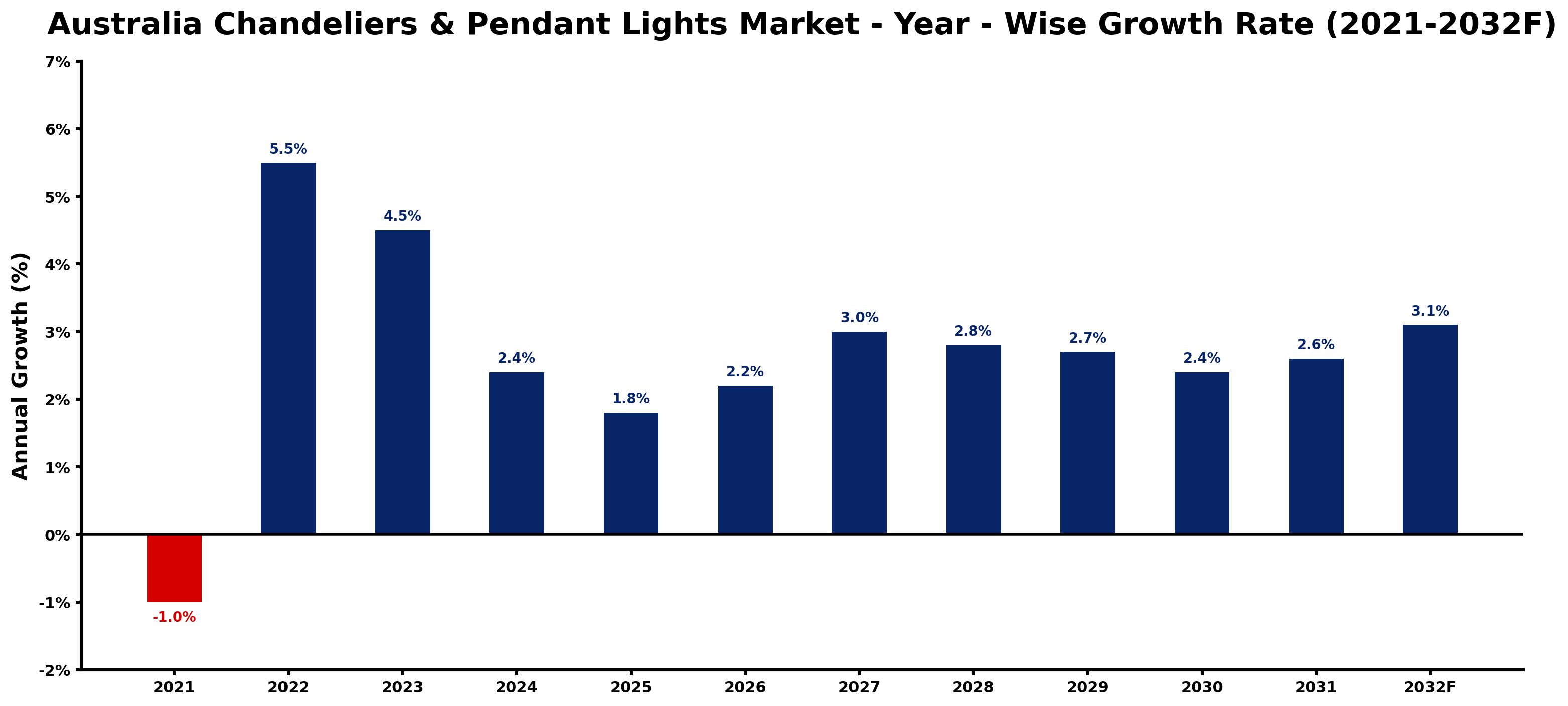
The table below presents the year wise growth rates along with the key drivers influencing the market
| Year | Growth Rate | Major Drivers |
| 2021 | -1.0% | Unforeseen supply chain disruptions limited inventory availability, causing significant delays in product launches and sales. |
| 2022 | 5.5% | Home renovation trends prompted consumers to seek unique chandelier designs for aesthetics. |
| 2023 | 4.5% | E-commerce platforms expanded, enabling easier access to diverse pendant light options. |
| 2024 | 2.4% | Sustainability concerns shifted preferences toward energy-efficient lighting solutions in chandeliers. |
| 2025 | 1.8% | Interior design shows highlighted innovative lighting concepts, inspiring consumer purchases substantially. |
| 2026 | 2.2% | Emerging smart home technologies integrated with lighting systems captivated tech-savvy homeowners. |
| 2027 | 3.0% | Luxury property developments increased demand for high-end pendant lighting in upscale markets. |
| 2028 | 2.8% | Architectural trends emphasized statement lighting fixtures, enhancing visibility and appeal in homes. |
| 2029 | 2.7% | Growing outdoor living spaces contributed to pendant light popularity in alfresco dining areas. |
| 2030 | 2.4% | Local artisans gained traction, offering bespoke chandelier designs tailored to modern tastes. |
| 2031 | 2.6% | Increased tourism in urban centers stimulated demand for unique hospitality lighting experiences. |
| 2032 | 3.1% | Cultural festivals showcased artistic lighting installations, influencing broader marketplace aesthetics. |
Note - Market size estimations and growth projections presented in this report are based on 6Wresearch's advanced forecasting approach, validated with industry datasets as of June 2026.
Australia Chandeliers & Pendant Lights Market Synopsis
The Australia Chandeliers Pendant Lights Market is projected to reach 2.2% and witness significant growth during the forecast period (2026-2032). This growth can be attributed to the increasing demand for decorative lighting solutions across various sectors, including residential, commercial, and hospitality. Chandeliers and pendant lights not only enhance aesthetic appeal but also provide ambient illumination, thereby solidifying their place in modern interior design. As consumer preferences shift towards stylish yet energy-efficient lighting solutions, the market is poised for substantial expansion.
Australia Chandeliers & Pendant Lights Market Growth Drivers
Numerous factors are fueling the growth of the Australia Chandeliers & Pendant Lights Market. Key drivers include:
- Rising demand for decorative lighting fixtures has led to a marked increase in the number of residential and commercial projects integrating chandeliers and pendant lights.
- The ongoing trend towards home renovation and interior design has encouraged consumers to invest in more sophisticated lighting solutions.
- Chandeliers and pendant lights serve as focal points in a room, which appeals to homeowners seeking to create unique, inviting spaces.
- Growing interest in energy-efficient lighting options is pushing manufacturers to innovate, leading to the emergence of smart lighting technologies.
- A variety of styles, sizes, and materials available in the market caters to diverse aesthetic preferences, making these lighting solutions more accessible.
Australia Chandeliers & Pendant Lights Market Trends and Opportunities
The Australia Chandeliers & Pendant Lights Market is witnessing several trends that present opportunities for stakeholders. Emerging trends include:
- The increasing popularity of minimalist and contemporary designs encourages manufacturers to adapt their offerings to align with modern tastes.
- Sustainable and eco-friendly materials are gaining traction, as consumers become more environmentally conscious and seek out products with a smaller carbon footprint.
- Technological advancements in LED technology are enabling energy-efficient pendant lights, appealing to a wider audience and reducing operational costs.
- The integration of smart home technologies allows for innovative lighting control systems, enhancing user experience and offering new functionalities.
- Customizable lighting solutions that cater to specific room requirements are becoming more sought-after as personalization in home décor continues to grow.
Australia Chandeliers & Pendant Lights Market Challenges and Restraints
Despite the positive outlook for the Australia Chandeliers & Pendant Lights Market, various challenges persist. Key challenges include:
- Diverse aesthetic preferences and rapidly changing design trends require manufacturers to remain agile and responsive to consumer demands.
- Ensuring product safety and compliance with stringent electrical regulations poses a continuous challenge for manufacturers in the market.
- Competition from alternative lighting solutions such as LEDs and smart lighting systems threatens market share and requires differentiation strategies.
- Economic fluctuations may affect consumer spending on decorative lighting, leading to potential volatility in market performance.
- Consumer preferences shifting towards modern designs can result in declining demand for traditional chandelier styles, necessitating innovation.
Australia Chandeliers & Pendant Lights Market Government Investment and Initiatives
Government initiatives aimed at promoting energy efficiency and sustainability in lighting solutions are crucial for the Australia Chandeliers & Pendant Lights Market. These may include:
- Incentives for adopting energy-efficient lighting practices among consumers and businesses, which can boost demand for advanced chandelier and pendant light technologies.
- Investment in public awareness campaigns to educate consumers about the benefits of decorative lighting and its role in enhancing aesthetic and functional aspects of spaces.
- Support for collaborations between lighting designers and manufacturers to drive innovation and address evolving market needs effectively.
- Policies promoting sustainable manufacturing practices within the lighting industry, thus ensuring long-term viability and acceptance of chandeliers and pendant lights.
- Funding for research and development initiatives focused on improving the efficiency and sustainability of lighting solutions, aligning with global environmental goals.
Australia Chandeliers & Pendant Lights Market Latest Developments (May 2025 - June 2026)
The period spanning May 2025 to June 2026 has seen numerous developments within the Australia Chandeliers & Pendant Lights Market. Noteworthy trends include a continued emphasis on energy efficiency, leading to the incorporation of smart technology in lighting products. Consumers are increasingly gravitating towards innovative designs that not only fulfill their lighting needs but also serve as aesthetic focal points in their interiors. Participation in sustainability initiatives has also intensified, with more manufacturers exploring eco-friendly materials and production methods. The market is witnessing an influx of products featuring customizable options, allowing consumers to align lighting with their unique preferences. Lastly, collaborations between designers and manufacturers have been observed, fostering creativity and technological advancements that enhance product offerings.
Australia Chandeliers & Pendant Lights Market - Key Attractiveness of the Report
- 10 Years of Market Numbers
- Historical Data Starting from 2022 to 2025
- Base Year: 2025
- Forecast Data until 2032
- Key Performance Indicators Impacting the Market
- Major Upcoming Developments and Projects
Key Highlights of the Report:
- Australia Chandeliers & Pendant Lights Market Outlook
- Market Size of Australia Chandeliers & Pendant Lights Market, 2025
- Forecast of Australia Chandeliers & Pendant Lights Market, 2032
- Historical Data and Forecast of Australia Chandeliers & Pendant Lights Revenues & Volume for the Period 2022-2032F
- Australia Chandeliers & Pendant Lights Market Trend Evolution
- Australia Chandeliers & Pendant Lights Market Drivers and Challenges
- Australia Chandeliers & Pendant Lights Price Trends
- Australia Chandeliers & Pendant Lights Porter's Five Forces
- Australia Chandeliers & Pendant Lights Industry Life Cycle
- Historical Data and Forecast of Australia Chandeliers & Pendant Lights Market Revenues & Volume By Product Type for the Period 2022-2032F
- Historical Data and Forecast of Australia Chandeliers & Pendant Lights Market Revenues & Volume By Traditional for the Period 2022-2032F
- Historical Data and Forecast of Australia Chandeliers & Pendant Lights Market Revenues & Volume By Transitional for the Period 2022-2032F
- Historical Data and Forecast of Australia Chandeliers & Pendant Lights Market Revenues & Volume By Modern for the Period 2022-2032F
- Historical Data and Forecast of Australia Chandeliers & Pendant Lights Market Revenues & Volume By Applications for the Period 2022-2032F
- Historical Data and Forecast of Australia Chandeliers & Pendant Lights Market Revenues & Volume By Commercial for the Period 2022-2032F
- Historical Data and Forecast of Australia Chandeliers & Pendant Lights Market Revenues & Volume By Residential for the Period 2022-2032F
- Historical Data and Forecast of Australia Chandeliers & Pendant Lights Market Revenues & Volume By Distribution Channel for the Period 2022-2032F
- Historical Data and Forecast of Australia Chandeliers & Pendant Lights Market Revenues & Volume By Online for the Period 2022-2032F
- Historical Data and Forecast of Australia Chandeliers & Pendant Lights Market Revenues & Volume By Offline for the Period 2022-2032F
- Australia Chandeliers & Pendant Lights Import Export Trade Statistics
- Market Opportunity Assessment By Product Type
- Market Opportunity Assessment By Applications
- Market Opportunity Assessment By Distribution Channel
- Australia Chandeliers & Pendant Lights Top Companies Market Share
- Australia Chandeliers & Pendant Lights Competitive Benchmarking By Technical and Operational Parameters
- Australia Chandeliers & Pendant Lights Company Profiles
- Australia Chandeliers & Pendant Lights Key Strategic Recommendations






































