Australia Cleaning Products and Detergents Market Summary
The australia cleaning products and detergents market was estimated at USD 178 Million in 2025 and is projected to reach USD 209 Million by 2032, growing at a CAGR of 3.0% from 2026 to 2032.
Australia Cleaning Products and Detergents Market Year-wise Growth Rate and Key Drivers
This graph highlights how the Australia Cleaning Products and Detergents Market has steadily grown over the past five years, supported by major growth factors.
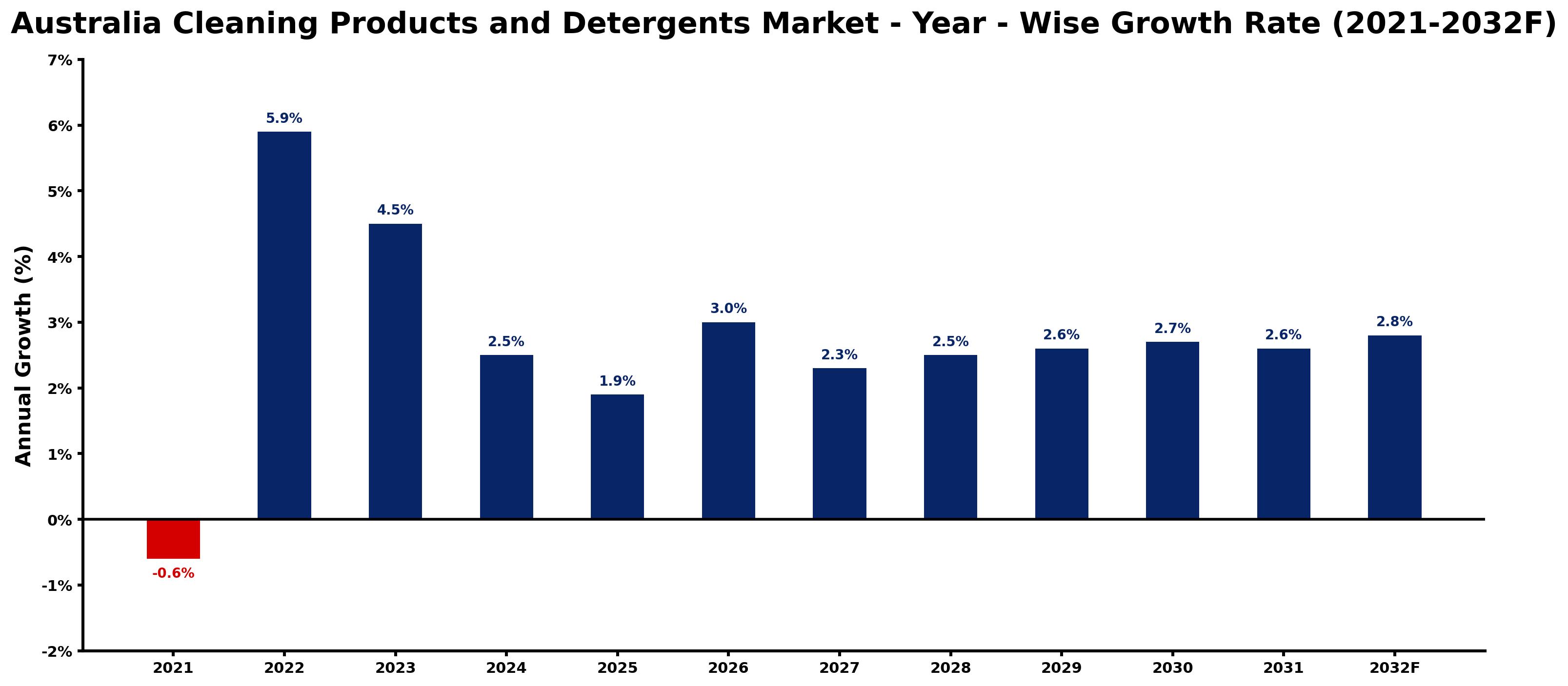
The table below presents the year wise growth rates along with the key drivers influencing the market
| Year | Growth Rate | Major Drivers |
| 2021 | -0.6% | Shifts toward ecofriendly alternatives eroded demand for traditional cleaning products, impacting overall market performance. |
| 2022 | 5.9% | Changing consumer preferences favor eco-friendly products, boosting market engagement significantly. |
| 2023 | 4.5% | E-commerce expansion reshapes distribution channels, enhancing product accessibility for consumers. |
| 2024 | 2.5% | Innovative formulations in detergents attract environmentally conscious buyers seeking effectiveness. |
| 2025 | 1.9% | Urbanization in Australian cities drives higher consumption of cleaning products in households. |
| 2026 | 3.0% | Growth in the real estate sector prompts increased demand for commercial cleaning supplies. |
| 2027 | 2.3% | Health awareness campaigns highlight the importance of hygiene, influencing product purchasing behavior. |
| 2028 | 2.5% | Sustainability initiatives across brands reshape offerings towards biodegradable cleaning solutions. |
| 2029 | 2.6% | Investment in marketing strategies emphasizes brand loyalty among cleaning product consumers. |
| 2030 | 2.7% | Technological integration in manufacturing processes enhances product efficiency and lowers costs. |
| 2031 | 2.6% | International trade partnerships facilitate the introduction of innovative cleaning technologies in Australia. |
| 2032 | 2.8% | Consumer education on product efficacy propels informed purchasing and brand switching behaviors. |
Note - Market size estimations and growth projections presented in this report are based on 6Wresearch's advanced forecasting approach, validated with industry datasets as of June 2026.
Australia Cleaning Products and Detergents Market Synopsis
The Australia Cleaning Products and Detergents Market is projected to reach 3.0% and witness significant growth during the forecast period (2026-2032). This market encompasses a comprehensive selection of cleaning solutions designed for household, commercial, and industrial uses, satisfying the increasing demand for effective and environmentally sustainable cleaning options. The range of products includes surface cleaners, dishwashing detergents, laundry detergents, disinfectants, and specialty cleaners, each addressing specific cleaning needs across various surfaces and materials. A notable trend is the ongoing innovation in formulations, favoring biodegradable ingredients and sustainable packaging, as consumers and businesses increasingly prioritize eco-conscious choices.
Australia Cleaning Products and Detergents Market Growth Drivers
Multiple factors contribute to the growth of the Australia Cleaning Products and Detergents Market. The rising awareness of hygiene and cleanliness among the population plays a pivotal role, especially in the wake of public health initiatives. Key drivers include:
- Increasing health consciousness among consumers necessitates frequent cleaning to remove germs and contaminants.
- Urbanization trends lead to more households and commercial establishments, thereby driving demand for effective cleaning solutions.
- The growing disposable income enables consumers to invest in higher-quality cleaning products.
- Innovations in product formulations, particularly those using natural ingredients and multi-functional capabilities, attract eco-aware shoppers.
- Aggressive marketing techniques and promotional campaigns enhance visibility, encouraging consumer engagement and broadening market reach.
Australia Cleaning Products and Detergents Market Trends and Opportunities
Several trends are shaping the landscape of the Australia Cleaning Products and Detergents Market. Consumers are increasingly gravitating towards products that reflect their values, creating rich opportunities for manufacturers and retailers:
- The demand for eco-friendly cleaning products is on the rise, reflecting a broader global trend towards sustainability.
- Functionality enhancement is a key focus, with brands offering products that serve multiple purposes, thus providing greater value to consumers.
- Packaging innovations, particularly in sustainability, are becoming a marketing focal point, with consumers opting for brands that use recyclable materials.
- Online sales channels are expanding, allowing consumers to access a wider variety of products conveniently and enhancing market competition.
- Health and hygiene certifications are gaining importance, as consumers are likely to choose products that meet specific safety and efficacy standards.
Australia Cleaning Products and Detergents Market Challenges and Restraints
While the market shows promise, it is not devoid of challenges. Companies in the Australia Cleaning Products and Detergents Market must navigate several hurdles:
- Environmental concerns regarding synthetic chemical ingredients and their ecological footprint present significant challenges for manufacturers.
- Increased consumer expectations for biodegradable and eco-friendly products demand constant innovation and adaptation.
- Intense competition necessitates differentiated branding and marketing strategies to capture consumer interest and loyalty.
- Regulatory compliance related to safety, health, and environmental impact can complicate product development and marketing efforts.
- Economic fluctuations and changing consumer priorities may affect discretionary spending on non-essential cleaning products.
Australia Cleaning Products and Detergents Market Government Investment and Initiatives
The Australian government plays an instrumental role in shaping the cleaning products and detergents market through various initiatives and regulatory frameworks. These efforts aim to enhance product safety and environmental responsibility:
- Implementation of strict regulations governing the composition, labeling, and safety standards of cleaning products ensures consumer safety and environmental protection.
- Public initiatives encouraging sustainable practices in manufacturing and waste management influence market dynamics positively.
- Financial incentives and grants for businesses that innovate eco-friendly cleaning solutions promote research and development within the industry.
- Collaborative efforts between government agencies and industry stakeholders facilitate knowledge sharing and best practices in product development and marketing.
- Awareness campaigns targeting consumers educate them on the benefits of using environmentally friendly cleaning products, thereby boosting market demand.
Australia Cleaning Products and Detergents Market Latest Developments (May 2025 - June 2026)
The Australia Cleaning Products and Detergents Market has experienced a variety of significant developments from May 2025 to June 2026. This period has seen a notable shift towards sustainability, with many manufacturers enhancing their product lines to include eco-friendly options. Additionally, the rise of e-commerce has transformed retail strategies, with increasing investments in online distribution channels. Promotional activities surrounding health and safety have become more prevalent, reflecting the ongoing consumer focus on hygiene. Furthermore, innovations in packaging aimed at reducing environmental impact have gained traction, compelling brands to rethink their approach to product presentation. Companies are also exploring partnerships and collaborations to expand their reach and enhance product offerings.
Australia Cleaning Products and Detergents Market - Key Attractiveness of the Report
- 10 Years of Market Numbers
- Historical Data Starting from 2022 to 2025
- Base Year: 2025
- Forecast Data until 2032
- Key Performance Indicators Impacting the Market
- Major Upcoming Developments and Projects
Key Highlights of the Report:
- Australia Cleaning Products and Detergents Market Outlook
- Market Size of Australia Cleaning Products and Detergents Market, 2025
- Forecast of Australia Cleaning Products and Detergents Market, 2032
- Historical Data and Forecast of Australia Cleaning Products and Detergents Revenues & Volume for the Period 2022-2032F
- Australia Cleaning Products and Detergents Market Trend Evolution
- Australia Cleaning Products and Detergents Market Drivers and Challenges
- Australia Cleaning Products and Detergents Price Trends
- Australia Cleaning Products and Detergents Porter's Five Forces
- Australia Cleaning Products and Detergents Industry Life Cycle
- Historical Data and Forecast of Australia Cleaning Products and Detergents Market Revenues & Volume By Type for the Period 2022-2032F
- Historical Data and Forecast of Australia Cleaning Products and Detergents Market Revenues & Volume By Anionic Detergents for the Period 2022-2032F
- Historical Data and Forecast of Australia Cleaning Products and Detergents Market Revenues & Volume By Cationic Detergents for the Period 2022-2032F
- Historical Data and Forecast of Australia Cleaning Products and Detergents Market Revenues & Volume By Non-ionic Detergents for the Period 2022-2032F
- Historical Data and Forecast of Australia Cleaning Products and Detergents Market Revenues & Volume By Zwitterionic (Amphoteric) Detergents for the Period 2022-2032F
- Historical Data and Forecast of Australia Cleaning Products and Detergents Market Revenues & Volume By Applications for the Period 2022-2032F
- Historical Data and Forecast of Australia Cleaning Products and Detergents Market Revenues & Volume By Laundry Cleaning Products for the Period 2022-2032F
- Historical Data and Forecast of Australia Cleaning Products and Detergents Market Revenues & Volume By Household Cleaning Products for the Period 2022-2032F
- Historical Data and Forecast of Australia Cleaning Products and Detergents Market Revenues & Volume By Dishwashing Products for the Period 2022-2032F
- Historical Data and Forecast of Australia Cleaning Products and Detergents Market Revenues & Volume By Fuel Additives for the Period 2022-2032F
- Historical Data and Forecast of Australia Cleaning Products and Detergents Market Revenues & Volume By Biological Reagent for the Period 2022-2032F
- Historical Data and Forecast of Australia Cleaning Products and Detergents Market Revenues & Volume By Others for the Period 2022-2032F
- Australia Cleaning Products and Detergents Import Export Trade Statistics
- Market Opportunity Assessment By Type
- Market Opportunity Assessment By Applications
- Australia Cleaning Products and Detergents Top Companies Market Share
- Australia Cleaning Products and Detergents Competitive Benchmarking By Technical and Operational Parameters
- Australia Cleaning Products and Detergents Company Profiles
- Australia Cleaning Products and Detergents Key Strategic Recommendations






































