Australia Cloud Infrastructure Services Market Size & Growth Rate (2026-2032)
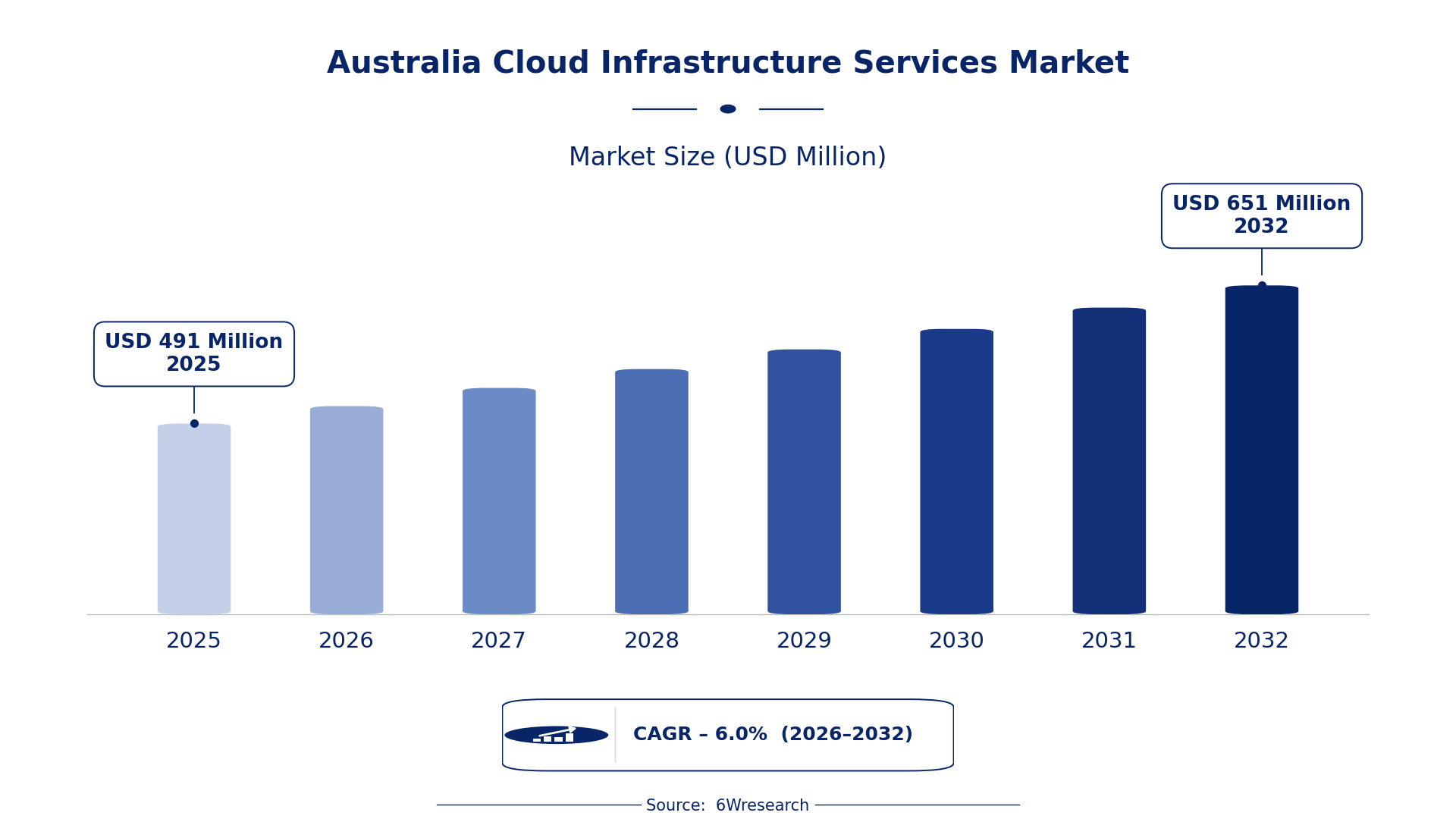
The Australia Cloud Infrastructure Services Market was estimated at USD 491 Million in 2025 and is projected to reach USD 651 Million by 2032, growing at a CAGR of 6.0% from 2026 to 2032.
Australia Cloud Infrastructure Services Market Synopsis
The Australia Cloud Infrastructure Services Market has experienced notable momentum in recent years, driven by increasing enterprise migration to cloud solutions. This shift is primarily fueled by the need for agile, scalable, and cost-effective IT infrastructure, aligning with the broader trend of digital transformation.
Looking ahead, the market is set to evolve as organizations seek to optimize their cloud strategies. The competitive landscape, characterized by both global players and local service providers, will continue to challenge enterprises to choose solutions that best fit their operational needs and compliance requirements.
Australia Cloud Infrastructure Services Market Year-wise Growth Rate and Key Drivers
This graph illustrates the annual growth rates of the Australia Cloud Infrastructure Services Market from 2021 to 2032, highlighting a steady upward trajectory and projected expansion over the forecast period.
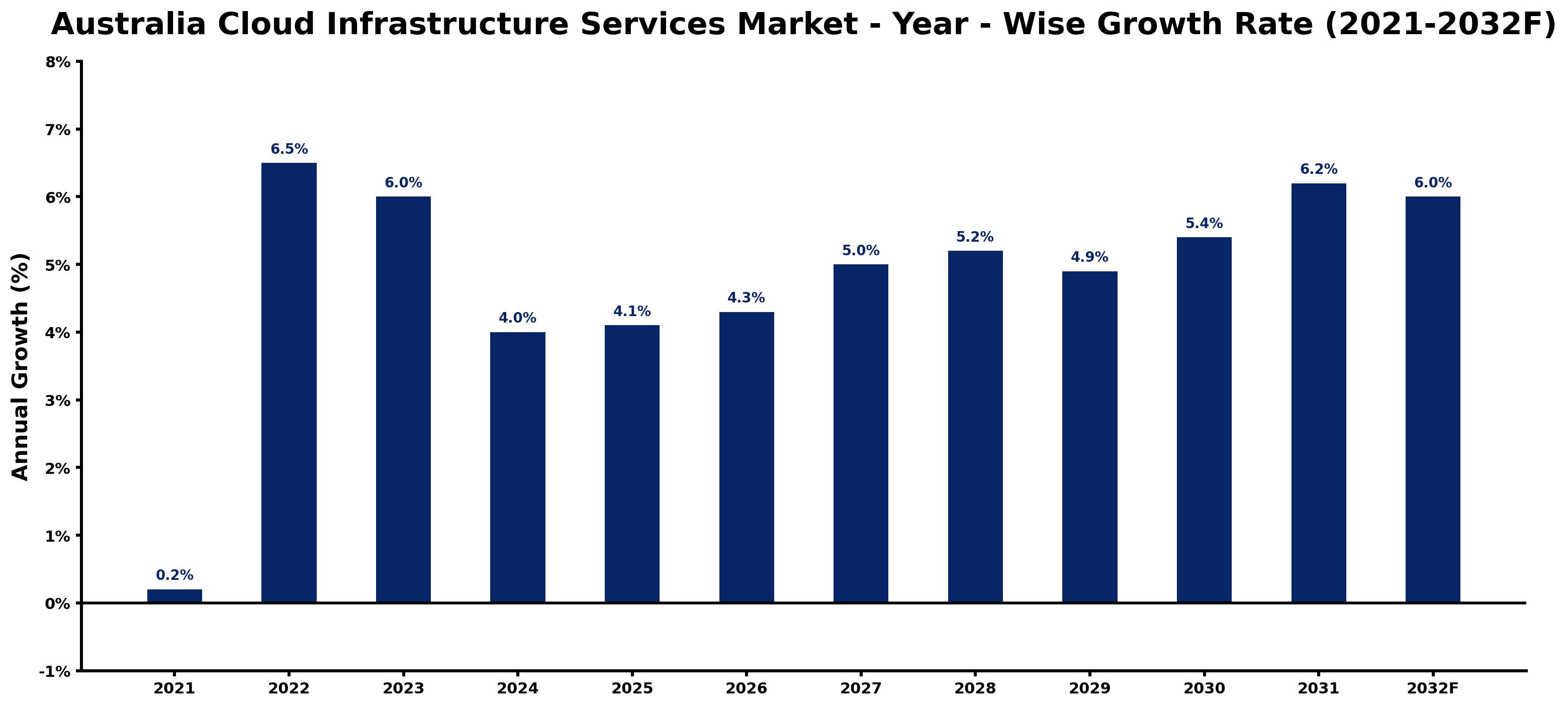
The table below presents the year‑wise growth rates along with the key drivers influencing the market
| Year | Growth Rate | Major Drivers |
| 2021 | 0.2% | Government Cloud Computing Strategy supporting local data centers. |
| 2022 | 6.5% | Increased investment in cybersecurity frameworks by Australian firms. |
| 2023 | 6.0% | Growing adoption of AI technologies in local industries. |
| 2024 | 4.0% | Federal budget allocations for digital transformation initiatives. |
| 2025 | 4.1% | Rising small business transitions to cloud solutions. |
| 2026 | 4.3% | Increasing regulatory compliance demands for data storage. |
| 2027 | 5.0% | Local tech startups driving innovation in cloud services. |
| 2028 | 5.2% | Government support for green IT and sustainable practices. |
| 2029 | 4.9% | Increased demand for disaster recovery solutions in businesses. |
| 2030 | 5.4% | Growth in remote education driving cloud service needs. |
| 2031 | 6.2% | Public sector agencies migrating services to cloud platforms. |
| 2032 | 6.0% | Emergence of regional tech hubs fostering cloud partnerships. |
Note: Market size estimations and growth projections presented in this report are based on 6Wresearch's proprietary forecasting methodology, utilizing the latest available industry data, government publications, and primary research inputs.
Australia Cloud Infrastructure Services Market Key Takeaways
Below are some of the specific key takeaways from the market, including:
- The market is driven by demand for reliable and scalable IT infrastructure.
- Pay-as-you-go pricing models are increasingly appealing to businesses.
- Data residency and sovereignty remain critical issues for organizations.
- Local managed service providers are gaining traction against global hyperscalers.
- Regulatory compliance is a key consideration for cloud adoption in Australia.
Evaluation of Restraints in Australia Cloud Infrastructure Services Market
Despite its growth potential, the Australia Cloud Infrastructure Services Market faces several constraints. Companies often struggle with optimizing their cloud environments for performance and cost efficiency. Concerns regarding data sovereignty and compliance with stringent regulations can delay cloud adoption. on top of that, maintaining the reliability of services, especially for mission-critical applications, poses an ongoing challenge that requires continuous attention and investment.
Australia Cloud Infrastructure Services Market Trends
The trend towards hybrid cloud solutions is gaining traction as organizations look for flexibility in managing their workloads. Alongside this, the adoption of Artificial Intelligence (AI) and Machine Learning (ML) technologies is reshaping how cloud services are utilized, enhancing data analytics capabilities. Increased focus on sustainability is also influencing cloud infrastructure decisions, with businesses seeking green cloud options to align with corporate responsibility goals.
Australia Cloud Infrastructure Services Market Opportunities
Opportunities abound in the Australia Cloud Infrastructure Services Market, particularly for providers offering tailored solutions that address specific industry needs. The ongoing push for digital transformation across sectors, such as healthcare and finance, presents avenues for growth. on top of that, as remote working becomes entrenched, there is a rising demand for cloud solutions that facilitate collaboration and enhance productivity.
Government Initiatives in the Australia Cloud Infrastructure Services Market
Government policy is increasingly influencing the trajectory of the Australia Cloud Infrastructure Services Market. Regulatory frameworks are being established to ensure data protection and compliance, which are crucial for building trust in cloud services. The government is also prioritizing investments in digital infrastructure, recognizing its role in fostering innovation and economic growth.
- A national digital infrastructure upgrade programme now in its rollout phase aims to enhance connectivity and service delivery.
- A regulatory framework introduced in 2025 mandating billing transparency to protect consumers and businesses alike.
- A public-private initiative expected to expand telecom infrastructure access by 2028, improving cloud service delivery.
- Currently, a review of data protection laws is underway to ensure alignment with international best practices.
- Upcoming initiatives focusing on cybersecurity measures are planned to enhance the resilience of cloud services.
Future Insights of the Australia Cloud Infrastructure Services Market
From 2026 to 2032, the Australia Cloud Infrastructure Services Market is likely to witness a shift towards more specialized services that cater to the unique requirements of various sectors. As cloud providers evolve their offerings, expect a stronger emphasis on security, compliance, and performance optimization. The integration of advanced technologies, such as AI and automation, will also reshape service delivery, making cloud solutions more efficient and user-friendly.
Australia Cloud Infrastructure Services Market Latest Developments
Recent developments in the Australia Cloud Infrastructure Services Market reflect a dynamic environment with ongoing innovation and investment. Providers are increasingly focusing on enhancing service offerings while addressing regulatory requirements, resulting in a more competitive landscape.
- A major technology vendor launched a new cloud service aimed at the healthcare sector in early 2025, enhancing data security and compliance features.
- An initiative that began in mid-2025 and remains underway focuses on improving cloud infrastructure to better support remote work capabilities.
- A partnership between local managed service providers and universities was established in Q1 2026 to foster innovation in cloud technologies.
- Upcoming plans for a cloud service upgrade expected to begin in late 2026 will incorporate AI-driven analytics to improve operational efficiency.
- A recently completed national training program was aimed at equipping IT professionals with the skills necessary for effective cloud management.
Australia Cloud Infrastructure Services Market - Key Attractiveness of the Report
- 10 Years of Market Numbers
- Historical Data Starting from 2022 to 2025
- Base Year: 2025
- Forecast Data until 2032
- Key Performance Indicators Impacting the Market
- Major Upcoming Developments and Projects
Key Highlights of the Report:
- Australia Cloud Infrastructure Services Market Outlook
- Market Size of Australia Cloud Infrastructure Services Market, 2025
- Forecast of Australia Cloud Infrastructure Services Market, 2032
- Historical Data and Forecast of Australia Cloud Infrastructure Services Revenues & Volume for the Period 2022-2032F
- Australia Cloud Infrastructure Services Market Trend Evolution
- Australia Cloud Infrastructure Services Market Drivers and Challenges
- Australia Cloud Infrastructure Services Price Trends
- Australia Cloud Infrastructure Services Porter's Five Forces
- Australia Cloud Infrastructure Services Industry Life Cycle
- Historical Data and Forecast of Australia Cloud Infrastructure Services Market Revenues & Volume By Service Type for the Period 2022-2032F
- Historical Data and Forecast of Australia Cloud Infrastructure Services Market Revenues & Volume By Compute as a Service for the Period 2022-2032F
- Historical Data and Forecast of Australia Cloud Infrastructure Services Market Revenues & Volume By Storage as a Service for the Period 2022-2032F
- Historical Data and Forecast of Australia Cloud Infrastructure Services Market Revenues & Volume By Disaster Recovery and Backup as a Service for the Period 2022-2032F
- Historical Data and Forecast of Australia Cloud Infrastructure Services Market Revenues & Volume By Networking as a Service for the Period 2022-2032F
- Historical Data and Forecast of Australia Cloud Infrastructure Services Market Revenues & Volume By Desktop as a Service for the Period 2022-2032F
- Historical Data and Forecast of Australia Cloud Infrastructure Services Market Revenues & Volume By Managed Hosting for the Period 2022-2032F
- Historical Data and Forecast of Australia Cloud Infrastructure Services Market Revenues & Volume By Deployment Type for the Period 2022-2032F
- Historical Data and Forecast of Australia Cloud Infrastructure Services Market Revenues & Volume By On-premises for the Period 2022-2032F
- Historical Data and Forecast of Australia Cloud Infrastructure Services Market Revenues & Volume By Cloud for the Period 2022-2032F
- Historical Data and Forecast of Australia Cloud Infrastructure Services Market Revenues & Volume By Organization Size for the Period 2022-2032F
- Historical Data and Forecast of Australia Cloud Infrastructure Services Market Revenues & Volume By Small and Medium-sized Enterprises (SMEs) for the Period 2022-2032F
- Historical Data and Forecast of Australia Cloud Infrastructure Services Market Revenues & Volume By Large Enterprises for the Period 2022-2032F
- Historical Data and Forecast of Australia Cloud Infrastructure Services Market Revenues & Volume By Vertical for the Period 2022-2032F
- Historical Data and Forecast of Australia Cloud Infrastructure Services Market Revenues & Volume By Banking, Financial Services, and Insurance (BFSI) for the Period 2022-2032F
- Historical Data and Forecast of Australia Cloud Infrastructure Services Market Revenues & Volume By IT and Telecommunications for the Period 2022-2032F
- Historical Data and Forecast of Australia Cloud Infrastructure Services Market Revenues & Volume By Government and Public Sector for the Period 2022-2032F
- Historical Data and Forecast of Australia Cloud Infrastructure Services Market Revenues & Volume By Retail and Consumer Goods for the Period 2022-2032F
- Historical Data and Forecast of Australia Cloud Infrastructure Services Market Revenues & Volume By Manufacturing for the Period 2022-2032F
- Historical Data and Forecast of Australia Cloud Infrastructure Services Market Revenues & Volume By Energy and Utilities for the Period 2022-2032F
- Historical Data and Forecast of Australia Cloud Infrastructure Services Market Revenues & Volume By Media and Entertainment for the Period 2022-2032F
- Historical Data and Forecast of Australia Cloud Infrastructure Services Market Revenues & Volume By Healthcare and Life Sciences for the Period 2022-2032F
- Australia Cloud Infrastructure Services Import Export Trade Statistics
- Market Opportunity Assessment By Service Type
- Market Opportunity Assessment By Deployment Type
- Market Opportunity Assessment By Organization Size
- Market Opportunity Assessment By Vertical
- Australia Cloud Infrastructure Services Top Companies Market Share
- Australia Cloud Infrastructure Services Competitive Benchmarking By Technical and Operational Parameters
- Australia Cloud Infrastructure Services Company Profiles
- Australia Cloud Infrastructure Services Key Strategic Recommendations






































