Australia Coaxial Cables Market Summary
The australia coaxial cables market was estimated at USD 101 Million in 2025 and is projected to reach USD 118 Million by 2032, growing at a CAGR of 2.5% from 2026 to 2032.
Australia Coaxial Cables Market Year-wise Growth Rate and Key Drivers
This graph highlights how the Australia Coaxial Cables Market has steadily grown over the past five years, supported by major growth factors.
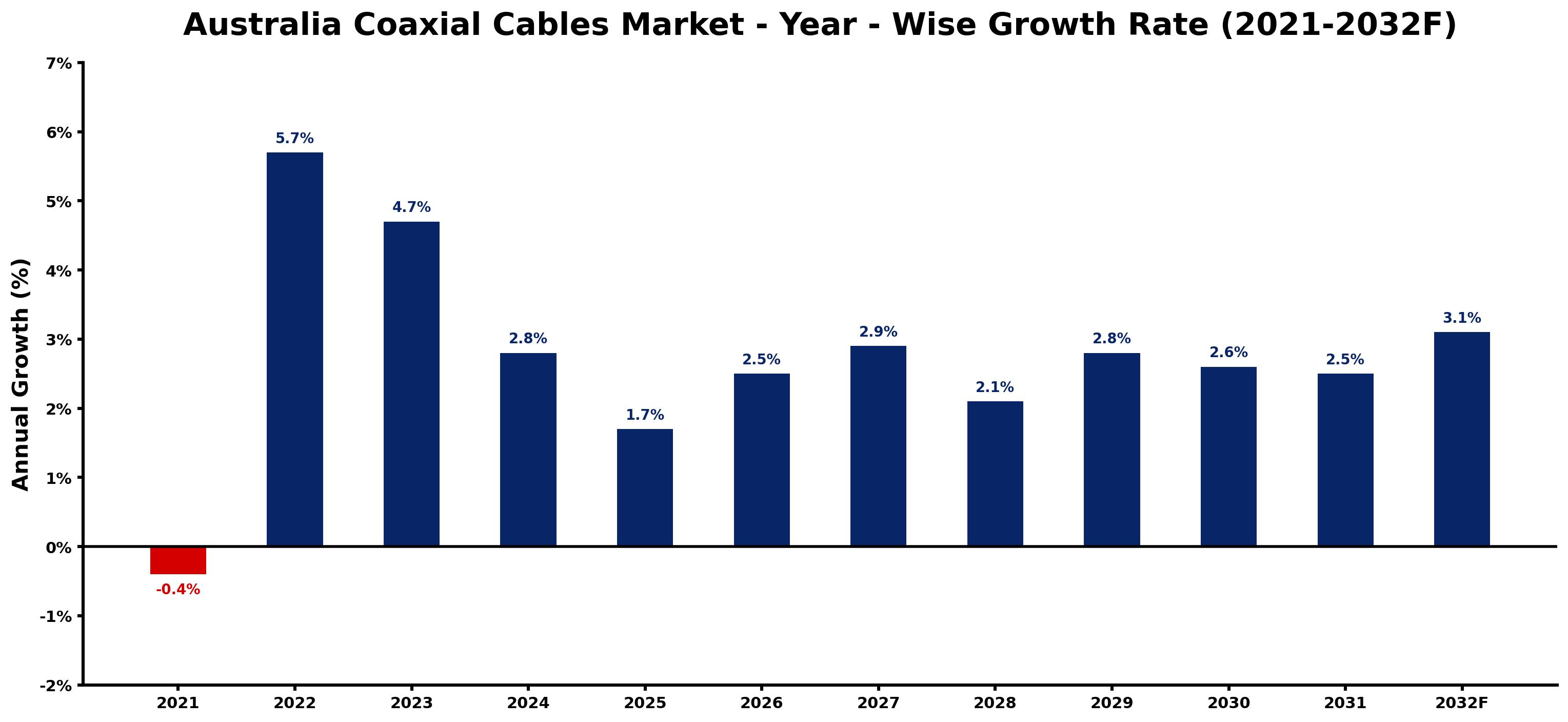
The table below presents the year wise growth rates along with the key drivers influencing the market
| Year | Growth Rate | Major Drivers |
| 2021 | -0.4% | Supply chain disruptions due to pandemicrelated restrictions hindered production and delayed project completions. |
| 2022 | 5.7% | Legacy copper grid failures prompted upgrades to modern coaxial technologies and infrastructure. |
| 2023 | 4.7% | Telecommunication companies expanded fiber networks, creating a complementary demand for coaxial cables. |
| 2024 | 2.8% | The construction sector's rebound highlighted the importance of robust connectivity solutions. |
| 2025 | 1.7% | Consumer electronics trends shifted towards higher bandwidth needs, fueling coaxial cable requirements. |
| 2026 | 2.5% | Digital transformation initiatives across industries encouraged investment in enhanced networking capabilities. |
| 2027 | 2.9% | Emerging smart home technologies increased the uptake of coaxial installations in residential areas. |
| 2028 | 2.1% | Streaming services' popularity necessitated better signal quality, benefiting coaxial cable sales. |
| 2029 | 2.8% | Corporate shifts towards remote work led to upgrades in home office connectivity standards. |
| 2030 | 2.6% | Increased urbanization resulted in more complex infrastructure demands, favoring coaxial cable solutions. |
| 2031 | 2.5% | Growing data centers required upgraded cabling systems to support vast amounts of information. |
| 2032 | 3.1% | Diverse applications in IoT and automation expanded the coaxial cable market significantly. |
Note - Market size estimations and growth projections presented in this report are based on 6Wresearch's advanced forecasting approach, validated with industry datasets as of June 2026.
Australia Coaxial Cables Market Synopsis
The Australia Coaxial Cables Market is projected to reach 2.5% and witness significant growth during the forecast period (2026-2032). The market is experiencing a surge driven by the escalating demand for efficient data transmission and the expansive development of telecommunications networks across the continent. Coaxial cables are essential in conveying radio frequency signals for diverse applications, such as cable television, internet services, and aerospace communication systems. Several factors contribute to market advancements, including increasing internet penetration, heightened investments in 5G infrastructure, and continuous technological advancements in cable manufacturing.
Australia Coaxial Cables Market Growth Drivers
The primary factors driving the Australia Coaxial Cables market include:
- Growing demand for high-speed data transmission across telecommunications, broadband, and broadcasting sectors is a primary growth driver, as coaxial cables provide essential connectivity.
- The expansion of 5G networks is significantly bolstering market demand, as these networks necessitate improved infrastructure that incorporates coaxial cables for efficient signal transmission.
- Advancements in coaxial cable technology enhance performance, thereby increasing adoption rates in various sectors, including security and video streaming.
- The rise in high-definition video streaming and online gaming is prompting enhanced infrastructure, creating a greater need for reliable coaxial cable solutions.
- In the construction and infrastructure development sectors, there is an uptick in demand for coaxial cables for applications such as CCTV surveillance and building automation systems.
Australia Coaxial Cables Market Challenges and Restraints
Despite the robust growth, the Australia Coaxial Cables market faces several challenges:
- Intensifying competition from alternative technologies, notably fiber optics and wireless solutions, poses a significant threat to coaxial cables, which may limit market growth.
- Emerging transmission mediums offer advantages like faster data transfer rates and scalability, compelling stakeholders to innovate or risk obsolescence.
- Economic fluctuations may affect investment in telecommunications infrastructure, impacting the demand for coaxial cables in the short term.
- The rapid evolution of technology requires continuous adaptation and investments from manufacturers to maintain competitive relevance.
- Compliance with stringent product standards and certification processes presents additional burdens on manufacturers to ensure quality and reliability.
Australia Coaxial Cables Market Government Investment and Initiatives
Government policies in Australia significantly affect the Coaxial Cables market, particularly regarding infrastructure development and network enhancements. Initiatives aimed at improving internet connectivity and promoting digital inclusion stimulate demand for coaxial cables within telecommunications networks. Furthermore, government emphasis on competition and market liberalization encourages investment by telecommunications enterprises, enabling infrastructure upgrades and modernization projects. Regulations ensuring product quality and reliability for coaxial cables used in critical communication systems underscore the importance of maintaining high standards in production. These supportive frameworks contribute to the overall growth and development of the market.
Australia Coaxial Cables Market Latest Developments (May 2025 - June 2026)
Recent developments in the Australia Coaxial Cables market indicate a progressive shift towards enhancing communication infrastructures. This period has seen various initiatives focusing on improving broadband access and mobile network capabilities, promoting the need for advanced coaxial cable solutions. Companies are increasingly investing in innovative technologies to streamline manufacturing processes and enhance cable performance. Efforts to modernize existing telecommunications frameworks have also gained momentum, driven by the demand for higher bandwidth and faster data transmission. Collaboration between public and private sectors has enabled the exploration of new applications and improvements in coaxial cable technologies, reflecting the market's adaptive capabilities in a rapidly evolving landscape.
Australia Coaxial Cables Market - Key Attractiveness of the Report
- 10 Years of Market Numbers
- Historical Data Starting from 2022 to 2025
- Base Year: 2025
- Forecast Data until 2032
- Key Performance Indicators Impacting the Market
- Major Upcoming Developments and Projects
Key Highlights of the Report:
- Australia Coaxial Cables Market Outlook
- Market Size of Australia Coaxial Cables Market, 2025
- Forecast of Australia Coaxial Cables Market, 2032
- Historical Data and Forecast of Australia Coaxial Cables Revenues & Volume for the Period 2022-2032F
- Australia Coaxial Cables Market Trend Evolution
- Australia Coaxial Cables Market Drivers and Challenges
- Australia Coaxial Cables Price Trends
- Australia Coaxial Cables Porter's Five Forces
- Australia Coaxial Cables Industry Life Cycle
- Historical Data and Forecast of Australia Coaxial Cables Market Revenues & Volume By Types for the Period 2022-2032F
- Historical Data and Forecast of Australia Coaxial Cables Market Revenues & Volume By Hard-line Cable for the Period 2022-2032F
- Historical Data and Forecast of Australia Coaxial Cables Market Revenues & Volume By Triaxial Cable for the Period 2022-2032F
- Historical Data and Forecast of Australia Coaxial Cables Market Revenues & Volume By Twin Axial Cable for the Period 2022-2032F
- Historical Data and Forecast of Australia Coaxial Cables Market Revenues & Volume By Applications for the Period 2022-2032F
- Historical Data and Forecast of Australia Coaxial Cables Market Revenues & Volume By Internet Data Transfer for the Period 2022-2032F
- Historical Data and Forecast of Australia Coaxial Cables Market Revenues & Volume By Video Distribution for the Period 2022-2032F
- Historical Data and Forecast of Australia Coaxial Cables Market Revenues & Volume By Radio Distribution Frequency Transfer for the Period 2022-2032F
- Historical Data and Forecast of Australia Coaxial Cables Market Revenues & Volume By Others for the Period 2022-2032F
- Historical Data and Forecast of Australia Coaxial Cables Market Revenues & Volume By End-users for the Period 2022-2032F
- Historical Data and Forecast of Australia Coaxial Cables Market Revenues & Volume By Cable Television Industry for the Period 2022-2032F
- Historical Data and Forecast of Australia Coaxial Cables Market Revenues & Volume By Military and Aerospace for the Period 2022-2032F
- Historical Data and Forecast of Australia Coaxial Cables Market Revenues & Volume By Internet Service Providers for the Period 2022-2032F
- Historical Data and Forecast of Australia Coaxial Cables Market Revenues & Volume By Telephone Network Operators for the Period 2022-2032F
- Historical Data and Forecast of Australia Coaxial Cables Market Revenues & Volume By Communication Equipment Manufactures for the Period 2022-2032F
- Australia Coaxial Cables Import Export Trade Statistics
- Market Opportunity Assessment By Types
- Market Opportunity Assessment By Applications
- Market Opportunity Assessment By End-users
- Australia Coaxial Cables Top Companies Market Share
- Australia Coaxial Cables Competitive Benchmarking By Technical and Operational Parameters
- Australia Coaxial Cables Company Profiles
- Australia Coaxial Cables Key Strategic Recommendations






































