Australia Coir Market (2026-2032) | Trends, Industry, Outlook, Forecast, Revenue, Value, Growth, Share, Companies, Size & Analysis
Market Forecast By Product Type (White Fiber, Brown Fiber), By Nature (Organic, Conventional), By Source (Green Coconuts, Brown Coconuts), By Form (Bales, Blocks, Disks & Coins, Husk Chips, Grow Bags & Open Top, Rope) And Competitive Landscape
| Product Code: ETC422371 | Publication Date: Oct 2022 | Updated Date: Mar 2026 | Product Type: Market Research Report | |
| Publisher: 6Wresearch | Author: Shubham Padhi | No. of Pages: 75 | No. of Figures: 35 | No. of Tables: 20 |
Australia Coir Market: Import Trend Analysis
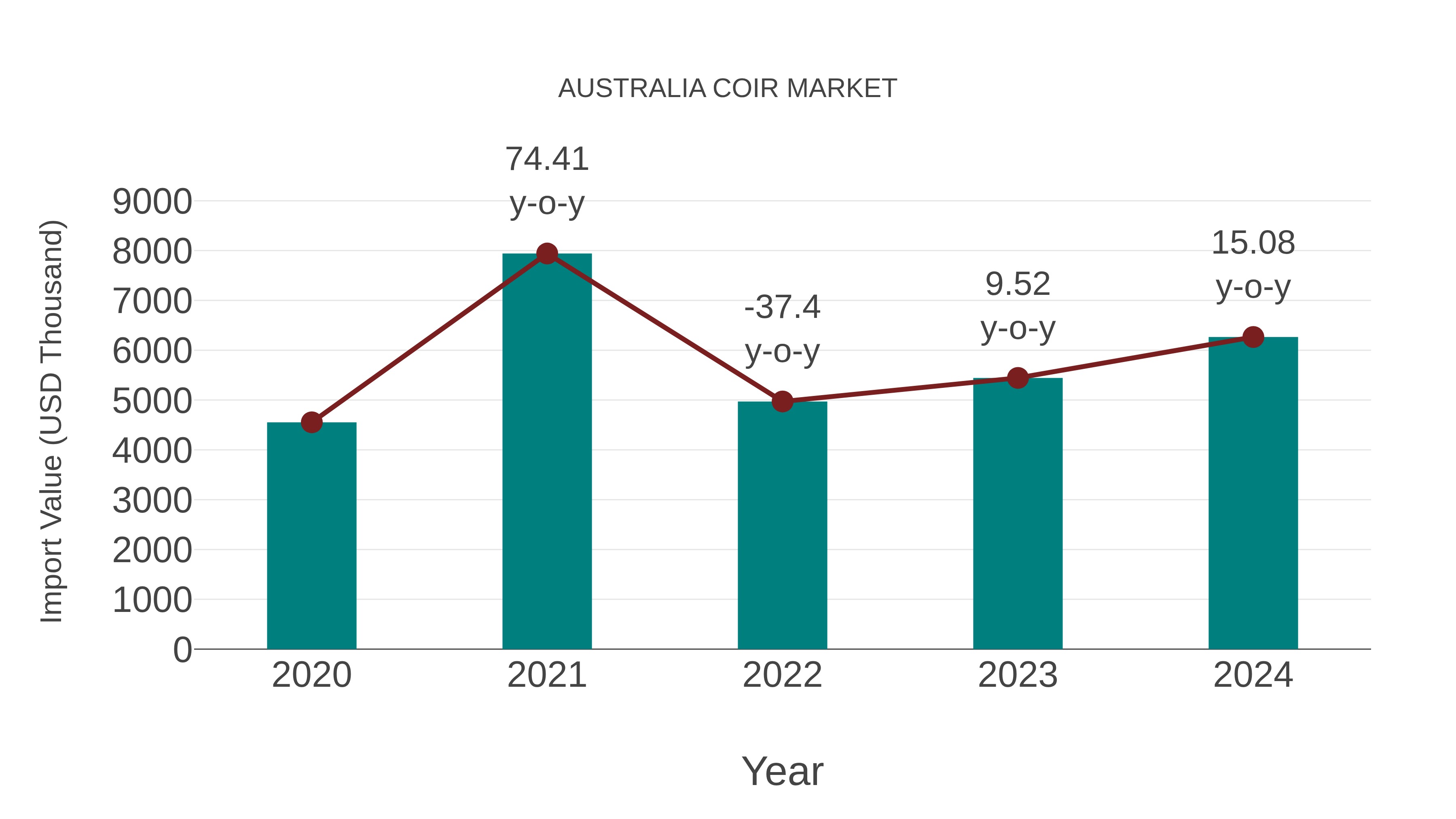
Australia`s import trend for the coir market exhibited a notable growth rate of 15.08% from 2023 to 2024, with a compound annual growth rate (CAGR) of 8.31% from 2020 to 2024. This import momentum can be attributed to a surge in demand for sustainable and eco-friendly products, driving market stability amidst evolving consumer preferences.
Australia Coir Market Highlights
| Report Name | Australia Coir Market |
| Forecast Period | 2025-2031 |
| CAGR | 8% |
| Growing Sector | Agriculture |
Topics Covered in Australia Coir Market Report:
Australia Coir Market thoroughly covers the market By Product Type, By Nature, By Source, By Form. The market report provides an unbiased and detailed analysis of the ongoing market trends, opportunities/high growth areas, and market drivers which would help the stakeholders to devise and align their market strategies according to the current and future market dynamics.
Australia Coir Market Synopsis
Australia Coir Market is witnessing a notable expansion, driven by the growing awareness of the environmental benefits of using natural and sustainable materials. Coir, a fibrous material extracted from the husk of coconuts, is increasingly being utilized in various sectors, including agriculture for soil treatment and erosion control, horticulture as a peat moss alternative, and in the manufacturing of eco-friendly geotextiles. The demand is further bolstered by the construction industry, where coir is used for its durability and natural resistance to rot and moisture, making it an ideal material for outdoor landscaping and as an erosion control fabric. With Australia's commitment to sustainability and the increasing sophistication of environmental standards, the coir market is expected to see significant growth, primarily driven by its application in green infrastructure projects and organic farming practices.
According to 6Wresearch, the Australia Coir Market size is projected to rise at a CAGR of 8% during 2025-2031. The Australia coir market is primarily driven by the country's strong emphasis on environmental sustainability and the growing recognition of coir's ecological benefits. The widespread adoption of green infrastructure projects and organic farming practices has significantly increased the demand for coir products. Furthermore, the construction industry's search for sustainable and durable materials has recognized coir as an excellent solution, given its natural resistance to rot, moisture, and pests. This demand is complemented by the horticultural sector, where coir is prized as a renewable substitute for peat moss, contributing to the preservation of peatlands, which are critical carbon sinks. However, the coir market in Australia faces several challenges that could impede its growth trajectory.
One of the foremost challenges is the reliance on imports for raw materials, as coconuts are not extensively grown in Australia. This dependency subjects the market to fluctuations in global supply chains and potential increases in costs. Additionally, there is a lack of widespread awareness and understanding of coir's applications and benefits among potential end-users, which slows market penetration. Finally, the competition from synthetic and non-renewable alternatives, often priced lower than coir-based products, poses a significant challenge to expanding coir’s footprint in the sustainability-conscious sectors. Despite these challenges, the Australia coir market presents several opportunities for growth and innovation. The growing demand for sustainable and eco-friendly products is likely to encourage investments in domestic coconut cultivation and processing facilities, reducing reliance on imports. Furthermore, increasing government initiatives towards promoting organic agriculture and green infrastructure development provide a favorable environment for the Australia Coir Market Growth.
Australia Coir Market: Leading Players:
Prominent entities driving the Australia Coir Industry forward comprise esteemed names like Cocoloco Pty Ltd., Australian Horticultural Exporters, Mackay Fertiliser and Agricultural Services Pty Ltd., The Green Life Soil Co., Australian Native Landscapes Pty Ltd., Small Farms Group, and Bunnings Group Limited. These companies stand out for their proficiency in coir processing, adeptness in product innovation, and expansive distribution networks. As industry frontrunners, they exert significant influence in defining market trajectories and spearheading technological progressions to cater to ever-changing consumer preferences. Their collective contributions shape the landscape of the coir market, setting benchmarks for excellence and sustainability in the industry.
Australia Coir Market: Government Initiatives
Government initiatives targeting sustainable agriculture and environmental preservation are pivotal in enhancing the Australia Coir Market. Subsidies, grants, and awareness campaigns are instrumental in encouraging the uptake of coir-based solutions. These efforts create an enabling environment for market expansion and advancement. By incentivizing the utilization of coir, authorities foster a sustainable ecosystem that benefits both agricultural practices and environmental conservation. Such strategic interventions not only support the growth of the coir market but also contribute to the broader goal of fostering sustainability and resilience within the agricultural sector in Australia.
Future Insights of the Market
The coir market in Australia is expected to continue its growth trajectory in the coming years, driven by a combination of environmental awareness and government support for sustainable practices. The rise in demand for organic products and natural materials is expected to fuel the adoption of coir across various industries, including food and beverage, cosmetics, and pharmaceuticals. Additionally, with advancements in technology and processing methods, the quality and versatility of coir products are also expected to improve, further driving demand in both domestic and international markets.
As sustainability becomes a global priority, there is an increasing focus on reducing plastic waste and finding eco-friendly alternatives. This presents immense growth opportunities for the coir industry as it can be used as a substitute for plastic in various applications such as packaging materials, disposable utensils, and biodegradable products. The versatility of coir also makes it suitable for use in various industries, including construction, agriculture, and consumer goods.
Market Segmentation by Product Type:
According to Ravi Bhandari, Research Manager, 6Wresearch, in the Australian coir market, Brown Fiber is expected to witness significant growth due to its durability, high density, and moisture retention, making it the preferred option for agriculture, geotextiles, and landscaping.
Market Segmentation by Nature:
The Australia Coir Market is witnessing substantial expansion, especially in Organic coir products, driven by heightened consumer consciousness and preference for eco-friendly agricultural and gardening solutions. Organic coir, derived from coconut husks sans synthetic chemicals, aligns with these demands effectively.
Market Segmentation by Source
The Brown Coconuts segment dominates Australia's growing coir market due to readily available and durable fibers. Their versatility makes them preferred in various applications like garden products and erosion control.
Market Segmentation by Form
The Grow Bags & Open Top segment is experiencing notable expansion in Australia's coir market due to increasing demand for sustainable growing mediums in agriculture and horticulture, driven by their superior water retention, aeration, and user-friendly characteristics.
Key attractiveness of the report
- 10 Years Market Numbers.
- Historical Data Starting from 2021 to 2024.
- Base Year: 2024.
- Forecast Data until 2031.
- Key Performance Indicators Impacting the Market.
- Major Upcoming Developments and Projects.
Key Highlights of the Report:
- Australia Coir Market Outlook
- Market Size of Australia Coir Market, 2025
- Forecast of Australia Coir Market, 2032
- Historical Data and Forecast of Australia Coir Revenues & Volume for the Period 2022-2032F
- Australia Coir Market Trend Evolution
- Australia Coir Market Drivers and Challenges
- Australia Coir Price Trends
- Australia Coir Porter's Five Forces
- Australia Coir Industry Life Cycle
- Historical Data and Forecast of Australia Coir Market Revenues & Volume By Product Type for the Period 2022-2032F
- Historical Data and Forecast of Australia Coir Market Revenues & Volume By White Fiber for the Period 2022-2032F
- Historical Data and Forecast of Australia Coir Market Revenues & Volume By Brown Fiber for the Period 2022-2032F
- Historical Data and Forecast of Australia Coir Market Revenues & Volume By Nature for the Period 2022-2032F
- Historical Data and Forecast of Australia Coir Market Revenues & Volume By Organic for the Period 2022-2032F
- Historical Data and Forecast of Australia Coir Market Revenues & Volume By Conventional for the Period 2022-2032F
- Historical Data and Forecast of Australia Coir Market Revenues & Volume By Source for the Period 2022-2032F
- Historical Data and Forecast of Australia Coir Market Revenues & Volume By Green Coconuts for the Period 2022-2032F
- Historical Data and Forecast of Australia Coir Market Revenues & Volume By Brown Coconuts for the Period 2022-2032F
- Historical Data and Forecast of Australia Coir Market Revenues & Volume By Form for the Period 2022-2032F
- Historical Data and Forecast of Australia Coir Market Revenues & Volume By Bales for the Period 2022-2032F
- Historical Data and Forecast of Australia Coir Market Revenues & Volume By Blocks for the Period 2022-2032F
- Historical Data and Forecast of Australia Coir Market Revenues & Volume By Disks & Coins for the Period 2022-2032F
- Historical Data and Forecast of Australia Coir Market Revenues & Volume By Husk Chips for the Period 2022-2032F
- Historical Data and Forecast of Australia Coir Market Revenues & Volume By Grow Bags & Open Top for the Period 2022-2032F
- Historical Data and Forecast of Australia Coir Market Revenues & Volume By Rope for the Period 2022-2032F
- Australia Coir Import Export Trade Statistics
- Market Opportunity Assessment By Product Type
- Market Opportunity Assessment By Nature
- Market Opportunity Assessment By Source
- Market Opportunity Assessment By Form
- Australia Coir Top Companies Market Share
- Australia Coir Competitive Benchmarking By Technical and Operational Parameters
- Australia Coir Company Profiles
- Australia Coir Key Strategic Recommendations
Market Covered
The report offers a comprehensive study of the subsequent market segments:
By Product Type
- White Fiber
- Brown Fiber
By Nature
- Organic
- Conventional
By Source
- Green Coconuts
- Brown Coconuts
By Form
- Bales
- Blocks
- Disks & Coins
- Husk Chips
- Grow Bags & Open Top
- Rope
Australia Coir Market (2026-2032): FAQs
The growth of the Australia Coir Market is primarily driven by rising environmental consciousness, governmental initiatives promoting sustainable practices, increasing adoption of organic farming techniques, and coir's superior moisture retention and weed suppression attributes.
The Australia Coir Market faces challenges such as restricted raw material access, volatile coconut husk supply, demands for substantial processing infrastructure, and competition from synthetic alternatives.
Prominent companies in the Australia Coir Market include Cocoloco Pty Ltd., Australian Horticultural Exporters, Mackay Fertiliser and Agricultural Services Pty Ltd., The Green Life Soil Co., Australian Native Landscapes Pty Ltd., Small Farms Group, and Bunnings Group Limited.
Government initiatives targeting sustainable agriculture and environmental preservation, including subsidies, grants, and awareness campaigns, are instrumental in encouraging the uptake of coir-based solutions, thus fostering market expansion and advancement.
6Wresearch actively monitors the Australia Coir Market and publishes its comprehensive annual report, highlighting emerging trends, growth drivers, revenue analysis, and forecast outlook. Our insights help businesses to make data-backed strategic decisions with ongoing market dynamics. Our analysts track relevent industries related to the Australia Coir Market, allowing our clients with actionable intelligence and reliable forecasts tailored to emerging regional needs.
Yes, we provide customisation as per your requirements. To learn more, feel free to contact us on sales@6wresearch.com
| 1 Executive Summary |
| 2 Introduction |
| 2.1 Key Highlights of the Report |
| 2.2 Report Description |
| 2.3 Market Scope & Segmentation |
| 2.4 Research Methodology |
| 2.5 Assumptions |
| 3 Australia Coir Market Overview |
| 3.1 Australia Country Macro Economic Indicators |
| 3.2 Australia Coir Market Revenues & Volume, 2022 & 2032F |
| 3.3 Australia Coir Market - Industry Life Cycle |
| 3.4 Australia Coir Market - Porter's Five Forces |
| 3.5 Australia Coir Market Revenues & Volume Share, By Product Type, 2022 & 2032F |
| 3.6 Australia Coir Market Revenues & Volume Share, By Nature, 2022 & 2032F |
| 3.7 Australia Coir Market Revenues & Volume Share, By Source, 2022 & 2032F |
| 3.8 Australia Coir Market Revenues & Volume Share, By Form, 2022 & 2032F |
| 4 Australia Coir Market Dynamics |
| 4.1 Impact Analysis |
| 4.2 Market Drivers |
| 4.2.1 Increasing awareness about sustainable and eco-friendly products |
| 4.2.2 Growing demand for organic and biodegradable materials |
| 4.2.3 Government initiatives promoting the use of natural fibers in various industries |
| 4.3 Market Restraints |
| 4.3.1 Fluctuations in raw material prices |
| 4.3.2 Lack of standardized quality control measures |
| 4.3.3 Competition from synthetic alternatives |
| 5 Australia Coir Market Trends |
| 6 Australia Coir Market, By Types |
| 6.1 Australia Coir Market, By Product Type |
| 6.1.1 Overview and Analysis |
| 6.1.2 Australia Coir Market Revenues & Volume, By Product Type, 2022 & 2032F |
| 6.1.3 Australia Coir Market Revenues & Volume, By White Fiber, 2022 & 2032F |
| 6.1.4 Australia Coir Market Revenues & Volume, By Brown Fiber, 2022 & 2032F |
| 6.2 Australia Coir Market, By Nature |
| 6.2.1 Overview and Analysis |
| 6.2.2 Australia Coir Market Revenues & Volume, By Organic, 2022 & 2032F |
| 6.2.3 Australia Coir Market Revenues & Volume, By Conventional, 2022 & 2032F |
| 6.3 Australia Coir Market, By Source |
| 6.3.1 Overview and Analysis |
| 6.3.2 Australia Coir Market Revenues & Volume, By Green Coconuts, 2022 & 2032F |
| 6.3.3 Australia Coir Market Revenues & Volume, By Brown Coconuts, 2022 & 2032F |
| 6.4 Australia Coir Market, By Form |
| 6.4.1 Overview and Analysis |
| 6.4.2 Australia Coir Market Revenues & Volume, By Bales, 2022 & 2032F |
| 6.4.3 Australia Coir Market Revenues & Volume, By Blocks, 2022 & 2032F |
| 6.4.4 Australia Coir Market Revenues & Volume, By Disks & Coins, 2022 & 2032F |
| 6.4.5 Australia Coir Market Revenues & Volume, By Husk Chips, 2022 & 2032F |
| 6.4.6 Australia Coir Market Revenues & Volume, By Grow Bags & Open Top, 2022 & 2032F |
| 6.4.7 Australia Coir Market Revenues & Volume, By Rope, 2022 & 2032F |
| 7 Australia Coir Market Import-Export Trade Statistics |
| 7.1 Australia Coir Market Export to Major Countries |
| 7.2 Australia Coir Market Imports from Major Countries |
| 8 Australia Coir Market Key Performance Indicators |
| 8.1 Percentage of agricultural land dedicated to coir cultivation |
| 8.2 Adoption rate of coir products in industries such as agriculture, horticulture, and landscaping |
| 8.3 Number of research and development projects focused on improving coir production techniques |
| 9 Australia Coir Market - Opportunity Assessment |
| 9.1 Australia Coir Market Opportunity Assessment, By Product Type, 2022 & 2032F |
| 9.2 Australia Coir Market Opportunity Assessment, By Nature, 2022 & 2032F |
| 9.3 Australia Coir Market Opportunity Assessment, By Source, 2022 & 2032F |
| 9.4 Australia Coir Market Opportunity Assessment, By Form, 2022 & 2032F |
| 10 Australia Coir Market - Competitive Landscape |
| 10.1 Australia Coir Market Revenue Share, By Companies, 2025 |
| 10.2 Australia Coir Market Competitive Benchmarking, By Operating and Technical Parameters |
| 11 Company Profiles |
| 12 Recommendations |
| 13 Disclaimer |
Export potential assessment - trade Analytics for 2030
Export potential enables firms to identify high-growth global markets with greater confidence by combining advanced trade intelligence with a structured quantitative methodology. The framework analyzes emerging demand trends and country-level import patterns while integrating macroeconomic and trade datasets such as GDP and population forecasts, bilateral import–export flows, tariff structures, elasticity differentials between developed and developing economies, geographic distance, and import demand projections. Using weighted trade values from 2020–2024 as the base period to project country-to-country export potential for 2030, these inputs are operationalized through calculated drivers such as gravity model parameters, tariff impact factors, and projected GDP per-capita growth. Through an analysis of hidden potentials, demand hotspots, and market conditions that are most favorable to success, this method enables firms to focus on target countries, maximize returns, and global expansion with data, backed by accuracy.
By factoring in the projected importer demand gap that is currently unmet and could be potential opportunity, it identifies the potential for the Exporter (Country) among 190 countries, against the general trade analysis, which identifies the biggest importer or exporter.
To discover high-growth global markets and optimize your business strategy:
Click Here
Pricing
- Single User License$ 1,995
- Department License$ 2,400
- Site License$ 3,120
- Global License$ 3,795

Search
Thought Leadership and Analyst Meet





Our Clients








Latest Reports
- United Kingdom (UK) Long-term Care Insurance Market (2026-2032) | Growth, Share, Consumer Insights, Drivers, Opportunities, Competition, Pricing Analysis, Segments, Restraints, Companies, Competitive, Value, Outlook, Size, Demand, Analysis, Challenges, Strategic Insights, Investment Trends, Revenue, Trends, Supply, Forecast
- United Kingdom (UK) Long Term Care Market (2026-2032) | Companies, Outlook, Analysis, Trends, Value, Revenue, Segmentation, Share, Forecast, Competitive Landscape, Growth, Size & Forecast
- Iraq Insulation and Waterproofing Market (2026-2032) | Outlook, Drivers, Growth, Size, Share, Industry, Revenue, Trends, Demand, Competitive, Strategic Insights, Opportunities, Segments, Companies, Challenges, Strategy, Consumer Insights, Analysis, Investment Trends, Value, Segmentation, Forecast, Restraints
- India Switchgear Market Outlook (2026 - 2032) | Size, Share, Trends, Growth, Revenue, Forecast, Analysis, Value, Outlook
- Pakistan Contraceptive Implants Market (2025-2031) | Demand, Growth, Size, Share, Industry, Pricing Analysis, Competitive, Strategic Insights, Strategy, Consumer Insights, Analysis, Investment Trends, Opportunities, Revenue, Segments, Value, Segmentation, Supply, Forecast, Restraints, Outlook, Competition, Drivers, Trends, Companies, Challenges
- Sri Lanka Packaging Market (2026-2032) | Outlook, Competition, Drivers, Trends, Demand, Pricing Analysis, Competitive, Strategic Insights, Companies, Challenges, Strategy, Consumer Insights, Analysis, Investment Trends, Opportunities, Growth, Size, Share, Industry, Revenue, Segments, Value, Segmentation, Supply, Forecast, Restraints
- India Kids Watches Market (2026-2032) | Strategy, Consumer Insights, Analysis, Investment Trends, Opportunities, Growth, Size, Share, Industry, Revenue, Segments, Value, Segmentation, Supply, Forecast, Restraints, Outlook, Competition, Drivers, Trends, Demand, Pricing Analysis, Competitive, Strategic Insights, Companies, Challenges
- Saudi Arabia Core Assurance Service Market (2025-2031) | Strategy, Consumer Insights, Analysis, Investment Trends, Opportunities, Growth, Size, Share, Industry, Revenue, Segments, Value, Segmentation, Supply, Forecast, Restraints, Outlook, Competition, Drivers, Trends, Demand, Pricing Analysis, Competitive, Strategic Insights, Companies, Challenges
- Romania Uninterruptible Power Supply (UPS) Market (2026-2032) | Industry, Analysis, Revenue, Size, Forecast, Outlook, Value, Trends, Share, Growth & Companies
- Saudi Arabia Car Window Tinting Film, Paint Protection Film (PPF), and Ceramic Coating Market (2025-2031) | Strategy, Consumer Insights, Analysis, Investment Trends, Opportunities, Growth, Size, Share, Industry, Revenue, Segments, Value, Segmentation, Supply, Forecast, Restraints, Outlook, Competition, Drivers, Trends, Demand, Pricing Analysis, Competitive, Strategic Insights, Companies, Challenges
Industry Events and Analyst Meet

India EV Show 2026

EV tech India Expo 2026

Auto Tech Asia 2026

Battery Tech India 2026

Smart Production Solutions Guangzhou 2026
Whitepaper
- Middle East & Africa Commercial Security Market Click here to view more.
- Middle East & Africa Fire Safety Systems & Equipment Market Click here to view more.
- GCC Drone Market Click here to view more.
- Middle East Lighting Fixture Market Click here to view more.
- GCC Physical & Perimeter Security Market Click here to view more.
6WResearch In News
- Doha a strategic location for EV manufacturing hub: IPA Qatar
- Demand for luxury TVs surging in the GCC, says Samsung
- Empowering Growth: The Thriving Journey of Bangladesh’s Cable Industry
- Demand for luxury TVs surging in the GCC, says Samsung
- Video call with a traditional healer? Once unthinkable, it’s now common in South Africa
- Intelligent Buildings To Smooth GCC’s Path To Net Zero


