Australia Commercial Hvac Market: Import Trend Analysis
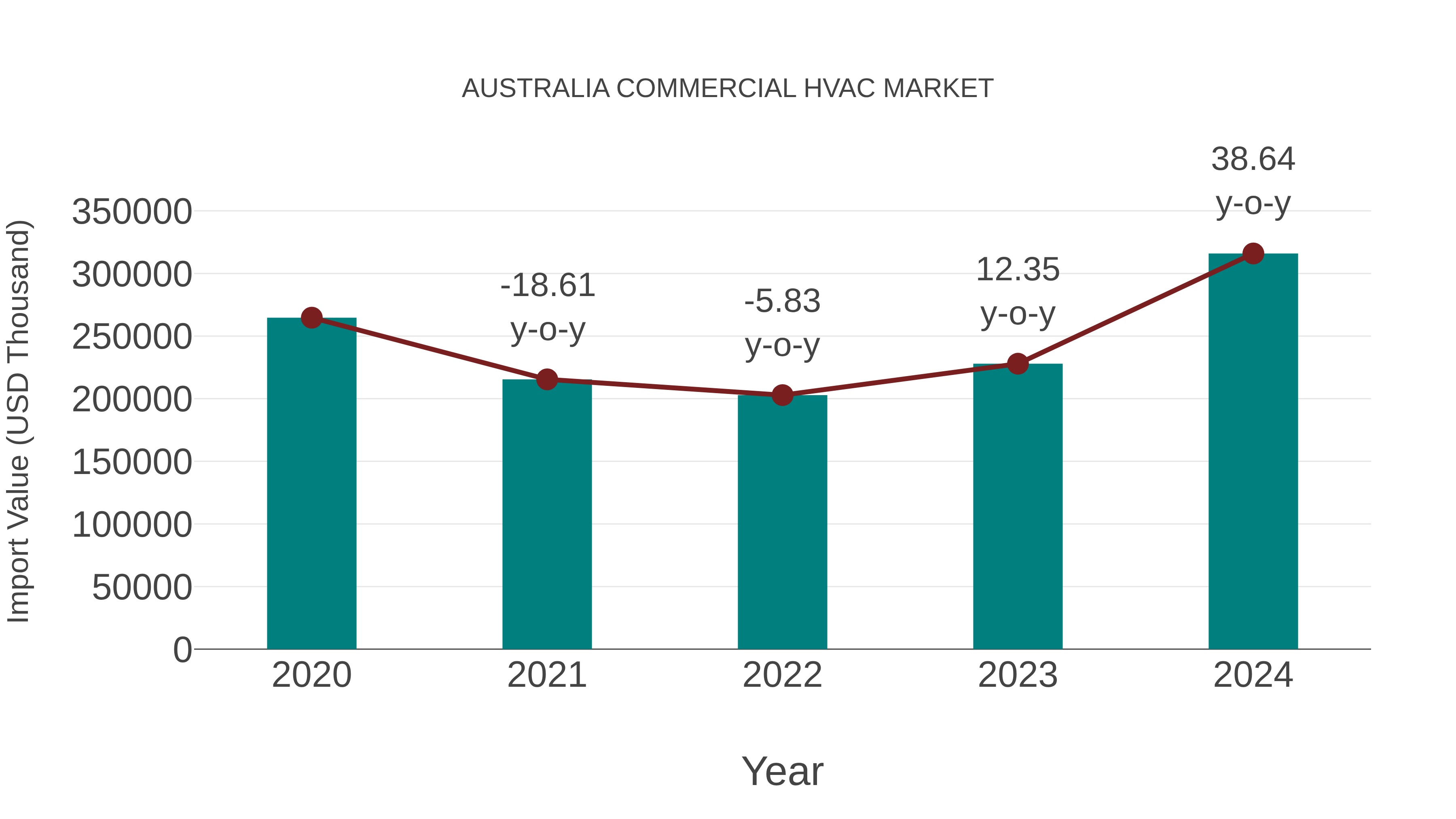
Australia`s import trend for the commercial HVAC market experienced significant growth from 2023 to 2024, with a growth rate of 38.64%. The compound annual growth rate (CAGR) for the period of 2020 to 2024 stood at 4.53%. This surge in imports can be attributed to a notable shift in demand towards energy-efficient HVAC systems, reflecting the market`s response to sustainability initiatives and regulations.
Australia Commercial Hvac Market Overview
The commercial HVAC market in Australia is experiencing steady growth driven by factors such as increasing construction activities, stringent regulations on energy efficiency, and the growing emphasis on sustainable building practices. The market is characterized by a high demand for energy-efficient HVAC systems, particularly in sectors such as healthcare, education, hospitality, and commercial offices. Key trends include the adoption of smart HVAC technologies, such as IoT-enabled systems and building automation, to optimize energy usage and enhance overall building performance. Major players in the market are focusing on product innovation, strategic partnerships, and expanding their service offerings to meet the evolving needs of customers. The market is expected to continue its growth trajectory, spurred by ongoing urbanization, infrastructure development projects, and the increasing awareness of environmental sustainability.
Australia Commercial Hvac Market Trends
The commercial HVAC market in Australia is experiencing a shift towards energy efficiency and sustainability, driven by increasing awareness of environmental concerns and government regulations. Businesses are prioritizing energy-saving solutions, such as smart HVAC systems and variable refrigerant flow (VRF) technology, to reduce operational costs and carbon footprint. Demand for integrated building automation systems that offer centralized control and real-time monitoring is also on the rise. Additionally, there is a growing interest in air quality management solutions, including advanced filtration systems and UV-C disinfection technology, in response to the COVID-19 pandemic. Overall, the Australian commercial HVAC market is evolving towards more innovative, efficient, and environmentally friendly solutions to meet the changing needs of businesses and building owners.
Australia Commercial Hvac Market Challenges
In the Australian commercial HVAC market, some key challenges include increasing energy costs and the push for more sustainable and energy-efficient solutions. Stricter regulations and building codes also pose a challenge for HVAC companies to meet compliance standards while remaining competitive. Additionally, the market is seeing a shift towards smart HVAC systems and automation, requiring companies to invest in technology and skilled labor to meet the changing demands of customers. The ongoing impact of the COVID-19 pandemic has also disrupted the market, leading to delays in projects and uncertainties in demand. Overall, staying ahead in innovation, adapting to regulatory changes, and managing operational costs are critical challenges faced by players in the Australian commercial HVAC market.
Australia Commercial Hvac Market Investment Opportunities
The Australia commercial HVAC market presents various investment opportunities driven by factors such as increasing demand for energy-efficient systems, government regulations promoting sustainable practices, and the need for advanced technologies for indoor air quality. Investing in companies that specialize in innovative HVAC solutions, such as smart building automation systems and energy-efficient technologies, could prove beneficial. Additionally, there is potential in offering maintenance and retrofitting services to existing commercial HVAC systems to enhance energy efficiency and reduce operating costs for businesses. As the market continues to evolve with a focus on sustainability and cost-effectiveness, investors can capitalize on these trends by supporting companies at the forefront of technological advancements in the commercial HVAC sector.
Australia Commercial Hvac Market Government Policy
The Australian government has implemented various policies to promote energy efficiency and sustainability in the commercial HVAC market. The National Australian Built Environment Rating System (NABERS) rates the energy efficiency of buildings, encouraging owners to invest in more efficient HVAC systems. The Commercial Building Disclosure (CBD) program requires building owners to disclose energy efficiency ratings when selling or leasing commercial office spaces over 1,000 square meters. Additionally, the Emissions Reduction Fund incentivizes businesses to reduce greenhouse gas emissions, which can include upgrading HVAC systems to more energy-efficient models. These policies aim to drive the adoption of energy-efficient HVAC technologies, reduce carbon emissions, and create a more sustainable built environment in Australia.
Australia Commercial Hvac Market Future Outlook
The future outlook for the Australia commercial HVAC market appears promising, driven by factors such as increasing investments in infrastructure projects, growing awareness of energy efficiency, and stringent government regulations promoting sustainable building practices. With a focus on reducing carbon emissions and operating costs, businesses are expected to invest in advanced HVAC systems that offer better energy performance and indoor air quality. Additionally, the rising trend of smart buildings and the integration of IoT technology in HVAC systems are anticipated to drive market growth. As the demand for commercial spaces continues to rise, especially in sectors like healthcare, retail, and hospitality, the market is likely to witness steady expansion and innovation in the coming years.
Key Highlights of the Report:
- Australia Commercial HVAC Market Outlook
- Market Size of Australia Commercial HVAC Market,2025
- Forecast of Australia Commercial HVAC Market, 2032
- Historical Data and Forecast of Australia Commercial HVAC Revenues & Volume for the Period 2022-2032F
- Australia Commercial HVAC Market Trend Evolution
- Australia Commercial HVAC Market Drivers and Challenges
- Australia Commercial HVAC Price Trends
- Australia Commercial HVAC Porter's Five Forces
- Australia Commercial HVAC Industry Life Cycle
- Historical Data and Forecast of Australia Commercial HVAC Market Revenues & Volume By Equipment Type for the Period 2022-2032F
- Historical Data and Forecast of Australia Commercial HVAC Market Revenues & Volume By Packaged HVAC Systems for the Period 2022-2032F
- Historical Data and Forecast of Australia Commercial HVAC Market Revenues & Volume By Split Systems for the Period 2022-2032F
- Historical Data and Forecast of Australia Commercial HVAC Market Revenues & Volume By Chillers for the Period 2022-2032F
- Historical Data and Forecast of Australia Commercial HVAC Market Revenues & Volume By Ventilation Systems for the Period 2022-2032F
- Historical Data and Forecast of Australia Commercial HVAC Market Revenues & Volume By Technology for the Period 2022-2032F
- Historical Data and Forecast of Australia Commercial HVAC Market Revenues & Volume By Smart Sensors for the Period 2022-2032F
- Historical Data and Forecast of Australia Commercial HVAC Market Revenues & Volume By IoT-Enabled for the Period 2022-2032F
- Historical Data and Forecast of Australia Commercial HVAC Market Revenues & Volume By AI-Based Control for the Period 2022-2032F
- Historical Data and Forecast of Australia Commercial HVAC Market Revenues & Volume By Remote Monitoring for the Period 2022-2032F
- Historical Data and Forecast of Australia Commercial HVAC Market Revenues & Volume By Application for the Period 2022-2032F
- Historical Data and Forecast of Australia Commercial HVAC Market Revenues & Volume By Commercial Buildings for the Period 2022-2032F
- Historical Data and Forecast of Australia Commercial HVAC Market Revenues & Volume By Industrial Plants for the Period 2022-2032F
- Historical Data and Forecast of Australia Commercial HVAC Market Revenues & Volume By Healthcare Facilities for the Period 2022-2032F
- Historical Data and Forecast of Australia Commercial HVAC Market Revenues & Volume By Retail Spaces for the Period 2022-2032F
- Historical Data and Forecast of Australia Commercial HVAC Market Revenues & Volume By End User for the Period 2022-2032F
- Historical Data and Forecast of Australia Commercial HVAC Market Revenues & Volume By Office Spaces for the Period 2022-2032F
- Historical Data and Forecast of Australia Commercial HVAC Market Revenues & Volume By Manufacturing for the Period 2022-2032F
- Historical Data and Forecast of Australia Commercial HVAC Market Revenues & Volume By Hospitals for the Period 2022-2032F
- Historical Data and Forecast of Australia Commercial HVAC Market Revenues & Volume By Shopping Malls for the Period 2022-2032F
- Historical Data and Forecast of Australia Commercial HVAC Market Revenues & Volume By Energy Efficiency for the Period 2022-2032F
- Historical Data and Forecast of Australia Commercial HVAC Market Revenues & Volume By Energy Star Certified for the Period 2022-2032F
- Historical Data and Forecast of Australia Commercial HVAC Market Revenues & Volume By LEED Certified for the Period 2022-2032F
- Historical Data and Forecast of Australia Commercial HVAC Market Revenues & Volume By Smart Grid Integration for the Period 2022-2032F
- Historical Data and Forecast of Australia Commercial HVAC Market Revenues & Volume By Low Energy Consumption for the Period 2022-2032F
- Australia Commercial HVAC Import Export Trade Statistics
- Market Opportunity Assessment By Equipment Type
- Market Opportunity Assessment By Technology
- Market Opportunity Assessment By Application
- Market Opportunity Assessment By End User
- Market Opportunity Assessment By Energy Efficiency
- Australia Commercial HVAC Top Companies Market Share
- Australia Commercial HVAC Competitive Benchmarking By Technical and Operational Parameters
- Australia Commercial HVAC Company Profiles
- Australia Commercial HVAC Key Strategic Recommendations






































