Australia Computer-Aided Manufacturing Market Size & Growth Rate (2026-2032)
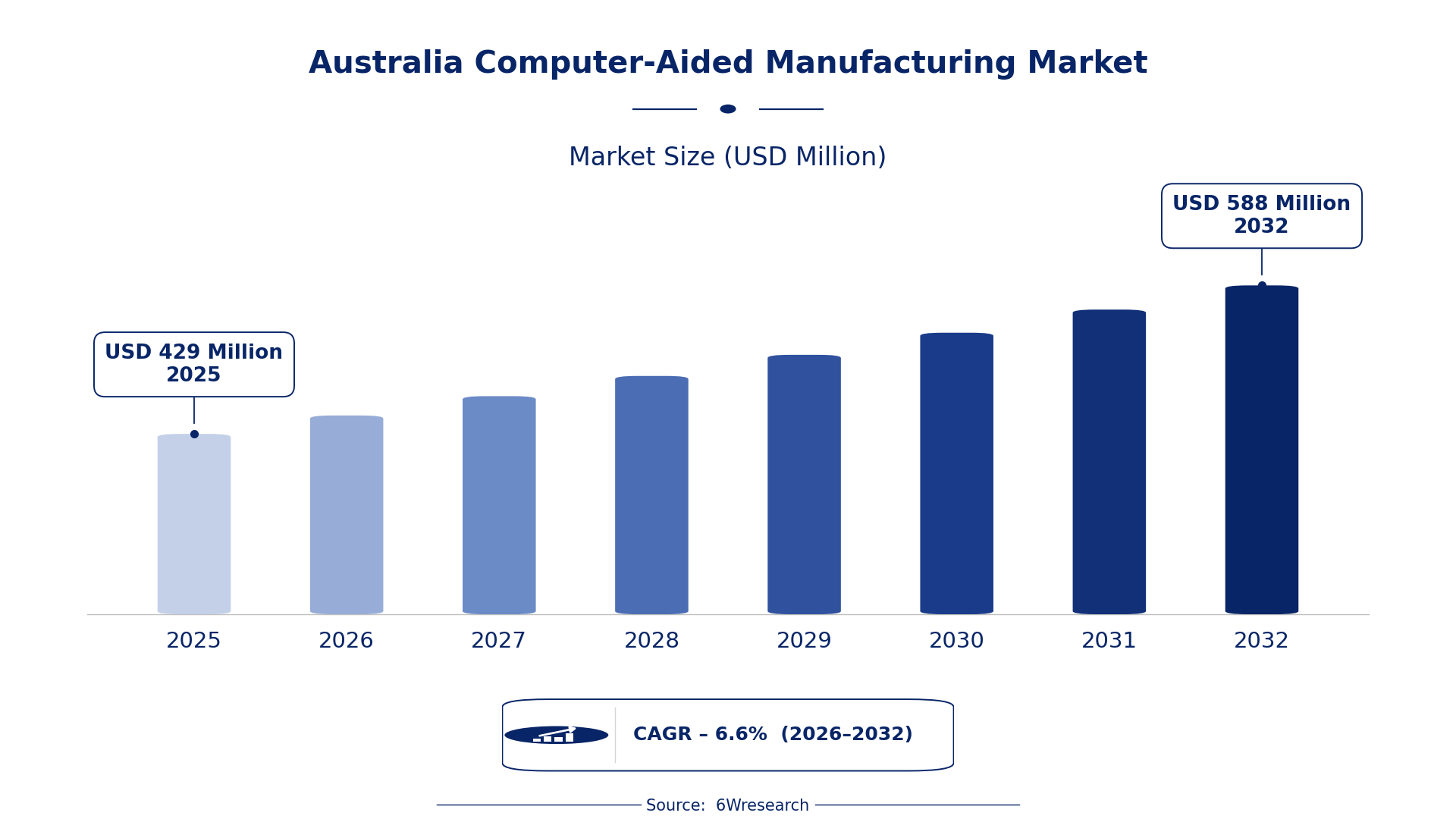
The Australia Computer-Aided Manufacturing Market was estimated at USD 429 Million in 2025 and is projected to reach USD 588 Million by 2032, growing at a CAGR of 6.6% from 2026 to 2032.
Australia Computer-Aided Manufacturing Market Synopsis
The Australia Computer-Aided Manufacturing market is transitioning from traditional manufacturing methodologies to advanced digital solutions. This shift is not merely a trend; it’s a necessary evolution spurred by rising consumer demands for customization and rapid production capabilities.
As industries increasingly embrace automation and integration with technologies like AI and robotics, the market is set to expand significantly. The convergence of these technologies not only optimizes production processes but also enhances operational flexibility, positioning Australia as a competitive player in the global manufacturing arena.
Australia Computer-Aided Manufacturing Market Year-wise Growth Rate and Key Drivers
This graph illustrates the annual growth rates of the Australia Computer-Aided Manufacturing Market from 2021 to 2032, highlighting a steady upward trajectory and projected expansion over the forecast period.
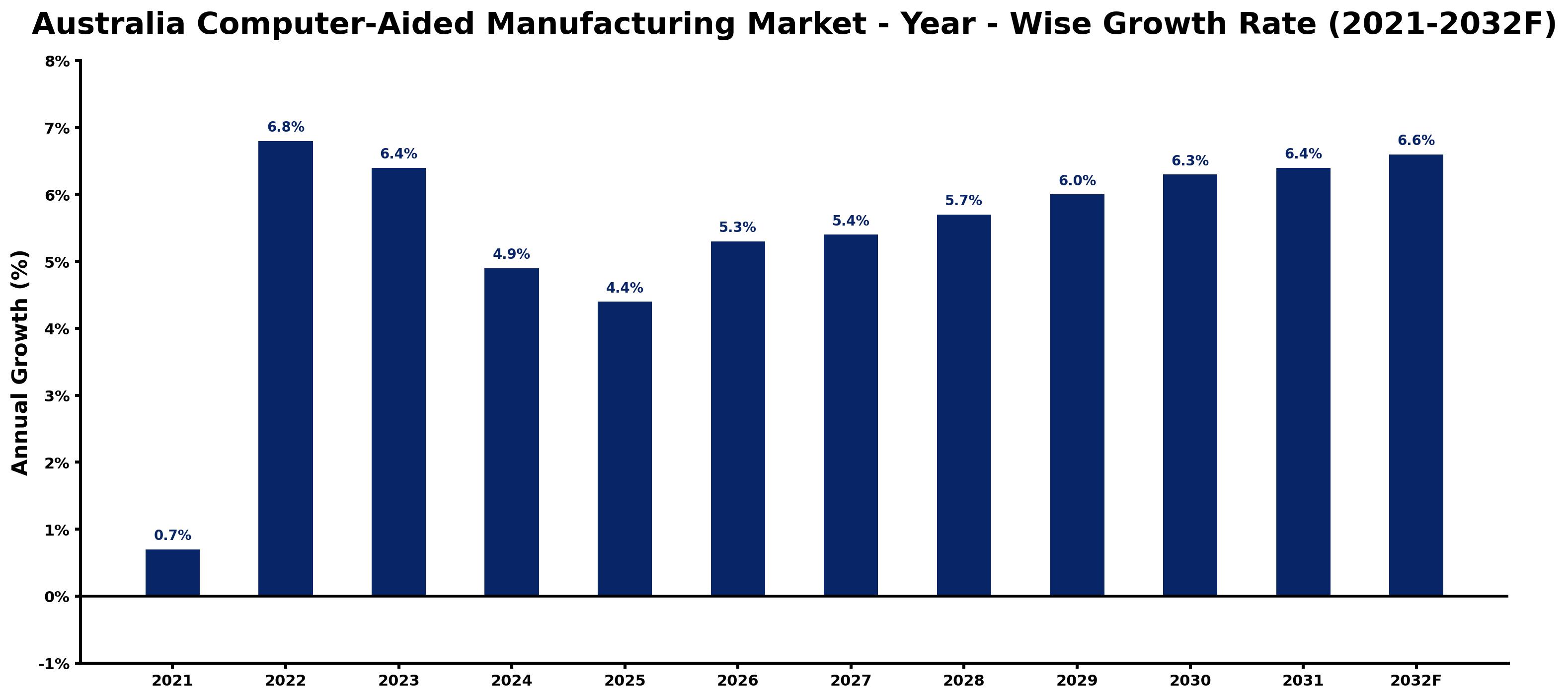
The table below presents the year‑wise growth rates along with the key drivers influencing the market
| Year | Growth Rate | Major Drivers |
| 2021 | 0.7% | Increased investment in local manufacturing capabilities post-pandemic. |
| 2022 | 6.8% | Australian government grants for advanced manufacturing technologies. |
| 2023 | 6.4% | Rising popularity of Industry 4.0 solutions among manufacturers. |
| 2024 | 4.9% | Strong collaboration between universities and manufacturing firms. |
| 2025 | 4.4% | Introduction of tax incentives for automation projects. |
| 2026 | 5.3% | Boost in Australian exports driving local manufacturing upgrades. |
| 2027 | 5.4% | Regional manufacturing hubs promoting technology adoption. |
| 2028 | 5.7% | Emerging trends in additive manufacturing and 3D printing. |
| 2029 | 6.0% | Growing focus on sustainability in manufacturing operations. |
| 2030 | 6.3% | Upsurge in robotics integration for efficiency improvements. |
| 2031 | 6.4% | Corporate investment in digital twins for production optimization. |
| 2032 | 6.6% | Government policies favoring smart manufacturing initiatives. |
Note: Market size estimations and growth projections presented in this report are based on 6Wresearch's proprietary forecasting methodology, utilizing the latest available industry data, government publications, and primary research inputs.
Australia Computer-Aided Manufacturing Market Key Takeaways
Below are some of the specific key takeaways from the market, including:
- Adoption of CAM technologies is growing across sectors, particularly in automotive and aerospace.
- Integration of CAM with AI and robotics is improving efficiency and customization capabilities.
- High implementation costs hinder small and medium-sized enterprises (SMEs) from adopting CAM solutions.
- Government policies are increasingly supporting advanced manufacturing initiatives and technology integration.
- The emphasis on product customization is driving demand for more sophisticated CAM solutions.
Evaluation of Restraints in Australia Computer-Aided Manufacturing Market
Despite the promising growth trajectory, the Australia Computer-Aided Manufacturing market faces several constraints. One of the primary hurdles is the financial burden associated with the implementation of advanced CAM technologies, which can be particularly daunting for SMEs. Many lack the necessary technical expertise to leverage these systems fully, leading to underutilization and inefficiencies. on top of that, challenges related to the interoperability of various CAM software and hardware solutions can create friction in the integration process. Addressing these barriers is essential for unlocking the full potential of CAM in the Australian manufacturing sector.
Australia Computer-Aided Manufacturing Market Trends
The market is witnessing several trends that are shaping its future. A significant trend is the increasing demand for personalized products, prompting manufacturers to adopt more flexible CAM solutions. The rise of additive manufacturing technologies, such as 3D printing, is also impacting traditional manufacturing processes, allowing for more complex designs and rapid prototyping.
on top of that, as environmental sustainability becomes a priority, manufacturers are looking to integrate CAM with green technologies to minimize waste and energy consumption. This shift not only aligns with global sustainability goals but also appeals to environmentally conscious consumers.
Australia Computer-Aided Manufacturing Market Opportunities
The opportunities in the Australia Computer-Aided Manufacturing market are abundant. With the ongoing digital transformation, companies have the chance to invest in cutting-edge CAM technologies that enhance productivity and reduce costs. The push towards Industry 4.0 presents another fertile ground for growth, as businesses seek to automate and digitize their manufacturing processes.
on top of that, collaborative ventures between government and private sectors can provide the necessary funding and resources for SMEs to adopt CAM solutions. This not only fosters innovation but also strengthens Australia’s position in the global manufacturing supply chain.
Government Initiatives in the Australia Computer-Aided Manufacturing Market
Government policy is playing a crucial role in shaping the direction of the Australia Computer-Aided Manufacturing market. As authorities prioritize advanced manufacturing and technology adoption, the regulatory environment is becoming increasingly supportive. These initiatives aim to enhance productivity and innovation within the manufacturing sector, ensuring that Australia remains competitive on the global stage.
- A recent initiative launched in 2025 focuses on providing grants for SMEs to implement advanced manufacturing technologies, aiming to increase adoption rates.
- A current program, now underway, promotes collaboration between educational institutions and industry to develop a skilled workforce adept in CAM technologies.
- A planned public-private partnership expected to be established by 2028 aims to create a national digital manufacturing hub, enhancing access to CAM resources.
- Ongoing funding programs are being allocated to support research and development in additive manufacturing technologies.
- A regulatory framework introduced in 2026 is designed to streamline the integration of digital technologies in manufacturing processes.
Future Insights of the Australia Computer-Aided Manufacturing Market
Looking ahead to 2026-2032, the Australia Computer-Aided Manufacturing market is set to experience transformative changes. With continued advancements in technology and a growing emphasis on automation, manufacturers will be better equipped to meet diverse consumer demands. The integration of AI and robotics will not only enhance production efficiency but also facilitate more agile manufacturing processes.
As the market matures, we can expect to see a greater focus on sustainability and resource efficiency, prompting manufacturers to adopt greener practices. This evolution will position Australia as a leader in innovative manufacturing solutions, ready to tackle future challenges and seize new opportunities.
Australia Computer-Aided Manufacturing Market Latest Developments
Recent activity in the Australia Computer-Aided Manufacturing market indicates a significant drive towards modernization and efficiency. Companies are increasingly investing in digital technologies to enhance their manufacturing capabilities and respond to market demands.
- A major technology vendor launched a new CAM software solution in early 2025, designed to improve production efficiency and reduce operational costs.
- An initiative that began in mid-2025 and remains underway aims to enhance cybersecurity measures within CAM systems to protect intellectual property.
- A leading regional operator is currently rolling out a comprehensive training program for its workforce, focusing on advanced CAM technologies, expected to complete by late 2025.
- By mid-2026, a collaborative project between universities and industry stakeholders is planned to explore innovative applications of additive manufacturing in the automotive sector.
- In Q3 2025, a pilot program was completed to test the integration of AI into CAM systems, with promising results that suggest significant efficiency improvements.
Australia Computer-Aided Manufacturing Market - Key Attractiveness of the Report
- 10 Years of Market Numbers
- Historical Data Starting from 2022 to 2025
- Base Year: 2025
- Forecast Data until 2032
- Key Performance Indicators Impacting the Market
- Major Upcoming Developments and Projects
Key Highlights of the Report:
- Australia Computer-Aided Manufacturing Market Outlook
- Market Size of Australia Computer-Aided Manufacturing Market, 2025
- Forecast of Australia Computer-Aided Manufacturing Market, 2032
- Historical Data and Forecast of Australia Computer-Aided Manufacturing Revenues & Volume for the Period 2022-2032F
- Australia Computer-Aided Manufacturing Market Trend Evolution
- Australia Computer-Aided Manufacturing Market Drivers and Challenges
- Australia Computer-Aided Manufacturing Price Trends
- Australia Computer-Aided Manufacturing Porter's Five Forces
- Australia Computer-Aided Manufacturing Industry Life Cycle
- Historical Data and Forecast of Australia Computer-Aided Manufacturing Market Revenues & Volume By Component for the Period 2022-2032F
- Historical Data and Forecast of Australia Computer-Aided Manufacturing Market Revenues & Volume By Solution for the Period 2022-2032F
- Historical Data and Forecast of Australia Computer-Aided Manufacturing Market Revenues & Volume By Services for the Period 2022-2032F
- Historical Data and Forecast of Australia Computer-Aided Manufacturing Market Revenues & Volume By Training and education for the Period 2022-2032F
- Historical Data and Forecast of Australia Computer-Aided Manufacturing Market Revenues & Volume By Support and maintenance for the Period 2022-2032F
- Historical Data and Forecast of Australia Computer-Aided Manufacturing Market Revenues & Volume By Industry Vertical for the Period 2022-2032F
- Historical Data and Forecast of Australia Computer-Aided Manufacturing Market Revenues & Volume By Automotive for the Period 2022-2032F
- Historical Data and Forecast of Australia Computer-Aided Manufacturing Market Revenues & Volume By Aerospace and Defense for the Period 2022-2032F
- Historical Data and Forecast of Australia Computer-Aided Manufacturing Market Revenues & Volume By Industrial Equipment for the Period 2022-2032F
- Historical Data and Forecast of Australia Computer-Aided Manufacturing Market Revenues & Volume By High Tech for the Period 2022-2032F
- Historical Data and Forecast of Australia Computer-Aided Manufacturing Market Revenues & Volume By Medical Devices and Component for the Period 2022-2032F
- Historical Data and Forecast of Australia Computer-Aided Manufacturing Market Revenues & Volume By Energy and Utilities for the Period 2022-2032F
- Historical Data and Forecast of Australia Computer-Aided Manufacturing Market Revenues & Volume By Others for the Period 2022-2032F
- Historical Data and Forecast of Australia Computer-Aided Manufacturing Market Revenues & Volume By Deployment Type for the Period 2022-2032F
- Historical Data and Forecast of Australia Computer-Aided Manufacturing Market Revenues & Volume By On-Premises for the Period 2022-2032F
- Historical Data and Forecast of Australia Computer-Aided Manufacturing Market Revenues & Volume By Cloud for the Period 2022-2032F
- Historical Data and Forecast of Australia Computer-Aided Manufacturing Market Revenues & Volume By Organization Size for the Period 2022-2032F
- Historical Data and Forecast of Australia Computer-Aided Manufacturing Market Revenues & Volume By Large enterprises for the Period 2022-2032F
- Historical Data and Forecast of Australia Computer-Aided Manufacturing Market Revenues & Volume By SMEs for the Period 2022-2032F
- Australia Computer-Aided Manufacturing Import Export Trade Statistics
- Market Opportunity Assessment By Component
- Market Opportunity Assessment By Industry Vertical
- Market Opportunity Assessment By Deployment Type
- Market Opportunity Assessment By Organization Size
- Australia Computer-Aided Manufacturing Top Companies Market Share
- Australia Computer-Aided Manufacturing Competitive Benchmarking By Technical and Operational Parameters
- Australia Computer-Aided Manufacturing Company Profiles
- Australia Computer-Aided Manufacturing Key Strategic Recommendations






































