Australia Concrete Vibrator Market Size, Share & Growth Rate
The Australia Concrete Vibrator Market was estimated at USD 182 Million in 2025 and is projected to reach USD 213 Million by 2032, growing at a CAGR of 2.3% from 2026 to 2032. This steady growth trajectory is underpinned by an upsurge in infrastructure projects and a robust residential and commercial construction sector. The shift towards high-performance concrete mixes and the increased focus on rapid construction timelines further amplify the demand for advanced concrete consolidation tools.
Australia Concrete Vibrator Market Year-wise Growth Rate and Key Drivers
This graph highlights how the Australia Concrete Vibrator Market has steadily grown over the years, supported by major growth factors.
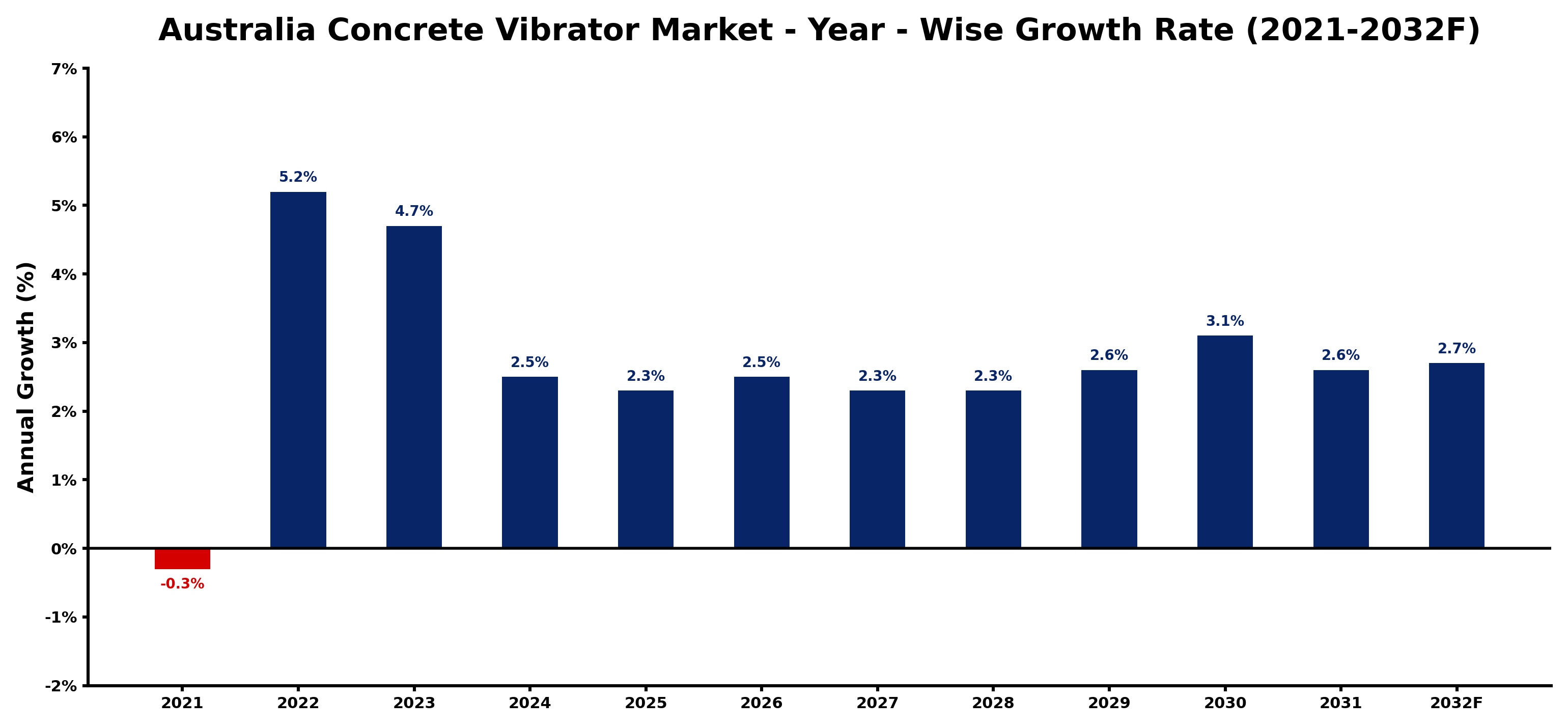
The table below presents the year‑wise growth rates along with the key drivers influencing the market
| Year | Growth Rate | Major Drivers |
| 2021 | -0.3% | Manufacturing investments declined due to decreased mining sector demand |
| 2022 | 5.2% | Domestic mining expansion boosts concrete vibrator manufacturing requirements |
| 2023 | 4.7% | Mining sector automation drives demand for advanced concrete vibrators |
| 2024 | 2.5% | Mining infrastructure investments drive concrete vibrator equipment demand |
| 2025 | 2.3% | Domestic concrete vibrator demand surged amid mining sector maintenance projects |
| 2026 | 2.5% | Mining infrastructure investments boosted demand for concrete vibrators |
| 2027 | 2.3% | Mining infrastructure projects boost demand for concrete vibrator supplies |
| 2028 | 2.3% | Upgraded mining equipment spurred concrete vibrator procurement demand |
| 2029 | 2.6% | Mining sector projects boost demand for advanced concrete vibration solutions |
| 2030 | 3.1% | Accelerated mining operations boost concrete vibrator equipment utilization |
| 2031 | 2.6% | Technological upgrades in concrete vibrators enhance mining operation efficiency |
| 2032 | 2.7% | Technology integration in mining boosts concrete vibrator efficiency |
Note - Market size estimations and growth projections presented in this report are based on 6Wresearch’s advanced forecasting approach, validated with industry datasets as of June 2026.
Australia Concrete Vibrator Market Synopsis
The Australian market for concrete vibrators is increasingly becoming vital in ensuring the integrity and durability of concrete structures. As construction activities accelerate, the need for reliable and efficient equipment that can eliminate air pockets and ensure proper compaction is more pronounced than ever.
Key factors influencing this market include the rapid urbanization and population growth across Australia. With a flourishing construction landscape, concrete vibrators are crucial for maintaining high-quality standards in building projects, thus making them indispensable tools for contractors and builders.
Australia Concrete Vibrator Market Key Takeaways
- The market is fueled by rapid infrastructure development and urban growth.
- Technological innovations are enhancing the usability and efficiency of concrete vibrators.
- The push for sustainable construction practices drives demand for high-quality concrete solutions.
- Regulatory compliance and safety standards play a significant role in product development.
- The market is witnessing increased competition, pushing for continuous innovation among manufacturers.
Evaluation of Restraints in Australia Concrete Vibrator Market
Despite its growth, the Australia Concrete Vibrator Market faces several restraints that could hinder its full potential. One key challenge is the need for continuous innovation to meet evolving customer demands and stringent industry standards. Manufacturers are pressured to invest significantly in research and development to improve their product offerings. Furthermore, market saturation has led to heightened competition, which can result in price wars and shrinking profit margins. Additionally, regulatory issues regarding noise and vibration emissions complicate the design and manufacturing processes of these essential tools.
Australia Concrete Vibrator Market Trends
Emerging trends in the Australia Concrete Vibrator Market reflect a shift towards lightweight and portable models, which improve ease of use on-site. Moreover, the integration of smart technology in construction equipment is becoming more prevalent, with concrete vibrators being no exception. Such innovations promise enhanced performance through real-time data monitoring and user-friendly operation. Sustainability also plays a crucial role, with manufacturers increasingly focusing on eco-friendly materials and energy-efficient designs to align with modern construction practices.
Australia Concrete Vibrator Market Opportunities
There are significant opportunities for growth and investment in the Australia Concrete Vibrator Market, particularly in the realm of advanced technology. As the demand for high-quality concrete structures rises, manufacturers who innovate with features such as energy efficiency, portability, and integrated smart technology will likely capture a larger market share. Additionally, as governmental infrastructure projects expand, there is a parallel opportunity for suppliers to become key partners in these developments, ultimately leading to increased market penetration.
Government Initiatives in the Australia Concrete Vibrator Market
Government policies in Australia significantly impact the concrete vibrator market, emphasizing safety regulations and quality standards that manufacturers must adhere to. Initiatives promoting infrastructure and urban renewal projects have proven beneficial, as they drive consistent demand for reliable concrete compaction tools. Moreover, policies aimed at training and certifying construction workers ensure that these individuals are well-equipped to handle and maintain concrete vibrating equipment, further enhancing the overall quality of construction practices across the country.
Future Insights of the Australia Concrete Vibrator Market
Looking ahead to the 2026-2032 period, the Australia Concrete Vibrator Market is poised for significant evolution. As urbanization continues and construction methodologies adapt, the focus will likely shift towards more sophisticated, efficient, and eco-friendly equipment. Manufacturers that prioritize innovation and sustainability will be at the forefront of this market's future, responding effectively to regulatory changes and consumer expectations. Additionally, the expansion of smart technologies will enhance operational efficiency, solidifying the role of concrete vibrators as indispensable tools in the construction sector.
Australia Concrete Vibrator Market Latest Developments (May 2025 - June 2026)
In recent months, the Australian concrete vibrator market has observed a surge in interest towards lightweight and smart vibrating equipment. Manufacturers are exploring partnerships with tech firms to incorporate data analytics and IoT capabilities into their offerings. This trend reflects a broader shift towards automation and efficiency in construction. Additionally, recent infrastructure announcements have spurred discussions about improving product quality and compliance with evolving safety standards, paving the way for potential new entrants and innovations in the market.
Australia Concrete Vibrator Market - Key Attractiveness of the Report
- 10 Years of Market Numbers
- Historical Data Starting from 2022 to 2025
- Base Year: 2025
- Forecast Data until 2032
- Key Performance Indicators Impacting the Market
- Major Upcoming Developments and Projects
Key Highlights of the Report:
- Australia Concrete Vibrator Market Outlook
- Market Size of Australia Concrete Vibrator Market, 2025
- Forecast of Australia Concrete Vibrator Market, 2032
- Historical Data and Forecast of Australia Concrete Vibrator Revenues & Volume for the Period 2022-2032F
- Australia Concrete Vibrator Market Trend Evolution
- Australia Concrete Vibrator Market Drivers and Challenges
- Australia Concrete Vibrator Price Trends
- Australia Concrete Vibrator Porter's Five Forces
- Australia Concrete Vibrator Industry Life Cycle
- Historical Data and Forecast of Australia Concrete Vibrator Market Revenues & Volume By Type for the Period 2022-2032F
- Historical Data and Forecast of Australia Concrete Vibrator Market Revenues & Volume By External Vibrator for the Period 2022-2032F
- Historical Data and Forecast of Australia Concrete Vibrator Market Revenues & Volume By Internal Vibrator for the Period 2022-2032F
- Historical Data and Forecast of Australia Concrete Vibrator Market Revenues & Volume By Others for the Period 2022-2032F
- Historical Data and Forecast of Australia Concrete Vibrator Market Revenues & Volume By Application for the Period 2022-2032F
- Historical Data and Forecast of Australia Concrete Vibrator Market Revenues & Volume By Architectural Engineering for the Period 2022-2032F
- Historical Data and Forecast of Australia Concrete Vibrator Market Revenues & Volume By Dam Engineering for the Period 2022-2032F
- Historical Data and Forecast of Australia Concrete Vibrator Market Revenues & Volume By Mine and Well Engineering for the Period 2022-2032F
- Historical Data and Forecast of Australia Concrete Vibrator Market Revenues & Volume By Others for the Period 2022-2032F
- Australia Concrete Vibrator Import Export Trade Statistics
- Market Opportunity Assessment By Type
- Market Opportunity Assessment By Application
- Australia Concrete Vibrator Top Companies Market Share
- Australia Concrete Vibrator Competitive Benchmarking By Technical and Operational Parameters
- Australia Concrete Vibrator Company Profiles
- Australia Concrete Vibrator Key Strategic Recommendations






































