Australia Connector Market: Import Trend Analysis
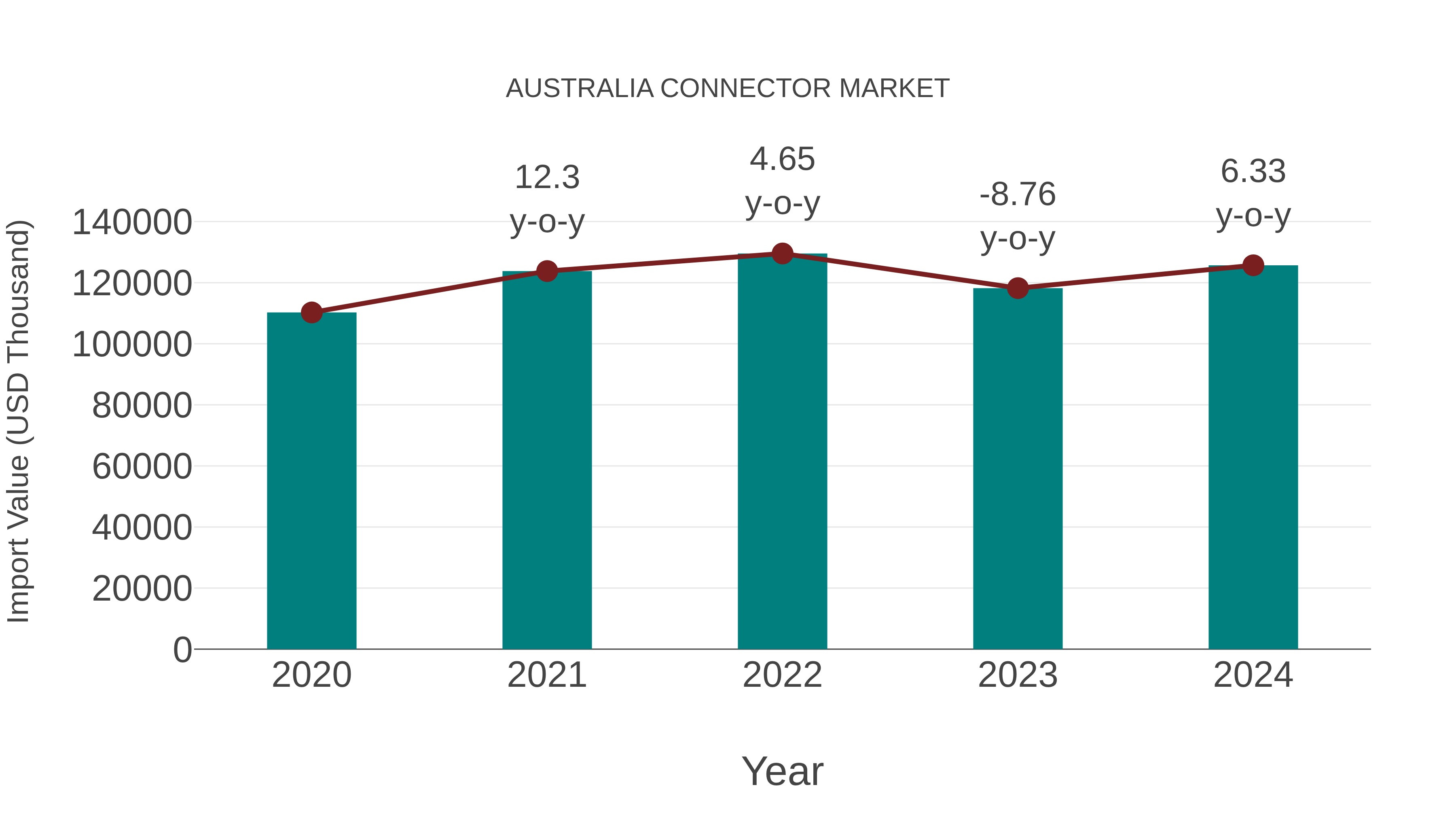
Australia`s import trend for the Australia connector market saw a growth rate of 6.33% from 2023 to 2024, with a compound annual growth rate (CAGR) of 3.33% from 2020 to 2024. This upward momentum can be attributed to increased demand for advanced technology products driving the need for connectors, indicating a stable market with a positive demand shift during this period.
Australia Connector Market Overview
The Australia Connector market is experiencing steady growth, driven by the increasing demand for connectors in various industries, including automotive, telecommunications, aerospace, and consumer electronics. Connectors play a crucial role in establishing electrical and mechanical connections between devices and components, enabling seamless communication and power transmission. Factors such as the expansion of telecommunications networks, the proliferation of electronic devices, and advancements in connector technology are driving market expansion in Australia. Moreover, the shift towards miniaturization and high-speed connectivity solutions is expected to further fuel market growth.
Drivers of the market
The Australia Connector market is witnessing steady growth, driven by the increasing demand for electrical and electronic connectivity solutions across various industries such as automotive, telecommunications, and consumer electronics. Connectors play a crucial role in facilitating the transmission of power, signals, and data between devices and components. Factors such as the growing adoption of automation and digitization, advancements in connector technology, and the expansion of telecommunications infrastructure are driving market growth in Australia. Moreover, the rise of IoT and smart devices is creating new opportunities for connectors in applications such as sensor networks and wearable devices.
Challenges of the market
The Australia Connector market faces challenges related to technological advancements, customization requirements, and market competitiveness. With the rapid evolution of electronic devices and industrial applications, there is a constant demand for connectors with higher performance, smaller form factors, and enhanced reliability. Meeting these evolving requirements while maintaining cost-effectiveness poses challenges for connector manufacturers. Additionally, the need for customized connectors to suit specific applications adds complexity to the design and production processes. Moreover, increasing competition from global players and fluctuating raw material prices impact market dynamics. Overcoming these challenges requires continuous innovation, investment in research and development, and agility in responding to market demands.
Government Policy of the market
In Australia, the Connector market is experiencing steady growth, driven by the increasing demand for reliable and high-performance electrical connectors across various industries, including automotive, aerospace, and telecommunications. Government policies related to product safety standards, import regulations, and industry certifications play a crucial role in shaping the market landscape. Regulations enforced by agencies such as the Australia Communications and Media Authority (ACMA) and the Australia Competition and Consumer Commission (ACCC) ensure that connectors meet quality and safety requirements and provide adequate protection for consumers. Moreover, initiatives aimed at promoting local manufacturing and innovation in the electronics industry contribute to market growth in the connector segment.
Key Highlights of the Report:
- Australia Connector Market Outlook
- Market Size of Australia Connector Market, 2024
- Forecast of Australia Connector Market, 2031
- Historical Data and Forecast of Australia Connector Revenues & Volume for the Period 2018 - 2031
- Australia Connector Market Trend Evolution
- Australia Connector Market Drivers and Challenges
- Australia Connector Price Trends
- Australia Connector Porter's Five Forces
- Australia Connector Industry Life Cycle
- Historical Data and Forecast of Australia Connector Market Revenues & Volume By Product for the Period 2018 - 2031
- Historical Data and Forecast of Australia Connector Market Revenues & Volume By PCB Connectors for the Period 2018 - 2031
- Historical Data and Forecast of Australia Connector Market Revenues & Volume By IO Connectors for the Period 2018 - 2031
- Historical Data and Forecast of Australia Connector Market Revenues & Volume By Circular Connectors for the Period 2018 - 2031
- Historical Data and Forecast of Australia Connector Market Revenues & Volume By Fiber Optic Connectors for the Period 2018 - 2031
- Historical Data and Forecast of Australia Connector Market Revenues & Volume By RF Coaxial Connectors for the Period 2018 - 2031
- Historical Data and Forecast of Australia Connector Market Revenues & Volume By Others for the Period 2018 - 2031
- Historical Data and Forecast of Australia Connector Market Revenues & Volume By End Use for the Period 2018 - 2031
- Historical Data and Forecast of Australia Connector Market Revenues & Volume By Telecom for the Period 2018 - 2031
- Historical Data and Forecast of Australia Connector Market Revenues & Volume By Transportation for the Period 2018 - 2031
- Historical Data and Forecast of Australia Connector Market Revenues & Volume By Automotive for the Period 2018 - 2031
- Historical Data and Forecast of Australia Connector Market Revenues & Volume By Industrial for the Period 2018 - 2031
- Historical Data and Forecast of Australia Connector Market Revenues & Volume By Computer & Peripherals for the Period 2018 - 2031
- Historical Data and Forecast of Australia Connector Market Revenues & Volume By Others for the Period 2018 - 2031
- Australia Connector Import Export Trade Statistics
- Market Opportunity Assessment By Product
- Market Opportunity Assessment By End Use
- Australia Connector Top Companies Market Share
- Australia Connector Competitive Benchmarking By Technical and Operational Parameters
- Australia Connector Company Profiles
- Australia Connector Key Strategic Recommendations






































