Australia Consent Management Market Size & Growth Rate (2026-2032)
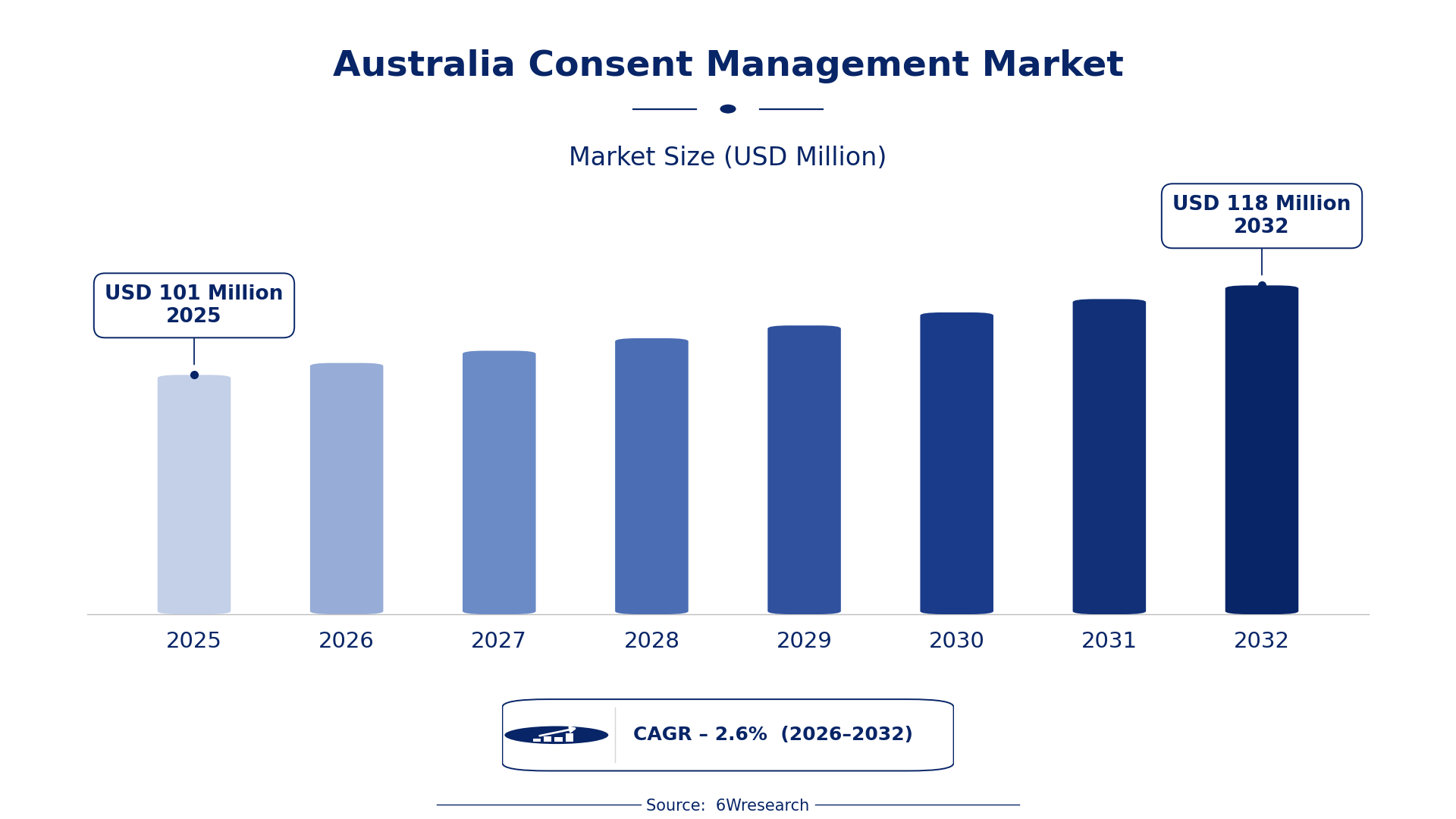
The Australia Consent Management Market was estimated at USD 101 Million in 2025 and is projected to reach USD 118 Million by 2032, growing at a CAGR of 2.6% from 2026 to 2032.
Australia Consent Management Market Synopsis
The Australia Consent Management Market is increasingly vital as organizations grapple with the need for stringent data privacy measures. With regulations like the GDPR and the Australia Privacy Principles shaping the landscape, companies must adopt effective consent management solutions to safeguard user data and ensure compliance.
The demand for consent management platforms is surging, driven by heightened awareness of data privacy issues among consumers and businesses alike. As digital transformation accelerates, organizations are prioritizing transparency in data handling, making consent management a critical component of their operational strategy.
Australia Consent Management Market Year-wise Growth Rate and Key Drivers
This graph illustrates the annual growth rates of the Australia Consent Management Market from 2021 to 2032, highlighting a steady upward trajectory and projected expansion over the forecast period.
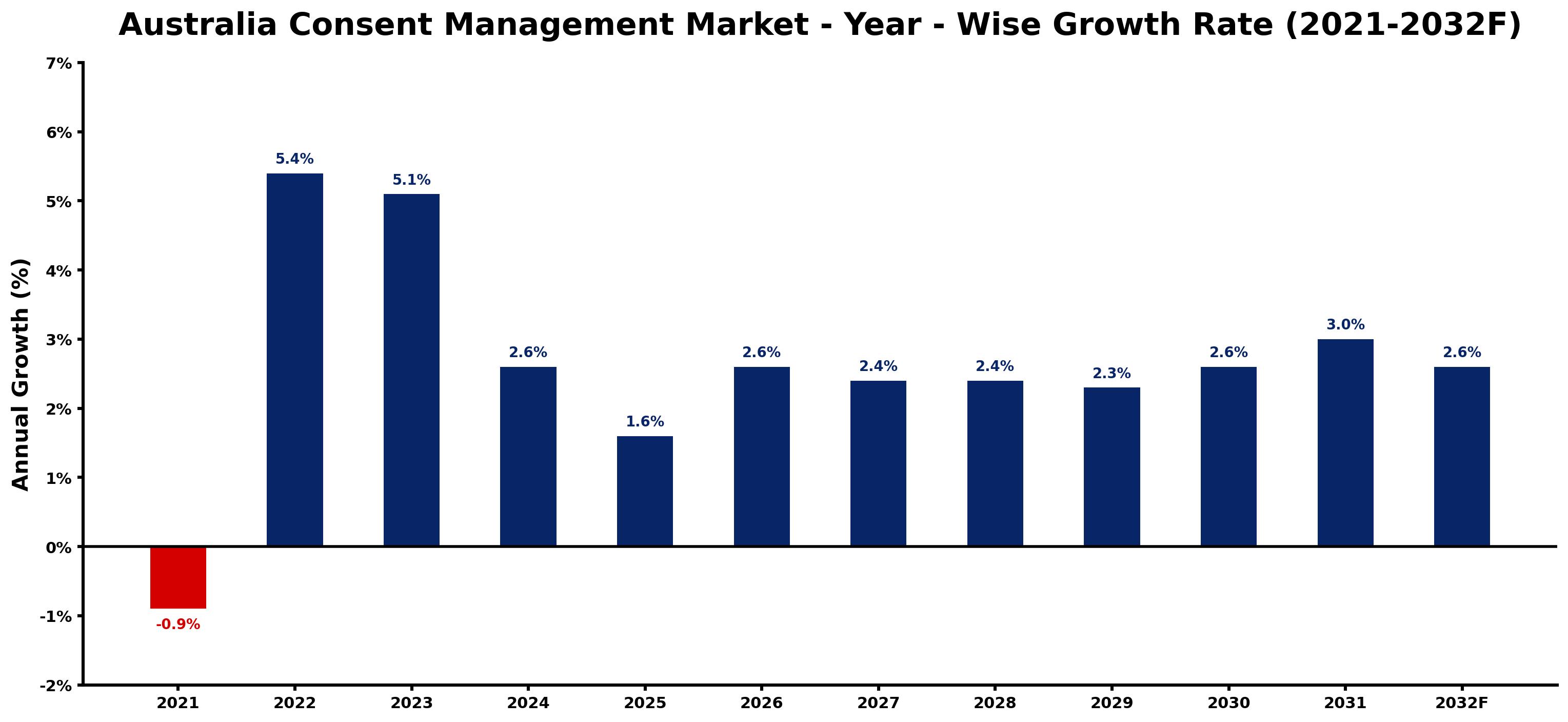
The table below presents the year‑wise growth rates along with the key drivers influencing the market
| Year | Growth Rate | Major Drivers |
| 2021 | -0.9% | Privacy Act amendments increased compliance costs for companies. |
| 2022 | 5.4% | Introduction of the Australian Data Privacy Framework |
| 2023 | 5.1% | Increased public awareness of personal data rights |
| 2024 | 2.6% | Implementation of stricter KYC regulations by AUSTRAC |
| 2025 | 1.6% | Rise in mobile app usage requiring consent solutions |
| 2026 | 2.6% | Regulatory push for enhanced digital privacy protections |
| 2027 | 2.4% | Growth of fintech firms demanding robust consent management |
| 2028 | 2.4% | Consumer demand for transparency in data handling |
| 2029 | 2.3% | Adoption of GDPR-like regulations in Australian market |
| 2030 | 2.6% | Collaborations among organizations to streamline consent processes |
| 2031 | 3.0% | Emergence of local tech startups focusing on data consent |
| 2032 | 2.6% | Shift towards cloud-based consent management systems |
Note: Market size estimations and growth projections presented in this report are based on 6Wresearch's proprietary forecasting methodology, utilizing the latest available industry data, government publications, and primary research inputs.
Australia Consent Management Market Key Takeaways
Below are some of the specific key takeaways from the market, including:
- The market is driven by increasing regulatory compliance needs and consumer rights awareness.
- Adoption of consent management solutions is on the rise across various sectors.
- Complexity of regulatory frameworks poses challenges for organizations.
- Emerging technologies are shaping the evolution of consent management practices.
- Transparency in data handling is becoming a competitive differentiator for businesses.
Evaluation of Restraints in Australia Consent Management Market
The primary restraint for the Australia Consent Management Market lies in the intricate web of regulatory requirements. Businesses are often overwhelmed by the need to align with various laws, such as the Australia Privacy Principles and the Notifiable Data Breaches scheme. This complexity can lead to compliance challenges, as organizations struggle to maintain user trust while adhering to stringent regulations. The rapidly evolving nature of these laws further complicates the landscape, necessitating continuous adaptation from consent management solution providers.
Australia Consent Management Market Trends
Several trends are shaping the Australia Consent Management Market today. The integration of artificial intelligence and machine learning technologies into consent management solutions is enhancing the efficiency of data processing and consent tracking. on top of that, the shift towards decentralized data storage solutions is encouraging businesses to adopt more transparent consent practices, allowing users greater control over their personal information.
The rise of consumer-centric data policies is prompting organizations to rethink their data handling practices. Companies are increasingly focusing on user engagement and education regarding consent processes, recognizing that informed consumers are more likely to trust brands that prioritize transparency.
Australia Consent Management Market Opportunities
The future holds promising growth opportunities for the Australia Consent Management Market. As organizations strive to comply with evolving regulations, demand for sophisticated consent management solutions will continue to rise. Investment in innovative technologies that enhance user experience and streamline consent processes will be crucial. on top of that, businesses that proactively adopt best practices in data privacy and consent management are likely to gain a competitive edge in an increasingly crowded marketplace.
Government Initiatives in the Australia Consent Management Market
Government policies play a significant role in shaping the Australia Consent Management Market. The regulatory framework emphasizes data privacy and consumer rights, compelling organizations to adopt transparent consent practices. The Office of the Australian Information Commissioner oversees compliance, guiding businesses in best practices for managing user consent effectively.
- A regulatory framework established in 2025 mandates enhanced consent management practices for organizations handling personal data.
- The implementation of the Consumer Data Right (CDR) in the financial sector is currently underway, requiring explicit consent for data sharing.
- A national initiative promoting public awareness of data privacy is planned for launch in 2026, aimed at educating consumers about their rights.
- The Office of the Australian Information Commissioner is actively updating guidelines to reflect current data handling practices as of early 2025.
Future Insights of the Australia Consent Management Market
Looking ahead to 2026-2032, the Australia Consent Management Market is set for steady growth as organizations prioritize compliance and consumer trust. The increasing complexity of data protection laws will drive demand for comprehensive solutions that simplify consent management. As businesses adapt to these changes, those that invest in technology and user education will stand to benefit the most, cultivating a culture of transparency and accountability in data practices.
Australia Consent Management Market Latest Developments
In the past year, the Australia Consent Management Market has seen notable activity as organizations respond to evolving regulations and consumer expectations. Key industry players are enhancing their offerings to provide more intuitive and user-friendly consent management solutions, focusing on improving transparency and compliance.
- A leading regional technology provider launched a new consent management platform in Q3 2025, designed to streamline compliance processes for businesses.
- An initiative that began in early 2025 is currently ongoing, focusing on integrating AI capabilities into consent management systems to enhance user experience.
- By mid-2026, a major regulatory update is expected to be implemented, requiring businesses to adopt new consent management protocols.
- A collaborative project between industry stakeholders to develop standardized consent management practices is set to kick off in late 2025.
Australia Consent Management Market - Key Attractiveness of the Report
- 10 Years of Market Numbers
- Historical Data Starting from 2022 to 2025
- Base Year: 2025
- Forecast Data until 2032
- Key Performance Indicators Impacting the Market
- Major Upcoming Developments and Projects
Key Highlights of the Report:
- Australia Consent Management Market Outlook
- Market Size of Australia Consent Management Market, 2025
- Forecast of Australia Consent Management Market, 2032
- Historical Data and Forecast of Australia Consent Management Revenues & Volume for the Period 2022-2032F
- Australia Consent Management Market Trend Evolution
- Australia Consent Management Market Drivers and Challenges
- Australia Consent Management Price Trends
- Australia Consent Management Porter's Five Forces
- Australia Consent Management Industry Life Cycle
- Historical Data and Forecast of Australia Consent Management Market Revenues & Volume By Component for the Period 2022-2032F
- Historical Data and Forecast of Australia Consent Management Market Revenues & Volume By Software for the Period 2022-2032F
- Historical Data and Forecast of Australia Consent Management Market Revenues & Volume By Services for the Period 2022-2032F
- Historical Data and Forecast of Australia Consent Management Market Revenues & Volume By Deployment Type for the Period 2022-2032F
- Historical Data and Forecast of Australia Consent Management Market Revenues & Volume By Cloud for the Period 2022-2032F
- Historical Data and Forecast of Australia Consent Management Market Revenues & Volume By On-premises for the Period 2022-2032F
- Historical Data and Forecast of Australia Consent Management Market Revenues & Volume By Touchpoint for the Period 2022-2032F
- Historical Data and Forecast of Australia Consent Management Market Revenues & Volume By Mobile App for the Period 2022-2032F
- Historical Data and Forecast of Australia Consent Management Market Revenues & Volume By Web App for the Period 2022-2032F
- Historical Data and Forecast of Australia Consent Management Market Revenues & Volume By Organization Size for the Period 2022-2032F
- Historical Data and Forecast of Australia Consent Management Market Revenues & Volume By Large Enterprises for the Period 2022-2032F
- Historical Data and Forecast of Australia Consent Management Market Revenues & Volume By Small and Medium-sized Enterprises (SMEs) for the Period 2022-2032F
- Australia Consent Management Import Export Trade Statistics
- Market Opportunity Assessment By Component
- Market Opportunity Assessment By Deployment Type
- Market Opportunity Assessment By Touchpoint
- Market Opportunity Assessment By Organization Size
- Australia Consent Management Top Companies Market Share
- Australia Consent Management Competitive Benchmarking By Technical and Operational Parameters
- Australia Consent Management Company Profiles
- Australia Consent Management Key Strategic Recommendations






































