Australia Container Security Market Size & Growth Rate (2026-2032)
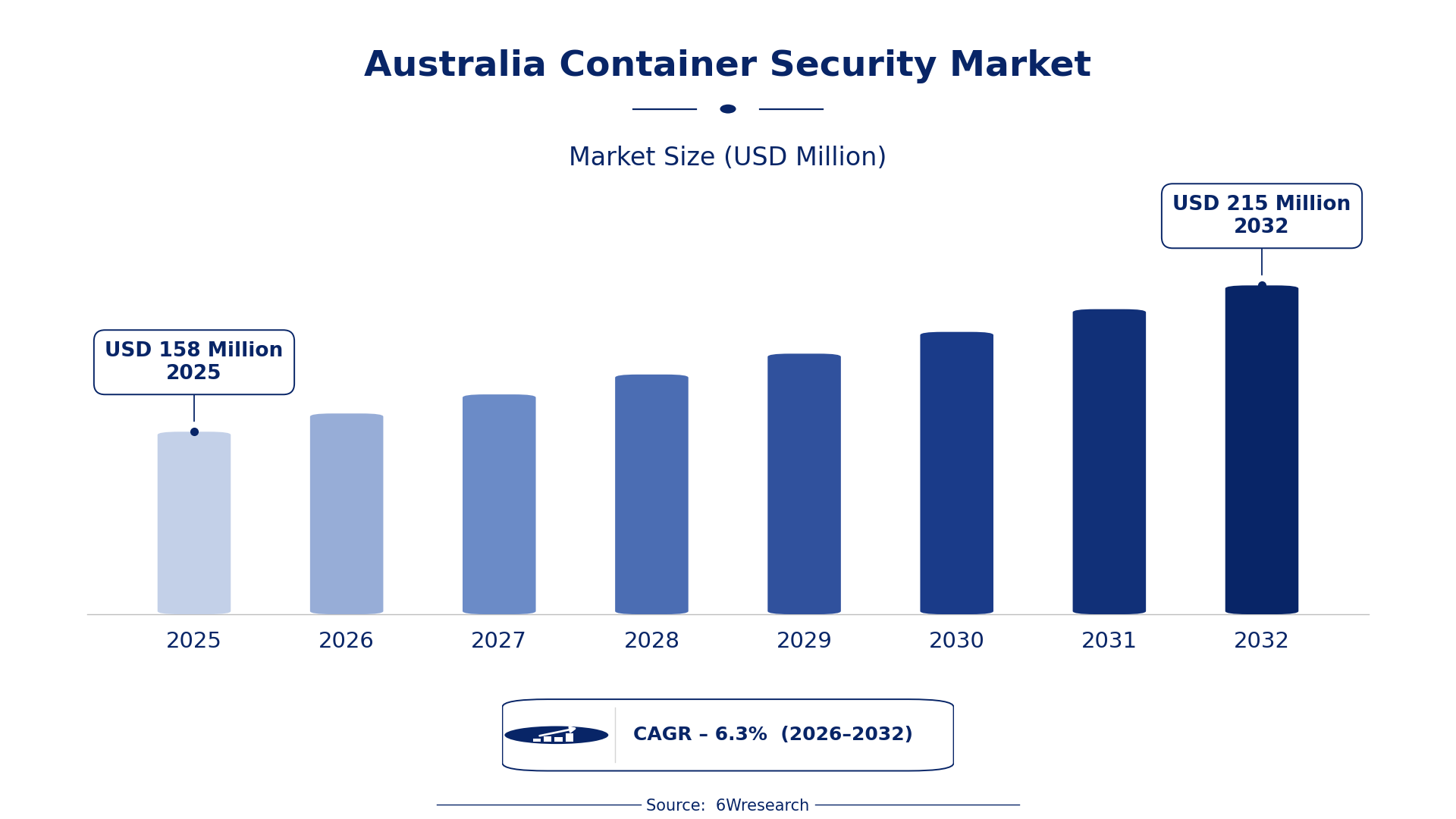
The Australia Container Security Market was estimated at USD 158 Million in 2025 and is projected to reach USD 215 Million by 2032, growing at a CAGR of 6.3% from 2026 to 2032.
Australia Container Security Market Synopsis
The primary force propelling the Australia Container Security Market is the escalating adoption of containerization within organizations. As businesses increasingly deploy cloud-native applications, they seek to safeguard their containerized environments, thereby enhancing demand for effective security solutions.
In addition to technological adoption, the threat landscape has become more intricate. The rising incidence of cyber threats targeting containerized applications underscores the urgency for organizations to implement robust container security measures to protect sensitive data and maintain compliance with regulatory standards.
Australia Container Security Market Year-wise Growth Rate and Key Drivers
This graph illustrates the annual growth rates of the Australia Container Security Market from 2021 to 2032, highlighting a steady upward trajectory and projected expansion over the forecast period.
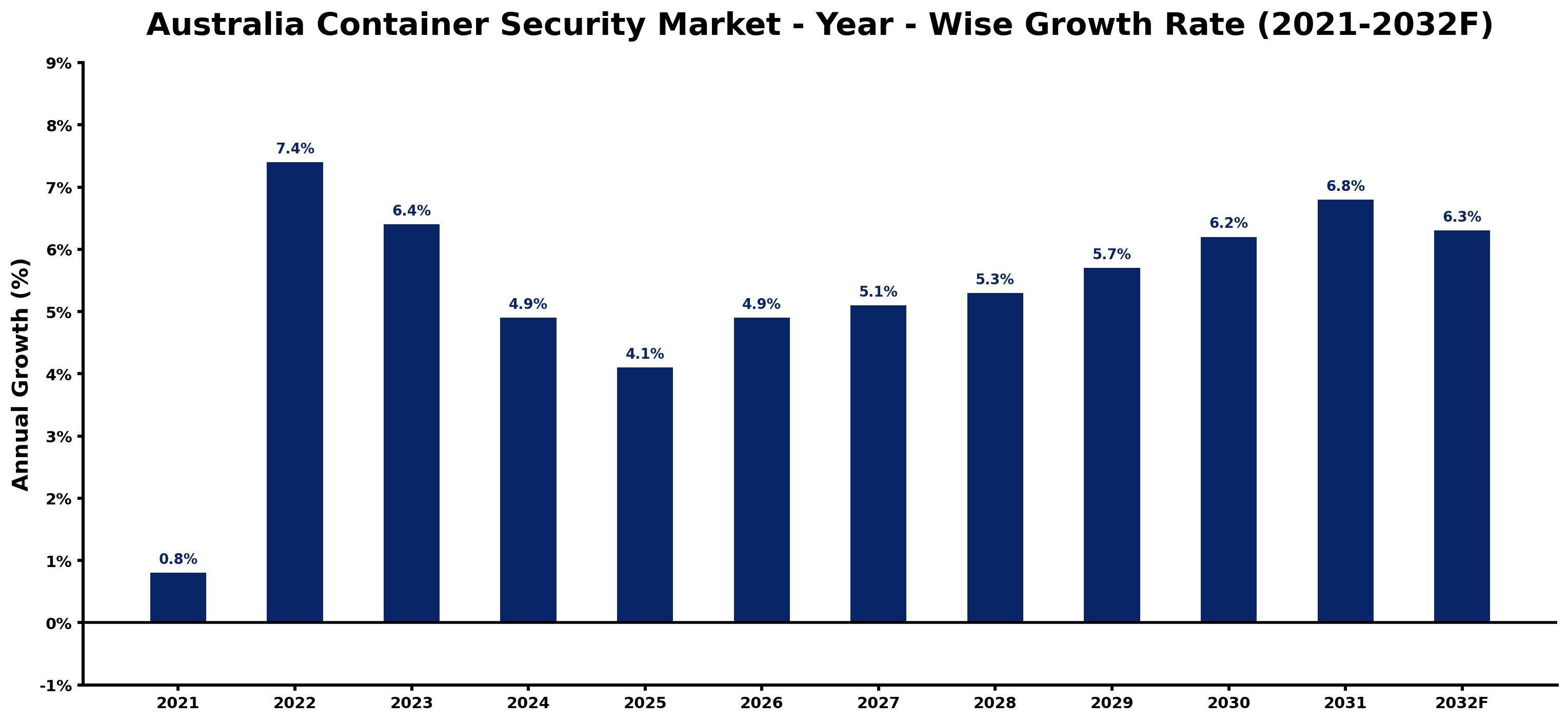
The table below presents the year‑wise growth rates along with the key drivers influencing the market
| Year | Growth Rate | Major Drivers |
| 2021 | 0.8% | Strengthened customs regulations by Australian Border Force. |
| 2022 | 7.4% | Post-COVID recovery boosting logistics and container security needs. |
| 2023 | 6.4% | Increased maritime trade demands enhancing security technologies implementation. |
| 2024 | 4.9% | Introduction of stricter container inspection protocols by authorities. |
| 2025 | 4.1% | Investment in cybersecurity measures for container tracking systems. |
| 2026 | 4.9% | Growing adoption of IoT for real-time container monitoring. |
| 2027 | 5.1% | Deployment of advanced screening technologies in Australian ports. |
| 2028 | 5.3% | Rising concerns over maritime terrorism driving security investments. |
| 2029 | 5.7% | Increased partnerships between government and private security firms. |
| 2030 | 6.2% | Development of regional security frameworks for supply chain resilience. |
| 2031 | 6.8% | Enhanced training programs for customs officials on security protocols. |
| 2032 | 6.3% | Government funding for modernization of port security infrastructure. |
Note: Market size estimations and growth projections presented in this report are based on 6Wresearch's proprietary forecasting methodology, utilizing the latest available industry data, government publications, and primary research inputs.
Australia Container Security Market Key Takeaways
Below are some of the specific key takeaways from the market, including:
- The adoption of cloud-native applications and microservices architecture is driving increased demand for container security solutions.
- Organizations are increasingly prioritizing threat detection, vulnerability management, and compliance monitoring to secure their containerized environments.
- Growing DevSecOps practices are reinforcing the need for integrated security measures across development and operational workflows.
- Regulatory mandates are pushing enterprises to adopt comprehensive security strategies for containerized applications.
- Integration with existing security tools is becoming a key requirement for new container security solutions.
Evaluation of Restraints in Australia Container Security Market
Despite the growth, the Australia Container Security Market is constrained by several factors. Organizations struggle to establish robust security protocols that encompass the entire lifecycle of containerized applications. Unique risks such as vulnerabilities in container images and misconfigurations challenge conventional security measures. Additionally, the dynamic and transient nature of containerized workloads complicates the implementation of traditional security approaches, which are generally suited for static infrastructures. To navigate these issues, organizations must develop comprehensive strategies that effectively address the complex threat landscape.
Australia Container Security Market Trends
The trend towards automation in security practices is gaining momentum, as companies seek efficiencies in their security operations. As container environments grow, organizations are adopting automated vulnerability scanning and compliance monitoring tools to ensure real-time protection. Another notable trend is the increasing emphasis on container security within DevOps processes, integrating security measures directly into the development lifecycle. This shift not only enhances security but also accelerates deployment timelines.
Australia Container Security Market Opportunities
Investment opportunities are abundant in container security solutions. With increasing regulatory scrutiny surrounding data protection, companies offering compliance-focused solutions are likely to see significant demand. on top of that, there’s a growing need for educational and training programs focusing on container security, as many organizations lack expertise in this area. This presents an opportunity for consultancy and training firms to expand their offerings. Lastly, as container technology continues to evolve, innovative security solutions that incorporate artificial intelligence and machine learning will find a receptive market.
Government Initiatives in the Australia Container Security Market
Government policies significantly influence the Australia Container Security Market, with a strong emphasis on cybersecurity and data protection. Regulatory frameworks are evolving to bolster the security posture of organizations, driving enterprises to adopt comprehensive container security solutions. As public sector priorities shift towards enhancing supply chain integrity, the urgency for robust security measures in containerized environments escalates.
- A national initiative launched in early 2025 aimed at improving cybersecurity resilience across critical infrastructure sectors, emphasizing the importance of container security.
- Current programs are underway to develop regulatory standards focusing on compliance for containerized applications across various industries, ensuring heightened security measures are established.
- Upcoming public-private partnerships planned for 2026 are expected to provide funding and resources for innovative container security technology development.
- Ongoing assessments of existing cybersecurity policies by government agencies are leading to proposed updates that prioritize container security across different sectors.
Future Insights of the Australia Container Security Market
Looking forward to 2026-2032, the Australia Container Security Market is expected to evolve significantly. Continuous advancements in technology will drive innovation in container security solutions. Organizations will increasingly adopt integrated security frameworks that encompass risk assessment, threat intelligence, and incident response. As the need for faster deployment grows, the market will likely witness a rise in automated security tools designed specifically for containerized environments. The collaboration between government entities and private sector firms will also shape future security standards and best practices, fostering a more secure container ecosystem.
Australia Container Security Market Latest Developments
Over the past year, activity in the Australia Container Security Market has intensified, reflecting a growing awareness of security vulnerabilities linked to containerization. Organizations are increasingly seeking solutions to fortify their defenses against cyber threats. As a result, numerous security firms have ramped up their efforts to deliver innovative solutions tailored to these needs.
- A leading regional operator unveiled a new container security solution in Q1 2025, enhancing threat detection capabilities for cloud-native applications.
- In mid-2025, a major technology vendor initiated a partnership with a cybersecurity firm to develop advanced vulnerability management tools specific to container environments.
- By late 2025, a government-backed initiative is set to launch a cybersecurity training program focused on container security, aimed at upskilling the workforce.
- An expansion project currently underway seeks to integrate security features into existing DevOps tools, enhancing overall container security across multiple platforms.
Australia Container Security Market - Key Attractiveness of the Report
- 10 Years of Market Numbers
- Historical Data Starting from 2022 to 2025
- Base Year: 2025
- Forecast Data until 2032
- Key Performance Indicators Impacting the Market
- Major Upcoming Developments and Projects
Key Highlights of the Report:
- Australia Container Security Market Outlook
- Market Size of Australia Container Security Market, 2025
- Forecast of Australia Container Security Market, 2032
- Historical Data and Forecast of Australia Container Security Revenues & Volume for the Period 2022-2032F
- Australia Container Security Market Trend Evolution
- Australia Container Security Market Drivers and Challenges
- Australia Container Security Price Trends
- Australia Container Security Porter's Five Forces
- Australia Container Security Industry Life Cycle
- Historical Data and Forecast of Australia Container Security Market Revenues & Volume By Component for the Period 2022-2032F
- Historical Data and Forecast of Australia Container Security Market Revenues & Volume By Container Security Products for the Period 2022-2032F
- Historical Data and Forecast of Australia Container Security Market Revenues & Volume By Services (Professional, Managed) for the Period 2022-2032F
- Historical Data and Forecast of Australia Container Security Market Revenues & Volume By Deployment Type for the Period 2022-2032F
- Historical Data and Forecast of Australia Container Security Market Revenues & Volume By Cloud for the Period 2022-2032F
- Historical Data and Forecast of Australia Container Security Market Revenues & Volume By On-premises for the Period 2022-2032F
- Historical Data and Forecast of Australia Container Security Market Revenues & Volume By Vertical for the Period 2022-2032F
- Historical Data and Forecast of Australia Container Security Market Revenues & Volume By BFSI for the Period 2022-2032F
- Historical Data and Forecast of Australia Container Security Market Revenues & Volume By Retail for the Period 2022-2032F
- Historical Data and Forecast of Australia Container Security Market Revenues & Volume By Government for the Period 2022-2032F
- Historical Data and Forecast of Australia Container Security Market Revenues & Volume By Healthcare for the Period 2022-2032F
- Australia Container Security Import Export Trade Statistics
- Market Opportunity Assessment By Component
- Market Opportunity Assessment By Deployment Type
- Market Opportunity Assessment By Vertical
- Australia Container Security Top Companies Market Share
- Australia Container Security Competitive Benchmarking By Technical and Operational Parameters
- Australia Container Security Company Profiles
- Australia Container Security Key Strategic Recommendations






































