Australia Content Analytics Market Size & Growth Rate (2026-2032)
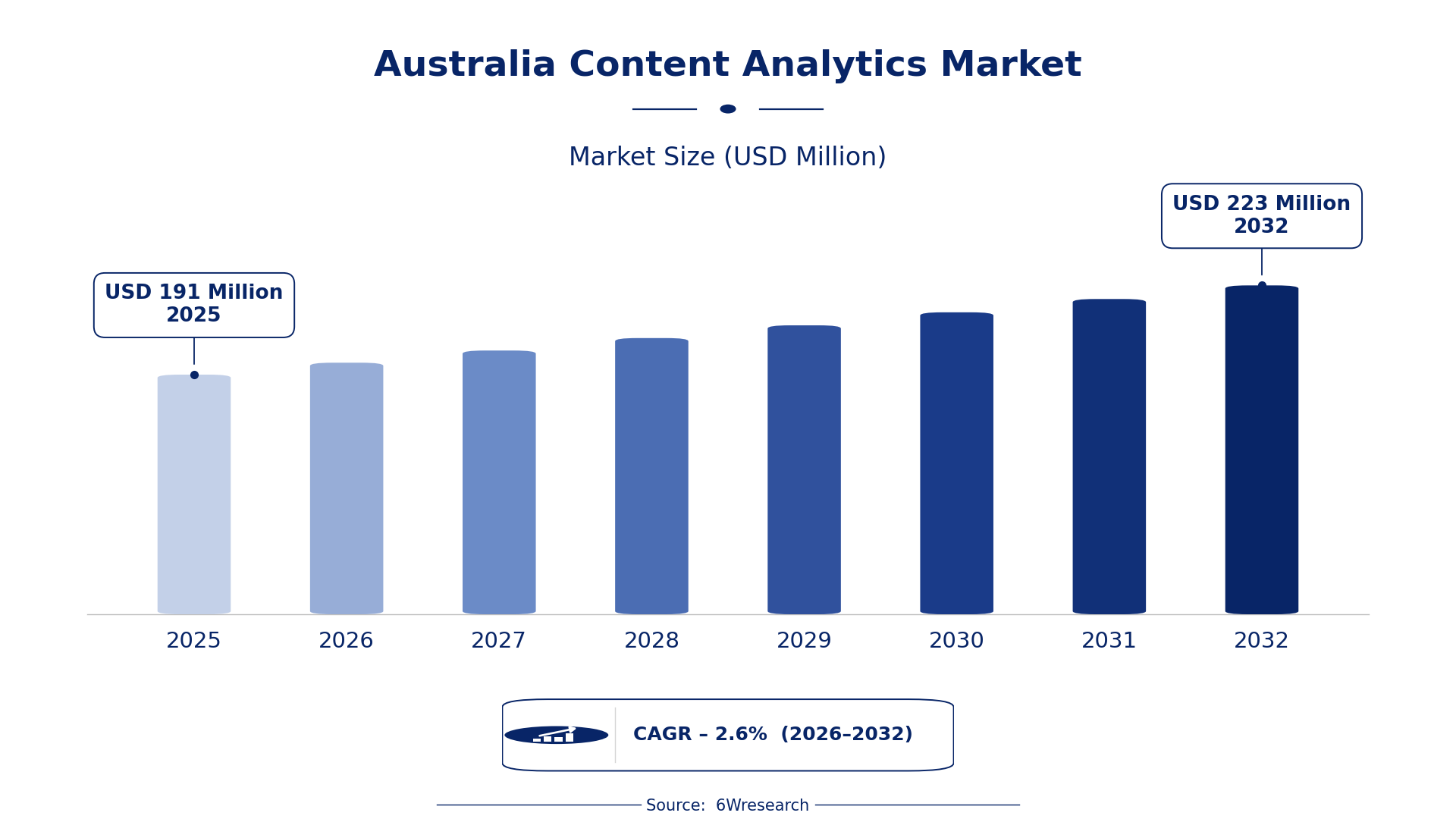
The Australia Content Analytics Market was estimated at USD 191 Million in 2025 and is projected to reach USD 223 Million by 2032, growing at a CAGR of 2.6% from 2026 to 2032.
Australia Content Analytics Market Synopsis
As Australian businesses increasingly recognize the need for data-driven insights, the demand for content analytics solutions is surging. These tools provide a means to sift through vast amounts of unstructured data, offering organizations the clarity they need to enhance customer engagement and personalize their offerings.
The rise of e-commerce and social media has further intensified this trend. Companies are not just interested in what their customers are saying; they want to understand the nuances of sentiment behind that content. With artificial intelligence playing a crucial role in parsing this information, the market is set for sustained growth.
Australia Content Analytics Market Year-wise Growth Rate and Key Drivers
This graph illustrates the annual growth rates of the Australia Content Analytics Market from 2021 to 2032, highlighting a steady upward trajectory and projected expansion over the forecast period.
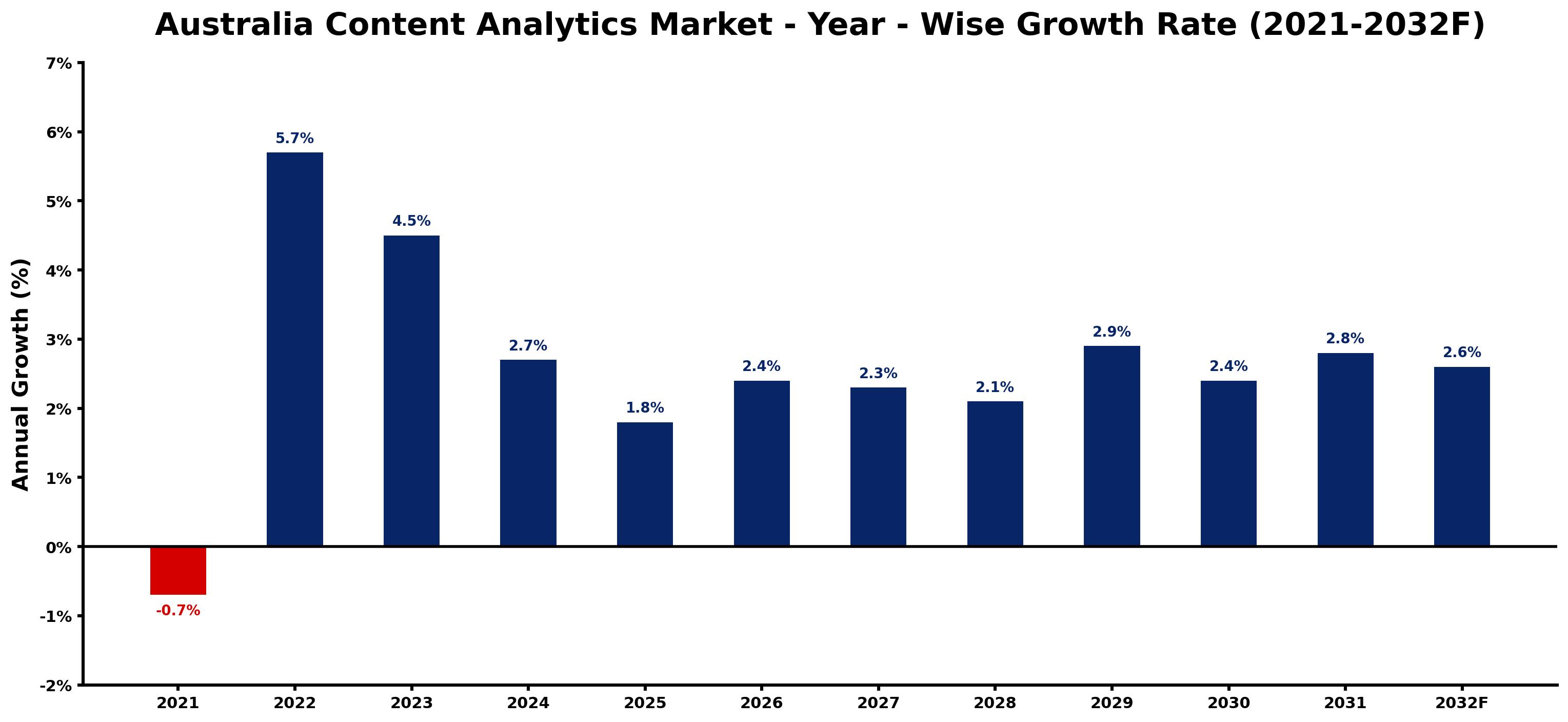
The table below presents the year‑wise growth rates along with the key drivers influencing the market
| Year | Growth Rate | Major Drivers |
| 2021 | -0.7% | Data retention regulations imposed by OAIC limited access. |
| 2022 | 5.7% | Australian government promoting digital content compliance standards. |
| 2023 | 4.5% | Growing adoption of AI-driven insights in media companies. |
| 2024 | 2.7% | Increased demand for content personalization in ecommerce. |
| 2025 | 1.8% | Rise of local digital publishers boosting content analytics needs. |
| 2026 | 2.4% | Regional emphasis on data privacy influencing analytics regulations. |
| 2027 | 2.3% | Boost in remote work fueling digital content consumption. |
| 2028 | 2.1% | Emergence of video streaming platforms enhancing engagement analytics. |
| 2029 | 2.9% | Strengthened focus on audience measurement in advertising sector. |
| 2030 | 2.4% | Australian universities advancing research in content analysis technologies. |
| 2031 | 2.8% | Government funding aiding local content innovation initiatives. |
| 2032 | 2.6% | Adoption of cloud analytics solutions among small businesses. |
Note: Market size estimations and growth projections presented in this report are based on 6Wresearch's proprietary forecasting methodology, utilizing the latest available industry data, government publications, and primary research inputs.
Australia Content Analytics Market Key Takeaways
Below are some of the specific key takeaways from the market, including:
- Growing demand for actionable insights from unstructured data is driving market expansion.
- Increased focus on personalized customer experiences is pushing businesses to adopt content analytics tools.
- Advancements in AI and natural language processing technologies are enhancing content analytics capabilities.
- Compliance with data privacy regulations presents a challenge for many organizations.
- Government initiatives are promoting the adoption of data-driven decision-making across sectors.
Evaluation of Restraints in Australia Content Analytics Market
Despite the promising growth trajectory, the Australia Content Analytics Market faces some significant hurdles. Data privacy and compliance regulations, particularly the Australia Privacy Act and GDPR, require organizations to tread carefully. The challenge lies in balancing the need for insights with the obligation to protect customer data.
on top of that, unstructured data's inherent complexity can make it difficult for businesses to extract meaningful insights. Organizations must invest in robust governance frameworks and advanced analytics techniques to navigate these challenges effectively.
Australia Content Analytics Market Trends
A noticeable trend in the Australia Content Analytics Market is the shift towards more advanced AI-driven solutions. Companies are increasingly using machine learning to refine their analytical capabilities, allowing for deeper insights into consumer behavior. This not only enhances the relevance of marketing efforts but also fosters stronger customer relationships.
on top of that, the integration of content analytics with other digital tools is becoming commonplace. Businesses are realizing that combining insights from various platforms can lead to a more comprehensive understanding of customer preferences and market dynamics.
Australia Content Analytics Market Opportunities
The opportunities for growth within this market are substantial. Organizations that effectively harness content analytics can gain a competitive edge by delivering personalized experiences that resonate with their customers. This is particularly crucial in sectors like retail and healthcare, where understanding consumer sentiment can directly influence business outcomes.
Investments in privacy-enhancing technologies present another avenue for growth. As companies strive to meet regulatory requirements while extracting valuable insights, those that innovate in this space will likely find themselves at a significant advantage.
Government Initiatives in the Australia Content Analytics Market
Government policy is actively shaping the trajectory of the Australia Content Analytics Market. With an emphasis on data-driven decision-making, various initiatives are being implemented to enhance regulatory compliance and promote transparency across sectors. These policies are crucial for instilling confidence in data usage while encouraging innovation within the analytics space.
- A recently completed initiative focused on establishing a national framework for data governance, aimed at enhancing data protection standards across industries.
- A currently ongoing program seeks to integrate advanced analytics capabilities within public service delivery to improve efficiency and transparency.
- A planned initiative aims to create partnerships between government bodies and private sectors to foster innovation in data analytics technologies by 2026.
- Current discussions are underway regarding updating regulations to facilitate more accessible data sharing among public institutions while ensuring compliance.
- A proposed policy is expected to be introduced in 2027, promoting the adoption of AI technologies in analytics to drive economic growth.
Future Insights of the Australia Content Analytics Market
Looking ahead to 2026-2032, the Australia Content Analytics Market is likely to witness transformative advancements. The integration of more sophisticated AI technologies will enable even deeper analysis of unstructured data, allowing organizations to anticipate customer needs and refine their strategies accordingly.
As data privacy regulations evolve, businesses will need to adapt their analytics strategies to maintain compliance while maximizing the value derived from their data assets. This dual focus on innovation and regulation will define the market's growth trajectory in the coming years.
Australia Content Analytics Market Latest Developments
Over the past year, the Australia Content Analytics Market has seen several noteworthy developments. Companies are increasingly adopting advanced analytics tools to better understand customer sentiment and drive business decisions. This shift is indicative of a broader trend towards data-driven strategies across various sectors.
- A major technology vendor launched a new AI-powered content analytics platform in early 2025, designed to help businesses extract actionable insights from diverse data sources.
- A partnership between leading regional operators was established in mid-2025 to enhance collaborative analytics efforts, focusing on improving customer experience across multiple channels.
- A public sector initiative that began in Q3 2025 aims to integrate content analytics within government services, enhancing operational efficiency and service delivery.
- An upcoming program is planned for early 2026, targeting the development of training resources for organizations to better utilize content analytics in compliance with data regulations.
- A service upgrade is currently underway, expected to enhance data visualization capabilities for analytics tools by late 2025.
Australia Content Analytics Market - Key Attractiveness of the Report
- 10 Years of Market Numbers
- Historical Data Starting from 2022 to 2025
- Base Year: 2025
- Forecast Data until 2032
- Key Performance Indicators Impacting the Market
- Major Upcoming Developments and Projects
Key Highlights of the Report:
- Australia Content Analytics Market Outlook
- Market Size of Australia Content Analytics Market, 2025
- Forecast of Australia Content Analytics Market, 2032
- Historical Data and Forecast of Australia Content Analytics Revenues & Volume for the Period 2022-2032F
- Australia Content Analytics Market Trend Evolution
- Australia Content Analytics Market Drivers and Challenges
- Australia Content Analytics Price Trends
- Australia Content Analytics Porter's Five Forces
- Australia Content Analytics Industry Life Cycle
- Historical Data and Forecast of Australia Content Analytics Market Revenues & Volume By Application for the Period 2022-2032F
- Historical Data and Forecast of Australia Content Analytics Market Revenues & Volume By Speech Analytics for the Period 2022-2032F
- Historical Data and Forecast of Australia Content Analytics Market Revenues & Volume By Text Analytics for the Period 2022-2032F
- Historical Data and Forecast of Australia Content Analytics Market Revenues & Volume By Web Analytics for the Period 2022-2032F
- Historical Data and Forecast of Australia Content Analytics Market Revenues & Volume By Social Media Analytics for the Period 2022-2032F
- Historical Data and Forecast of Australia Content Analytics Market Revenues & Volume By Others for the Period 2022-2032F
- Historical Data and Forecast of Australia Content Analytics Market Revenues & Volume By Deployment Type for the Period 2022-2032F
- Historical Data and Forecast of Australia Content Analytics Market Revenues & Volume By On-Premises for the Period 2022-2032F
- Historical Data and Forecast of Australia Content Analytics Market Revenues & Volume By Cloud/Hosted for the Period 2022-2032F
- Historical Data and Forecast of Australia Content Analytics Market Revenues & Volume By Vertical for the Period 2022-2032F
- Historical Data and Forecast of Australia Content Analytics Market Revenues & Volume By BFSI (Banking, Financial Services and Insurance) for the Period 2022-2032F
- Historical Data and Forecast of Australia Content Analytics Market Revenues & Volume By Retail & Consumer Goods for the Period 2022-2032F
- Historical Data and Forecast of Australia Content Analytics Market Revenues & Volume By IT & Telecom for the Period 2022-2032F
- Historical Data and Forecast of Australia Content Analytics Market Revenues & Volume By Healthcare for the Period 2022-2032F
- Historical Data and Forecast of Australia Content Analytics Market Revenues & Volume By Media & Entertainment for the Period 2022-2032F
- Historical Data and Forecast of Australia Content Analytics Market Revenues & Volume By Government for the Period 2022-2032F
- Historical Data and Forecast of Australia Content Analytics Market Revenues & Volume By Travel & Hospitality for the Period 2022-2032F
- Historical Data and Forecast of Australia Content Analytics Market Revenues & Volume By Others for the Period 2022-2032F
- Australia Content Analytics Import Export Trade Statistics
- Market Opportunity Assessment By Application
- Market Opportunity Assessment By Deployment Type
- Market Opportunity Assessment By Vertical
- Australia Content Analytics Top Companies Market Share
- Australia Content Analytics Competitive Benchmarking By Technical and Operational Parameters
- Australia Content Analytics Company Profiles
- Australia Content Analytics Key Strategic Recommendations






































