Australia Content Services Platforms Market Size & Growth Rate (2026-2032)
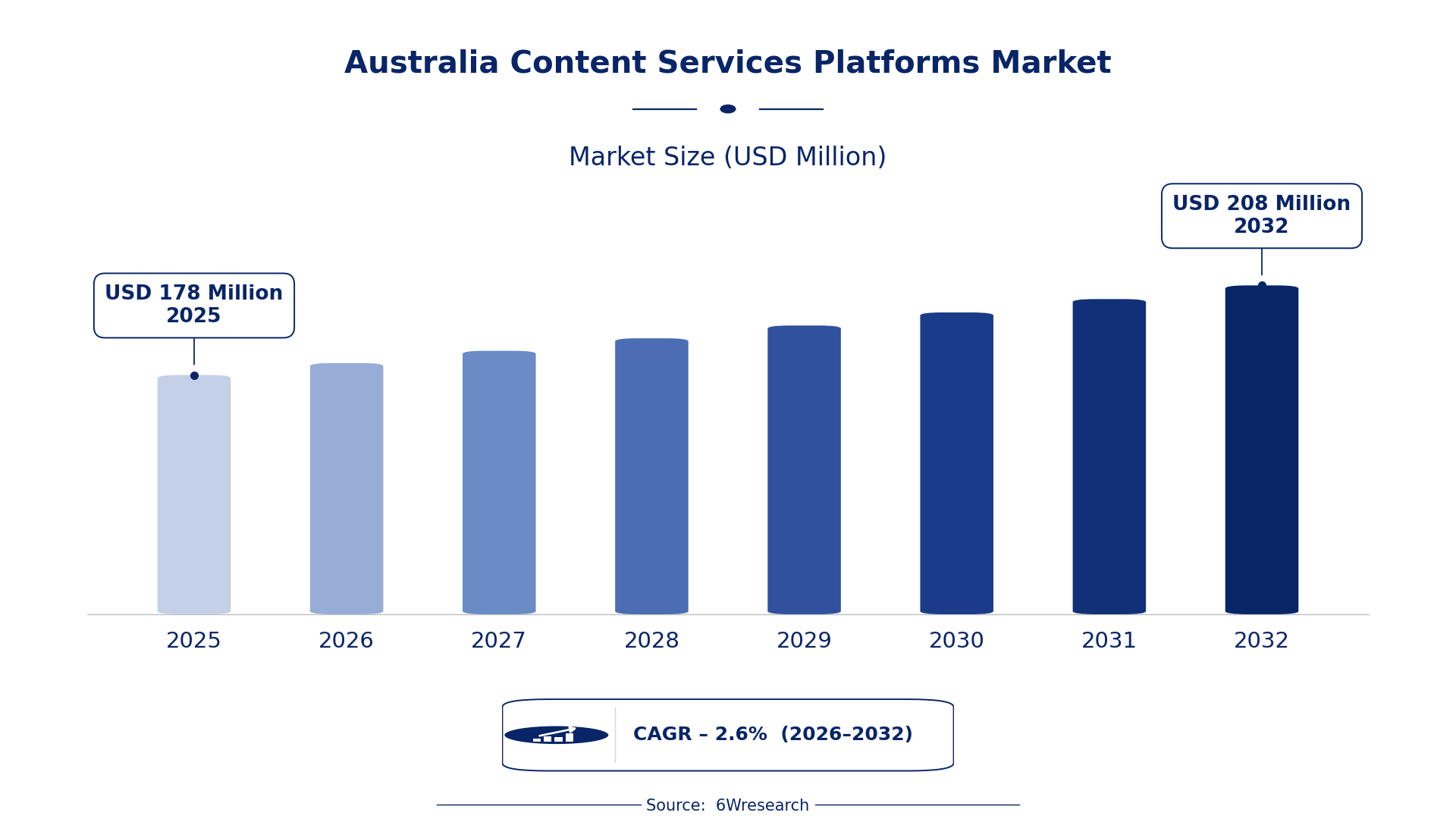
The Australia Content Services Platforms Market was estimated at USD 178 Million in 2025 and is projected to reach USD 208 Million by 2032, growing at a CAGR of 2.6% from 2026 to 2032.
Australia Content Services Platforms Market Synopsis
The Australia Content Services Platforms Market has gained momentum recently, driven by the need for efficient content management solutions across various sectors. As businesses increasingly embrace digital transformation, the demand for sophisticated content services is set to intensify, laying the groundwork for future growth.
Looking ahead, organizations are expected to prioritize integrated content management systems that offer collaboration, compliance, and data governance. This shift will create competitive pressures and spur innovation among providers, ultimately enhancing the market's resilience and adaptability.
Australia Content Services Platforms Market Year-wise Growth Rate and Key Drivers
This graph illustrates the annual growth rates of the Australia Content Services Platforms Market from 2021 to 2032, highlighting a steady upward trajectory and projected expansion over the forecast period.
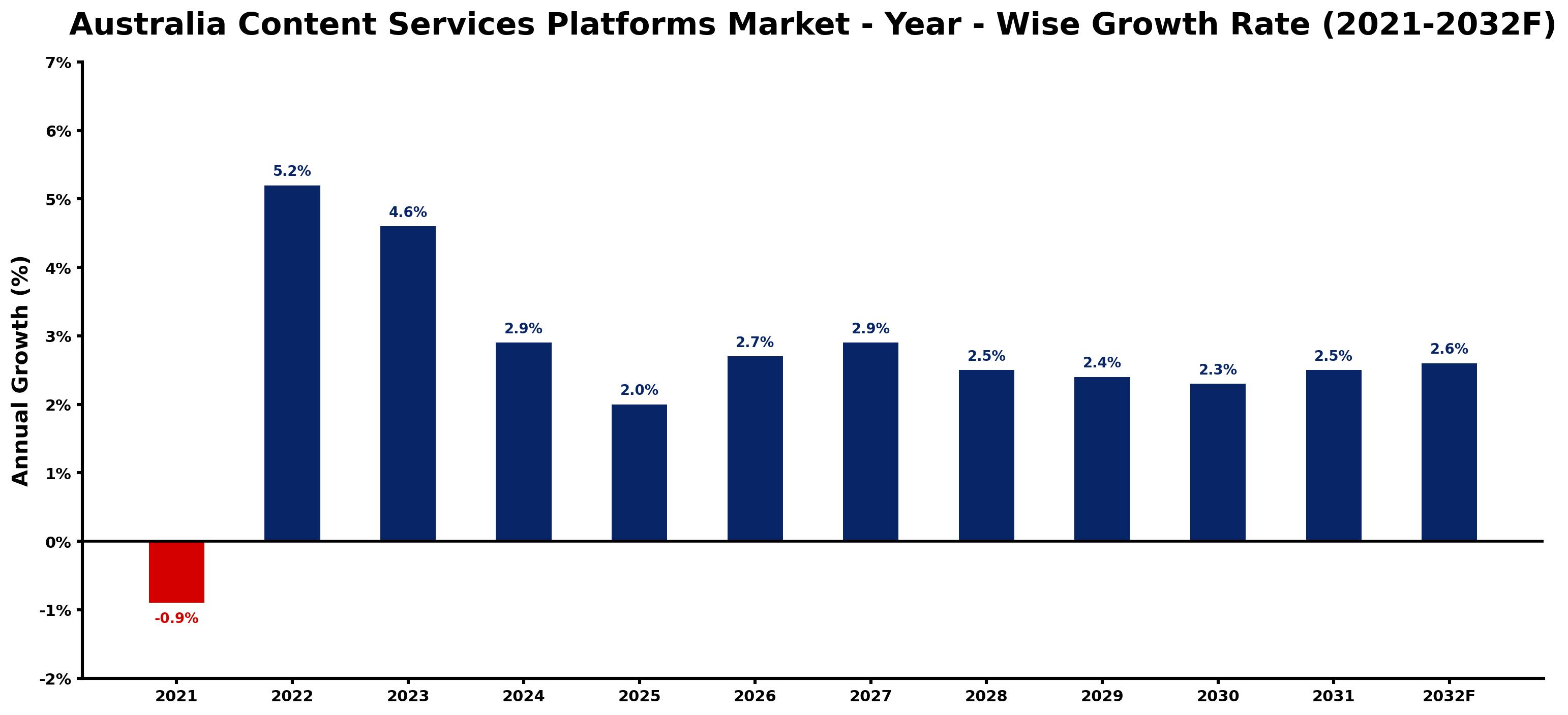
The table below presents the year‑wise growth rates along with the key drivers influencing the market
| Year | Growth Rate | Major Drivers |
| 2021 | -0.9% | Content regulation by ACMA stifled service innovation. |
| 2022 | 5.2% | Increased remote work driving demand for content services. |
| 2023 | 4.6% | Growth in media consumption boosting content service subscriptions. |
| 2024 | 2.9% | Rise of local startups leveraging cloud content management. |
| 2025 | 2.0% | Regulatory push for better data privacy practices. |
| 2026 | 2.7% | Investment in Australian media partnerships enhancing content delivery. |
| 2027 | 2.9% | Surge in online education necessitating robust content platforms. |
| 2028 | 2.5% | Local entertainment sector growth fueling content distribution needs. |
| 2029 | 2.4% | Adoption of AI tools optimizing content creation processes. |
| 2030 | 2.3% | Support for creative industries driving innovative content solutions. |
| 2031 | 2.5% | Emergence of augmented reality applications in content consumption. |
| 2032 | 2.6% | Increased focus on sustainability influencing content strategies. |
Note: Market size estimations and growth projections presented in this report are based on 6Wresearch's proprietary forecasting methodology, utilizing the latest available industry data, government publications, and primary research inputs.
Australia Content Services Platforms Market Key Takeaways
Below are some of the specific key takeaways from the market, including:
- The shift toward cloud-based solutions is reshaping how organizations manage content.
- Remote work is catalyzing the need for secure and scalable content management systems.
- Integration of AI and automation will drive further market innovation and efficiency.
- Regulatory compliance remains a critical driver influencing adoption rates.
- Organizations are increasingly focused on improving data governance and security measures.
Evaluation of Restraints in Australia Content Services Platforms Market
While the market is expanding, organizations face significant challenges, particularly concerning data governance and regulatory compliance. Managing sensitive information in line with industry regulations like the Australian Privacy Act and GDPR complicates content management initiatives. on top of that, the integration of CSP solutions with existing IT infrastructures often proves to be a complex task, hindering seamless adoption and implementation. These hurdles necessitate that CSP vendors prioritize robust security features and compliance tools to effectively support their clients.
Australia Content Services Platforms Market Trends
A noticeable trend is the increasing adoption of AI-driven analytics in content services platforms, enabling organizations to derive actionable insights from their data. on top of that, as businesses continue to prioritize collaboration, there is a growing emphasis on platforms that facilitate real-time content sharing and editing. The rise of hybrid work models has also led to heightened interest in cloud-native solutions, allowing for flexibility and scalability that on-premise systems cannot match.
Australia Content Services Platforms Market Opportunities
Opportunities abound in this market, particularly for vendors who can offer specialized solutions that address specific industry needs. Sectors such as healthcare and finance, which are heavily regulated, are ripe for growth as organizations seek compliance-ready content management tools. Additionally, as the push for digital transformation continues, companies that innovate in areas such as data governance and secure collaboration are likely to capture significant market share.
Government Initiatives in the Australia Content Services Platforms Market
Government policies in Australia are actively promoting the adoption of content services platforms to enhance efficiency and digital transformation across sectors. By prioritizing digital infrastructure and information management, these policies are critical in shaping the market's growth trajectory. As public sector organizations seek to modernize their content management practices, the influence of regulatory frameworks and initiatives will continue to play a significant role.
- A recently completed initiative, the Digital Continuity 2020 Policy Framework, encouraged government agencies to adopt CSP solutions for better record management.
- A current program, the Digital Records Transformation Initiative, focuses on improving digital content management practices in public sector organizations.
- The National Data Policy, currently underway, aims to support open data access and interoperability, driving demand for efficient CSP platforms.
- A planned initiative, the Digital Transformation Strategy, is expected to expand the use of CSP solutions across various government sectors by enhancing collaboration capabilities.
Future Insights of the Australia Content Services Platforms Market
From 2026 to 2032, the Australia Content Services Platforms Market is likely to evolve in response to changing business needs and technological advancements. With increasing pressure to comply with data regulations, organizations will seek out CSPs that not only streamline workflows but also offer enhanced security features. As integration with existing systems becomes more critical, vendors who can deliver interoperable solutions will be well-positioned for success. The emphasis on collaboration and remote work will also drive the continued evolution of content services platforms, ensuring they remain aligned with organizational goals.
Australia Content Services Platforms Market Latest Developments
In the past year, the Australia Content Services Platforms Market has seen notable activity, with organizations increasingly adopting innovative solutions to address their content management challenges. The push for cloud adoption and enhanced data governance has catalyzed several strategic initiatives among vendors and enterprises alike.
- A major technology vendor launched an upgraded CSP solution in early 2025, enhancing its security and compliance features to address regulatory demands.
- An initiative that began in mid-2025 focuses on integrating AI-driven analytics into existing content services platforms, providing organizations with deeper insights into their data.
- A rollout expected to begin in the second half of 2026 aims to expand cloud-based CSP offerings across various industries, including finance and healthcare.
- A collaborative project initiated in early 2025 is underway, focusing on developing interoperable solutions that facilitate better integration with existing IT infrastructures.
Australia Content Services Platforms Market - Key Attractiveness of the Report
- 10 Years of Market Numbers
- Historical Data Starting from 2022 to 2025
- Base Year: 2025
- Forecast Data until 2032
- Key Performance Indicators Impacting the Market
- Major Upcoming Developments and Projects
Key Highlights of the Report:
- Australia Content Services Platforms Market Outlook
- Market Size of Australia Content Services Platforms Market, 2025
- Forecast of Australia Content Services Platforms Market, 2032
- Historical Data and Forecast of Australia Content Services Platforms Revenues & Volume for the Period 2022-2032F
- Australia Content Services Platforms Market Trend Evolution
- Australia Content Services Platforms Market Drivers and Challenges
- Australia Content Services Platforms Price Trends
- Australia Content Services Platforms Porter's Five Forces
- Australia Content Services Platforms Industry Life Cycle
- Historical Data and Forecast of Australia Content Services Platforms Market Revenues & Volume By Business Function for the Period 2022-2032F
- Historical Data and Forecast of Australia Content Services Platforms Market Revenues & Volume By Human Resource for the Period 2022-2032F
- Historical Data and Forecast of Australia Content Services Platforms Market Revenues & Volume By Sales and Marketing for the Period 2022-2032F
- Historical Data and Forecast of Australia Content Services Platforms Market Revenues & Volume By Accounting and Legal for the Period 2022-2032F
- Historical Data and Forecast of Australia Content Services Platforms Market Revenues & Volume By Procurement and Supply Chain Management for the Period 2022-2032F
- Historical Data and Forecast of Australia Content Services Platforms Market Revenues & Volume By Deployment Mode for the Period 2022-2032F
- Historical Data and Forecast of Australia Content Services Platforms Market Revenues & Volume By Cloud for the Period 2022-2032F
- Historical Data and Forecast of Australia Content Services Platforms Market Revenues & Volume By On-premises for the Period 2022-2032F
- Historical Data and Forecast of Australia Content Services Platforms Market Revenues & Volume By Enterprise Size for the Period 2022-2032F
- Historical Data and Forecast of Australia Content Services Platforms Market Revenues & Volume By Large Enterprises for the Period 2022-2032F
- Historical Data and Forecast of Australia Content Services Platforms Market Revenues & Volume By SMEs for the Period 2022-2032F
- Historical Data and Forecast of Australia Content Services Platforms Market Revenues & Volume By Vertical for the Period 2022-2032F
- Historical Data and Forecast of Australia Content Services Platforms Market Revenues & Volume By Banking, Financial Services, and Insurance for the Period 2022-2032F
- Historical Data and Forecast of Australia Content Services Platforms Market Revenues & Volume By Retail and Consumer Goods for the Period 2022-2032F
- Historical Data and Forecast of Australia Content Services Platforms Market Revenues & Volume By Energy and Utilities for the Period 2022-2032F
- Historical Data and Forecast of Australia Content Services Platforms Market Revenues & Volume By Government and Public Sector for the Period 2022-2032F
- Historical Data and Forecast of Australia Content Services Platforms Market Revenues & Volume By Healthcare and Life Sciences for the Period 2022-2032F
- Historical Data and Forecast of Australia Content Services Platforms Market Revenues & Volume By IT and ITeS for the Period 2022-2032F
- Historical Data and Forecast of Australia Content Services Platforms Market Revenues & Volume By Manufacturing for the Period 2022-2032F
- Australia Content Services Platforms Import Export Trade Statistics
- Market Opportunity Assessment By Business Function
- Market Opportunity Assessment By Deployment Mode
- Market Opportunity Assessment By Enterprise Size
- Market Opportunity Assessment By Vertical
- Australia Content Services Platforms Top Companies Market Share
- Australia Content Services Platforms Competitive Benchmarking By Technical and Operational Parameters
- Australia Content Services Platforms Company Profiles
- Australia Content Services Platforms Key Strategic Recommendations






































