Australia Cooking Appliances Market Summary
The australia cooking appliances market was estimated at USD 203 Million in 2025 and is projected to reach USD 239 Million by 2032, growing at a CAGR of 2.6% from 2026 to 2032.
Australia Cooking Appliances Market Year-wise Growth Rate and Key Drivers
This graph highlights how the Australia Cooking Appliances Market has steadily grown over the past five years, supported by major growth factors.
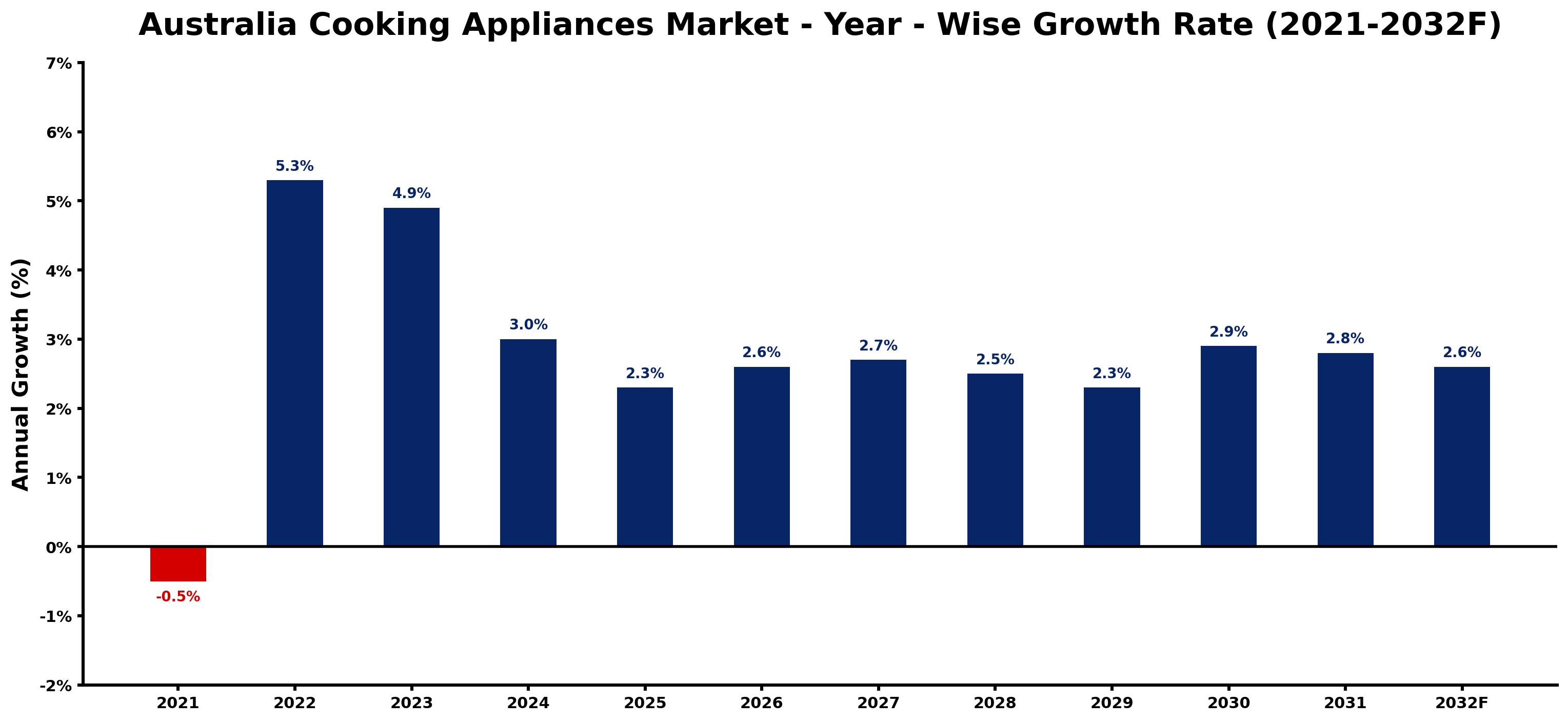
The table below presents the year wise growth rates along with the key drivers influencing the market
| Year | Growth Rate | Major Drivers |
| 2021 | -0.5% | Supply chain disruptions from global shipping issues hindered timely product availability, dampening consumer purchases. |
| 2022 | 5.3% | Consumer preference shifted towards energy-efficient appliances amid rising utility costs. |
| 2023 | 4.9% | Smart technology integration captivated tech-savvy home cooks exploring automation features. |
| 2024 | 3.0% | Rising health awareness led to increased interest in multifunctional cooking appliances. |
| 2025 | 2.3% | Sustainability trends encouraged manufacturers to develop eco-friendly cooking solutions. |
| 2026 | 2.6% | Urbanization propelled compact appliance designs suitable for smaller living spaces. |
| 2027 | 2.7% | Collaborations with celebrity chefs popularized premium kitchen gadgets among consumers. |
| 2028 | 2.5% | Increased online shopping trends transformed how consumers purchase cooking appliances. |
| 2029 | 2.3% | Emerging culinary shows inspired home cooks to invest in high-performance equipment. |
| 2030 | 2.9% | Enhanced product warranties improved consumer confidence in purchasing high-end appliances. |
| 2031 | 2.8% | Culinary tourism increased interest in authentic cooking experiences and appliances. |
| 2032 | 2.6% | Investment in home renovation projects bolstered sales of premium kitchen appliances. |
Note - Market size estimations and growth projections presented in this report are based on 6Wresearch's advanced forecasting approach, validated with industry datasets as of June 2026.
Australia Cooking Appliances Market Synopsis
The Australia Cooking Appliances Market is projected to reach 2.6% and witness significant growth during the forecast period (2026-2032). This market is characterized by an increasing demand for modern cooking solutions that enhance culinary experiences in Australian households. Factors such as urbanization, rising disposable incomes, and evolving consumer lifestyles play a pivotal role in shaping the landscape of cooking appliances in the region.
Australia Cooking Appliances Market Growth Drivers
The growth of the Australia Cooking Appliances Market can be attributed to several key drivers:
- The increasing trend towards home cooking has significantly influenced consumer preferences, prompting a demand for high-quality cooking appliances that offer convenience and versatility in meal preparation.
- Rising disposable incomes allow Australian consumers to invest in premium cooking appliances, which often feature advanced functionalities and greater energy efficiency.
- Technological advancements, such as induction cooking and smart connectivity, have enhanced the performance of cooking appliances, making them more attractive to tech-savvy consumers.
- The growing interest in healthy eating habits among Australians drives the need for appliances that facilitate nutritious meal preparation, further supporting market growth.
- Homeowners engaging in kitchen renovations and remodeling projects contribute to the increasing demand for modern cooking appliances, spurring replacement and upgrade purchases.
Australia Cooking Appliances Market Trends and Opportunities
Current trends in the Australia Cooking Appliances Market highlight significant opportunities for growth:
- The trend towards energy-efficient appliances is accelerating, with consumers actively seeking products that contribute to lower energy consumption and reduced environmental impact.
- Smart cooking appliances equipped with IoT capabilities are gaining traction, enabling greater control and monitoring of cooking processes through mobile applications.
- Sustainable materials and eco-friendly designs are becoming increasingly important to consumers, fostering demand for cooking appliances that align with these values.
- The expanding e-commerce sector provides a new avenue for consumers to purchase cooking appliances, allowing for greater access to diverse product offerings and competitive pricing.
- Customization options for cooking appliances are on the rise, as consumers seek products that fit their unique kitchen layouts and personal cooking styles.
Australia Cooking Appliances Market Challenges and Restraints
Despite the robust growth prospects, the Australia Cooking Appliances Market faces several challenges:
- Catering to diverse consumer preferences requires manufacturers to innovate continually, which can be resource-intensive and costly.
- Technological obsolescence remains a concern, as consumers increasingly expect cutting-edge features and advancements in their cooking appliances.
- Supply chain disruptions and logistical constraints, particularly related to imported appliances and components, can adversely affect market dynamics.
- Market players must navigate stringent regulations and compliance requirements related to safety and energy efficiency, which can impact product development timelines.
- Changes in consumer spending habits, influenced by economic fluctuations, can impact overall demand for cooking appliances.
Australia Cooking Appliances Market Government Investment and Initiatives
The government of Australia plays a significant role in shaping the Cooking Appliances Market through various policies and initiatives:
- Government regulations focus on promoting consumer safety through safety standards and energy efficiency ratings for cooking appliances, ensuring that products meet high-quality benchmarks.
- Incentives and rebate programs aimed at encouraging the adoption of energy-efficient appliances influence market dynamics by making such products more financially accessible to consumers.
- Public investment in energy conservation initiatives aligns with the government's commitment to sustainability, providing support for businesses that innovate in the cooking appliances sector.
- Regulatory bodies frequently update energy efficiency standards, pushing manufacturers to enhance their offerings while ensuring compliance with the latest guidelines.
- Collaborations between government agencies and industry stakeholders facilitate the exchange of knowledge and resources, fostering innovation within the cooking appliances market.
Australia Cooking Appliances Market Latest Developments (May 2025 - June 2026)
In the period from May 2025 to June 2026, the Australia Cooking Appliances Market has seen notable developments:
- A marked increase in consumer interest in smart cooking appliances has led to significant investments in research and development for innovative products within this segment.
- The growth of online retail channels has transformed consumer shopping experiences, with more Australians opting for online purchases of cooking appliances due to convenience.
- Sustainability initiatives have gained momentum, prompting manufacturers to focus on eco-friendly designs and materials in their cooking appliances.
- In response to supply chain challenges, companies have begun to explore local sourcing options to mitigate disruptions and ensure product availability.
- The introduction of energy-efficient products has been prioritized, driven by government regulations and growing consumer awareness of energy consumption.
Australia Cooking Appliances Market - Key Attractiveness of the Report
- 10 Years of Market Numbers
- Historical Data Starting from 2022 to 2025
- Base Year: 2025
- Forecast Data until 2032
- Key Performance Indicators Impacting the Market
- Major Upcoming Developments and Projects
Key Highlights of the Report:
- Australia Cooking Appliances Market Outlook
- Market Size of Australia Cooking Appliances Market, 2025
- Forecast of Australia Cooking Appliances Market, 2032
- Historical Data and Forecast of Australia Cooking Appliances Revenues & Volume for the Period 2022-2032F
- Australia Cooking Appliances Market Trend Evolution
- Australia Cooking Appliances Market Drivers and Challenges
- Australia Cooking Appliances Price Trends
- Australia Cooking Appliances Porter's Five Forces
- Australia Cooking Appliances Industry Life Cycle
- Historical Data and Forecast of Australia Cooking Appliances Market Revenues & Volume By Types for the Period 2022-2032F
- Historical Data and Forecast of Australia Cooking Appliances Market Revenues & Volume By Microwaves for the Period 2022-2032F
- Historical Data and Forecast of Australia Cooking Appliances Market Revenues & Volume By Ovens for the Period 2022-2032F
- Historical Data and Forecast of Australia Cooking Appliances Market Revenues & Volume By Cooktops for the Period 2022-2032F
- Historical Data and Forecast of Australia Cooking Appliances Market Revenues & Volume By Range Hoods for the Period 2022-2032F
- Historical Data and Forecast of Australia Cooking Appliances Market Revenues & Volume By Small Appliances for the Period 2022-2032F
- Historical Data and Forecast of Australia Cooking Appliances Market Revenues & Volume By Parts & Accessories for the Period 2022-2032F
- Historical Data and Forecast of Australia Cooking Appliances Market Revenues & Volume By Applications for the Period 2022-2032F
- Historical Data and Forecast of Australia Cooking Appliances Market Revenues & Volume By Household for the Period 2022-2032F
- Historical Data and Forecast of Australia Cooking Appliances Market Revenues & Volume By Commercial for the Period 2022-2032F
- Historical Data and Forecast of Australia Cooking Appliances Market Revenues & Volume By Fuel Type for the Period 2022-2032F
- Historical Data and Forecast of Australia Cooking Appliances Market Revenues & Volume By Cooking gas for the Period 2022-2032F
- Historical Data and Forecast of Australia Cooking Appliances Market Revenues & Volume By Electricity for the Period 2022-2032F
- Historical Data and Forecast of Australia Cooking Appliances Market Revenues & Volume By Distribution Channel for the Period 2022-2032F
- Historical Data and Forecast of Australia Cooking Appliances Market Revenues & Volume By Online for the Period 2022-2032F
- Historical Data and Forecast of Australia Cooking Appliances Market Revenues & Volume By Offline for the Period 2022-2032F
- Australia Cooking Appliances Import Export Trade Statistics
- Market Opportunity Assessment By Types
- Market Opportunity Assessment By Applications
- Market Opportunity Assessment By Fuel Type
- Market Opportunity Assessment By Distribution Channel
- Australia Cooking Appliances Top Companies Market Share
- Australia Cooking Appliances Competitive Benchmarking By Technical and Operational Parameters
- Australia Cooking Appliances Company Profiles
- Australia Cooking Appliances Key Strategic Recommendations






































