Australia Critical Infrastructure Protection Market Size & Growth Rate (2026-2032)
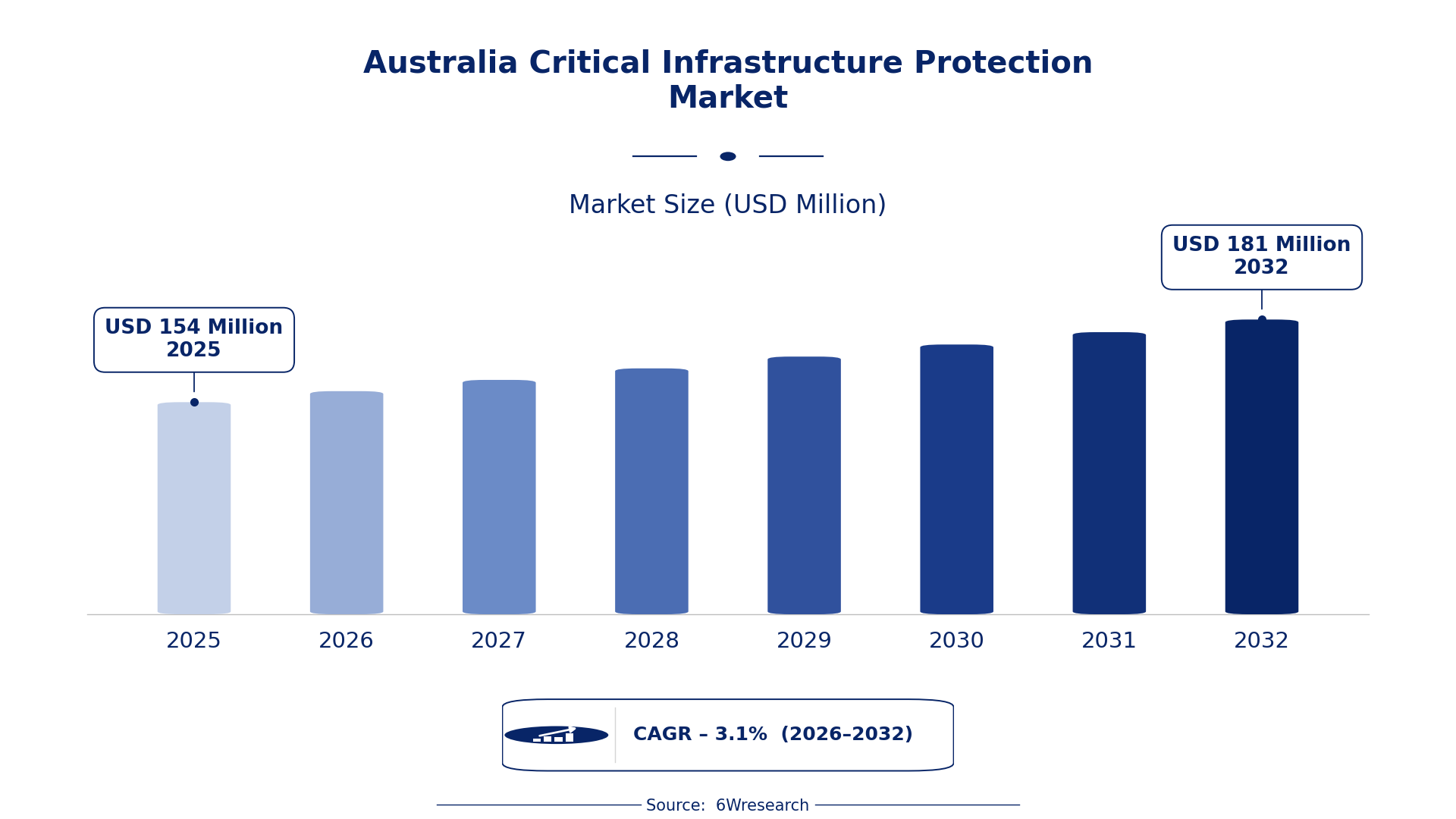
The Australia Critical Infrastructure Protection Market was estimated at USD 154 Million in 2025 and is projected to reach USD 181 Million by 2032, growing at a CAGR of 3.1% from 2026 to 2032.
Australia Critical Infrastructure Protection Market Synopsis
The escalating threat of cyberattacks is the primary force shaping the Australia Critical Infrastructure Protection Market. As digital interdependencies deepen across sectors, the vulnerabilities linked to cybersecurity are garnering heightened attention from stakeholders.
Critical infrastructure sectors, such as energy, transportation, and water supply, form the backbone of Australia's economy. Consequently, the increasing investment in advanced security solutions reflects the urgent need to bolster defenses against both physical and cyber threats.
Australia Critical Infrastructure Protection Market Year-wise Growth Rate and Key Drivers
This graph illustrates the annual growth rates of the Australia Critical Infrastructure Protection Market from 2021 to 2032, highlighting a steady upward trajectory and projected expansion over the forecast period.
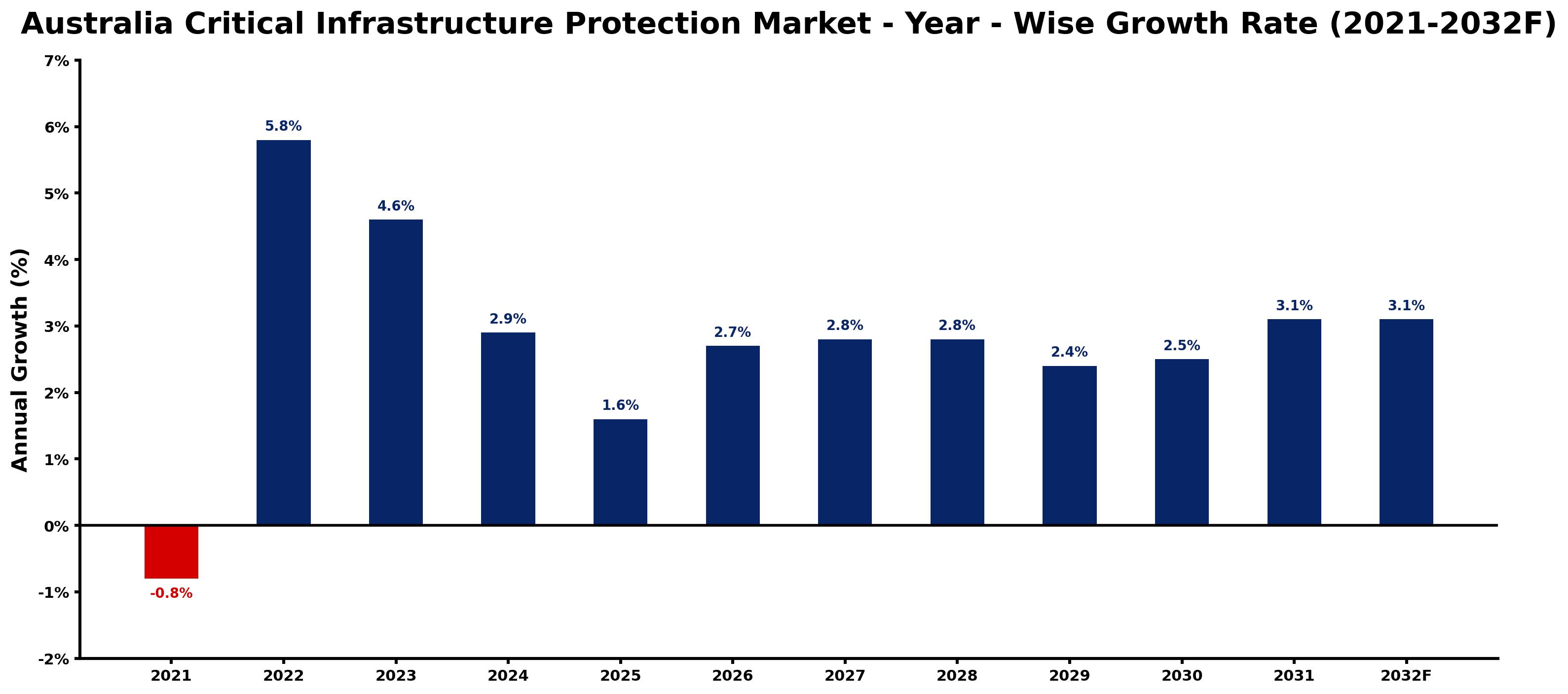
The table below presents the year‑wise growth rates along with the key drivers influencing the market
| Year | Growth Rate | Major Drivers |
| 2021 | -0.8% | Cybersecurity regulations delayed by Australian government reviews. |
| 2022 | 5.8% | Cybersecurity funding increase by Australian Cyber Security Centre |
| 2023 | 4.6% | Implementation of new national resilience strategies boosting security |
| 2024 | 2.9% | Rise in cyber threats prompting critical infrastructure investments |
| 2025 | 1.6% | Government task force on infrastructure protection established |
| 2026 | 2.7% | Investment in smart grid technologies enhancing operational security |
| 2027 | 2.8% | Increased collaboration with private sector for safety innovations |
| 2028 | 2.8% | Focus on climate resilience in infrastructure planning initiatives |
| 2029 | 2.4% | Growing public awareness of critical infrastructure vulnerabilities |
| 2030 | 2.5% | Adoption of 5G enhancing remote monitoring capabilities |
| 2031 | 3.1% | Legislative changes mandating security upgrades for operators |
| 2032 | 3.1% | Strategic partnerships for crisis management and response reliability |
Note: Market size estimations and growth projections presented in this report are based on 6Wresearch's proprietary forecasting methodology, utilizing the latest available industry data, government publications, and primary research inputs.
Australia Critical Infrastructure Protection Market Key Takeaways
Below are some of the specific key takeaways from the market, including:
- Cybersecurity vulnerabilities are a paramount concern, driving increased investment in protection measures.
- Regulatory mandates are pushing organizations to adopt comprehensive security frameworks.
- Technological advancements in surveillance and intrusion detection are enhancing operational resilience.
- Natural disasters underscore the necessity for proactive risk management strategies.
- Aging infrastructure presents ongoing challenges for maintaining security and operational effectiveness.
Evaluation of Restraints in Australia Critical Infrastructure Protection Market
The market faces multiple restraints that hinder its growth potential. The increasing sophistication of cyber threats poses a constant challenge, requiring continuous upgrades in security measures and technologies. Compounding this issue is the aging infrastructure that many sectors rely on, which often lacks the resilience needed to withstand attacks. on top of that, natural disasters such as bushfires and floods can abruptly disrupt operations, emphasizing the need for enhanced risk management solutions. As these factors persist, they place a strain on resources and highlight the urgency for systemic improvements.
Australia Critical Infrastructure Protection Market Trends
Several trends are currently shaping the demand for critical infrastructure protection in Australia. The integration of AI and machine learning technologies into security systems is transforming how threats are detected and mitigated. on top of that, the push towards smart infrastructure enhances connectivity but also amplifies potential vulnerabilities. Investment in public-private partnerships is gaining traction, fostering collaboration to fortify defenses across sectors. As organizations prioritize resilience, a shift towards comprehensive cybersecurity frameworks is becoming increasingly prevalent.
Australia Critical Infrastructure Protection Market Opportunities
As the market evolves, several growth opportunities present themselves. Investment in advanced cybersecurity technologies, particularly those utilizing AI for real-time threat detection, is crucial. Additionally, enhancing public-private partnerships can drive innovation and resource sharing, making security infrastructure more resilient. There's also a growing demand for training programs to develop expertise in managing critical infrastructure security, which presents an avenue for specialized service providers. Finally, regulatory compliance offers a pathway for businesses to differentiate themselves by adopting best practices in security.
Government Initiatives in the Australia Critical Infrastructure Protection Market
The Australian government plays a vital role in shaping the Critical Infrastructure Protection Market through targeted policies and initiatives. With an emphasis on cybersecurity and infrastructure resilience, various agencies are actively working to enhance protection measures across critical sectors. The current regulatory environment prioritizes collaboration between government, industry stakeholders, and international partners, which is essential for effective security implementation.
- A national digital infrastructure upgrade programme was recently launched to enhance cybersecurity across critical sectors.
- Current efforts include the ongoing rollout of the Cybersecurity Strategy, which aims to bolster defenses against cyber threats.
- Planned initiatives focus on regulatory frameworks to enhance information sharing and response strategies among critical infrastructure operators.
- The Critical Infrastructure Centre continues to work on frameworks to streamline the protection of essential services from emerging risks.
- Recently, a public-private task force was established to develop best practices for securing transportation networks.
Future Insights of the Australia Critical Infrastructure Protection Market
Looking ahead to 2026-2032, the Australia Critical Infrastructure Protection Market is set for gradual but steady growth. As digital transformation accelerates, the demand for comprehensive security solutions will intensify. Organizations will prioritize resilience, investing in advanced technologies and strategic collaborations to mitigate risks. The ongoing evolution of regulatory frameworks will also shape market dynamics, pushing for enhanced accountability and security measures. Thus, the market is expected to continue its trajectory towards greater sophistication and resilience.
Australia Critical Infrastructure Protection Market Latest Developments
Over the past 12-14 months, activity within the Australia Critical Infrastructure Protection Market has intensified as stakeholders respond to escalating threats. Companies are increasingly focused on integrating innovative technologies to bolster security measures. Investments in training and awareness programs have also surged, reflecting a commitment to cultivating expertise in the sector.
- A major technology vendor launched a new cybersecurity platform aimed at improving real-time threat detection in early 2025.
- An initiative to enhance water supply infrastructure security is currently underway, focusing on both physical and cyber protections.
- Planned partnerships between government bodies and private enterprises are expected to commence in late 2025 to address cybersecurity vulnerabilities.
- A public training program aimed at improving workforce capabilities in critical infrastructure security was initiated in Q1 2026 and remains ongoing.
- Currently, a national assessment of critical infrastructure sectors is being conducted to identify key vulnerabilities and improvement areas.
Australia Critical Infrastructure Protection Market - Key Attractiveness of the Report
- 10 Years of Market Numbers
- Historical Data Starting from 2022 to 2025
- Base Year: 2025
- Forecast Data until 2032
- Key Performance Indicators Impacting the Market
- Major Upcoming Developments and Projects
Key Highlights of the Report:
- Australia Critical Infrastructure Protection Market Outlook
- Market Size of Australia Critical Infrastructure Protection Market, 2025
- Forecast of Australia Critical Infrastructure Protection Market, 2032
- Historical Data and Forecast of Australia Critical Infrastructure Protection Revenues & Volume for the Period 2022-2032F
- Australia Critical Infrastructure Protection Market Trend Evolution
- Australia Critical Infrastructure Protection Market Drivers and Challenges
- Australia Critical Infrastructure Protection Price Trends
- Australia Critical Infrastructure Protection Porter's Five Forces
- Australia Critical Infrastructure Protection Industry Life Cycle
- Historical Data and Forecast of Australia Critical Infrastructure Protection Market Revenues & Volume By Solution for the Period 2022-2032F
- Historical Data and Forecast of Australia Critical Infrastructure Protection Market Revenues & Volume By Physical Safety for the Period 2022-2032F
- Historical Data and Forecast of Australia Critical Infrastructure Protection Market Revenues & Volume By Security Video Surveillance Systems for the Period 2022-2032F
- Historical Data and Forecast of Australia Critical Infrastructure Protection Market Revenues & Volume By Screening for the Period 2022-2032F
- Historical Data and Forecast of Australia Critical Infrastructure Protection Market Revenues & Volume By Scanning for the Period 2022-2032F
- Historical Data and Forecast of Australia Critical Infrastructure Protection Market Revenues & Volume By Cybersecurity for the Period 2022-2032F
- Historical Data and Forecast of Australia Critical Infrastructure Protection Market Revenues & Volume By Encryption for the Period 2022-2032F
- Historical Data and Forecast of Australia Critical Infrastructure Protection Market Revenues & Volume By Threat Intelligence for the Period 2022-2032F
- Historical Data and Forecast of Australia Critical Infrastructure Protection Market Revenues & Volume By Component for the Period 2022-2032F
- Historical Data and Forecast of Australia Critical Infrastructure Protection Market Revenues & Volume By Solution for the Period 2022-2032F
- Historical Data and Forecast of Australia Critical Infrastructure Protection Market Revenues & Volume By Services for the Period 2022-2032F
- Historical Data and Forecast of Australia Critical Infrastructure Protection Market Revenues & Volume By Vertical for the Period 2022-2032F
- Historical Data and Forecast of Australia Critical Infrastructure Protection Market Revenues & Volume By Financial Institutions for the Period 2022-2032F
- Historical Data and Forecast of Australia Critical Infrastructure Protection Market Revenues & Volume By Government for the Period 2022-2032F
- Historical Data and Forecast of Australia Critical Infrastructure Protection Market Revenues & Volume By Defense for the Period 2022-2032F
- Historical Data and Forecast of Australia Critical Infrastructure Protection Market Revenues & Volume By Transport and Logistics for the Period 2022-2032F
- Historical Data and Forecast of Australia Critical Infrastructure Protection Market Revenues & Volume By Energy and Power for the Period 2022-2032F
- Historical Data and Forecast of Australia Critical Infrastructure Protection Market Revenues & Volume By Commercial Sector for the Period 2022-2032F
- Historical Data and Forecast of Australia Critical Infrastructure Protection Market Revenues & Volume By Telecom for the Period 2022-2032F
- Historical Data and Forecast of Australia Critical Infrastructure Protection Market Revenues & Volume By Chemicals and Manufacturing for the Period 2022-2032F
- Australia Critical Infrastructure Protection Import Export Trade Statistics
- Market Opportunity Assessment By Solution
- Market Opportunity Assessment By Cybersecurity
- Market Opportunity Assessment By Component
- Market Opportunity Assessment By Vertical
- Australia Critical Infrastructure Protection Top Companies Market Share
- Australia Critical Infrastructure Protection Competitive Benchmarking By Technical and Operational Parameters
- Australia Critical Infrastructure Protection Company Profiles
- Australia Critical Infrastructure Protection Key Strategic Recommendations






































