Australia Crystal Lighting Market Summary
The australia crystal lighting market was estimated at USD 195 Million in 2025 and is projected to reach USD 228 Million by 2032, growing at a CAGR of 2.8% from 2026 to 2032.
Australia Crystal Lighting Market Year-wise Growth Rate and Key Drivers
This graph highlights how the Australia Crystal Lighting Market has steadily grown over the past five years, supported by major growth factors.
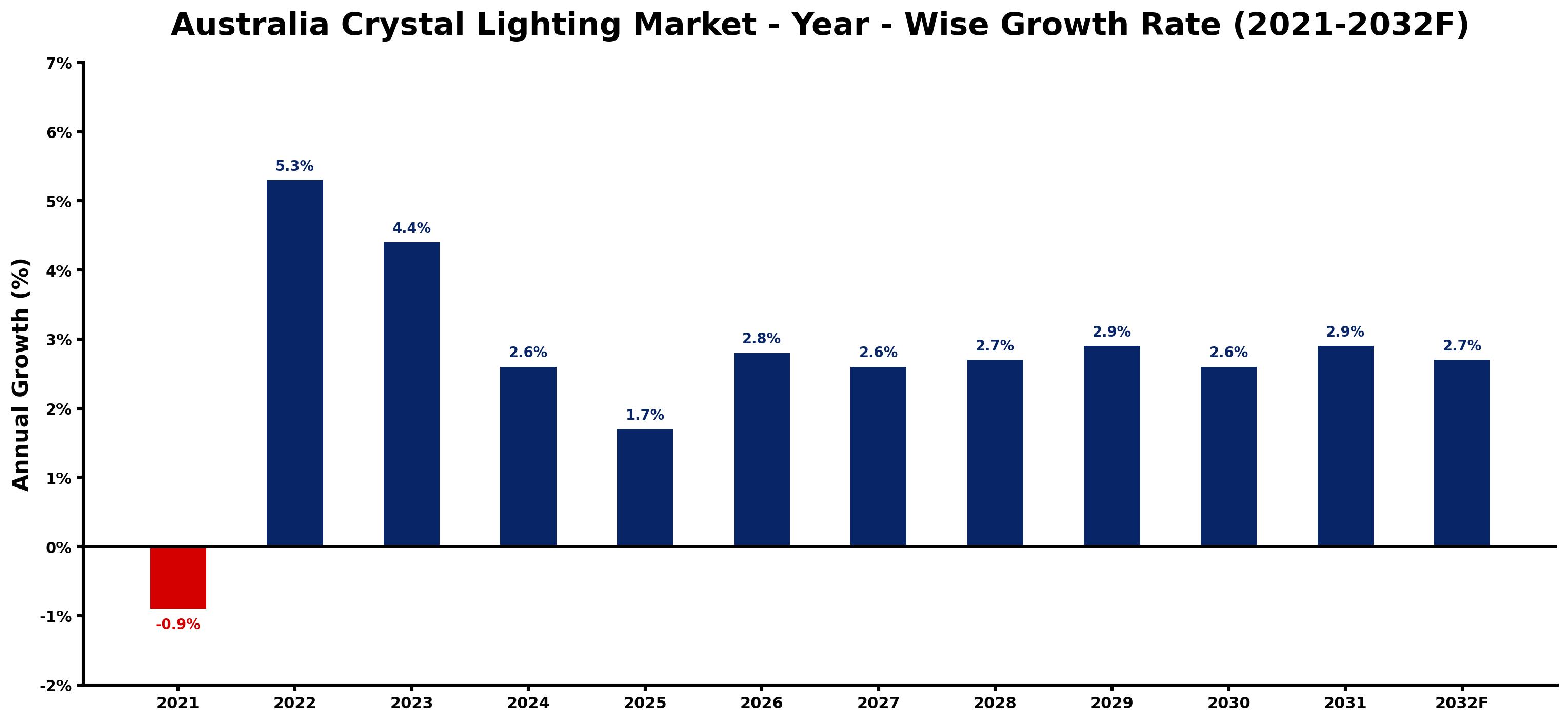
The table below presents the year wise growth rates along with the key drivers influencing the market
| Year | Growth Rate | Major Drivers |
| 2021 | -0.9% | Supply chain disruptions hampered imports of highdemand crystal lighting products, stifling market expansion opportunities. |
| 2022 | 5.3% | Homeowners increasingly prioritize ambiance, enhancing demand for decorative lighting solutions. |
| 2023 | 4.4% | Sustainable practices lead to innovations in energy-efficient crystal lighting products. |
| 2024 | 2.6% | Luxury property developments incorporate bespoke lighting to enhance architectural appeal. |
| 2025 | 1.7% | Online retail platforms expand, providing wider access to diverse crystal lighting options. |
| 2026 | 2.8% | Collaborations between interior designers and lighting manufacturers create bespoke offerings. |
| 2027 | 2.6% | Cultural events and festivals boost temporary installations of crystal lighting showcases. |
| 2028 | 2.7% | Technological advancements enable customizable smart crystal lighting solutions for consumers. |
| 2029 | 2.9% | International design trends influence Australian market, prompting new crystal lighting styles. |
| 2030 | 2.6% | Investment in residential renovations fosters greater demand for elegant lighting fixtures. |
| 2031 | 2.9% | Architecture firms increasingly recommend crystal lighting to enhance project aesthetics. |
| 2032 | 2.7% | Emerging artists utilize crystal lighting for interactive installations, pushing creative boundaries. |
Note - Market size estimations and growth projections presented in this report are based on 6Wresearch's advanced forecasting approach, validated with industry datasets as of June 2026.
Australia Crystal Lighting Market Synopsis
The Australia Crystal Lighting Market is projected to reach 2.8% and witness significant growth during the forecast period (2026-2032). This growth trajectory is being driven by an increasing consumer preference for elegant and energy-efficient lighting solutions across various sectors, including residential, commercial, and hospitality. With the rise in disposable incomes and urbanization, consumers are more inclined to invest in aesthetically pleasing crystal lighting fixtures that enhance the ambiance of their spaces. Furthermore, technological advancements in LED lighting are enabling more sustainable and customizable options, further propelling the market forward.
Australia Crystal Lighting Market Growth Drivers
Several key drivers contribute to the growth of the Australia Crystal Lighting Market. Firstly, consumers are increasingly drawn to luxurious and visually appealing lighting solutions, as crystal fixtures are synonymous with elegance and sophistication. This demand is particularly strong among homeowners, interior designers, and the hospitality sector.
- The integration of crystal lighting in both traditional and modern interior designs is becoming more prominent, reflecting consumer desires for unique and high-quality aesthetics.
- Technological advancements enable the manufacturing of innovative crystal lighting products, expanding choices for consumers and stimulating interest across different market segments.
- Consumer focus on energy efficiency is prompting a shift towards LED-based crystal lighting solutions, which offer the dual benefits of sustainability and energy savings.
- The rising popularity of smart home technology is influencing the crystal lighting market, as consumers seek integrated solutions that blend aesthetics with modern conveniences.
- The growth of the hospitality industry in Australia, particularly in urban centers, serves as a significant driver for crystal lighting fixtures that enhance guest experiences and overall decor.
Australia Crystal Lighting Market Challenges and Restraints
Despite the promising growth of the Australia Crystal Lighting Market, several challenges must be overcome. Intense competition from alternative lighting technologies, including LED and smart lighting, poses significant threats to traditional crystal lighting manufacturers.
- A shift in consumer preferences towards minimalist and contemporary designs can challenge the traditional appeal of crystal lighting, necessitating adaptations in product offerings.
- Sustainability concerns are becoming more pronounced among consumers, which can impact purchasing decisions and require manufacturers to innovate and meet evolving standards.
- Economic fluctuations and changes in consumer spending power can indirectly influence the luxury lighting segment, affecting demand for higher-priced crystal fixtures.
- Manufacturers face challenges in maintaining competitive pricing while ensuring high-quality and aesthetically appealing products, given the increasing costs of raw materials.
- The market's reliance on traditional distribution channels may hinder the adoption of newer, innovative sales strategies that cater to evolving consumer behavior.
Australia Crystal Lighting Market Government Investment and Initiatives
Government policies in Australia are playing a crucial role in shaping the Crystal Lighting Market. Initiatives promoting energy efficiency, such as the Energy Efficiency Standards and Labeling (EESL) program, set minimum performance standards that encourage the adoption of energy-efficient lighting solutions.
- Incentives and rebates for energy-efficient lighting upgrades are offered, motivating consumers and businesses alike to invest in high-quality crystal lighting fixtures that comply with sustainability standards.
- Regulatory frameworks and building codes are mandating energy-efficient lighting solutions in both commercial and residential projects, leading to increased demand for crystal lighting products.
- Public funding for innovative lighting technologies and sustainable design initiatives supports the growth of the crystal lighting market, fostering a culture of development and advancement.
- Collaboration between the government and industry stakeholders aims to raise awareness of energy efficiency benefits, further driving market expansion.
- The push for sustainable urban development integrates energy-efficient lighting solutions into planning practices, aligning with broader environmental goals set by the government.
Australia Crystal Lighting Market Latest Developments (May 2025 - June 2026)
Recent developments in the Australia Crystal Lighting Market indicate a dynamic shift towards innovation and sustainability. The market is witnessing increased collaborations aimed at integrating LED technology into crystal lighting designs. Moreover, there is a growing trend of customizing crystal lighting fixtures to cater to the specific aesthetic and functional needs of various consumer segments.
- Emerging designs focus on blending traditional crystal elements with contemporary aesthetics, attracting a broader audience.
- Research and development efforts are increasingly centered on sustainable materials that reduce environmental impact while maintaining the elegance associated with crystal lighting.
- The emphasis on energy efficiency has motivated manufacturers to seek certifications that validate the sustainability of their products, enhancing market credibility.
- Consumer education campaigns regarding the benefits of energy-efficient lighting solutions are being implemented, promoting the advantages of modern crystal lighting options.
- Market players are increasingly adopting e-commerce strategies to reach a wider audience, leveraging online platforms to showcase their crystal lighting products.
Australia Crystal Lighting Market - Key Attractiveness of the Report
- 10 Years of Market Numbers
- Historical Data Starting from 2022 to 2025
- Base Year: 2025
- Forecast Data until 2032
- Key Performance Indicators Impacting the Market
- Major Upcoming Developments and Projects
Key Highlights of the Report:
- Australia Crystal Lighting Market Outlook
- Market Size of Australia Crystal Lighting Market, 2025
- Forecast of Australia Crystal Lighting Market, 2032
- Historical Data and Forecast of Australia Crystal Lighting Revenues & Volume for the Period 2022-2032F
- Australia Crystal Lighting Market Trend Evolution
- Australia Crystal Lighting Market Drivers and Challenges
- Australia Crystal Lighting Price Trends
- Australia Crystal Lighting Porter's Five Forces
- Australia Crystal Lighting Industry Life Cycle
- Historical Data and Forecast of Australia Crystal Lighting Market Revenues & Volume By Product Type for the Period 2022-2032F
- Historical Data and Forecast of Australia Crystal Lighting Market Revenues & Volume By Ceiling Crystal Lights for the Period 2022-2032F
- Historical Data and Forecast of Australia Crystal Lighting Market Revenues & Volume By Crystal Chandeliers for the Period 2022-2032F
- Historical Data and Forecast of Australia Crystal Lighting Market Revenues & Volume By Others for the Period 2022-2032F
- Historical Data and Forecast of Australia Crystal Lighting Market Revenues & Volume By Applications for the Period 2022-2032F
- Historical Data and Forecast of Australia Crystal Lighting Market Revenues & Volume By Commercial for the Period 2022-2032F
- Historical Data and Forecast of Australia Crystal Lighting Market Revenues & Volume By Designer for the Period 2022-2032F
- Historical Data and Forecast of Australia Crystal Lighting Market Revenues & Volume By Superior Residential for the Period 2022-2032F
- Australia Crystal Lighting Import Export Trade Statistics
- Market Opportunity Assessment By Product Type
- Market Opportunity Assessment By Applications
- Australia Crystal Lighting Top Companies Market Share
- Australia Crystal Lighting Competitive Benchmarking By Technical and Operational Parameters
- Australia Crystal Lighting Company Profiles
- Australia Crystal Lighting Key Strategic Recommendations






































