Australia Curtains and Window Blinds Market: Import Trend Analysis
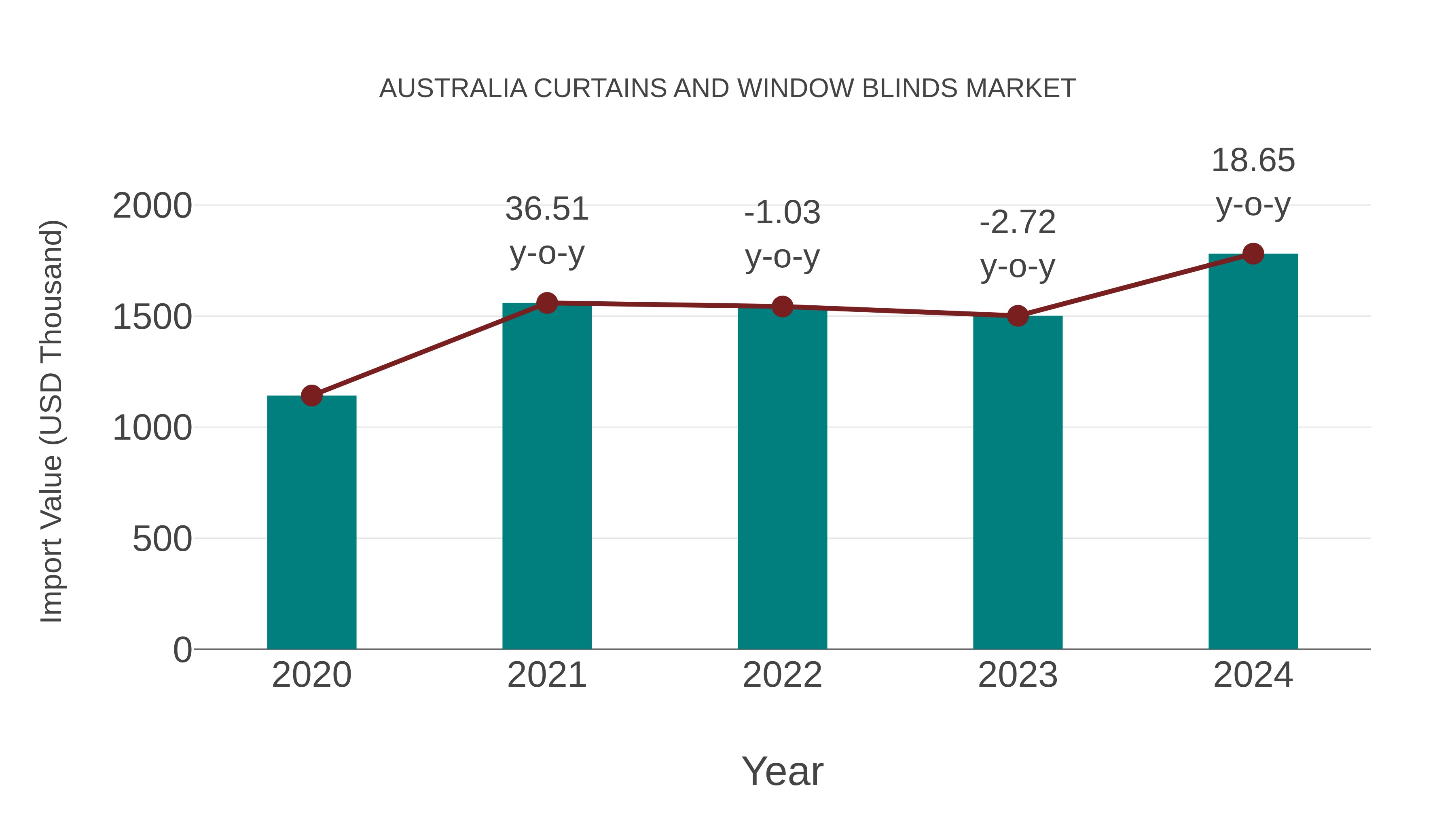
In the Australia curtains and window blinds market, the import trend showed significant growth from 2023 to 2024, with a growth rate of 18.65%. The compound annual growth rate (CAGR) for the period 2020-2024 stood at 11.75%. This surge in imports can be attributed to a notable shift in consumer demand towards higher-quality and more diverse window treatment options, indicating a positive market momentum and increasing competition among suppliers.
Australia Curtains and Window Blinds Market Overview
The Australia curtains and window blinds market is experiencing steady growth, driven by factors such as increasing disposable income, changing lifestyle preferences, and growing awareness regarding interior decor aesthetics. Curtains and window blinds play a vital role in enhancing the visual appeal of residential and commercial spaces while providing privacy and light control options. Market players are introducing innovative designs, materials, and technologies to cater to the diverse needs and preferences of consumers. Furthermore, the trend of eco-friendly and sustainable home furnishings is influencing product development in the Australia curtains and window blinds market.
Drivers of the market
The Australia curtains and window blinds market is experiencing steady growth owing to factors such as changing consumer lifestyles, increasing disposable incomes, and the growing focus on interior d?cor aesthetics. Curtains and window blinds are essential elements in home furnishing, offering privacy, light control, and thermal insulation benefits. The market is characterized by a wide range of product offerings, including various materials, designs, and functionalities, catering to diverse consumer preferences. Additionally, the proliferation of online retail channels and customization options is driving market expansion by offering convenience and personalized shopping experiences to consumers.
Challenges of the market
In the curtains and window blinds market, maintaining a balance between affordability and quality is a persistent challenge. With increasing competition from online retailers and shifting consumer preferences towards customizable options, manufacturers need to adapt their offerings to meet evolving market demands while managing production costs.
Government Policy of the market
Australia curtains and window blinds market have shown resilience amidst changing consumer preferences and economic fluctuations. Government initiatives promoting homeownership and renovation activities have supported market growth, with consumers investing in decorative window treatments to enhance the aesthetics of their living spaces. Additionally, advancements in fabric technologies and the availability of customizable options have fueled demand for premium curtains and blinds. Moreover, the emphasis on energy-efficient home solutions has led to the adoption of window coverings that offer insulation and light control benefits.
Key Highlights of the Report:
- Australia Curtains and Window Blinds Market Outlook
- Market Size of Australia Curtains and Window Blinds Market, 2025
- Forecast of Australia Curtains and Window Blinds Market, 2032
- Historical Data and Forecast of Australia Curtains and Window Blinds Revenues & Volume for the Period 2022-2032F
- Australia Curtains and Window Blinds Market Trend Evolution
- Australia Curtains and Window Blinds Market Drivers and Challenges
- Australia Curtains and Window Blinds Price Trends
- Australia Curtains and Window Blinds Porter's Five Forces
- Australia Curtains and Window Blinds Industry Life Cycle
- Historical Data and Forecast of Australia Curtains and Window Blinds Market Revenues & Volume By Materials for the Period 2022-2032F
- Historical Data and Forecast of Australia Curtains and Window Blinds Market Revenues & Volume By Curtains (Cotton, Linen, Polyester) for the Period 2022-2032F
- Historical Data and Forecast of Australia Curtains and Window Blinds Market Revenues & Volume By Window Blinds (Cotton, Linen, Wood, PVC, Metal) for the Period 2022-2032F
- Historical Data and Forecast of Australia Curtains and Window Blinds Market Revenues & Volume By Product for the Period 2022-2032F
- Historical Data and Forecast of Australia Curtains and Window Blinds Market Revenues & Volume By Curtains (Box pleat curtains, Pinch pleat curtains & drapery, Goblet pleat curtains & drapery, Eyelet curtains & drapery) for the Period 2022-2032F
- Historical Data and Forecast of Australia Curtains and Window Blinds Market Revenues & Volume By Window Blinds (Window Shades,, Window Screens, Connected) for the Period 2022-2032F
- Historical Data and Forecast of Australia Curtains and Window Blinds Market Revenues & Volume By Distribution Channel for the Period 2022-2032F
- Historical Data and Forecast of Australia Curtains and Window Blinds Market Revenues & Volume By B2B for the Period 2022-2032F
- Historical Data and Forecast of Australia Curtains and Window Blinds Market Revenues & Volume By B2C for the Period 2022-2032F
- Historical Data and Forecast of Australia Curtains and Window Blinds Market Revenues & Volume By E-commerce for the Period 2022-2032F
- Historical Data and Forecast of Australia Curtains and Window Blinds Market Revenues & Volume By Price Range for the Period 2022-2032F
- Historical Data and Forecast of Australia Curtains and Window Blinds Market Revenues & Volume By High for the Period 2022-2032F
- Historical Data and Forecast of Australia Curtains and Window Blinds Market Revenues & Volume By Medium for the Period 2022-2032F
- Historical Data and Forecast of Australia Curtains and Window Blinds Market Revenues & Volume By Low for the Period 2022-2032F
- Australia Curtains and Window Blinds Import Export Trade Statistics
- Market Opportunity Assessment By Materials
- Market Opportunity Assessment By Product
- Market Opportunity Assessment By Distribution Channel
- Market Opportunity Assessment By Price Range
- Australia Curtains and Window Blinds Top Companies Market Share
- Australia Curtains and Window Blinds Competitive Benchmarking By Technical and Operational Parameters
- Australia Curtains and Window Blinds Company Profiles
- Australia Curtains and Window Blinds Key Strategic Recommendations






































