Australia Cyclohexyl Isocyanate Market Size, Share & Growth Rate
The Australia Cyclohexyl Isocyanate Market was estimated at USD 90 Million in 2025 and is projected to reach USD 106 Million by 2032, growing at a CAGR of 2.4% from 2026 to 2032. This growth trajectory is predominantly driven by the rising demand in key sectors, including automotive and construction, where cyclohexyl isocyanate is a critical component in producing polyurethane-based products. Furthermore, the ongoing trend towards lightweight and energy-efficient materials is solidifying its position in the marketplace.
Australia Cyclohexyl Isocyanate Market Year-wise Growth Rate and Key Drivers
This graph highlights how the Australia Cyclohexyl Isocyanate Market has steadily grown over the years, supported by major growth factors.
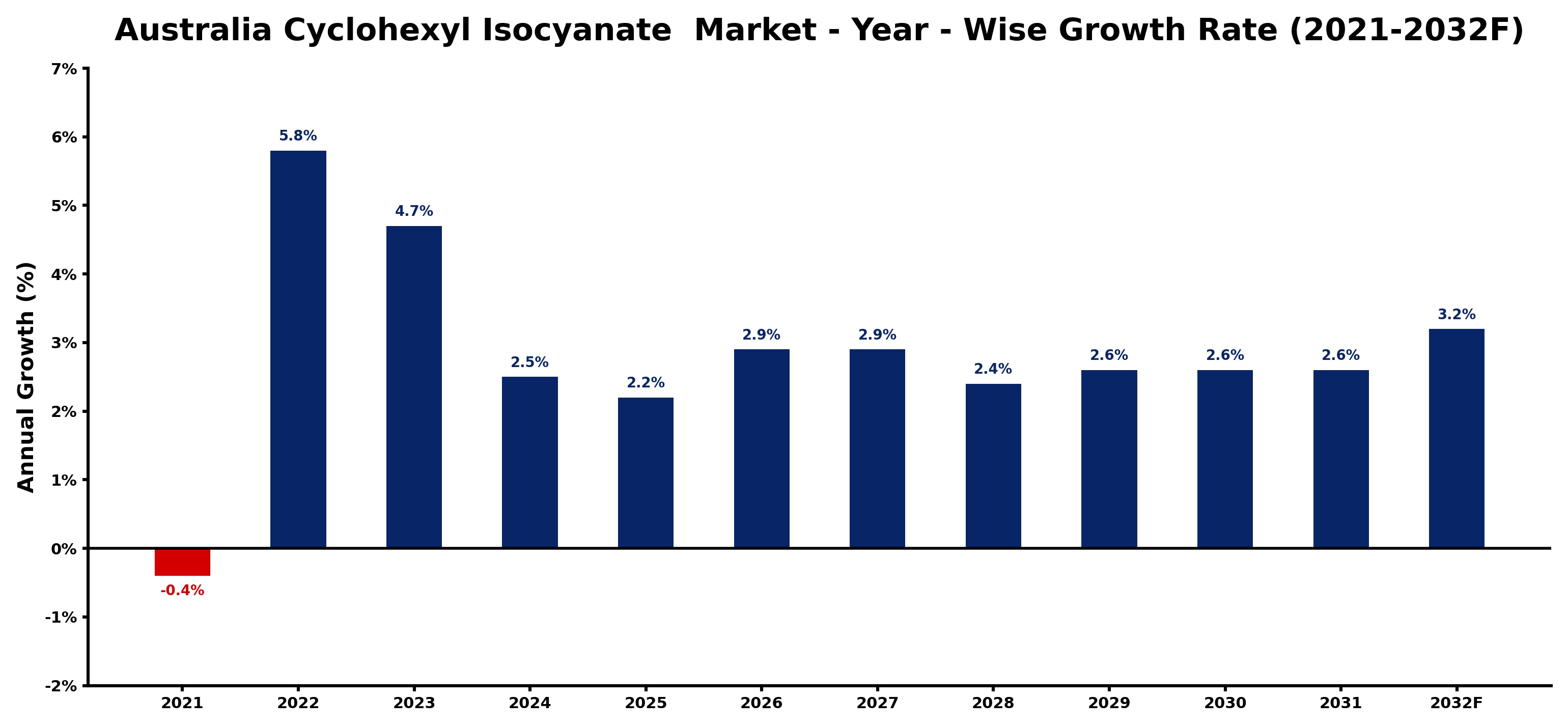
The table below presents the year‑wise growth rates along with the key drivers influencing the market
| Year | Growth Rate | Major Drivers |
| 2021 | -0.4% | Mining sector slowdowns reduced cyclohexyl isocyanate demand significantly |
| 2022 | 5.8% | Mining sector expansion boosts cyclohexyl isocyanate procurement needs |
| 2023 | 4.7% | Mining sector technology upgrades boost cyclohexyl isocyanate utilization |
| 2024 | 2.5% | Maintenance services for mining equipment boosted cyclohexyl isocyanate demand |
| 2025 | 2.2% | Mining sector expansion drives demand for cyclohexyl isocyanate solutions |
| 2026 | 2.9% | Manufacturing investments in mining support cyclohexyl isocyanate demand |
| 2027 | 2.9% | Mining sector maintenance schedules boost cyclohexyl isocyanate utilization |
| 2028 | 2.4% | Mining sector investments boosted demand for specialty chemical applications |
| 2029 | 2.6% | Mining sector projects boost cyclohexyl isocyanate production capacity |
| 2030 | 2.6% | Advanced mining equipment upgrades boost cyclohexyl isocyanate utilization |
| 2031 | 2.6% | Mining sector demand boosted cyclohexyl isocyanate production capacity |
| 2032 | 3.2% | Improved mining sector activity drives cyclohexyl isocyanate demand |
Note - Market size estimations and growth projections presented in this report are based on 6Wresearch's advanced forecasting approach, validated with industry datasets as of June 2026.
Australia Cyclohexyl Isocyanate Market Synopsis
The increasing focus on sustainability is the strongest force shaping the Australia Cyclohexyl Isocyanate Market today. As manufacturers pursue eco-friendly alternatives, the demand for high-performance, low-impact chemical solutions is accelerating, making cyclohexyl isocyanate more relevant than ever.
In parallel, regulatory pressures are compelling industry players to innovate while adhering to stringent environmental guidelines. This push for compliance not only enhances product safety but also positions companies favorably in a market increasingly driven by responsible practices.
Australia Cyclohexyl Isocyanate Market Key Takeaways
- The market is expected to grow steadily, reflecting an increasing emphasis on sustainable manufacturing practices.
- Key industries driving demand include automotive, construction, and electronics, particularly in the production of polyurethane products.
- Regulatory compliance and environmental considerations present challenges but also opportunities for innovation in product development.
- The shift towards lightweight and energy-efficient materials fuels market growth, particularly in automotive applications.
- Government initiatives are focused on promoting sustainability and innovation within the chemical industry.
Evaluation of Restraints in Australia Cyclohexyl Isocyanate Market
While the Australia Cyclohexyl Isocyanate Market is poised for growth, it faces notable restraints primarily linked to regulatory challenges. The stringent regulations governing the production and use of isocyanates can complicate operational processes for manufacturers, leading to increased compliance costs and production complexities. Additionally, securing a reliable supply chain for raw materials remains a critical concern, as fluctuations can disrupt manufacturing and impact overall product quality. These factors necessitate careful strategic planning by industry players to navigate the regulatory landscape effectively while maintaining profitability.
Australia Cyclohexyl Isocyanate Market Trends
Several trends are currently shaping the Australia Cyclohexyl Isocyanate Market. First, the adoption of sustainable practices is becoming essential as more manufacturers aim to reduce their environmental footprint. This shift is prompting the development of innovative formulations and alternatives that are less harmful to the environment. Second, there is a growing demand for high-performance polyurethane products, particularly in the automotive sector, where lightweight and energy-efficient materials are increasingly preferred. Additionally, advancements in production technology are enhancing the efficiency and safety of cyclohexyl isocyanate manufacturing processes.
Australia Cyclohexyl Isocyanate Market Opportunities
The market presents genuine growth opportunities, particularly in segments where sustainable practices can be integrated. For instance, the automotive industry's transition towards electric vehicles and energy-efficient designs creates substantial demand for lightweight materials. Furthermore, expanding construction projects focusing on energy efficiency could drive the need for cyclohexyl isocyanate in producing advanced polyurethane materials. Companies that innovate by developing eco-friendly products or enhancing existing formulations will likely capture significant market share moving forward.
Government Initiatives in the Australia Cyclohexyl Isocyanate Market
The Australian government is actively promoting the chemical industry, including cyclohexyl isocyanate, through various policies aimed at enhancing sustainability and innovation. These initiatives focus on ensuring compliance with environmental standards, encouraging research and development, and streamlining regulatory processes to facilitate market entry. The government's commitment to fostering a responsible chemical sector is likely to drive investment and growth in the coming years.
Future Insights of the Australia Cyclohexyl Isocyanate Market
Looking ahead to 2026-2032, the Australia Cyclohexyl Isocyanate Market is expected to maintain its growth momentum, fueled by ongoing innovations and evolving industry standards. As manufacturers adapt to regulatory changes and market demands, there will be a heightened focus on developing safer, more sustainable products. The demand for cyclohexyl isocyanate in key sectors like automotive and construction will persist, especially as sustainability becomes a cornerstone of business practices. Companies that leverage technological advancements to optimize production processes will likely thrive in this dynamic landscape.
Australia Cyclohexyl Isocyanate Market Latest Developments (May 2025 - June 2026)
In recent months, the industry has observed a noticeable shift towards adopting greener production methodologies, with several manufacturers exploring innovative approaches to minimize environmental impact. Additionally, there has been increased collaboration between stakeholders to enhance the quality and safety of cyclohexyl isocyanate products. These developments signal a proactive approach in the industry, as companies work to align their operations with both regulatory standards and market demands.
Australia Cyclohexyl Isocyanate Market - Key Attractiveness of the Report
- 10 Years of Market Numbers
- Historical Data Starting from 2022 to 2025
- Base Year: 2025
- Forecast Data until 2032
- Key Performance Indicators Impacting the Market
- Major Upcoming Developments and Projects
Key Highlights of the Report:
- Australia Cyclohexyl Isocyanate Market Outlook
- Market Size of Australia Cyclohexyl Isocyanate Market, 2025
- Forecast of Australia Cyclohexyl Isocyanate Market, 2032
- Historical Data and Forecast of Australia Cyclohexyl Isocyanate Revenues & Volume for the Period 2022-2032F
- Australia Cyclohexyl Isocyanate Market Trend Evolution
- Australia Cyclohexyl Isocyanate Market Drivers and Challenges
- Australia Cyclohexyl Isocyanate Price Trends
- Australia Cyclohexyl Isocyanate Porter's Five Forces
- Australia Cyclohexyl Isocyanate Industry Life Cycle
- Historical Data and Forecast of Australia Cyclohexyl Isocyanate Market Revenues & Volume By Type for the Period 2022-2032F
- Historical Data and Forecast of Australia Cyclohexyl Isocyanate Market Revenues & Volume By Purity(>99%) for the Period 2022-2032F
- Historical Data and Forecast of Australia Cyclohexyl Isocyanate Market Revenues & Volume By Purity(99%-95%) for the Period 2022-2032F
- Historical Data and Forecast of Australia Cyclohexyl Isocyanate Market Revenues & Volume By Purity(<95%) for the Period 2022-2032F
- Historical Data and Forecast of Australia Cyclohexyl Isocyanate Market Revenues & Volume By Application for the Period 2022-2032F
- Historical Data and Forecast of Australia Cyclohexyl Isocyanate Market Revenues & Volume By Agricultural Chemicals for the Period 2022-2032F
- Historical Data and Forecast of Australia Cyclohexyl Isocyanate Market Revenues & Volume By Pharmaceutical Materials for the Period 2022-2032F
- Historical Data and Forecast of Australia Cyclohexyl Isocyanate Market Revenues & Volume By Others for the Period 2022-2032F
- Australia Cyclohexyl Isocyanate Import Export Trade Statistics
- Market Opportunity Assessment By Type
- Market Opportunity Assessment By Application
- Australia Cyclohexyl Isocyanate Top Companies Market Share
- Australia Cyclohexyl Isocyanate Competitive Benchmarking By Technical and Operational Parameters
- Australia Cyclohexyl Isocyanate Company Profiles
- Australia Cyclohexyl Isocyanate Key Strategic Recommendations






































