Australia Data Protection Market Size & Growth Rate (2026-2032)
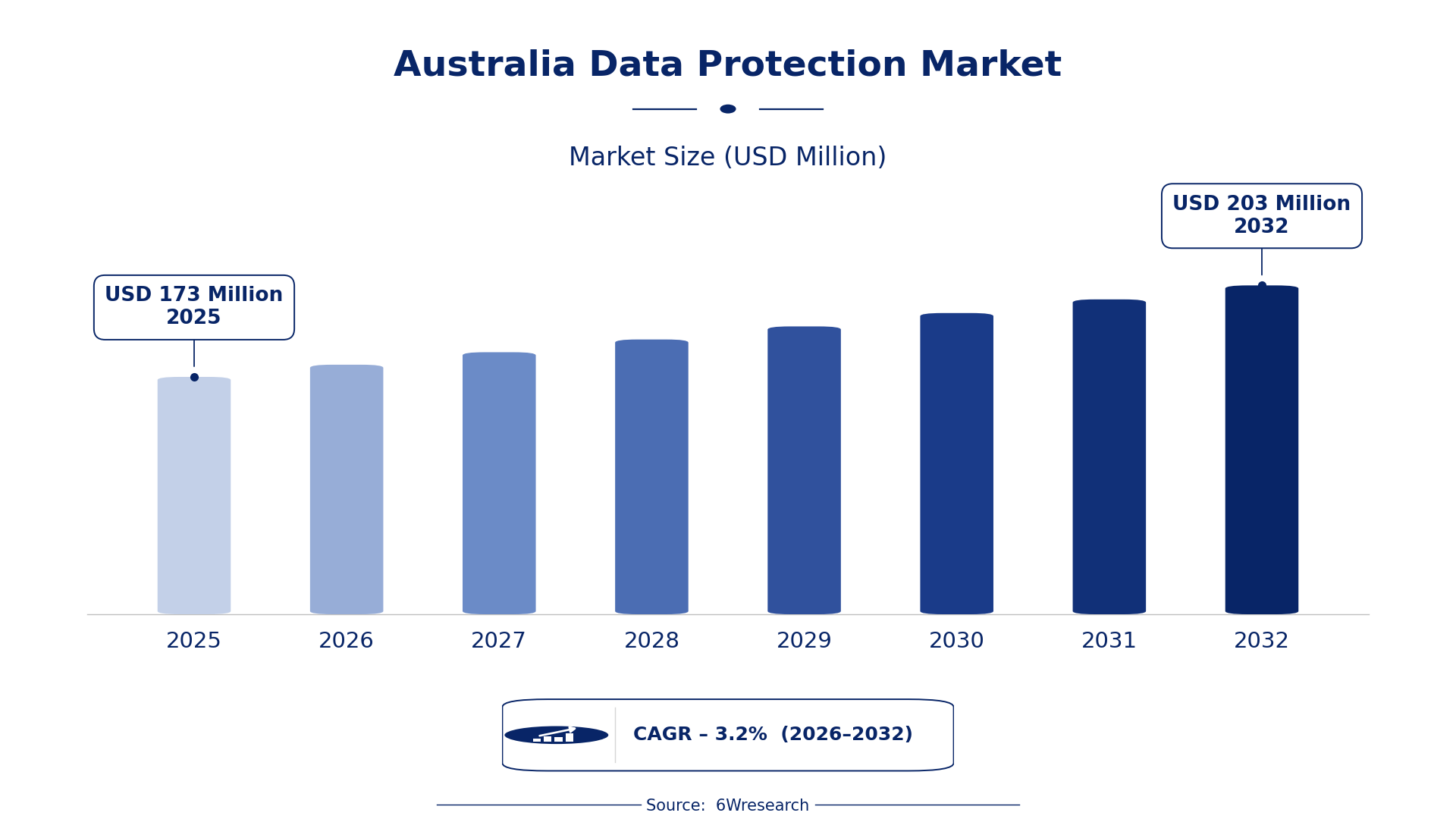
The Australia Data Protection Market was estimated at USD 173 Million in 2025 and is projected to reach USD 203 Million by 2032, growing at a CAGR of 3.2% from 2026 to 2032.
Australia Data Protection Market Synopsis
The most dominant factor currently shaping the Australia Data Protection Market is the increasing regulatory scrutiny surrounding data privacy. Organizations are under pressure to comply with stringent regulations, driving investments in data protection solutions.
Additionally, rising cyber threats are compelling businesses to adopt comprehensive data protection strategies. With the increasing sophistication of cyberattacks, companies in Australia are prioritizing solutions that secure sensitive information from unauthorized access and breaches.
Australia Data Protection Market Year-wise Growth Rate and Key Drivers
This graph illustrates the annual growth rates of the Australia Data Protection Market from 2021 to 2032, highlighting a steady upward trajectory and projected expansion over the forecast period.
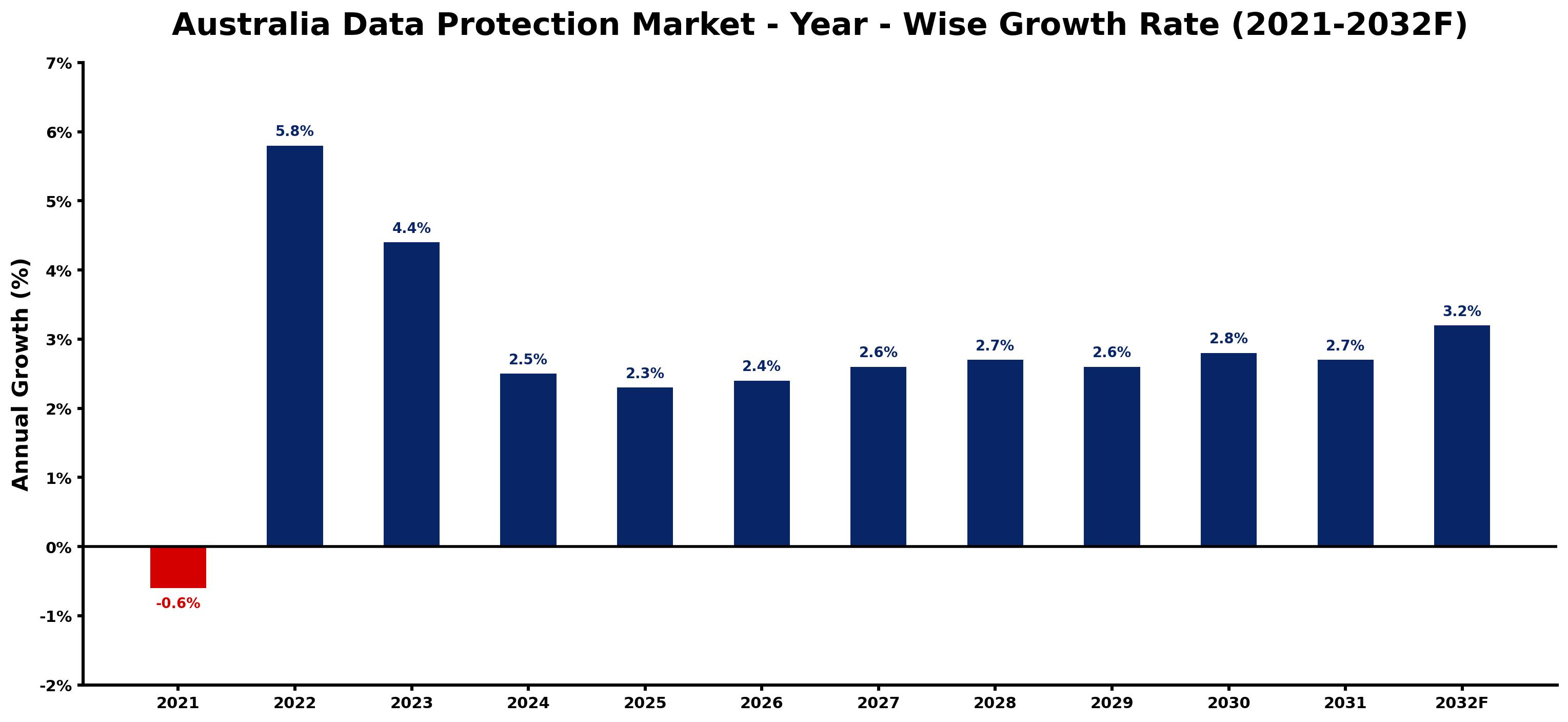
The table below presents the year‑wise growth rates along with the key drivers influencing the market
| Year | Growth Rate | Major Drivers |
| 2021 | -0.6% | Australian Privacy Principles under review by OAIC. |
| 2022 | 5.8% | Introduction of Australian Data Privacy Act 2022 |
| 2023 | 4.4% | Increased cybersecurity threats targeting Australian financial institutions |
| 2024 | 2.5% | Heightened consumer awareness of personal data protection |
| 2025 | 2.3% | Government incentives for local businesses adopting data safeguards |
| 2026 | 2.4% | Growth in remote work necessitating stronger data security measures |
| 2027 | 2.6% | Emergence of local data sovereignty regulations driving compliance |
| 2028 | 2.7% | Surge in data breach incidents prompting regulatory responses |
| 2029 | 2.6% | Enhanced digital identity verification requirements by Australian authorities |
| 2030 | 2.8% | Increased adoption of AI for data protection solutions |
| 2031 | 2.7% | Collaboration between tech firms and government cybersecurity initiatives |
| 2032 | 3.2% | Rise of data protection awareness campaigns in Australia |
Note: Market size estimations and growth projections presented in this report are based on 6Wresearch's proprietary forecasting methodology, utilizing the latest available industry data, government publications, and primary research inputs.
Australia Data Protection Market Key Takeaways
Below are some of the specific key takeaways from the market, including:
- The market's growth is significantly driven by regulatory compliance demands, such as the Notifiable Data Breaches (NDB) scheme.
- Organizations are increasingly investing in cloud-based data protection solutions to support remote work environments.
- Awareness regarding data privacy regulations like GDPR and CCPA continues to shape the data protection strategies adopted by companies.
- The rise of advanced persistent threats (APTs) is making data protection a top priority for businesses across sectors.
- Enterprises are focusing on comprehensive data protection measures to mitigate risks and secure sensitive data assets.
Evaluation of Restraints in Australia Data Protection Market
Despite the growing investments, the Australia Data Protection Market encounters challenges that hinder its potential. The escalating sophistication of cyber threats necessitates continuous advancements in protection measures. Organizations also grapple with the intricate landscape of compliance regulations that can complicate their data protection strategies. As businesses adapt to new threats and regulatory frameworks, the complexity involved in implementing effective measures remains a significant barrier.
Australia Data Protection Market Trends
Several trends are shaping the future of the data protection market in Australia. The increased shift towards cloud computing is driving the demand for advanced data protection solutions that cater to diverse environments. Remote work has also spurred organizations to adopt more flexible and dynamic data security measures. on top of that, the proliferation of artificial intelligence and machine learning technologies is enhancing threat detection capabilities, enabling proactive data protection. Companies are now focusing on integrating these technologies into their existing frameworks to bolster their defense mechanisms.
Australia Data Protection Market Opportunities
Emerging market opportunities in Australia lie in the development and implementation of comprehensive data protection solutions tailored to industry-specific needs. With many sectors facing distinct regulatory requirements, providers have the chance to offer customized solutions that address unique challenges. Additionally, as organizations embrace digital transformation, the demand for cloud-based data protection services is set to rise, presenting significant growth prospects for providers willing to innovate and adapt.
Government Initiatives in the Australia Data Protection Market
The Australian government plays a crucial role in shaping the data protection framework through various initiatives aimed at enhancing data privacy and security. With an emphasis on regulatory compliance and best practices, these initiatives are designed to foster trust in digital services while promoting a secure digital environment.
- A regulatory framework introduced in 2025 mandating enhanced transparency for organizations handling personal data.
- A planned public-private initiative expected to strengthen national cybersecurity resilience by 2028.
- A recent rollout of educational programs aimed at improving data privacy awareness among businesses and consumers.
- A national digital infrastructure upgrade program currently underway, enhancing the capabilities of organizations to protect sensitive data.
Future Insights of the Australia Data Protection Market
Looking ahead to 2026-2032, the Australia Data Protection Market is likely to experience steady growth driven by regulatory advancements and the ever-increasing threat landscape. Organizations will continue investing in more sophisticated protection solutions, especially as emerging technologies like artificial intelligence become integral to data security. Companies that prioritize adaptability and innovation in their data protection strategies will find themselves well-positioned for success. The interplay between regulation and cybersecurity measures will remain critical in shaping market dynamics, reinforcing the need for ongoing investment in this space.
Australia Data Protection Market Latest Developments
In the past year, activity within the Australia Data Protection Market has been vibrant, with businesses pivoting towards enhanced security measures in response to rising cyber threats. New strategies and technologies are being adopted to bolster defenses against increasingly sophisticated attacks, reflecting a proactive stance among organizations.
- A major technology vendor launched a new data encryption service in early 2025, aimed at strengthening data security for cloud environments.
- An initiative that began in mid-2025 is currently underway, focusing on collaborative efforts between public and private sectors to enhance cybersecurity practices.
- A rollout of updated compliance tools designed to help organizations meet the requirements of the NDB scheme is expected to begin in Q3 2026.
- A significant partnership between cybersecurity firms was formed in early 2025 to develop new strategies for tackling ransomware attacks.
Australia Data Protection Market - Key Attractiveness of the Report
- 10 Years of Market Numbers
- Historical Data Starting from 2022 to 2025
- Base Year: 2025
- Forecast Data until 2032
- Key Performance Indicators Impacting the Market
- Major Upcoming Developments and Projects
Key Highlights of the Report:
- Australia Data Protection Market Outlook
- Market Size of Australia Data Protection Market, 2025
- Forecast of Australia Data Protection Market, 2032
- Historical Data and Forecast of Australia Data Protection Revenues & Volume for the Period 2022-2032F
- Australia Data Protection Market Trend Evolution
- Australia Data Protection Market Drivers and Challenges
- Australia Data Protection Price Trends
- Australia Data Protection Porter's Five Forces
- Australia Data Protection Industry Life Cycle
- Historical Data and Forecast of Australia Data Protection Market Revenues & Volume By Component for the Period 2022-2032F
- Historical Data and Forecast of Australia Data Protection Market Revenues & Volume By Solutions for the Period 2022-2032F
- Historical Data and Forecast of Australia Data Protection Market Revenues & Volume By Services (Professional Services and Managed Services) for the Period 2022-2032F
- Historical Data and Forecast of Australia Data Protection Market Revenues & Volume By Deployment Mode for the Period 2022-2032F
- Historical Data and Forecast of Australia Data Protection Market Revenues & Volume By On-premises for the Period 2022-2032F
- Historical Data and Forecast of Australia Data Protection Market Revenues & Volume By Cloud for the Period 2022-2032F
- Historical Data and Forecast of Australia Data Protection Market Revenues & Volume By Industry Vertical for the Period 2022-2032F
- Historical Data and Forecast of Australia Data Protection Market Revenues & Volume By Government and defense for the Period 2022-2032F
- Historical Data and Forecast of Australia Data Protection Market Revenues & Volume By Banking, Financial Services, and Insurance (BFSI) for the Period 2022-2032F
- Historical Data and Forecast of Australia Data Protection Market Revenues & Volume By Healthcare for the Period 2022-2032F
- Historical Data and Forecast of Australia Data Protection Market Revenues & Volume By IT and telecom for the Period 2022-2032F
- Historical Data and Forecast of Australia Data Protection Market Revenues & Volume By Consumer goods and retail for the Period 2022-2032F
- Historical Data and Forecast of Australia Data Protection Market Revenues & Volume By Education for the Period 2022-2032F
- Historical Data and Forecast of Australia Data Protection Market Revenues & Volume By Media and entertainment for the Period 2022-2032F
- Historical Data and Forecast of Australia Data Protection Market Revenues & Volume By Organization Size Large Enterprises for the Period 2022-2032F
- Historical Data and Forecast of Australia Data Protection Market Revenues & Volume By SMEs for the Period 2022-2032F
- Historical Data and Forecast of Australia Data Protection Market Revenues & Volume By Large Enterprises for the Period 2022-2032F
- Australia Data Protection Import Export Trade Statistics
- Market Opportunity Assessment By Component
- Market Opportunity Assessment By Deployment Mode
- Market Opportunity Assessment By Industry Vertical
- Market Opportunity Assessment By Organization Size Large Enterprises
- Australia Data Protection Top Companies Market Share
- Australia Data Protection Competitive Benchmarking By Technical and Operational Parameters
- Australia Data Protection Company Profiles
- Australia Data Protection Key Strategic Recommendations






































