Australia Decorative tile Market Summary
The australia decorative tile market was estimated at USD 91 Million in 2025 and is projected to reach USD 106 Million by 2032, growing at a CAGR of 2.9% from 2026 to 2032.
Australia Decorative tile Market Year-wise Growth Rate and Key Drivers
This graph highlights how the Australia Decorative tile Market has steadily grown over the past five years, supported by major growth factors.
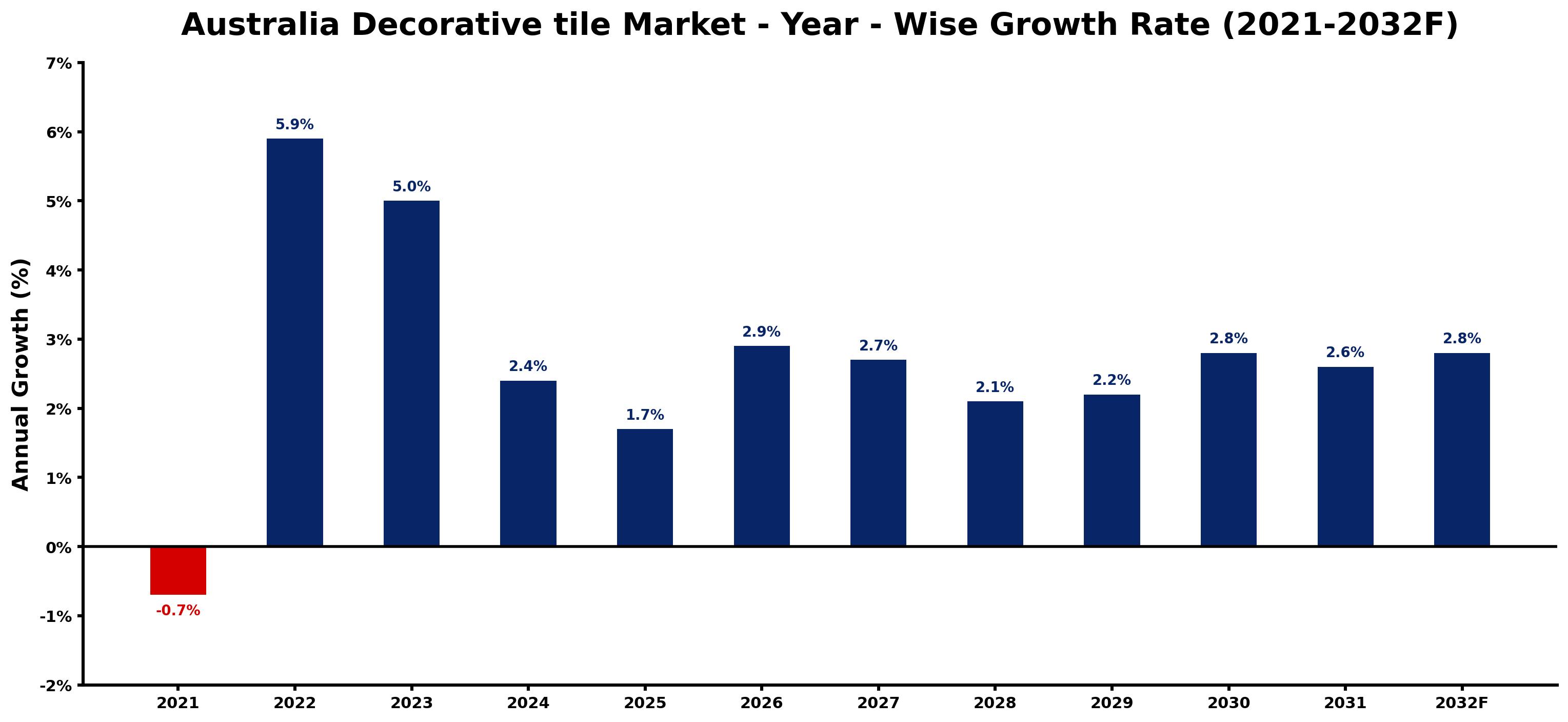
The table below presents the year wise growth rates along with the key drivers influencing the market
| Year | Growth Rate | Major Drivers |
| 2021 | -0.7% | A surplus of imported tiles led to price undercutting, diminishing local production viability and consumer investment. |
| 2022 | 5.9% | Sustainable materials gain traction as consumers seek eco-friendly decorative options. |
| 2023 | 5.0% | Technological innovation in tile design enhances consumer choices and aesthetic appeal. |
| 2024 | 2.4% | Urban development initiatives boost the demand for decorative tiles in city projects. |
| 2025 | 1.7% | Increased focus on home aesthetics influences renovations in residential properties. |
| 2026 | 2.9% | Digital marketing strategies elevate brand visibility, attracting younger consumers to tiles. |
| 2027 | 2.7% | Collaboration between designers and manufacturers creates unique, customized tile solutions. |
| 2028 | 2.1% | E-commerce platforms expand accessibility, allowing consumers to explore diverse tile selections. |
| 2029 | 2.2% | Luxury home trends reflect in higher investments in decorative tiles for upscale projects. |
| 2030 | 2.8% | Integration of smart technology in homes drives demand for modern tile applications. |
| 2031 | 2.6% | Cultural appreciation for intricate designs fosters interest in handcrafted decorative tiles. |
| 2032 | 2.8% | Increased disposable income enables more households to invest in decorative tile renovations. |
Note - Market size estimations and growth projections presented in this report are based on 6Wresearch's advanced forecasting approach, validated with industry datasets as of June 2026.
Australia Decorative tile Market Synopsis
The Australia Decorative tile Market is projected to reach 2.9% and witness significant growth during the forecast period (2026-2032). This market is driven by a multitude of factors, including an increasing demand for stylish and visually appealing tiles in both residential and commercial settings. As households invest in home improvement and renovation projects, the need for high-quality decorative tiles continues to swell. The rise in per capita incomes across Australia has further fueled this demand, as consumers are increasingly able to afford premium decorative solutions. Additionally, the ongoing trend of urbanization in key Australian metropolitan areas has steepened the growth curve for the decorative tile market.
Australia Decorative tile Market Growth Drivers
Several key growth drivers are propelling the Australia Decorative tile Market. The foremost among these is the rising consumer preference for aesthetically pleasing interiors, which has led to significant investments in decorative tiles. Moreover, the growth in household disposable income plays a pivotal role in enhancing consumer spending on home décor products, including tiles. Urbanization in cities not only drives population growth but also induces infrastructural development, subsequently escalating the demand for decorative tiles. Additionally, the prevalence of modern architectural designs necessitates the incorporation of innovative tile designs that align with contemporary aesthetics. Finally, advancements in technology and manufacturing processes have improved product quality, making decorative tiles more accessible to a broader demographic.
Australia Decorative tile Market Trends and Opportunities
The Australia Decorative tile Market is witnessing several emerging trends that present notable opportunities. Firstly, the inclination towards sustainability is prompting companies to innovate eco-friendly tile options, tapping into the growing market niche of green building materials. Secondly, digital technology has enabled enhanced designs and customization options, allowing consumers to create unique spaces. Smart home integration is another trend as decorative tiles can now incorporate technology for added functionality. Additionally, there's a growing trend of online retail which is making decorative tiles more accessible to consumers than traditional brick-and-mortar stores. These trends highlight a dynamic landscape rich with potential for manufacturers and suppliers within the industry.
Australia Decorative tile Market Challenges and Restraints
Despite its promising growth trajectory, the Australia Decorative tile Market faces several challenges. The fluctuations in raw material prices can significantly impact production costs and pricing strategies, leading to potential profit margin erosion. Moreover, the market is characterized by intense competition, resulting in price wars that can compromise product quality. Regulatory challenges surrounding import duties and building codes can also pose barriers for market entrants. Additionally, the disruption caused by unforeseen events such as natural disasters or economic downturns can adversely affect supply chains and consumer spending. Finally, the alignment with ever-evolving consumer preferences necessitates continuous innovation, which can be resource-intensive.
Australia Decorative tile Market Government Investment and Initiatives
The Australian government plays a crucial role in fostering an environment conducive to the growth of the decorative tile market through various investments and initiatives. Policies aimed at enhancing urban infrastructure development encourage the use of decorative tiles in public buildings and residential complexes. Furthermore, public spending on housing and infrastructure projects directly influences demand for decorative tiles. Incentives for eco-friendly construction practices are also being promoted, encouraging manufacturers to adopt sustainable practices in the production of decorative tiles. These initiatives not only stimulate market growth but also align with national goals for sustainable development and urban renewal.
Australia Decorative tile Market Latest Developments (May 2025 - June 2026)
In the period from May 2025 to June 2026, the Australia Decorative tile Market has experienced notable developments that reflect the evolving landscape of the industry. Innovations in product offerings, particularly in the realm of sustainable and eco-friendly materials, have gained significant traction. Suppliers and manufacturers have increasingly focused on incorporating recycled materials into their tile production processes. Furthermore, there has been a marked increase in the adoption of advanced manufacturing technologies aimed at enhancing production efficiency while maintaining high-quality standards. The trend toward digital sales platforms has also accelerated, with many consumers opting for online purchases due to convenience and a wider range of choices. In addition, collaboration between government bodies and the private sector has resulted in new initiatives aimed at promoting sustainable building practices aligned with market demand.
Australia Decorative tile Market - Key Attractiveness of the Report
- 10 Years of Market Numbers
- Historical Data Starting from 2022 to 2025
- Base Year: 2025
- Forecast Data until 2032
- Key Performance Indicators Impacting the Market
- Major Upcoming Developments and Projects
Key Highlights of the Report:
- Australia Decorative tile Market Outlook
- Market Size of Australia Decorative tile Market, 2025
- Forecast of Australia Decorative tile Market, 2032F
- Historical Data and Forecast of Australia Decorative tile Revenues & Volume for the Period 2022-2032F
- Australia Decorative tile Market Trend Evolution
- Australia Decorative tile Market Drivers and Challenges
- Australia Decorative tile Price Trends
- Australia Decorative tile Porter's Five Forces
- Australia Decorative tile Industry Life Cycle
- Historical Data and Forecast of Australia Decorative tile Market Revenues & Volume By Type for the Period 2022-2032F
- Historical Data and Forecast of Australia Decorative tile Market Revenues & Volume By Ceramic Wall Tiles for the Period 2022-2032F
- Historical Data and Forecast of Australia Decorative tile Market Revenues & Volume By Vinyl Wall Tiles for the Period 2022-2032F
- Historical Data and Forecast of Australia Decorative tile Market Revenues & Volume By Stone Wall Tiles for the Period 2022-2032F
- Historical Data and Forecast of Australia Decorative tile Market Revenues & Volume By Other Types for the Period 2022-2032F
- Historical Data and Forecast of Australia Decorative tile Market Revenues & Volume By End-users for the Period 2022-2032F
- Historical Data and Forecast of Australia Decorative tile Market Revenues & Volume By Residential for the Period 2022-2032F
- Historical Data and Forecast of Australia Decorative tile Market Revenues & Volume By Commercial for the Period 2022-2032F
- Historical Data and Forecast of Australia Decorative tile Market Revenues & Volume By Application for the Period 2022-2032F
- Historical Data and Forecast of Australia Decorative tile Market Revenues & Volume By Flooring for the Period 2022-2032F
- Historical Data and Forecast of Australia Decorative tile Market Revenues & Volume By Wall Coverings for the Period 2022-2032F
- Historical Data and Forecast of Australia Decorative tile Market Revenues & Volume By Other Applications for the Period 2022-2032F
- Australia Decorative tile Import Export Trade Statistics
- Market Opportunity Assessment By Type
- Market Opportunity Assessment By End-users
- Market Opportunity Assessment By Application
- Australia Decorative tile Top Companies Market Share
- Australia Decorative tile Competitive Benchmarking By Technical and Operational Parameters
- Australia Decorative tile Company Profiles
- Australia Decorative tile Key Strategic Recommendations






































